

Instagram Influencer Engagement Scraper
Pricing
from $2.20 / 1,000 results
Instagram Influencer Engagement Scraper
Instagram Influencer Engagement Scraper analyzes Instagram creator engagement by username: follower count, posting rate, engagement rate, feed vs. Reels performance and interactions per 1,000 followers, computed over recent posts. Export JSON, CSV or Excel, or use the API.
Pricing
from $2.20 / 1,000 results
Rating
0.0
(0)
Developer

Social Data API
Maintained by CommunityActor stats
0
Bookmarked
2
Total users
1
Monthly active users
a day ago
Last modified
Categories
Features
Share
Instagram Influencer Engagement Scraper — Followers, Engagement Rate, Reels vs Feed
Instagram Influencer Engagement Scraper pulls creator engagement metrics for any public Instagram username: follower and following counts, post count, and an engagement breakdown computed over that creator's recent posts, split between feed posts and Reels. Every response is structured JSON — ready to pass directly to an LLM, index into a vector store, or feed an influencer-vetting pipeline. No Instagram account or cookies needed. Start with one creator, then run a whole shortlist in one call.
What data can I extract with Instagram Influencer Engagement Scraper?
Using this Instagram engagement API, you will be able to extract the following Instagram creator data:
| 👤 Full name & username | 👥 Follower & following count | ✅ Verified badge | 📦 Post count (exact or rounded) |
|---|---|---|---|
| 🖼️ Profile picture URL | 🔗 Bio link | 💬 Total interactions (likes + comments) | 📊 Engagement rate by followers (feed) |
| 🎬 Reels engagement rate by views | ⚖️ Reels vs feed engagement skew | 🧮 Average interactions per post | 📈 Interactions per 1,000 followers |
| 🗂️ Feed vs Reels split | 👁️ View-count coverage per bucket | ⚠️ Error reason (private/not found) |
How to use Instagram Influencer Engagement Scraper
Marketers, agencies and growth teams vetting creators for a campaign send a list of usernames and get back a ranked-ready engagement profile for each.
Copy to your AI assistant:
Instagram Influencer Engagement Scraper MCP Server: use these Actors from ChatGPT, Claude or Cursor
Point your AI assistant at Social Data API and it can read Instagram creator engagement on its own. No glue code, no scraping logic in your prompts.
Step by step
- Create a free Apify account.
- Open Instagram Influencer Engagement Scraper in the Apify Store.
- Enter the Instagram usernames to analyze.
- Click Start.
- Download or stream your results in JSON, CSV or Excel.
How to scale Instagram Influencer Engagement Scraper to bulk
Add every username to the "Usernames" list in one run — each one gives its own row and its own postsToAnalyze/maxFeedPosts/maxReels window, so one input entry never eats into another's results. For scheduled tracking (e.g. a weekly engagement snapshot of a creator roster), run the Actor on an Apify schedule and compare rows across runs.
✨ Features
Instagram Influencer Engagement Scraper fetches clean, structured creator engagement data from Instagram ⚡ at low cost 💸. It's ideal for influencer vetting, campaign reporting, competitor benchmarking and feeding an AI agent real engagement numbers instead of follower count alone.
It extracts, per creator:
- Follower & following count – audience size and who they follow
- Post count – exact digit, or a rounded value flagged as approximate for large accounts
- Total interactions – likes + comments summed over the analyzed window
- Feed engagement rate – average feed-post interactions as a percent of followers
- Reels engagement rate – average Reel interactions as a percent of average Reel views
- Feed vs Reels split – how many of the analyzed posts are feed posts vs Reels, and how each performs
- Interactions per 1,000 followers – a size-independent engagement benchmark
⚡ Works without an Instagram account or cookies — it reads only what a visitor sees without logging in.
Use cases 💡
- Agency — rank a creator shortlist by engagement rate before a campaign pitch.
- Brand marketer — spot-check whether a creator's follower count matches real interaction volume.
- Growth analyst — track a competitor's own account engagement over time.
- Talent manager — compare a roster's feed vs Reels performance to plan content mix.
- AI agent builder — feed engagement JSON straight into an LLM-based influencer-scoring pipeline.
Building an AI agent? Connect Instagram Influencer Engagement Scraper over MCP and let it call the actor on its own.
Why choose this actor?
- One row per creator, every time. A recorded run analyzed 10 recent posts for "mrbeast" (5 feed + 5 Reels) in 18.3 seconds, returning a full engagement breakdown in one row.
- Real post counts, not a null. Instagram serves
0/nullpost counts to anonymous visitors on the raw profile field; this actor falls back to the public page text and still returns the real number (527 for a recorded "mrbeast" run), flagging it as approximate only when Instagram itself only shows a rounded figure. - Feed and Reels, capped independently. Set separate caps for feed posts and Reels in one run instead of one combined window — a recorded run with a 3/7 split returned exactly 3 feed posts and 7 Reels.
⬇️ Input
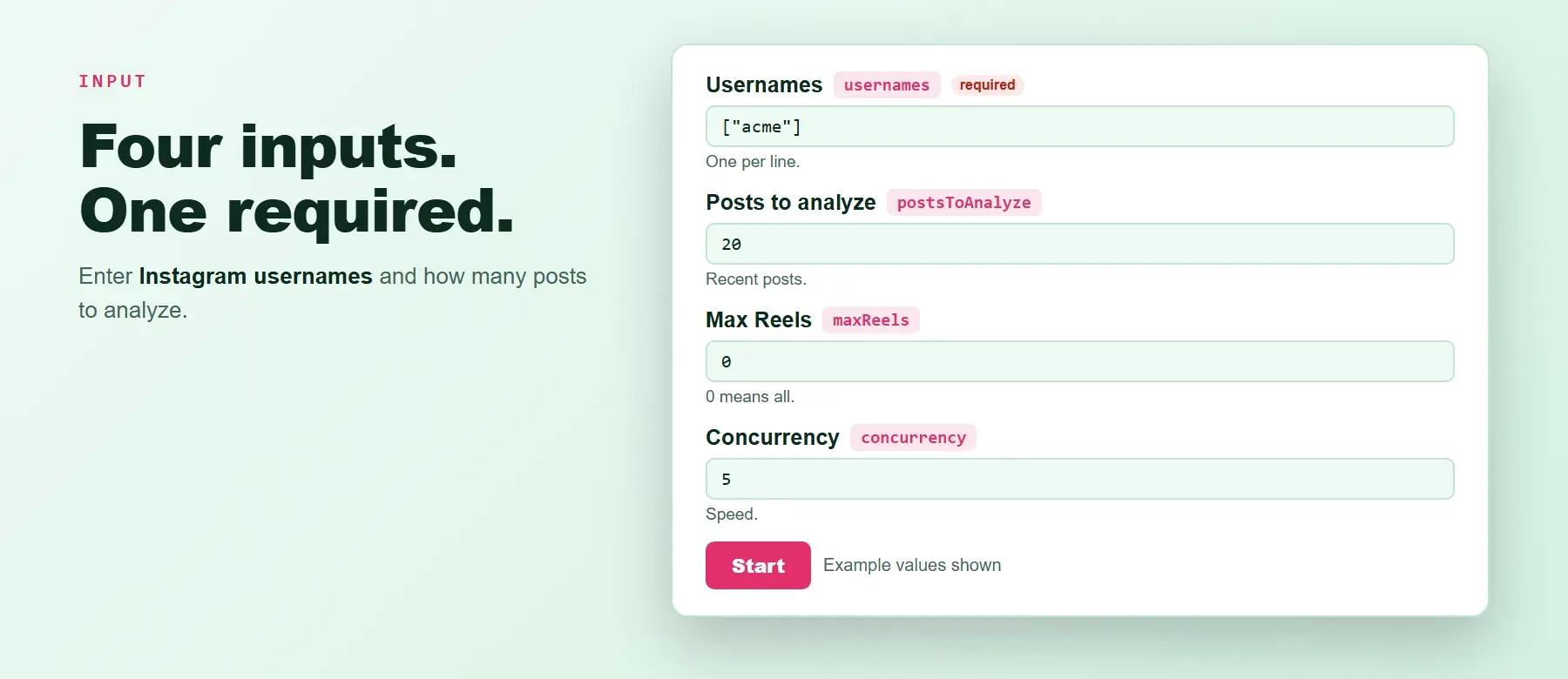
Give the actor one or more public Instagram usernames; "Usernames" is the only required field.
| Parameter | Required | Type | Description | Example value |
|---|---|---|---|---|
usernames | Yes | array | Public Instagram usernames (no @, no URL). One row per username. | ["mrbeast", "natgeo"] |
postsToAnalyze | No | integer | Combined feed+Reels window per username. Default 20, maximum 1000. Ignored when both caps below are set. Measured at roughly 1.2 seconds per post at scale - for values above ~500, raise this run's Timeout in Run options (e.g. 1800s). | 20 |
maxFeedPosts | No | integer | Separate feed-post cap. Default 0 (off). Set with maxReels to turn on the split. | 5 |
maxReels | No | integer | Separate Reels cap. Default 0 (off). Set with maxFeedPosts to turn on the split. | 5 |
concurrency | No | integer | Usernames processed in parallel. Default 5. | 5 |
maxRetries | No | integer | Retries per request before giving up on it. Default 3. | 3 |
pageDelaySeconds | No | number | Delay between pagination/per-post requests. Default 0.6. | 0.6 |
rateLimitBackoffSeconds | No | integer | Base wait on a soft rate limit; scales per retry. Default 45. | 45 |
proxyConfiguration | No | object | Optional starting proxy; the actor escalates to a residential proxy on its own if blocked. | {"useApifyProxy": false} |
Free plan limits
Users on the Apify free plan can fetch up to 20 usernames per run (all entries together) and 200 usernames per month. When the limit is reached the run finishes successfully with a status message explaining the limit. Upgrade to any paid Apify plan to remove these limits.
Example input
⬆️ Output
The postsToAnalyze window counts distinct feed posts and Reels. Engagement calculations include only posts whose like and comment counts were read successfully during the run; unreadable counts are never treated as zero. coverage.requested_items reports the configured window, fetched_items the discovered sample, total_items the analyzed sample, failed_items fetched posts without usable counts (including unfinished requests), and window_complete whether the requested sample was fully analyzed. Smaller public histories can return fewer posts. Data is a snapshot collected during the run.
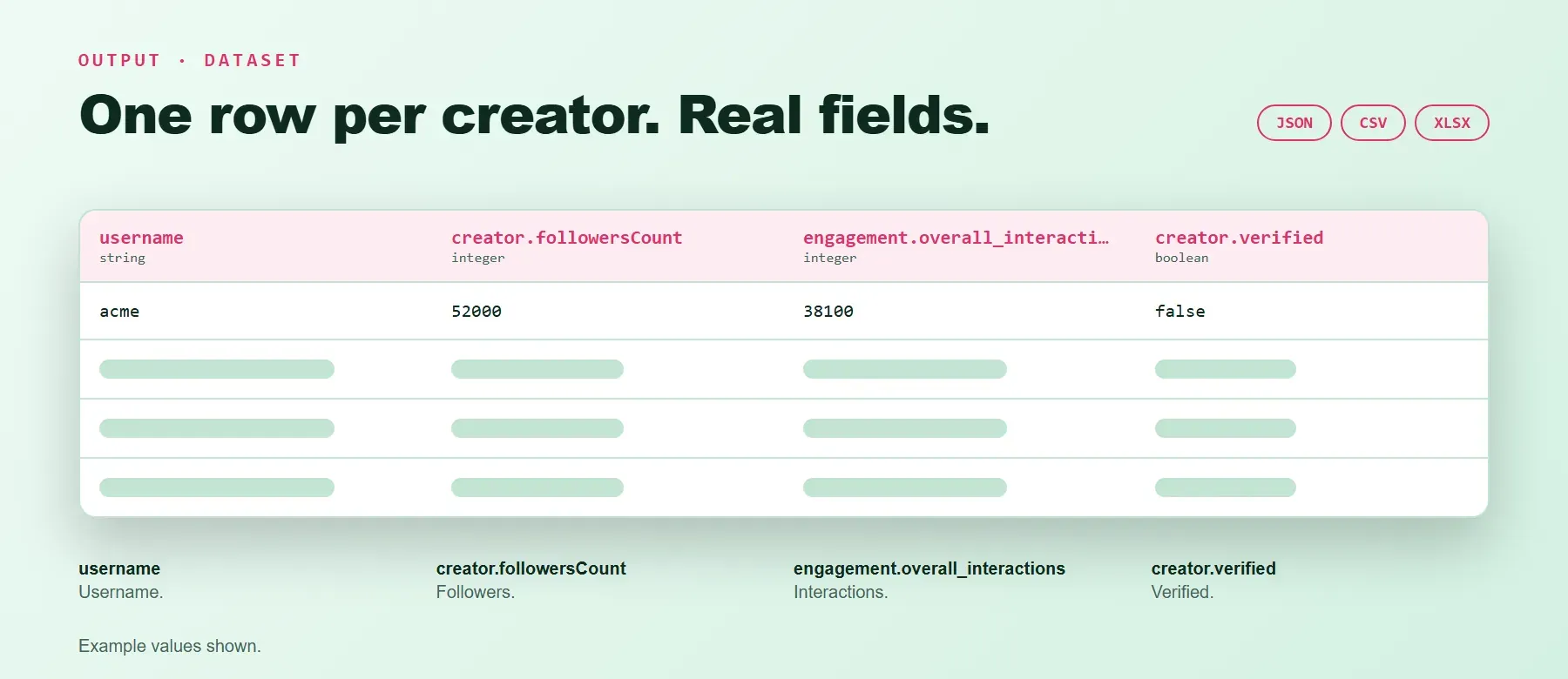
Every username is one typed, normalized JSON item with the same schema on every run: a successful row carries creator, engagement and coverage; a username that is private, not found or blocked carries only an error reason instead. Export formats: JSON (default), CSV or Excel.
Example output
How does it work?
Instagram Influencer Engagement Scraper reads the same public pages any logged-out visitor sees on instagram.com — a creator's profile page and their recent posts — and computes the engagement numbers from that public data. It starts with a direct connection and switches to an Apify proxy, escalating to a residential proxy automatically, if Instagram blocks a request. No Instagram account, login or cookies are ever used. The output schema stays the same from run to run even when Instagram changes its page layout.
How do you integrate Instagram Influencer Engagement Scraper into your stack?
It works with what you already use: a REST API from any language, MCP for AI agents, and no-code automation tools.
Using Instagram Influencer Engagement Scraper with the Apify API
Works in Go, Ruby, Node.js, cURL — any language that can make an HTTP request.
MCP integration for AI agents
Register the actor as a tool your agent can call directly, so it can look up creator engagement on its own instead of you writing scraping logic into the prompt.
Works with Claude Code, Cursor and Windsurf.
No-code tools (n8n, Make, LangChain)
In n8n, use the Apify node's "Run an Actor" operation with this Actor's ID, then "Get Dataset Items" to pull the rows into your workflow. In Make, use the Apify app's "Run an Actor" module followed by "Get Dataset Items". In LangChain, install langchain-apify and call ApifyActorsTool("socialdataapi/instagram-influencer-engagement-scraper").
Is it legal to scrape Instagram data?
Scraping publicly available Instagram data is generally permitted; this is factual framing, not legal advice. Instagram Influencer Engagement Scraper returns only publicly available data — what any visitor sees without logging in. Scraping public data is generally permissible under GDPR, but storing and using it must still comply with local data-protection law. Consult legal counsel if your use case involves bulk storage of personal data.
Frequently asked questions
What fields does Instagram Influencer Engagement Scraper return?
Follower count, post count, total interactions, feed engagement rate and Reels engagement rate, among others. See the data fields section.
Does Instagram Influencer Engagement Scraper require an Instagram account or login?
No. Only public creator data is extracted, and no credentials are needed.
How fast does Instagram Influencer Engagement Scraper run?
A recorded run analyzed 10 recent posts for one creator in 18.3 seconds. At scale, a recorded run analyzed 509 recent posts for one creator (the real end of that creator's available history) in 631 seconds - roughly 1.2 seconds per post. For a postsToAnalyze value above ~500, raise this run's Timeout in Run options (e.g. 1800s) so the full window has time to finish. It reads live data on every run, never a cache.
What happens if a username is private or doesn't exist?
That username comes back as one row with "error": "private_or_not_found" (or "unexpected: <reason>" on an unexpected failure) instead of being silently dropped, so you always get one row per requested username.
Can I scrape multiple Instagram usernames at once?
Yes — add as many usernames as you like to the "Usernames" list; each one gives its own row with its own post window.
Does Instagram Influencer Engagement Scraper work with Claude, ChatGPT, and other AI agent tools?
Yes — it is available as an MCP tool. Use the command above to register it in Claude Code, Cursor or Windsurf. Any agent that can call an HTTP endpoint can also use the REST API directly.
Does Instagram Influencer Engagement Scraper return data in a format LLMs can use directly?
Yes. Typed, normalized JSON with consistent field names — no HTML parsing, no selectors. Pass it straight to an LLM, index it into a vector store, or feed it to an agent tool.
What happens when Instagram changes its layout or anti-bot system?
Social Data API maintains the actor. When Instagram changes its pages, the actor is updated and keeps returning the same JSON schema with no changes on your end.
Can I use Instagram Influencer Engagement Scraper without managing proxies or browser infrastructure?
Yes. Proxy escalation runs on the actor's side — you send one request and get structured JSON back, with no proxy accounts or headless browser setup to maintain.
Which fields work best for AI training data and RAG indexing?
For RAG: the full name and bio link, in plain text. For training data or scoring models: the numeric fields — follower count, total interactions, engagement rates and interactions per 1,000 followers. All fields are typed primitives (strings, integers, numbers, booleans), so no normalization step is needed.
Your feedback
Found a bug or missing a field? Open an issue on the actor's Issues tab in Apify Console. The Social Data API team reads every report and ships fixes.


