
SEC Form D Filings - Recently Funded Companies & Startups
Pricing
from $8.50 / 1,000 filings
SEC Form D Filings - Recently Funded Companies & Startups
SEC Form D filings as a daily feed of companies that just raised money: amount raised and offered, investors, industry, first-sale date, exemption, address, phone and named executives. Funds are skipped by default; filter by industry, state and amount, and get only new filings.
Pricing
from $8.50 / 1,000 filings
Rating
0.0
(0)
Developer

Sonic Scraper
Maintained by CommunityActor stats
0
Bookmarked
2
Total users
1
Monthly active users
7 hours ago
Last modified
Categories
Features
Share
Get the companies that just raised money, straight from SEC Form D filings: how much they raised and are raising, from how many investors, their industry, first-sale date, address, phone number and named executives. Investment funds are filtered out by default, so you get operating companies. Filter by industry, state, amount and company age, and run it daily for only new filings. $10 per 1,000 filings.
A US company that raises money privately (a seed round, a Series A, a convertible note, a real estate syndication) usually files a Form D with the SEC within 15 days of the first sale. That makes Form D the earliest public signal that a company has fresh cash, and a well-known lead source for anyone who sells to newly funded companies: banks, accountants, insurance and payroll providers, recruiters, agencies, SaaS sales teams, and investors tracking deal flow.
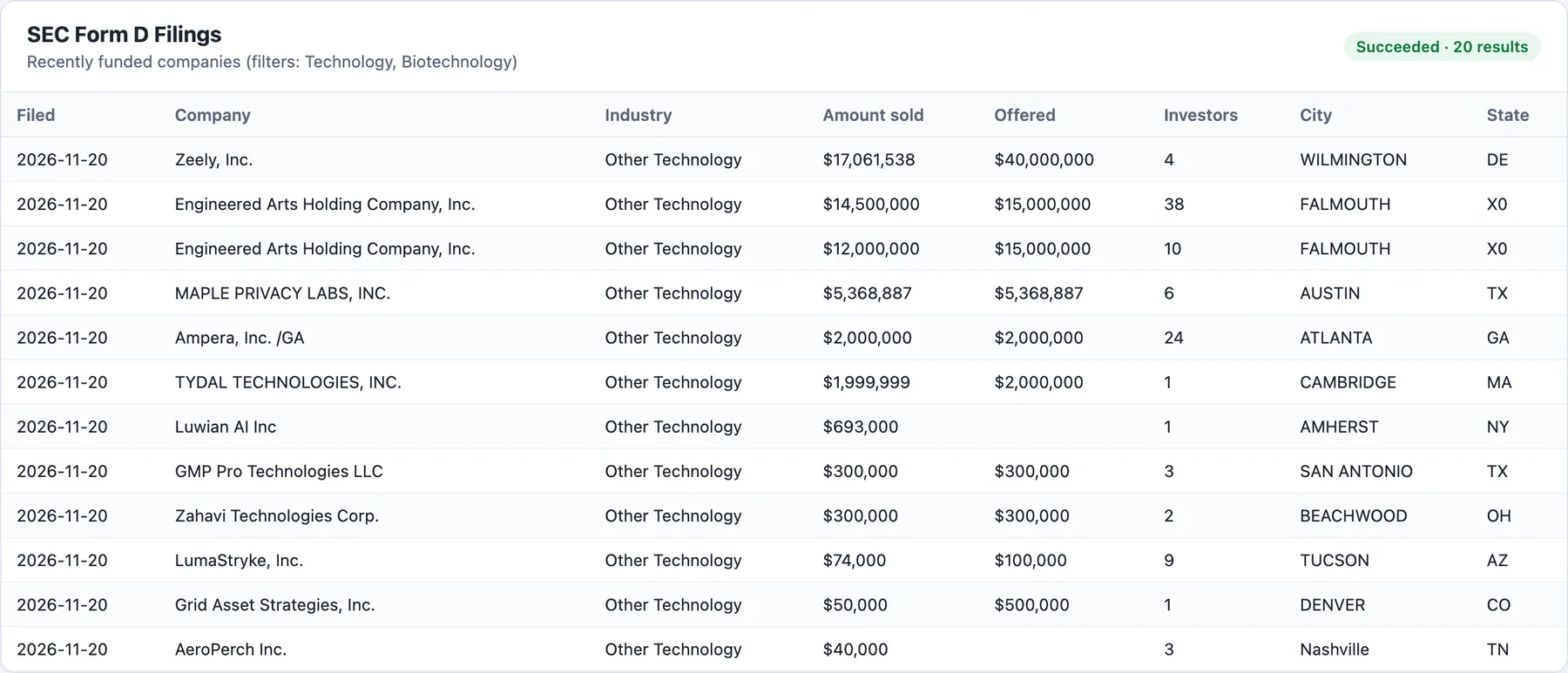
Real output from a run of SEC Form D Filings (filters: Technology, Biotechnology), sorted by amount sold. Phone numbers and executives are in the full rows.
What you get
One row per filing:
| Field | Example |
|---|---|
companyName, cik | Example Robotics, Inc., 0001234567 |
filedAt, dateOfFirstSale | 2026-11-20, 2026-11-06 |
totalAmountSold, totalOfferingAmount, totalRemaining | 3,250,000 / 5,000,000 / 1,750,000 |
investorCount, minimumInvestment | 12, 25,000 |
industryGroup | Other Technology, Biotechnology, Health Care, Real Estate, Energy... |
securitiesOffered, exemptionNames | Equity; Rule 506(b) |
entityType, yearOfIncorporation, jurisdictionOfIncorporation | Corporation, 2024, Delaware |
street, city, state, zipCode, phone | Issuer's business address and phone |
executives, executiveNames | Executive officers, directors and promoters named in the filing |
brokers, salesCommission, findersFee | Placement agents and their fees |
documentUrl, filingIndexUrl | Links to the filing on sec.gov |
The Recently funded view shows company, amount, investors, industry, place, phone and executives in one table. Export as CSV or Excel, or send new rows to Google Sheets, HubSpot, Slack or a webhook with Apify integrations, Make, Zapier or n8n.
Quick start
Operating companies that filed a Form D in the last 5 days:
Tech and biotech companies in California and New York that raised at least $1 million:
A daily feed of newly funded young companies, only new filings:
Save the input as a task and add a daily schedule (Schedules, then Create). With onlyNew, a 3-day window catches filings that EDGAR indexes late, and none is delivered or billed twice.
Researching funds instead? Set excludePooledFunds to false and industries to ["Venture Capital"], ["Private Equity"] or ["Hedge Fund"].
Filters
| Field | What it does |
|---|---|
filedWithinDays or dateFrom / dateTo | Filing dates, up to 90 days per run. |
excludePooledFunds | Skip venture, private equity, hedge and real estate funds (default on). About 6 in 10 Form Ds are funds. |
industries | Words in the Form D industry group, e.g. "Technology", "Biotechnology", "Health Care", "Real Estate". |
states | Issuer's state, e.g. CA, NY, TX. |
minAmountSold / maxAmountSold | Amount already sold, USD. |
incorporatedWithinFiveYearsOnly | Young companies only. |
nameIncludes | Words in the company name. |
includeAmendments | Also return D/A amendments (default off, so each raise appears once). |
How it works and where the data comes from
The Actor lists each day's Form D filings from SEC EDGAR full-text search (with EDGAR's daily form index as a fallback), then reads each filing's structured XML document from sec.gov. It follows SEC's fair-access rules: it identifies itself in the User-Agent and stays under 10 requests per second. No login, API key or browser is used. A typical weekday (about 250 filings, of which roughly 70-80 are operating companies) takes about a minute.
Use with AI agents / MCP
Connect the Apify MCP server at https://mcp.apify.com?tools=sonic_scraper/sec-form-d-filings in Claude Desktop, Cursor, VS Code or any MCP client. Example prompt: "Which tech companies in California raised more than $2 million in the last week, and who runs them?" Each row is flat JSON with plain-English fields, so an agent can filter and summarise it directly.
Pricing
$10 per 1,000 filings saved ($0.01 per filing) on the free plan, with lower rates on paid Apify plans (see the Pricing tab). Filings removed by your filters, funds you skip, filings a monitor already delivered and errors are not billed. maxResults caps each run, and the Actor stops before your run's maximum charge.
Example: every operating-company Form D for a month is typically about 1,500 filings (roughly 70-80 per weekday), about $15.
Using the data responsibly
Form D filings are public SEC records. The people named in them (executive officers, directors and promoters) are listed by name and role only; their addresses are left out. If you contact them, follow the laws that apply to you, such as CAN-SPAM and the TCPA in the US. Phone numbers are the company's business numbers as filed.
Limits
- Amounts are self-reported by the issuer and can be updated later in a D/A amendment. "Amount sold" is what had been sold when the filing was made.
- Not every raise is filed. Some companies file late or not at all, and Form D is filed by the issuer, not the investors, so investor names are not included.
- The industry group is broad. "Other Technology" covers most software and hardware startups; combine it with name or state filters.
- Filing day versus raise day. Companies have 15 days after the first sale to file;
dateOfFirstSaleshows when the raise actually started. - EDGAR has no filings on weekends and federal holidays, so a 1-day window on those days returns nothing.
FAQ
How do I search SEC Form D filings?
Run this Actor with a date window and optional filters. It returns every Form D in that window with the key fields parsed, instead of opening filings one by one on EDGAR.
How can I find recently funded startups?
Use filedWithinDays 7, keep excludePooledFunds on, and add industries like "Technology" and minAmountSold like 500000. Each row is a company that just raised money, with its phone and executives.
Does it include investors' names?
No. Form D names the company's executives, directors and promoters, and any placement agents, but not the investors.
Can I get new Form D filings every day?
Yes. Turn on onlyNew, keep a 3-day window and schedule the task daily.
What is the difference between D and D/A?
D is a new offering notice; D/A amends an earlier one, often with a larger amount sold. By default only new filings (D) are returned.
Related actors
- Insider Trading Tracker: SEC Form 4 insider buys and sells, with cluster-buy signals.
- Business Entity Search: new LLCs and corporations from US state registries.
- UK New Companies: newly incorporated UK companies from Companies House.
- Contact Details Scraper: emails, phones and tech stack from company websites.
Questions or a wrong row? Open an issue on the Issues tab with the accession number and your run ID. This is an independent tool and is not affiliated with the SEC.


