
AI Overview Tracker & Checker: Is Your Site Cited, and Why Not
Pricing
from $2.00 / 1,000 keyword checkeds
AI Overview Tracker & Checker: Is Your Site Cited, and Why Not
Check whether your website is cited in Google's AI Overview for each keyword, who is cited instead, and one plain reason why: not ranking, ranking but not cited, named but not linked, local listings, brand unknown and more. Pay per keyword checked.

Is your site in Google's AI Overview for your keywords? If it isn't, who is cited instead, and why? Enter your domain and a list of keywords. Each keyword gets one row: whether Google shows an AI Overview, whether it cites your site (and which page), where you rank in the organic results, the domains cited in your place, and one plain reason for the result.
$0.003 per keyword checked on Apify's Free and Starter plans, less on higher plans. Keywords where Google shows no AI Overview cost $0.001. Invalid keywords and failed searches are free.
What people use this AI Overview checker for
- SEO reporting: which of your keywords trigger an AI Overview, and in how many of them your site is cited.
- Finding gaps: keywords where you rank on page one but the overview cites other pages.
- Competitor checks: add competitor domains and see where they are cited and you are not.
- Brand checks: whether Google's overview knows your brand, names it without a link, or confuses it with something else.
- Local businesses: overviews that answer from Google's place listings instead of websites.
- Tracking over time: put the actor on an Apify schedule and compare each week's table with the last.
The reason for each keyword
Each keyword gets one reason. The first that fits wins, in this order:
| Reason | What it means |
|---|---|
invalid / error | The keyword was rejected (search operators such as site:, too long) or the search failed. Free. |
no_overview | Google shows no AI Overview for this keyword. |
local_listings | The overview cites no websites and answers from Google's place listings (a place card or a local pack). |
overview_no_sources | The overview cites no sources at all. |
cited_and_ranking | Your site is cited and ranks in the organic results. |
cited_not_ranking | Your site is cited but is not in the organic results checked. |
cited_organic_unverified | Your site is cited on a search for your brand, and its organic listing was missing (see the notes below). |
brand_unknown | A search for your brand: no citation, no organic listing, and the overview doesn't recognise the name or rewrites its spelling. |
named_not_linked | The overview names your brand or domain but doesn't link to your site. |
ranking_not_cited | You rank in the organic results at position N, but the overview cites other pages. |
not_in_top_10 | Your site is neither cited nor in the organic results checked. |
Every row also carries the facts behind its reason, so you can check it yourself: overviewPresent, isCited,
isBrandMentioned, organicPosition, organicStatus, organicResultsChecked and the cited pages.
Example: rtings.com and 10 product keywords
Input:
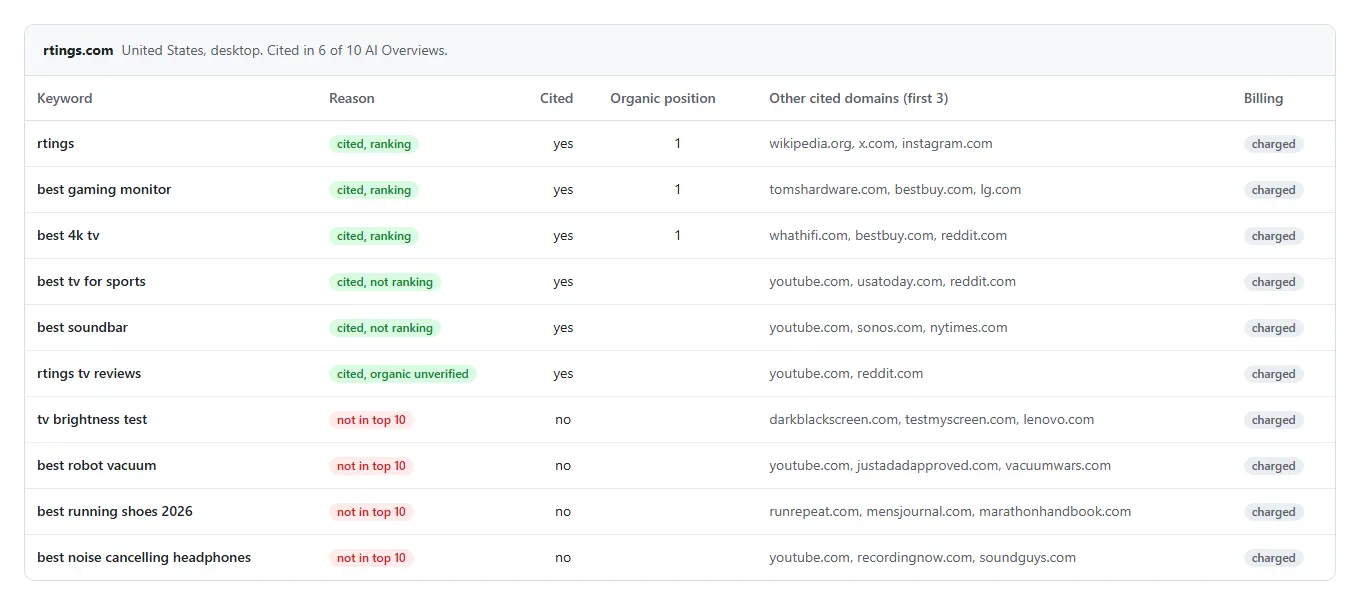
Result (real run, November 2026, US desktop): all 10 keywords had an AI Overview, and rtings.com was cited in 6 of them. On "best tv for sports" the overview cited its sports TV guide first, although the page wasn't in the organic results checked. On "best robot vacuum" it cited youtube.com, justadadapproved.com and vacuumwars.com instead. The brand name added a tenth keyword, "rtings", where rtings.com ranked first and was cited.
One row, shortened:
What you get
- One row per keyword: the reason and its plain-English
reasonText, the facts above, your cited pages (userCitedPageswith URL, title and citation position), every cited page (citedPageswith URL, domain and title), the top organic results, your competitors' citations and positions, the overview text, country, language, device,chargedandstatus. - A summary in the run's key-value store under
SUMMARY: counts per reason, the share of overviews that cite you, the most cited domains across all keywords, and your competitors' citation counts. - Export as CSV, JSON or Excel, or read it through the API.
Input
- Your website (
domain, required):example.com. A full URL works too. Subdomains count as your site. - Keywords (
keywords, required): up to 1,000 per run, one row each. - Brand name (
brandName, optional): adds your brand as a keyword and helps spot overviews that name you without a link. Searches containing your brand name or domain are treated as brand searches. - Competitor domains (
competitorDomains, optional): whether each is cited and where it ranks, per keyword. - Country, Language and Device (desktop or mobile): United States, English and desktop by default.
- Max keywords (
maxKeywords, optional): checks at most this many and skips the rest.
Pricing
Pay per event. Apify platform usage is included.
| Event | Free and Starter | Scale | Business |
|---|---|---|---|
Keyword checked (Google showed an AI Overview, any reason from local_listings on) | $0.003 | $0.0025 | $0.002 |
Keyword without an AI Overview (no_overview) | $0.001 | $0.001 | $0.001 |
| Invalid keyword or failed search | free | free | free |
| Run (Free and Starter) | Cost |
|---|---|
| 10 keywords, all with an overview | $0.03 |
| 100 keywords, 70 with an overview | $0.24 |
| 1,000 keywords, 700 with an overview | $2.40 |
To cap a run's cost, set a maximum cost per run in the run options. The actor checks only as many keywords as that limit allows and says so in the run's status.
On Apify's free plan a run checks at most 10 keywords, up to 3 runs a day (UTC). The actor developer set these limits, and a paid Apify plan removes them.
Good to know
- A check takes up to about 6 minutes. Google's results are fetched through a queue. A run of 10 keywords took about 3 minutes in our tests, and larger lists can take longer. To run it from code, start the run and wait for it (as in the example below).
- Answers vary between runs. Google rewrites AI Overviews often. When we checked the same keywords again, the cited domains overlapped by about two thirds after 10 minutes and by half after a day. Treat one run as a snapshot, and compare runs over time for trends.
- On searches for your own brand, Google sometimes leaves your site out of the organic results it returns
while still citing you in the overview. The actor then reports
organicStatusunverifiedand the reasoncited_organic_unverified. - One domain per run. To check several of your sites, run once per site, or list the others as competitor domains.
- Search operators such as
site:,intitle:orinurl:aren't supported. Those keywords come back asinvalidrows and cost nothing.
Run it from code
Python:
FAQ
Why does "not in top 10" sometimes mean fewer than 10 results?
The actor checks the organic results on Google's first page. When the page also shows an AI Overview, ads,
videos or a local pack, it may hold fewer than 10 organic results. organicResultsChecked says how many there
were.
Does it count Google's own links as citations? No. Links to Google Maps, Shopping panels, place cards and the knowledge panel are left out, so the cited domains are real websites.
Can it check Google AI Mode or ChatGPT? Not yet. This version checks Google's AI Overview in the regular search results.


