

AI Visibility Tracker: ChatGPT, Perplexity & AI Overviews
Pricing
from $80.00 / 1,000 ai answers
AI Visibility Tracker: ChatGPT, Perplexity & AI Overviews
Track whether ChatGPT, Perplexity, Gemini, Claude, Grok and Google's AI Overview name and cite your brand, by country: AI search visibility for GEO, AEO and LLM tracking. Newest models every run. Answers, cited sources, mention rate, citation share. $0.10 per answer; no-overview questions free.

AI Visibility Tracker: ChatGPT, Perplexity, Gemini, Claude, Grok & Google AI Overviews
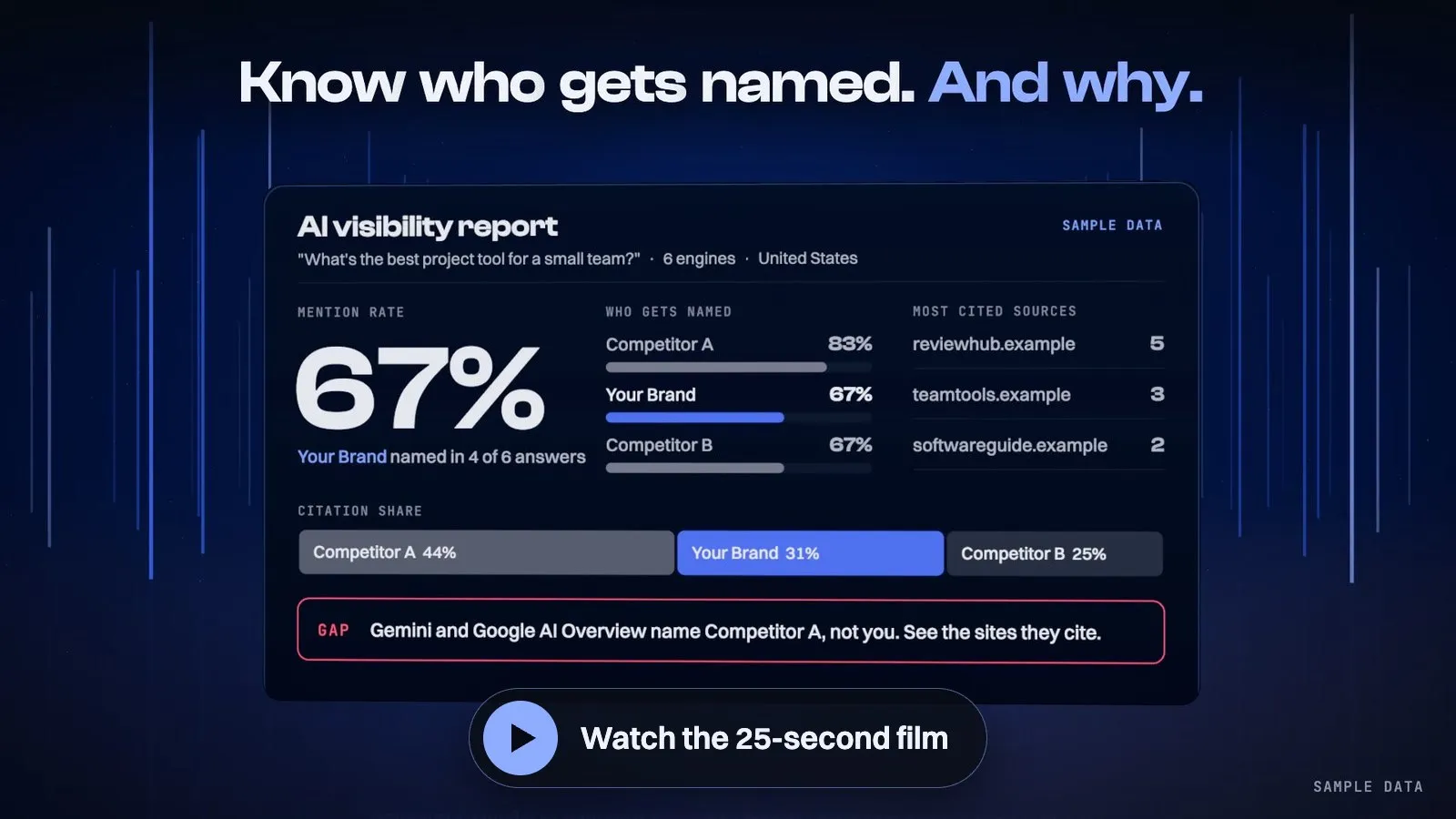
See what AI assistants and Google's AI Overview answer when your buyers ask a question, which websites they cite, and whether your brand is named or cited, by country. One run asks the same questions of ChatGPT's models (OpenAI GPT), Perplexity, Google Gemini, Anthropic Claude and xAI Grok, each through its official API with live web search, and reads Google's AI Overview for the same question from Google's own results page. You get every answer, every cited source, and a per-brand mention rate and citation share for GEO / AEO tracking.
Always the newest models. Each run uses each company's newest model at that moment, so your tracking follows what people actually get: on 12 October 2026 that was GPT-6.1 Sol, Perplexity Sonar Pro Search, Gemini 3.8 Flash, Claude Sonnet 5.5 and Grok 4.7. You can pin a model under Advanced if you want a fixed one.
Try it in a minute: the form is filled in. Press Start and you get the answers, the sources they cite, a brand report and a monitoring baseline. A first run of one question across three engines costs about $0.30, plus about $0.10 of AI usage at cost.
Then run it every week. Keep the project name and add a schedule (Actor page, then Schedules). Each run shows the mentions you gained and lost since the last one, per question and engine, and which competitors moved. An agency tracking 50 questions on 4 engines every week pays about $20 a week in answers, plus AI usage at cost.
What it does
For every question, engine and run, it returns:
- The full answer text (for Google, the whole AI Overview, including the part behind "Show more").
- Every source the answer cites, in order (position, URL, domain), with redirect links resolved to the real pages.
- For each brand you track: whether the answer names it, its rank among your brands by first mention, whether its site is cited, and at what position.
- The model that answered, the country used for the search, the time, and the AI cost of that answer.
When the run finishes, the key-value store record SUMMARY gives, per brand, overall and per engine:
- Mention rate: share of answers that name the brand.
- Citation share: share of answers that cite the brand's site.
- Average mention rank and average cited position.
- The most-cited sites overall and per engine, and the source mix (Reddit, Wikipedia, YouTube, marketplaces).
Who uses it
- Brands and agencies tracking GEO / AEO: are we recommended when buyers ask AI assistants or see Google's AI Overview, and who is recommended instead?
- SEO teams: which pages Google's AI Overview and the assistants cite, so you know where to be mentioned.
- Local markets: the same question asked as a searcher in the US, the UK, Germany, India, South Africa or anywhere else.
Example
Two questions buyers ask about project management software, asked as a searcher in the US of all six engines, one run each, 12 October 2026. 11 answers: Google showed an AI Overview for one of the two questions (the other was free).
| Brand | Named in the answer | Its site cited | Average rank when named |
|---|---|---|---|
| ClickUp | 11 of 11 | 4 of 9 | 2.1 |
| Asana | 11 of 11 | 4 of 9 | 2.2 |
| Trello | 11 of 11 | 4 of 9 | 2.7 |
| monday.com | 9 of 11 | 2 of 9 | 2.8 |
| Notion | 5 of 11 | 0 of 9 | 5.0 |
The engines disagree on who comes first: ChatGPT named Asana first in both answers, Perplexity and Google's AI Overview led with ClickUp, Claude with monday.com. The products' own sites were cited most: Asana's 5 times, ClickUp's and Trello's 4 each, ahead of any review site. Notion was named in under half the answers and never cited. Grok's two answers aren't in the cited column, because Grok doesn't say which pages it used.
Input
prompts: the questions, one per line, as buyers would type them into an assistant or Google.brands: a name, a domain, or both asName | domain.com. With a domain, citations are matched on the site; with only a name, on the name in the address.engines: any ofopenai(ChatGPT's models),perplexity,gemini,claude,grok,google-ai-overview.country: ChatGPT, Perplexity, Claude and Grok search as from that country, and Google's AI Overview is read from that country's Google. Gemini's API takes no location.languagesets Google's results language (optional).runsPerPrompt: assistants' answers change from run to run; use 3 or more for a stable rate. Google's AI Overview is read once per question.- Advanced: a fixed model for any engine (an OpenRouter model id), answer length and concurrency.
Output
One row per question, engine and run (answer text and citations shortened):
status is ok (answer with sources), zero-cite (answer without sources, still data), no-ai-overview (Google
showed none for that question, free) or error (free).
Perplexity lists every page it pulled while answering: citations holds the ones its answer marks as used, and
pagesRead the rest. Grok lists every page it came across and doesn't say which it used, so its rows have them in
pagesRead, citationsUnknown: true and cited: null per brand, and its answers are left out of citation share.
Pricing
- $0.10 per AI answer analysed: one engine's answer to one question, with its citations and brand matches.
- Free: failed calls, and questions for which Google shows no AI Overview.
- AI usage for the assistants is billed to your Apify account by Apify's own OpenRouter gateway, at OpenRouter's rates for paying Apify plans (Apify charges free-plan accounts more for it). Google's AI Overview has no AI usage. Measured per answer on 12 October 2026 with the newest models: Gemini 3.8 Flash about $0.007, Perplexity Sonar Pro Search about $0.026, Claude Sonnet 5.5 about $0.048, GPT-6.1 Sol about $0.085, Grok 4.7 $0.15-0.23 (it reads 60 or more pages per answer).
- Plus Apify's standard run start fee of $0.00005. Your spending limit for the run is respected.
Use it from code, automations and AI agents
- API: run it and get the results in one call:
POST https://api.apify.com/v2/acts/zaiq~ai-answer-tracker/run-sync-get-dataset-items?token=YOUR_TOKENwith the input as JSON. The API tab on this page has ready-made Python, JavaScript and cURL examples. - Python (
pip install apify-client):
- No code: connect it to Google Sheets, Zapier, Make or n8n from the Integrations tab, schedule weekly runs in Apify Console, and get a webhook when a run finishes.
- AI agents (MCP): add it as a tool to Claude, Cursor or any MCP client through Apify's MCP server:
https://mcp.apify.com?tools=zaiq/ai-answer-tracker.
Weekly monitoring, competitor gaps and a report
On when a project name is set (the form starts with one), at no extra charge (no new events):
- Project name (
projectName): keeps every run's results under that name and compares each run with the last one: mentions gained and lost per question and engine, citation-rate moves, cited sites gained and lost, and competitors that appeared (recordCHANGES). Schedule the Actor weekly to follow the movement. - Report (
includeReport): a one-pageREPORT.htmlwith the visibility score and its formula, per-engine tables, competitor gaps (the questions where a competitor is named or cited and you are not, with the sites cited there) and a fix list drawn from the pages the engines cite. - Cited pages to read (
maxCitedPages, default 8): how many of the cited pages are read for the fix list.
FAQ
Is this what people see in the ChatGPT, Gemini, Claude or Grok apps? These are the vendors' official APIs with web search: the same models and search the vendors offer to developers. The consumer apps can differ (memory, personalisation, their own interface). This Actor does not log in to or scrape any AI app. Google's AI Overview is read from Google's public results page, as a signed-out searcher in the country you choose.
Why do answers change between runs? AI answers are sampled. One run is a sample, not a verdict: track the same questions weekly with 3 or more runs and watch the mention rate.
Does every question get a Google AI Overview? No. Google shows one for many questions but not all, and it varies
by country and day. Questions without one are free and are marked no-ai-overview.
Which model does each engine use? The newest in the company's main family at the time of the run (ChatGPT: GPT Sol; Gemini: Flash; Claude: Sonnet; Grok: the newest Grok; Perplexity: Sonar Pro Search). Each row records the exact model.
Does it invent citations? No. What the engine returned is what you get; an answer that cites nothing is recorded as
zero-cite.
Limits
- Up to 10 runs per question and 10 answers at a time.
- Grok's answers take about a minute each; the others 5-25 seconds.
- Google's AI Overview is read in the country's usual language unless you set
language.


