

AI Citation Outreach Finder: Source Pages & Contact Routes
Pricing
from $100.00 / 1,000 cited pages
AI Citation Outreach Finder: Source Pages & Contact Routes
Find AI-cited pages naming competitors but not your brand, with public business contact routes, an HTML report and run comparisons. Rivals' own pages are free. $0.10 per read page plus $0.025 per sourced model answer or $0.04 per Google overview. AI usage separate.
Pricing
from $100.00 / 1,000 cited pages
Rating
0.0
(0)
Developer

Zaiq
Maintained by CommunityActor stats
0
Bookmarked
2
Total users
1
Monthly active users
11 days ago
Last modified
Categories
Features
Share
AI Citation Outreach Finder: cited pages, competitor gaps and contact routes
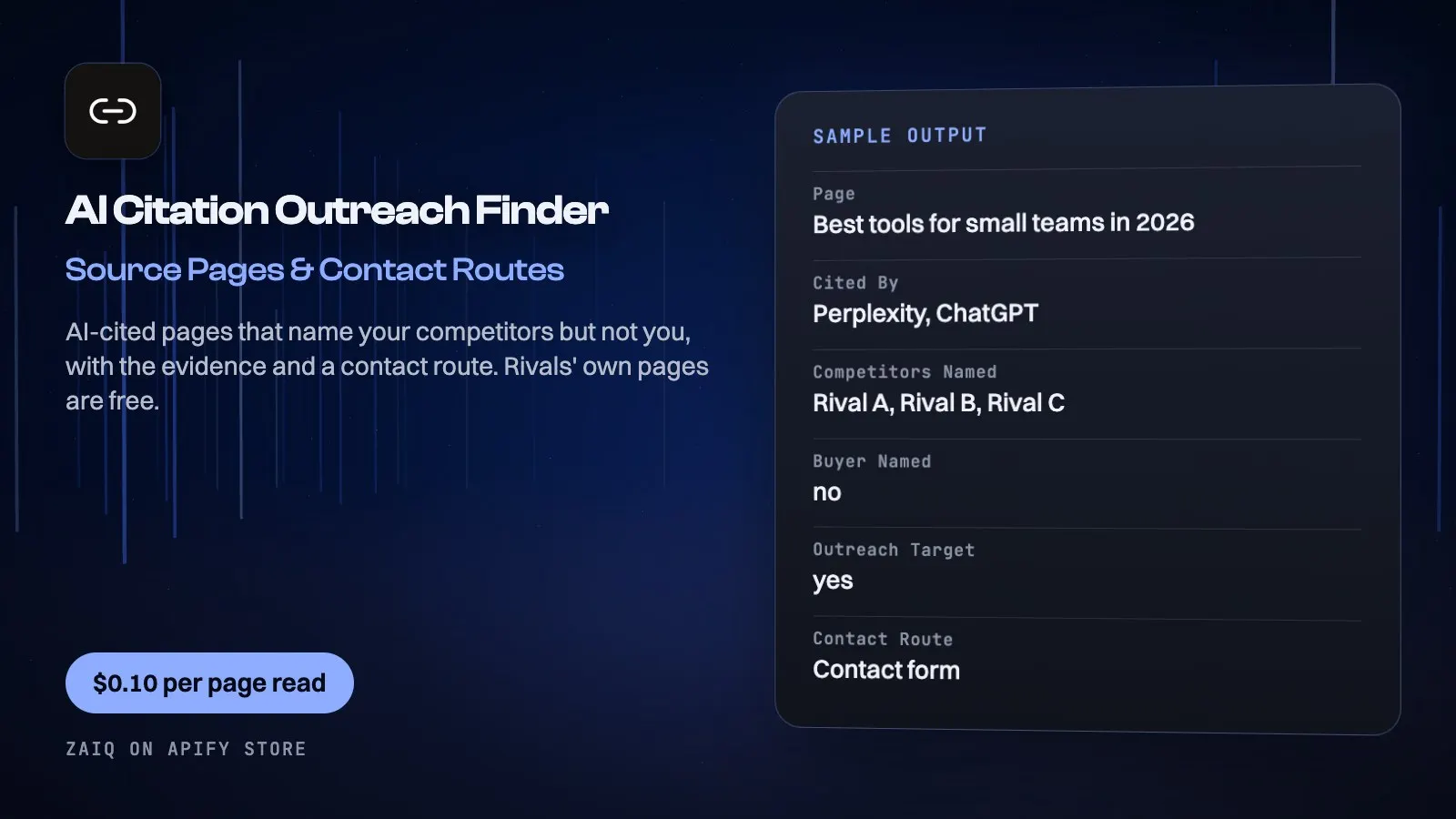
Find which AI-cited pages mention your competitors but leave out your brand, with the page evidence and available business contact routes. The first column gives a verdict; the HTML report ranks outreach targets, with sites that sell their own product last. You do not pay for pages on your own or your competitors' sites: they are skipped before reading, because they can never be a placement.
Tracking your brand across AI engines? AI Visibility Tracker checks ChatGPT, Perplexity, Gemini, Claude, Grok and Google's AI Overviews together, with share of voice against competitors, citation share and changes since your last run, for $0.06 an answer.
A real run on 30 October 2026: three buyer questions on Perplexity and ChatGPT for one brand in a crowded software market cited 76 pages. 33 were on rivals' own sites and were skipped for free. It read 14 others and found 12 outreach targets on 11 different sites for about $1.87 in all, or $0.16 a target ($1.55 in events, about $0.32 model usage).
$0.10 per successfully read cited page, plus $0.025 per sourced model answer or $0.04 per sourced Google AI Overview. Model usage is billed separately through Apify’s OpenRouter gateway. Start with one brand and one buyer question; the default engine is Perplexity.
The Actor collects citations from ChatGPT models, Perplexity, Gemini, Claude and Google AI Overviews. It reads public source pages, checks for literal brand and competitor mentions, and looks for contact pages, visible enquiry forms and generic business mailboxes. It does not send outreach.
What you get
| Field | What it holds |
|---|---|
| Verdict first | Whether this is an outreach target, an existing mention or another citation source, with citation coverage and contact availability. |
| Citation evidence | url, citedUrls, domain, title, engines, prompts, citationCount, citationPositions and promptCount. Positions refer to the source order returned with an answer. |
| Competitor gap | buyerNamed, competitorsNamed, short matching excerpts, outreachTarget, sellsOwnProduct and outreachAngle. |
| Page facts | pageType, pageTypeReason, published/updated dates where shown, declared language and Tranco domain popularity rank when available. |
| Public contact route | contactPageUrl, contactFormUrl, contactFormState, businessEmails and source evidence. Null means no route was verified within the crawl budget. |
| Answer evidence | Sourced answer rows and the ANSWERS record preserve full answer text, engine, model, question, status and every collected citation. |
| Client report | REPORT.html: top cited domains, citation share by tracked brand, ranked outreach targets, coverage and run comparisons. |
| Run records | SUMMARY explains counts, failures, route escalations and charges. CHANGES compares the latest comparable run in an optional named history store. |
What people use it for
- GEO and SEO agencies: Turn AI visibility findings into a sourced list of pages to assess for citation-building work.
- Brand and PR teams: Find relevant comparison lists, reviews, articles and directories where tracked competitors appear.
- Recurring client reporting: Repeat the same questions and settings, then compare new citations, lost citations and changed page mentions.
How to use it
- Enter your brand and domains. Add competitor names, preferably as
Example Rival | rival.exampleso owned pages can be identified. - Add one or more exact buyer questions, or topics. Alternatively, leave both empty and supply your website plus category to generate neutral questions in one model call.
- Select engines, country, language and a maximum number of cited pages. Start with one engine, one question and five pages.
- Run the Actor. Open the citation outreach table and
REPORT.html. FilterrecordTypetopagefor the source-page list; answer rows and free notes remain separately identifiable. - Use the same
historyStorename and input settings for later runs. Schedule one run at a time for each history store.
Input
| Field | Example | Notes |
|---|---|---|
| brand / domains | Example Workspace / example.com | Exact brand and domain matching. Use brandAliases for spelling variants. |
| competitors | Example Rival | rival.example | Up to 20 names or name/domain pairs. Only configured domains are treated as competitor-owned. |
| prompts | Which CRM tools suit a small team? | Up to 30 exact questions. The buyer’s name is not inserted into the question. |
| topics | small-team CRM tools | Alternative to prompts; each topic becomes a neutral comparison question. |
| website / category | https://example.com / CRM software | Alternative to prompts and topics. A public website must be readable; one model call generates 1–20 questions. |
| engines | Choose in the input form | Five supported engine choices. Model API answers may differ from the corresponding consumer apps. |
| country / language | US / en | Search location where supported and answer language; direct source reads are not forced to that country. |
| includeContacts / includeTranco | Both on | Contacts and domain popularity are included in the page price, when available. |
| maxPages | 5 | Prefill: 5; API default for supplied jobs: 20; maximum: 500. Most cited first, at most two a site until every site has had a turn, with product, pricing and help pages last. |
| includeCompetitorPages | off | Also read and charge for pages on your own, your competitors' and Wikipedia's sites. |
| historyStore | example-project | Optional named history. Changing questions, competitors or other assessment settings starts a separate baseline. |
Output
Each result is one row in the run's dataset (download it as JSON, CSV, Excel, XML or HTML, or read it through the API). An example row (values shortened):
This example comes from a real public-page test on 26 October 2026. Company names, engine names in the verdict, the page title and site addresses have been replaced; counts, flags and returned contact availability are unchanged. The test used fake model answers containing real URLs, then fetched those URLs live. It demonstrates page extraction, not a verified live AI citation. The SUMMARY record states coverage and charges for each run.
Pricing
- Cited page: $0.10. Charged once per delivered, readable source URL after assessment. Redirect aliases that resolve to the same fetched page are merged. Contact discovery, deterministic analysis and the HTML report are included.
- Your own, your competitors' and Wikipedia's pages: free. They are skipped before reading and still count in Most cited domains. List your competitors with their domains (
Rival | rival.example) to use this. - Sourced model answer: $0.025. Charged only for a complete returned answer with usable citation URLs. The answer is delivered even if its source pages later refuse access.
- Google AI Overview: $0.04. Charged only when a readable overview with usable sources is delivered. An absent or unavailable overview produces a free note.
- Model usage is separate. Apify’s OpenRouter gateway bills the account running the Actor for model and search usage. No model key is requested in the input. Usage depends on the selected models and questions, including any question-generation call.
- Blocked pages, errors and incomplete or zero-citation answers have no corresponding page or answer event. Provider model usage may still apply to a failed or truncated model response.
- The same price on every Apify plan for these Actor events. Apify’s $0.00005 start charge counts towards the buyer’s Maximum cost per run. Gateway usage can have separate plan-dependent terms.
What typical jobs cost at the list price:
| Job | Cost |
|---|---|
| 1 sourced model answer + 1 read page | $0.12505, plus model usage |
| 1 sourced model answer + 5 read pages | $0.52505, plus model usage |
| 20 sourced model answers + 50 unique read pages | $5.50005, plus model usage |
| 1 sourced Google overview + 5 read pages | $0.54005 |
| A sourced model answer whose pages all refuse access | $0.02505, plus model usage; no page charges |
Set Maximum cost per run to limit this Actor’s events, including the start charge. The Actor reserves room for an answer and a page before requesting the answer, and checks remaining room before source work. Model usage through the gateway is billed separately and is not capped by this Actor’s event limit. A one-answer, one-page model run needs at least $0.12505 of event budget; the Google equivalent needs $0.14005.
Tips
- Use questions your prospective customers actually ask. Keep the exact same questions for comparisons.
- Supply the actual domains used by competitors. A company can own several unrelated domains; ownership is never guessed from its name.
- Inspect matching excerpts for common-word brands and ambiguous names. Literal matching is transparent, but it is not semantic entity recognition.
- Use the contact evidence to judge suitability. A public support form or business mailbox is not necessarily an editorial contact.
- Review all coverage notes before treating a missing mention or lost citation as a market change.
Use it through the API
Python
JavaScript
HTTP (one call, results back)
Integrations and schedules
- Schedules: run it every hour, day or week from the Apify Console (Schedules) and keep a history of results.
- Make, Zapier, n8n, Google Sheets, Slack, Airtable: connect it through Apify's integrations, or send each finished run to a webhook.
- Datasets: results stay in the run's dataset; export them or read them by API whenever you need them.
Use it with AI agents (MCP)
Add Apify's MCP server with this Actor already pinned (https://mcp.apify.com?tools=zaiq/ai-citation-outreach) to Claude, ChatGPT, Cursor, VS Code or any MCP client. The agent can find this Actor and run it for you: ask it for "find the pages AI cites for small-team CRM questions that mention my competitors but not my brand, with public business contact routes". AI agents can also pay for runs directly through Apify's agentic payments.
Limits
- Public, signed-out HTML and text only. No browser rendering, logins, CAPTCHA solving, author lookups, personal contact extraction or form submission.
- Outreach targets depend on the competitors you list: a rival you have not listed reads as an ordinary site. Most cited domains shows who else is being cited.
- Every site gets at most ten requests, counting robots.txt, redirects, citation pages, contacts and retries. Contact discovery follows up to two additional candidate pages within that shared budget. HTTP 429 stops further requests to that site for the run.
- Source requests start direct, then use cloud datacenter and fresh residential routes where available for blocked, empty or unreadable responses. Restrictions that remain are reported as free notes. robots.txt is respected.
- Page bodies are bounded at 24 MB decoded. Site work has a 150-second deadline and a 60 MB decoded budget. A site cited many times may exhaust its shared request budget.
- A JavaScript embed is marked unconfirmed. A form URL is returned only when visible enquiry controls were found in the static page. Only generic mailboxes published on the same site are returned.
- Page types follow ordered rules: configured owned domains; Wikipedia; forums; list/comparison wording; reviews; documentation; directories; news; then article or other. Each row gives the rule that matched. List/comparison wording is checked in the title and H1, and can occasionally describe an ordinary article.
- Brand absence means absent from fetched main/article text. Hidden content, scripts, images, navigation and gated text are not evidence. Common-word names can still be ambiguous.
- Tranco is a popularity proxy, not proof of editorial quality. Null means the domain was unlisted or the public list could not be read. Page language and dates remain null when not declared or shown.
- Citation share measures tracked brand mentions on assessed pages, weighted by how many engine–question answers cite each page. It does not measure endorsements in the AI answer. Unreadable pages are excluded.
- All collected citations remain in ANSWERS even if maxPages or the spending limit prevents reading them. Incomplete runs do not replace a complete history baseline, and do not report lost citations.
- AI search varies between runs, models and consumer interfaces. Some answers have no citations. No placement, response or visibility improvement is guaranteed.
FAQ
How is this different from a visibility tracker?
A tracker reports whether an AI answer names a brand. This Actor reads the cited pages, finds page-level competitor gaps and returns evidence and available contact routes.
Why are competitors' own pages not read?
They can never be a placement, so reading them would only cost you money and use up your page limit. In a real test they were 33 of 76 cited pages. They still appear in Most cited domains, and you can read them with includeCompetitorPages.
What does sellsOwnProduct mean?
The page links to its own pricing page or a free-trial or demo button, so the site sells something and its lists are partly marketing. A placement is less likely, so these rank below independent sites. It is a signal from the page, not a verdict: a vendor's page without those links can read as independent.
Does it send messages?
No. It delivers a research list and suggested next actions.
Will every cited page have a contact email?
No. Only published generic same-site addresses are returned. Contact pages or confirmed static forms may be available instead; otherwise the fields are empty with an explanation.
Why can I pay for an answer but get no page rows?
A complete sourced answer is a delivered result with its own event. Its sources can subsequently refuse public access. Those page failures are free notes; the answer and its citations remain available.
Can I generate questions from my website?
Yes. Supply brand, website and category, and leave prompts and topics empty. A single model call generates neutral buyer questions; invalid or brand-leading output is refused.
What does the outreach ranking mean?
Pages naming tracked competitors but not the buyer are sorted by citation count. Buyer-owned, configured competitor-owned and Wikipedia pages are excluded from outreach targets. Relevance and editorial suitability still need review.
How does history work?
The named store saves the latest complete result for the same assessment settings. CHANGES lists added and lost citations and changed page assessments; partial runs disclose missing coverage.
Do I need my own AI key?
No. Cloud AI calls use Apify’s OpenRouter gateway and the run’s own authorization. The account running the Actor must be able to use that gateway.
Can I export the report?
REPORT.html is a standalone HTML file in the run’s key-value store. The source rows, answers and summary are also available through the run’s output links.
Related Actors from Zaiq
- ai-answer-tracker: measure whether AI answers mention and cite your brand
- contact-form-finder: check public contact pages and static forms on a supplied site list
- seo-site-audit: inspect technical SEO and AI crawler access
Support
Questions, a site that changed, or a field you need? Open an issue on this Actor's Issues tab: we answer there, usually within a day.
Also found as: AI citation outreach finder, GEO citation sources, competitor citation gap, AI search outreach, AI citation building, AI source pages.


