

Clinical Trials Monitor
Pricing
from $4.25 / 1,000 delivered clinical trial records
Clinical Trials Monitor
Retrieve up to 100 ClinicalTrials.gov studies for up to 25 condition, drug, or sponsor queries. Delivered rows include NCT ID, status, phase, sponsor, dates, source link, confidence, gaps, and billing. No-match and failure rows are free; registry data is not medical advice or proof of efficacy.
Pricing
from $4.25 / 1,000 delivered clinical trial records
Rating
0.0
(0)
Developer

Tim Zinin
Maintained by CommunityActor stats
0
Bookmarked
2
Total users
1
Monthly active users
2 months ago
Last modified
Categories
Share
Clinical Trials Monitor — Official Registry Evidence Feed
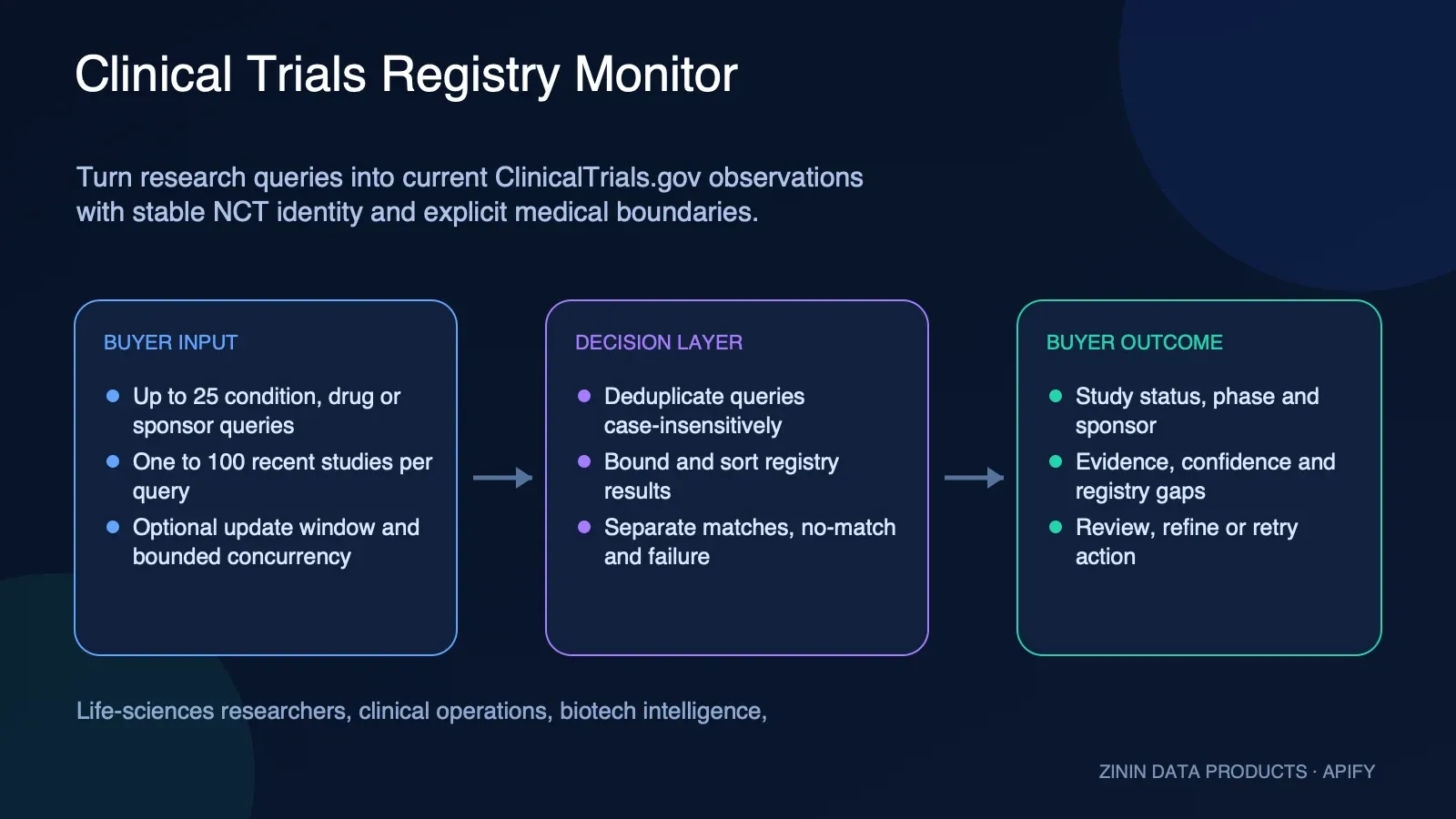
Turn condition, drug, or sponsor queries into recently updated ClinicalTrials.gov study observations with stable NCT identity and explicit medical boundaries.
This Store guide treats the Actor as a commercial data product: the raw observation, its source identity, evidence quality, gaps, recommended next step, delivery state, and billing meaning travel together. It helps a buyer answer a bounded question; it never converts public data into permission or certainty.
The decision this product supports
Which registry studies match these research queries, and which primary ClinicalTrials.gov records require review?
The Actor reduces repetitive collection and first-pass triage. A result is useful because it is structured and reviewable, not because it eliminates human judgment.
Who uses it
| Buyer or operator | What they get |
|---|---|
| Life-sciences market researchers | Monitor bounded condition, intervention, or sponsor queries using official registry metadata. |
| Clinical operations teams | Create a review queue of recently updated public study records. |
| Biotech intelligence teams | Track selected research topics without treating registry metadata as efficacy or approval evidence. |
| Medical content teams | Find primary NCT records for qualified editorial or scientific review. |
| Data and automation teams | Normalize study identity, status, phase, sponsor, conditions, dates, and source links. |
Input contract
| Input field | How to use it |
|---|---|
| queries | Required list of up to 25 condition, drug, intervention, or sponsor search terms, deduplicated case-insensitively. |
| pageSize | One to 100 most-recently-updated studies returned per query. |
| sinceDays | Optional 1-to-3,650-day filter applied to the registry last-update date. |
| maxConcurrency | Parallel registry queries from 1 to 8. |
Recommended first Input
Run the bounded example first. Inspect all returned row types and KVS OUTPUT before increasing volume or concurrency.
Output examples: success, partial, and failure
These are compact contract examples derived from the Actor's acceptance fixtures and decision-layer tests. Dates, counts, titles, and registry or filing identifiers are representative, not current market, medical, or filing claims. A production consumer must use the values returned by its own run and retain the complete row.
Successful observation shape
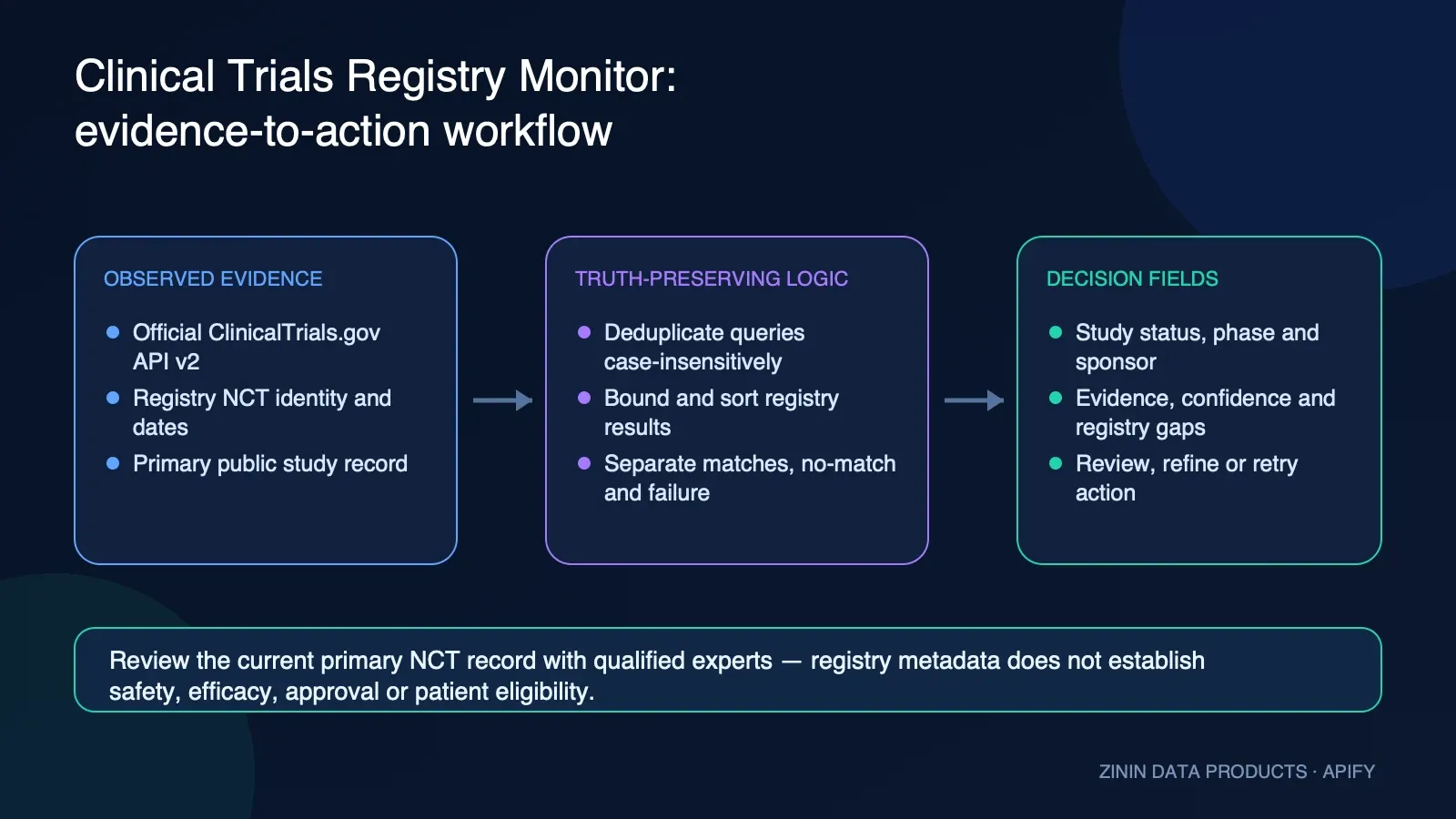
Interpret this row under the rule: A successful row proves that the official registry returned a matching study observation at collection time. It does not establish medical suitability, safety, efficacy, approval, or current recruitment eligibility.
Partial or budget-stopped shape
The partial row is not a negative business fact. Preserve the gap, do not bill the advisory, and resume only the unfinished authorized scope.
Source-failure shape
The failure row must never enter a positive-results lane. Retry only when retryable=true; otherwise correct the input or policy issue first.
Field dictionary
| Field or group | Meaning |
|---|---|
| sourceQuery, nctId, entityId, observedAt | Submitted query, stable study identity, and observation time. |
| title, status, phase, sponsor, conditions | Current public registry metadata returned by the official API. |
| lastUpdated, firstPosted, url | Registry dates and direct primary study link. |
| found, matched, error, summary | Query/result status without converting source failure into absence. |
| confidenceScore, confidenceBand, confidenceReasons, confidenceRisks | Support for the registry observation, not medical truth. |
| sourceEvidence, dataGaps, negativeSignals | Traceability and medical/registry limitations. |
| recommendedAction, actionPriority, actionReason, safeToAutomate | Routing to primary-record review, query refinement, or retry. |
| failureType, retryable, failureDiagnostics, billing | Operational and linked-delivery semantics. |
Common decision fields
| Field | Operational meaning |
|---|---|
| recordType | The semantic row family. Use it to distinguish a business result from an advisory or terminal record. |
| schemaVersion | Version of the additive decision-intelligence contract. Pin or validate it in strict consumers. |
| entityId | Stable entity identity for deduplication and joins. It is not necessarily a legal identifier. |
| inputRef | The relevant submitted input reference after normalization. |
| observedAt | When the Actor observed or finalized the evidence. It is not necessarily the source publication time. |
| firstSeenAt and lastSeenAt | Always-emitted observation boundaries. Stateful monitors use the compatible baseline/current boundary. Stateless rows set both equal to observedAt for the current run; that equality does not establish historical tenure. |
| freshness | A structured statement about evidence age or availability, not a prediction. Its basis and age unit follow the source-specific field definition. |
| eventId | For monitors, the stable identity of one observed transition or monitor outcome. It is distinct from entityId. |
| before and after | For monitors, the bounded comparable snapshots used for the decision. Null means that side of a comparison was not honestly available. |
| changedFields and changeFlags | Machine-readable monitor deltas and normalized change labels. Empty arrays mean no supported changed field was established, not that every possible real-world fact stayed constant. |
| materialityScore and materialityBand | Magnitude of an observed monitor change when the Actor can calculate it. Materiality is separate from evidence confidence and may be unknown when the source lacks the required facts. |
| confidenceScore | Evidence support on a 0–100 scale. It is separate from materiality, lead score, or business value. |
| confidenceBand | Readable high/medium/low/unknown grouping of evidence support. |
| confidenceReasons | Observed facts that raise confidence. |
| confidenceRisks | Missing, partial, ambiguous, inferred, or conflicting aspects that reduce confidence. |
| confidenceConflict | Explicit consistency warning when structured evidence does not reconcile. |
| sourceEvidence | Source-linked observations supporting the row. Preserve this during export. |
| dataGaps | Important evidence the Actor did not observe or cannot establish. Keep these gaps visible in CRM, spreadsheet, and automation exports. |
| negativeSignals | Machine-readable risks or gaps. A negative signal is not automatically a negative business outcome. |
| recommendedAction | Bounded review label produced from the available evidence. |
| actionPriority | Suggested queue priority, not urgency guaranteed by the source. |
| actionReason | Plain-language explanation for the recommended action. |
| safeToAutomate | Whether the narrow recommended action is deterministic enough for automation. Organizational policy still applies. |
| failureType | Normalized terminal or partial failure classification. Null means no classified failure. |
| retryable | Whether a later retry may legitimately change an operationally incomplete result. |
| recommendation | Human-readable handling guidance, especially for terminal rows. |
Evidence, confidence, and honest boundaries
What the evidence supports
- Matching studies are returned by the official ClinicalTrials.gov API v2 for the submitted query.
- Stable NCT identifiers and primary study URLs are retained.
- Configured page and date bounds are explicit.
- Registry no-match and source failure remain separate operational states.
- Run OUTPUT reconciles delivered, paid, free, failed, partial, and withheld work.
What this Actor never claims
- Registry inclusion does not prove safety, efficacy, quality, regulatory approval, recruitment eligibility, completion, or availability at a site.
- The Actor does not provide diagnosis, treatment, medical advice, patient matching, or adverse-event interpretation.
- Sponsor and status metadata can change and require review at the primary record.
- A bounded no-match does not prove no relevant trial exists under different terminology or outside the selected window.
- It does not replace qualified clinical, regulatory, scientific, legal, or ethical review.
Reading data gaps correctly
A data gap is part of the result. Nulls, partial flags, confidence risks, source failures, and unavailable fields must survive export. Removing these fields makes the remaining facts look more complete than they are. When two sources conflict or a required identity cannot be proven, lower confidence and keep safeToAutomate=false.
Source evidence is not permission
A public source proves only that a value or statement was observable at the recorded time and URL. It does not establish consent, contractual rights, legal status, accuracy after observation, or authorization for a downstream action. Your organization remains responsible for source terms, privacy rules, outreach policy, retention, and human review.
Decision policy and action routing
| Action | How to use it |
|---|---|
| REVIEW_PRIMARY_TRIAL_RECORD | Open the NCT record and verify current eligibility, locations, status, design, contacts, and update history. |
| REFINE_QUERY_OR_SCHEDULE_RECHECK | Adjust terminology or record the bounded no-match for later monitoring. |
| RETRY_REGISTRY_QUERY | Retry only when the failure is operational and retryable. |
Confidence is not attractiveness
confidenceScore answers “how strongly does the available evidence support this factual classification?” It does not answer “how valuable is this lead, property, account, or address?” A high-confidence negative fact may be commercially uninteresting; a low-confidence positive signal may deserve research but not action. Keep the concepts separate in dashboards, exports, and CRM fields.
Why safeToAutomate is conservative
safeToAutomate is intentionally false whenever the next step could amplify an uncertain inference. It may be true only for narrow deterministic actions explicitly supported by the row, such as suppressing an email with invalid syntax. A true value does not waive legal, privacy, consent, contractual, or organizational rules.
Retry policy
- Retry when
retryable=trueand the failure is operational, such as a temporary source or DNS problem. - Do not endlessly retry deterministic invalid input, policy refusal, or confirmed absence.
- A retry must preserve the original input reference and must not create duplicate downstream actions.
- Budget exhaustion is not negative evidence about the entity. Resume only the unprocessed scope with an authorized budget.
- A failed Actor run is an operational event. Never transform it into “no listing,” “no contact,” “bad lead,” or “invalid email.”
Commercial use-case playbooks
1. Competitive trial watch
Goal. Schedule explicit sponsor or intervention terms and route newly observed NCT records to a qualified analyst.
Recommended runbook.
- Define the submitted cohort and write down why it is in scope.
- Start with the smallest useful Input and preserve the exact run ID.
- Inspect the Dataset overview before exporting anything.
- Check
failureType,retryable, completeness indicators, andconfidenceBand. - Open the relevant
sourceEvidenceor source URL for material rows. - Apply the recommended action as a review label, not as an instruction to contact, buy, delete, accuse, or publish.
- Record the analyst's final disposition in the destination system.
Do not skip. A successful row proves that the official registry returned a matching study observation at collection time. It does not establish medical suitability, safety, efficacy, approval, or current recruitment eligibility.
2. Condition landscape research
Goal. Collect a bounded recent slice, group statuses and phases downstream, and retain page/date limits in the report.
Recommended runbook.
- Define the submitted cohort and write down why it is in scope.
- Start with the smallest useful Input and preserve the exact run ID.
- Inspect the Dataset overview before exporting anything.
- Check
failureType,retryable, completeness indicators, andconfidenceBand. - Open the relevant
sourceEvidenceor source URL for material rows. - Apply the recommended action as a review label, not as an instruction to contact, buy, delete, accuse, or publish.
- Record the analyst's final disposition in the destination system.
Do not skip. A successful row proves that the official registry returned a matching study observation at collection time. It does not establish medical suitability, safety, efficacy, approval, or current recruitment eligibility.
3. Medical content sourcing
Goal. Use returned NCT links as primary references and require qualified review before publication.
Recommended runbook.
- Define the submitted cohort and write down why it is in scope.
- Start with the smallest useful Input and preserve the exact run ID.
- Inspect the Dataset overview before exporting anything.
- Check
failureType,retryable, completeness indicators, andconfidenceBand. - Open the relevant
sourceEvidenceor source URL for material rows. - Apply the recommended action as a review label, not as an instruction to contact, buy, delete, accuse, or publish.
- Record the analyst's final disposition in the destination system.
Do not skip. A successful row proves that the official registry returned a matching study observation at collection time. It does not establish medical suitability, safety, efficacy, approval, or current recruitment eligibility.
4. Clinical operations queue
Goal. Stage recently updated records and verify locations, eligibility, and contacts directly in the current registry record.
Recommended runbook.
- Define the submitted cohort and write down why it is in scope.
- Start with the smallest useful Input and preserve the exact run ID.
- Inspect the Dataset overview before exporting anything.
- Check
failureType,retryable, completeness indicators, andconfidenceBand. - Open the relevant
sourceEvidenceor source URL for material rows. - Apply the recommended action as a review label, not as an instruction to contact, buy, delete, accuse, or publish.
- Record the analyst's final disposition in the destination system.
Do not skip. A successful row proves that the official registry returned a matching study observation at collection time. It does not establish medical suitability, safety, efficacy, approval, or current recruitment eligibility.
5. Research data integration
Goal. Use nctId for deduplication and keep observation time distinct from registry update dates.
Recommended runbook.
- Define the submitted cohort and write down why it is in scope.
- Start with the smallest useful Input and preserve the exact run ID.
- Inspect the Dataset overview before exporting anything.
- Check
failureType,retryable, completeness indicators, andconfidenceBand. - Open the relevant
sourceEvidenceor source URL for material rows. - Apply the recommended action as a review label, not as an instruction to contact, buy, delete, accuse, or publish.
- Record the analyst's final disposition in the destination system.
Do not skip. A successful row proves that the official registry returned a matching study observation at collection time. It does not establish medical suitability, safety, efficacy, approval, or current recruitment eligibility.
Integration recipes
All examples use placeholders. Keep the Apify token in a secret manager and never write it into a Dataset, README, screenshot, or client-side application.
cURL: start a run and wait briefly
The run response includes defaultDatasetId. Read clean JSON rows with:
JavaScript with apify-client
Python with apify-client
Apify MCP call
Generic webhook consumer policy
- Trigger on a terminal Actor run event.
- Confirm the run status is
SUCCEEDEDbefore reading business rows. - Retrieve rows from
defaultDatasetId. - Reject or quarantine rows whose
failureTypeis non-null unless your policy explicitly handles that failure. - Send
safeToAutomate=falserows to a human-review queue. - Store
entityId,observedAt,sourceEvidence, confidence, action, and the Apify run ID together. - Make retries idempotent by keying the destination on the stable entity ID plus the intended observation or event identity.
Where this fits in a practical stack
| Destination | Recommended pattern |
|---|---|
| Apify Console | Use the visual Input form, start the run, then open the default Dataset overview. This is the fastest path for a one-off review and the best place to inspect evidence before automating anything. |
| Apify API | POST JSON input to the Actor run endpoint, wait or poll for completion, then read the default Dataset through the URL returned by the run object. |
| JavaScript client | Use apify-client from a Node.js service, pass the same JSON object as the Console Input, and preserve the returned run and Dataset IDs in your own audit log. |
| Python client | Use apify-client in a Python enrichment job, iterate Dataset items, and route rows by recommendedAction, confidenceBand, failureType, and retryable. |
| Make | Start the Actor from a scenario, wait for the run, retrieve Dataset items, filter unsafe or low-confidence rows, then insert review-ready rows into the destination application. |
| Zapier | Use an Apify run action or webhook trigger, fetch Dataset items, apply a Filter step, and send only review-approved fields into the next sales or operations step. |
| n8n | Use HTTP Request or Apify nodes, branch on failureType and retryable, keep a manual-review lane for safeToAutomate=false, and write sourceEvidence together with the business fields. |
| Google Sheets | Export the Dataset directly or append rows from an automation. Keep stable entityId as a hidden key so reruns update the correct record instead of creating ambiguous duplicates. |
| Airtable | Map entityId to a primary or deduplication field, store confidence and evidence in separate columns, and expose recommendedAction as the triage view. |
| Webhook | Configure an Apify webhook for terminal run states, retrieve the Dataset after SUCCEEDED, and treat FAILED or TIMED-OUT runs as operational events rather than negative business evidence. |
A safe automation shape
The Actor is a collection and decision-support component. A production workflow should keep raw evidence, decision metadata, and business action in distinct layers:
- Collect: run the Actor with explicit bounded input.
- Validate: require a successful run and schema-valid Dataset rows.
- Triage: branch on
failureType,retryable,confidenceBand, andsafeToAutomate. - Review: open source evidence for rows that may affect a person, campaign, investment, compliance decision, or customer record.
- Act: execute only the action approved by your own policy and authorized operator.
- Audit: retain run ID, Dataset ID, observation time, input reference, source evidence, and the final human decision.
This separation prevents a common automation error: turning “data was observed” into “a business action is justified.”
Operating guide
Before the first production run
- Write the business question in one sentence: Which registry studies match these research queries, and which primary ClinicalTrials.gov records require review?
- Confirm every submitted input is within your authorized scope.
- Use the prefilled small example and review all returned row types.
- Map stable identifiers, confidence, evidence, actions, gaps, failure, and retry fields into the destination.
- Establish a human owner for review exceptions.
- Set a run budget and output bound appropriate to the test.
- Verify that secrets are stored only in the platform or workflow secret manager.
After every scheduled run
- Check terminal run status and logs.
- Compare the number of submitted entities, produced business rows, and advisory rows.
- Review partial, unknown, conflict, and low-confidence buckets.
- Inspect a sample of source evidence, including at least one positive and one negative result.
- Confirm the destination deduplicated on the intended stable key.
- Verify that no downstream action was triggered from an error row.
- Track cost per useful reviewed row rather than cost per raw request alone.
Production monitoring signals
Monitor source-unavailable rate, partial-row rate, low-confidence share, missing evidence, retry volume, run duration, Dataset row count, and spend. A sudden shift may indicate source drift, input drift, or an upstream outage. Stop automation and investigate before accepting a new pattern as business truth.
Cost control
Start with two specific queries, pageSize 10, and concurrency 2. Inspect NCT identity, duplicates, no-match/failure behavior, current registry links, and live event prices before scaling.
Use maxTotalChargeUsd when calling a monetized Actor if your workflow supports it. Treat a buyer-set cap as a hard safety boundary. If the cap stops work, the unfinished items remain unprocessed; they do not become negative results.
Pricing and billing contract
Current prices are shown by Apify on the live Store page and are authoritative. The Actor links a billable result-found event to a successfully delivered useful row. Advisory, no-match, source-failure, and budget-stop rows use the free channel only when the runtime confirms default Dataset writes are unpriced. If pricing cannot be read safely, the Actor fails closed. Concurrent workers serialize the budget check and linked delivery so they cannot independently pass the same remaining-budget test.
Use a small representative run to calculate cost per useful reviewed row. A buyer-set maximum charge is a hard boundary; unprocessed rows remain unprocessed rather than becoming negative evidence.
Production acceptance checklist
- The business question matches: Which registry studies match these research queries, and which primary ClinicalTrials.gov records require review?
- Inputs are authorized, bounded, deduplicated, and tested on a small representative sample.
- The destination stores
entityId,observedAt, source evidence, confidence, gaps, action, and failure fields. - Dataset result rows and KVS
OUTPUTreconcile with the submitted scope. - Partial, failure, free-advisory, and budget-stopped rows cannot enter the positive-results lane.
-
safeToAutomate=falsecreates a visible human-review task. - Retries are idempotent and cannot duplicate downstream actions or charges.
- The live pricing panel and a small canary run were reviewed before scale-up.
- Source terms, privacy, retention, consent, and organizational policy were reviewed for the intended use.
- A named operator owns source drift, low-confidence exceptions, and rollback.
Frequently asked questions
Is this a database?
No. It is an on-demand observation tool. Each run collects or evaluates the submitted scope and records evidence at that time.
Does a found row prove commercial interest?
No. A found row proves only the factual observation described by its fields. Buyer intent is never inferred.
Can I automatically contact every result?
No. Use recommendedAction as triage, verify the evidence and identity, and apply your own consent, privacy, suppression, and outreach rules.
Why is safeToAutomate often false?
Because a useful observation can still require identity, context, legal, or source verification before action. Conservative routing prevents false certainty from scaling.
What should I do with low confidence?
Open confidenceRisks and sourceEvidence, close the important gap, or keep the row in a manual queue. Do not hide the confidence field.
What does partial mean?
The Actor obtained some usable evidence but could not support a complete observation of the configured scope. Partial is not the same as empty.
What is a confirmed zero?
Only an explicit source or deterministic rule can support a confirmed absence. An outage, truncation, or unreadable response is not a zero.
Should I retry every failure?
No. Retry only when retryable is true. Invalid input, policy refusal, or deterministic classification should be corrected or handled, not looped.
Can I delete failure rows?
You can exclude them from a business-results view, but retain them in operational logs so Dataset completeness and retry decisions stay explainable.
How should I deduplicate?
Use entityId for the entity and, for stateful monitors, eventId for the observed transition. Also retain the Apify run ID.
Can I treat confidence as conversion probability?
No. Confidence measures evidence support, not purchase probability, revenue, suitability, or expected return.
Can I change the recommended action?
Yes. It is an explainable default. Your downstream policy can be stricter, and should encode organization-specific authorization and risk tolerance.
How do I estimate cost?
Run the smallest representative input, inspect live event prices and run usage in Apify, then model the number of billable result events. The live pricing panel is authoritative.
Why use a small prefill?
It produces a cheap, fast, inspectable first run and reduces the chance of scaling a wrong input or workflow assumption.
Can I schedule it?
Yes. Use an Apify schedule, but make the destination idempotent and review changes in failure, partial, and confidence rates.
Can I export CSV or Excel?
Yes. Apify Datasets support common export formats. JSON is recommended when you need nested evidence and decision fields.
Can I send results to Sheets or Airtable?
Yes. Preserve entityId, confidence, evidence, gaps, actions, and failure fields instead of mapping only the headline value.
Can I use it from Make, Zapier, or n8n?
Yes. Start the Actor, wait for a successful terminal state, read Dataset items, then branch on decision and failure fields.
Can an LLM consume the output?
Yes, but pass the structured evidence and limitations together. Instruct the model not to invent missing facts and to cite sourceEvidence.
What happens when a source changes?
The run may become partial, unavailable, or fail validation. Monitor these rates and inspect logs before treating changed output as a real-world shift.
Does public mean unrestricted?
No. Public visibility does not remove source terms, privacy obligations, retention rules, or the need for a legitimate downstream purpose.
Is a source URL permanent?
Not necessarily. Store observation time and material facts because web content can change or disappear.
Can I rely on one row for a high-stakes decision?
No. High-stakes legal, financial, employment, compliance, safety, or personal decisions require appropriate primary evidence and qualified review.
How do I report a suspected parsing issue?
Provide the Actor run ID, a redacted input, affected field, expected source evidence, and whether the issue reproduces. Never include tokens or private data.
What does success mean?
A successful row proves that the official registry returned a matching study observation at collection time. It does not establish medical suitability, safety, efficacy, approval, or current recruitment eligibility.
Support information
Provide the public Actor name, run ID, Dataset item index or entityId, a redacted Input, affected source URL, expected behavior, observed behavior, and whether a bounded retry reproduced it. Never include Apify tokens, private customer records, credentials, or unnecessary personal data.
Final interpretation rule
A successful row proves that the official registry returned a matching study observation at collection time. It does not establish medical suitability, safety, efficacy, approval, or current recruitment eligibility.


