

Tender Alert — New EU Tender Watch
Pricing
from $8.50 / 1,000 delivered tender baseline or new notices
Tender Alert — New EU Tender Watch
Monitor one stable EU TED query. Receive a paid first-run baseline, then only newly observed procurement notices after complete checks. Each row includes evidence, confidence, gaps, review action and billing truth. Partial, failed, quiet and withheld outcomes are free and never advance the watch.
Pricing
from $8.50 / 1,000 delivered tender baseline or new notices
Rating
0.0
(0)
Developer

Tim Zinin
Maintained by CommunityActor stats
0
Bookmarked
2
Total users
1
Monthly active users
a month ago
Last modified
Categories
Share
Tender Alert — Official EU TED Opportunity Watch
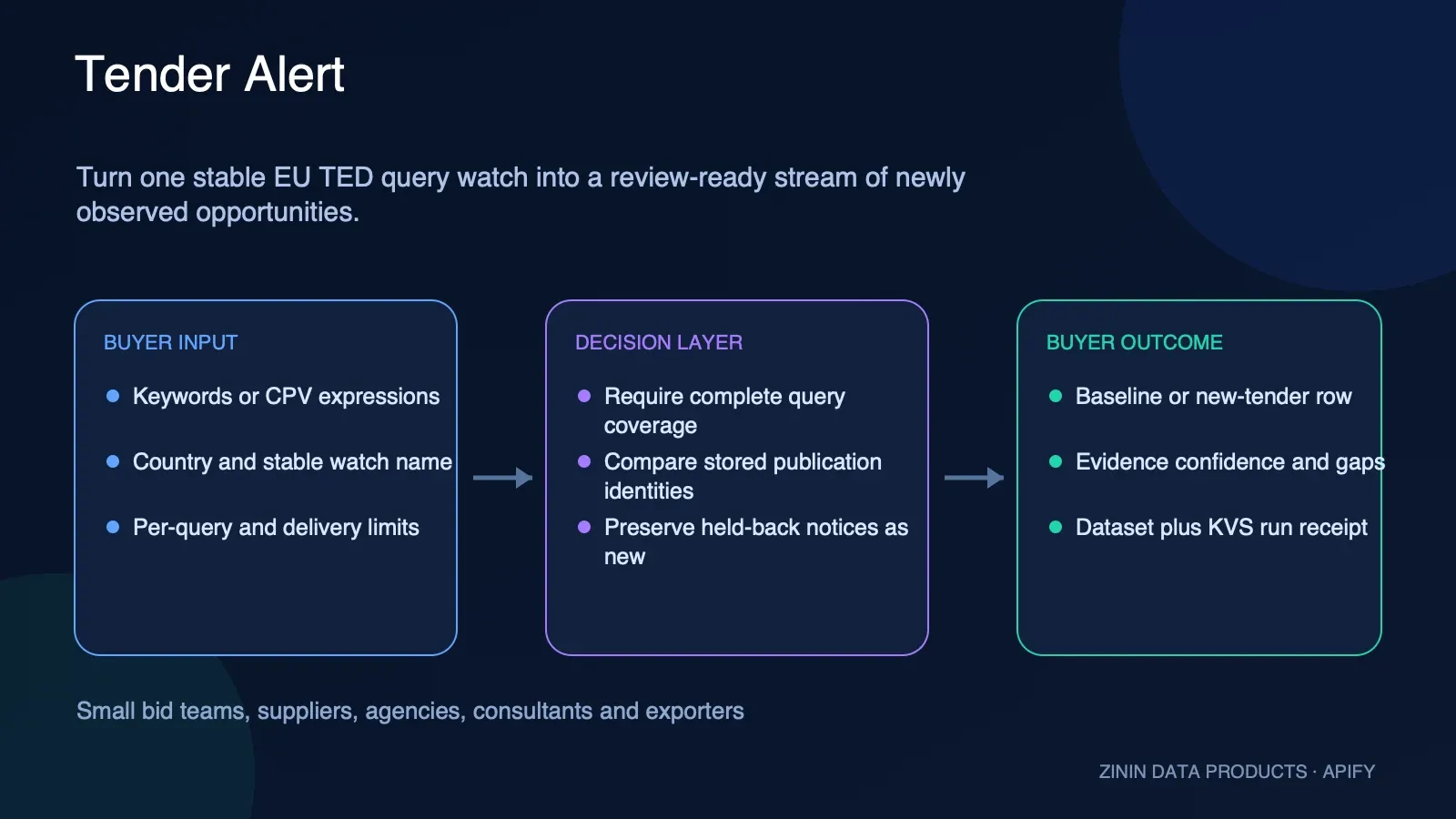
Turn a stable keyword or CPV watch into a review-ready stream of newly observed EU procurement notices, with complete-source gating, primary evidence, confidence, explicit gaps, billing truth, and a manual bid-review action.
Built for: Small businesses, bid teams, procurement consultants, agencies, software vendors, construction suppliers, export teams, and data teams that need a narrow repeatable EU opportunity watch without re-reading the same TED notices every day.
Commercial unit: one delivered baseline or newly observed tender row. Live pricing contract: $0.01 per delivered result-found row plus the configured start event (starting at $0.005). The Apify pricing panel is authoritative for the buyer's current tier. Invalid input, source failure, incomplete snapshots, free watch-status rows, duplicates, budget-withheld rows, and ambiguous delivery are not newly delivered paid opportunities.
What this Actor sells
A procurement search and an opportunity monitor are not the same product. Search answers “what is visible now?” A monitor must also prove what it checked before, whether the current source window is comparable, which identities are genuinely new to the watch, what was withheld, and whether delivery and billing settled. Without those controls, a daily export can repeatedly sell the same notices or silently lose an opportunity when a page, budget, or source call fails.
Provide one or more TED expert queries or keywords, an optional ISO-3 buyer country, a stable watch name, a per-query result limit, and a cap on newly delivered notices per run.
The Actor queries the official keyless TED Search API directly. It rejects malformed query outcomes, requires every requested query to complete before advancing state, reads the buyer-scoped watch baseline, and compares stable publication identities. The first complete run creates a baseline. Later complete runs deliver only publication identities absent from that baseline. A partial or failed snapshot creates a free advisory and never advances the baseline. If budget or max_items withholds a notice, that identity stays new for a future run.
The useful output is a defensible human-review queue. Open the primary TED notice, verify fit and deadline, qualify the opportunity with a human, and keep submission or no-bid decisions outside the Actor. The Actor never submits a bid, contacts a buyer, certifies eligibility, predicts an award, estimates profit, changes a CRM disposition, or converts missing evidence into a negative conclusion.
Buyer-visible outcomes
- One stable named watch per market thesis, geography, product, service, or CPV scope.
- An explicit first-run baseline instead of pretending every current notice is newly discovered.
- Only newly observed TED publication identities on later complete runs.
- Primary notice URLs and source coverage retained with the result.
- Evidence confidence separated from commercial attractiveness and award probability.
- Free partial/source advisories that never advance the stored baseline.
- Held-back identities preserved as new when
max_itemsor run budget stops delivery. - One KVS
OUTPUTreceipt reconciling request, source, Dataset, paid/free/withheld, failure, and replay state. - A bounded manual next action with
safeToAutomate=false.
Good fit
- Watching one product, service, CPV family, geography, or buyer-country opportunity thesis repeatedly.
- Feeding a CRM or review queue with newly observed TED notices instead of full repeated search exports.
- Giving a small bid team a transparent baseline and a bounded daily or weekly opportunity delta.
- Keeping source completeness, evidence confidence, data gaps, action priority, and billing attached to every row.
Not a fit
- Predicting contract awards, buyer intent, eligibility, win probability, margin, legal compliance, or the quality of a bid.
- Monitoring every possible TED notice with an unbounded crawl; the query and per-run limits define coverage.
- Submitting bids, downloading private tender-room documents, contacting buyers, or taking any external action.
- Treating a missing notice in a partial snapshot as deleted, cancelled, or irrelevant. Use a separate workflow for qualification, tender-room access, internal approvals, cost modelling, partner selection, bid writing, legal review, and submission. Keeping discovery evidence separate from business action makes the boundary reviewable and prevents a source lookup from becoming an unapproved external decision.
Evidence-to-decision workflow
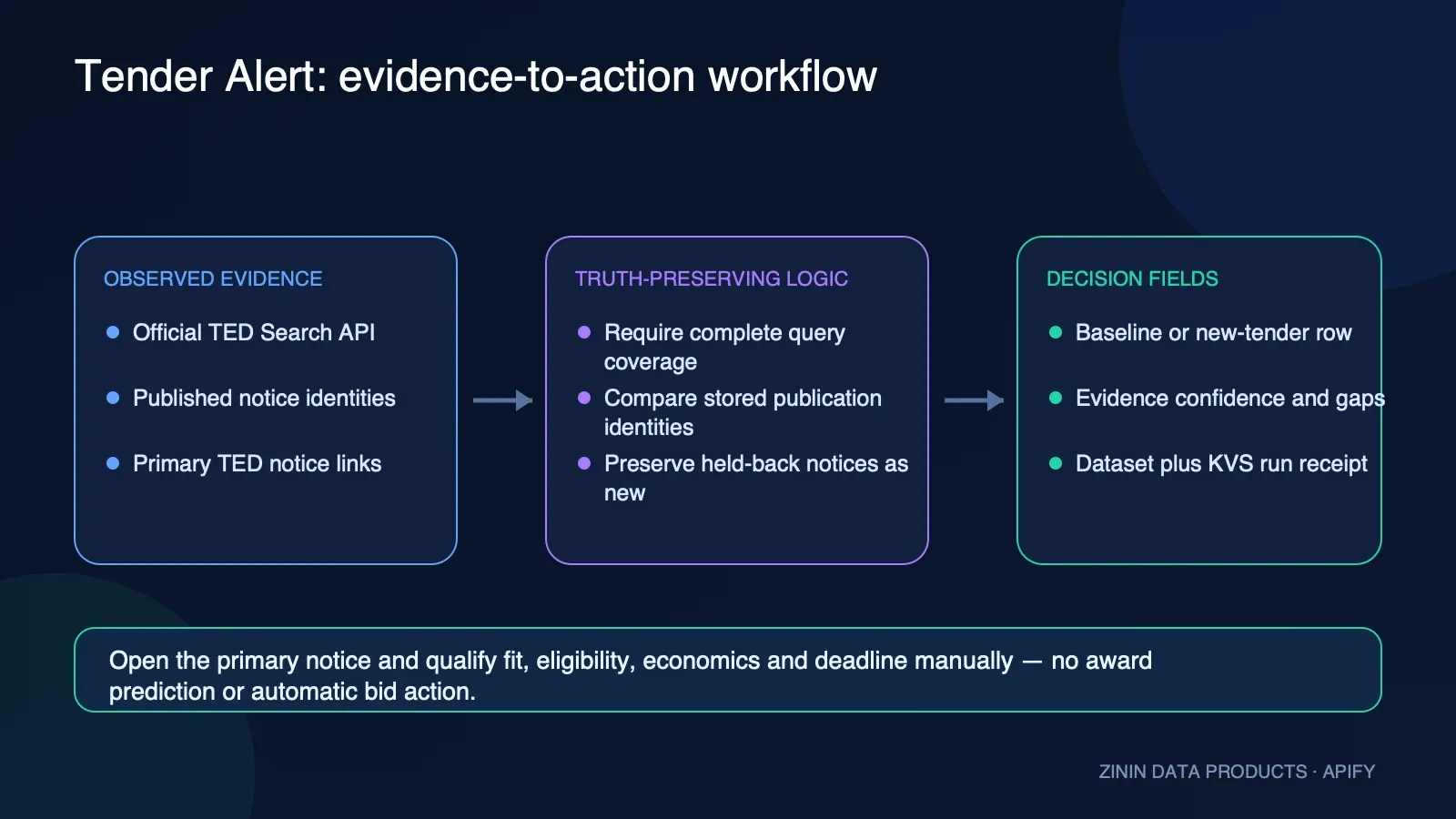
- Define one narrow opportunity thesis as keywords or TED expert-query/CPV expressions.
- Give that thesis a stable watch name so its state cannot collide with another market segment.
- Run the Actor once to establish a complete bounded baseline; do not treat current notices as newly discovered on that first run.
- Schedule later runs at a cadence appropriate to the market and deadline sensitivity.
- Require every query to complete; route partial/source failures to retry without changing the baseline.
- Compare stable TED publication identities with the last successfully stored watch baseline.
- Deliver and charge only the explicit baseline or newly observed notice rows; leave held-back identities new.
- Read KVS
OUTPUTand reconcile Dataset, paid/free counts, withholding, source failures, and replay safety. - Open each primary notice and let a human qualify requirements, eligibility, fit, economics, deadline, and bid/no-bid action.
Official source and reuse boundary
The runtime calls https://api.ted.europa.eu/v3/notices/search, an official European Union Search API intended for published-notice analysis and reuse and available without authentication. Notice metadata is retained with primary TED URLs. The Actor does not log into a buyer portal, submit a bid, access private documents, or use an unofficial mirror.
TED states that procurement notices can generally be reused for commercial or non-commercial purposes unless otherwise noted; editorial content is CC BY 4.0 and system metadata is CC0. Preserve attribution, indicate changes, do not reuse TED/SIMAP logos without consent, and review any third-party or identifiable-person content separately.
The Actor attributes the source in its public documentation and preserves primary notice URLs. It does not copy TED/SIMAP logos into its assets. Technical access and general reuse permission do not remove a buyer’s responsibility to review specific third-party material, personal data, confidentiality, retention, local procurement rules, and downstream use. Keep only fields needed for the opportunity-review purpose.
What source-complete means
sourceComplete: true means every requested query returned a response that the runtime could classify as either valid tender rows or an explicit clean no-match envelope. It does not mean the queries cover the entire procurement market. Coverage is still bounded by query syntax, country, per-query limit, the source index, publication timing, and the run schedule.
sourceComplete: false means at least one requested query failed, returned an error row, produced an empty or malformed envelope, or otherwise could not be classified. That run cannot prove a clean delta. It produces a free advisory, leaves the last complete baseline untouched, and tells automation whether the condition is retryable.
State and baseline contract
Every watch_name owns an isolated stored baseline in the buyer’s Actor storage context. Reuse the name only when the query meaning remains the same. A different product, geography, CPV scope, buyer cohort, or material query change should use a different name; otherwise two incompatible opportunity theses share state and the delta loses meaning.
The first complete run stores the current bounded identities and delivers a baseline row. That row is useful: it proves initialization, records source coverage, and prevents the Actor from falsely marketing all current notices as newly published. Later complete runs compare publication identities. Existing identities are not re-sold. New identities become paid new_tender rows. This version does not claim to detect every amendment to an existing publication number.
Baseline movement follows delivery. If a paid push is confirmed, that identity can enter the baseline. If budget, max_items, source failure, storage error, or ambiguous delivery blocks a row, the Actor does not silently mark it as seen. A later compatible run can still deliver it. This ordering is the difference between a monitor and a lossy scheduled search.
Input
Use Try for free on Apify Store or send the same JSON through API, Task, schedule, webhook, Make, n8n, Zapier, or a standard Apify MCP integration.
Input fields
| Field | Buyer responsibility |
|---|---|
queries | One to twenty keywords or TED expert-query expressions. Remove empty and duplicate expressions; keep the business meaning stable across a watch. |
country | Optional ISO-3 buyer-country filter such as DEU or FRA; not a free-text location. |
watch_name | Stable state namespace for exactly one intended query scope. Use a new name when that meaning changes. |
limit | Per-query bounded result window, 1–100. A larger value expands the observed window but is never “all TED.” |
max_items | Maximum new paid rows delivered in one run, 1–200. Additional new identities stay new for later delivery. |
Query design guide
- Start with a business decision: which opportunities would a human actually review?
- Prefer a narrow CPV or expert expression to a generic word that creates a noisy baseline.
- Add a buyer country only when geographic delivery or eligibility makes it meaningful.
- Choose a per-query limit large enough for the expected publication volume between runs.
- Name the watch after the stable thesis, not after today’s date or one temporary campaign.
- Run once, inspect the baseline and source coverage, then schedule the same bounded contract.
- Version the watch name when query semantics materially change; do not splice incompatible history.
Output stores
The default Dataset contains buyer-facing baseline, new-tender, watch-status, withheld, and failure advisory rows. The default Key-Value Store record OUTPUT is the run receipt. It records requested/unique/duplicate queries, attempted/successful/failed source work, detected identities, delivered/paid/free/withheld rows, source failures, partial state, budget stop, fatal error, replay safety, the watch name, and the Dataset URL.
Do not infer success from exit code or Dataset count alone. A quiet complete run can contain one free status row. A source failure can also contain one free row. An ambiguous paid delivery can require reconciliation. Read OUTPUT first, branch on terminal/failure state, then consume Dataset rows according to recordType.
Core fields
| Field | Meaning |
|---|---|
baselineKey | Buyer-defined stable watch identity used for isolated state and downstream joins. |
publicationNumber | Stable TED publication identity for a newly observed notice. |
title / buyer / buyerCountry | Notice and contracting-body context returned by the official search response. |
cpv | Published CPV evidence when returned; not an independently inferred market classification. |
deadline / publicationDate | Published timing context that must be checked in the current primary notice. |
url | Primary TED notice link for human verification. |
sourceStatus / sourceComplete | Whether every requested query produced a classifiable snapshot. |
queriesRequested / Succeeded / Failed | Run-level source-coverage counts copied to the row. |
recordType / schemaVersion | Stable semantic row family and additive contract version. |
entityId / observedAt | Stable downstream identity and Actor observation time. |
confidenceScore / confidenceBand | Confidence in the evidence path, never win probability or commercial attractiveness. |
sourceEvidence / freshness | Official review pointers and point-in-time observation metadata. |
change | Whether a publication identity was first observed after the stored watch baseline. |
dataGaps / negativeSignals | Coverage and interpretation limits that must remain visible downstream. |
recommendedAction / actionPriority | Bounded human-review routing label, not an automatic bid decision. |
failureType / retryable / partial | Machine-readable failure and handling truth. |
billing | Whether this exact delivered row was linked to the paid result event. |
safeToAutomate | Always false for bidding, outreach, eligibility, award, or legal action. |
Field-by-field review guide
baselineKey
Meaning: Buyer-defined stable watch identity used for isolated state and downstream joins. Review rule: Keep it with source status, observation time, watch identity and primary evidence. Confirm the value is type-correct and source-supported; never replace a missing value with a guess or CRM conclusion. Automation rule: Use it for routing and evidence display, never to authorize outreach, eligibility, spend, bid submission, legal conclusions, or an award forecast.
publicationNumber
Meaning: Stable TED publication identity for a newly observed notice. Review rule: Keep it with source status, observation time, watch identity and primary evidence. Confirm the value is type-correct and source-supported; never replace a missing value with a guess or CRM conclusion. Automation rule: Use it for routing and evidence display, never to authorize outreach, eligibility, spend, bid submission, legal conclusions, or an award forecast.
title / buyer / buyerCountry
Meaning: Notice and contracting-body context returned by the official search response. Review rule: Keep it with source status, observation time, watch identity and primary evidence. Confirm the value is type-correct and source-supported; never replace a missing value with a guess or CRM conclusion. Automation rule: Use it for routing and evidence display, never to authorize outreach, eligibility, spend, bid submission, legal conclusions, or an award forecast.
cpv
Meaning: Published CPV evidence when returned; not an independently inferred market classification. Review rule: Keep it with source status, observation time, watch identity and primary evidence. Confirm the value is type-correct and source-supported; never replace a missing value with a guess or CRM conclusion. Automation rule: Use it for routing and evidence display, never to authorize outreach, eligibility, spend, bid submission, legal conclusions, or an award forecast.
deadline / publicationDate
Meaning: Published timing context that must be checked in the current primary notice. Review rule: Keep it with source status, observation time, watch identity and primary evidence. Confirm the value is type-correct and source-supported; never replace a missing value with a guess or CRM conclusion. Automation rule: Use it for routing and evidence display, never to authorize outreach, eligibility, spend, bid submission, legal conclusions, or an award forecast.
url
Meaning: Primary TED notice link for human verification. Review rule: Keep it with source status, observation time, watch identity and primary evidence. Confirm the value is type-correct and source-supported; never replace a missing value with a guess or CRM conclusion. Automation rule: Use it for routing and evidence display, never to authorize outreach, eligibility, spend, bid submission, legal conclusions, or an award forecast.
sourceStatus / sourceComplete
Meaning: Whether every requested query produced a classifiable snapshot. Review rule: Keep it with source status, observation time, watch identity and primary evidence. Confirm the value is type-correct and source-supported; never replace a missing value with a guess or CRM conclusion. Automation rule: Use it for routing and evidence display, never to authorize outreach, eligibility, spend, bid submission, legal conclusions, or an award forecast.
queriesRequested / Succeeded / Failed
Meaning: Run-level source-coverage counts copied to the row. Review rule: Keep it with source status, observation time, watch identity and primary evidence. Confirm the value is type-correct and source-supported; never replace a missing value with a guess or CRM conclusion. Automation rule: Use it for routing and evidence display, never to authorize outreach, eligibility, spend, bid submission, legal conclusions, or an award forecast.
recordType / schemaVersion
Meaning: Stable semantic row family and additive contract version. Review rule: Keep it with source status, observation time, watch identity and primary evidence. Confirm the value is type-correct and source-supported; never replace a missing value with a guess or CRM conclusion. Automation rule: Use it for routing and evidence display, never to authorize outreach, eligibility, spend, bid submission, legal conclusions, or an award forecast.
entityId / observedAt
Meaning: Stable downstream identity and Actor observation time. Review rule: Keep it with source status, observation time, watch identity and primary evidence. Confirm the value is type-correct and source-supported; never replace a missing value with a guess or CRM conclusion. Automation rule: Use it for routing and evidence display, never to authorize outreach, eligibility, spend, bid submission, legal conclusions, or an award forecast.
confidenceScore / confidenceBand
Meaning: Confidence in the evidence path, never win probability or commercial attractiveness. Review rule: Keep it with source status, observation time, watch identity and primary evidence. Confirm the value is type-correct and source-supported; never replace a missing value with a guess or CRM conclusion. Automation rule: Use it for routing and evidence display, never to authorize outreach, eligibility, spend, bid submission, legal conclusions, or an award forecast.
sourceEvidence / freshness
Meaning: Official review pointers and point-in-time observation metadata. Review rule: Keep it with source status, observation time, watch identity and primary evidence. Confirm the value is type-correct and source-supported; never replace a missing value with a guess or CRM conclusion. Automation rule: Use it for routing and evidence display, never to authorize outreach, eligibility, spend, bid submission, legal conclusions, or an award forecast.
change
Meaning: Whether a publication identity was first observed after the stored watch baseline. Review rule: Keep it with source status, observation time, watch identity and primary evidence. Confirm the value is type-correct and source-supported; never replace a missing value with a guess or CRM conclusion. Automation rule: Use it for routing and evidence display, never to authorize outreach, eligibility, spend, bid submission, legal conclusions, or an award forecast.
dataGaps / negativeSignals
Meaning: Coverage and interpretation limits that must remain visible downstream. Review rule: Keep it with source status, observation time, watch identity and primary evidence. Confirm the value is type-correct and source-supported; never replace a missing value with a guess or CRM conclusion. Automation rule: Use it for routing and evidence display, never to authorize outreach, eligibility, spend, bid submission, legal conclusions, or an award forecast.
recommendedAction / actionPriority
Meaning: Bounded human-review routing label, not an automatic bid decision. Review rule: Keep it with source status, observation time, watch identity and primary evidence. Confirm the value is type-correct and source-supported; never replace a missing value with a guess or CRM conclusion. Automation rule: Use it for routing and evidence display, never to authorize outreach, eligibility, spend, bid submission, legal conclusions, or an award forecast.
failureType / retryable / partial
Meaning: Machine-readable failure and handling truth. Review rule: Keep it with source status, observation time, watch identity and primary evidence. Confirm the value is type-correct and source-supported; never replace a missing value with a guess or CRM conclusion. Automation rule: Use it for routing and evidence display, never to authorize outreach, eligibility, spend, bid submission, legal conclusions, or an award forecast.
billing
Meaning: Whether this exact delivered row was linked to the paid result event. Review rule: Keep it with source status, observation time, watch identity and primary evidence. Confirm the value is type-correct and source-supported; never replace a missing value with a guess or CRM conclusion. Automation rule: Use it for routing and evidence display, never to authorize outreach, eligibility, spend, bid submission, legal conclusions, or an award forecast.
safeToAutomate
Meaning: Always false for bidding, outreach, eligibility, award, or legal action. Review rule: Keep it with source status, observation time, watch identity and primary evidence. Confirm the value is type-correct and source-supported; never replace a missing value with a guess or CRM conclusion. Automation rule: Use it for routing and evidence display, never to authorize outreach, eligibility, spend, bid submission, legal conclusions, or an award forecast.
Pricing, delivery, and budget truth
This Actor uses pay per event: $0.01 per delivered result-found row plus the configured start event (starting at $0.005). A result event represents one actually delivered baseline or newly observed tender row, not one query, one source request, one page, one failed attempt, or one row the Actor merely found internally.
- Apify charges the configured start event according to allocated memory and the buyer’s tier.
- The Actor checks that the commercial result event is priced and that ordinary Dataset writes are not silently billable.
- It checks remaining run budget before spending on the TED scan when no result could be sold afterward.
- It performs paid Dataset delivery through the linked
result-foundevent inside a serialized money-critical section. - A positive charged count proves current-row delivery; an event-limit signal can still describe the final successfully charged row.
- A zero charged count, budget stop, or thrown push never becomes a paid success.
- Free status, partial, source-error, storage-error, duplicate, and withheld advisories do not use
result-found. - KVS
OUTPUTlets the operator reconcile Dataset and event counts before downstream action or retry. If delivery/charge state is unknown,replaySafebecomes false and the run is fatal. Do not blindly retry that input. Inspect the original run, Dataset, KVS and settled event ledger first. A second run can duplicate cost or state when the first outcome is unknown.
API integration
Keep APIFY_TOKEN in a secret manager or environment variable. Never paste it into public input, a Dataset row, an issue, or a screenshot.
cURL
After the run is terminal, use defaultKeyValueStoreId to read OUTPUT and defaultDatasetId to read rows.
JavaScript
Python
Automation patterns
Daily bid-review queue
Schedule one stable watch per narrow opportunity thesis. On COMPLETE, create review tasks only for recordType: new_tender. Include title, buyer, country, deadline, primary URL, observation time, confidence, gaps, source status, run ID and watch name. Keep baseline and no-change status visible in operational logs but do not create false opportunities from them.
CRM enrichment
Upsert by entityId or TED publicationNumber, not by title. Store the raw row before mapping to your CRM. Use a separate human-controlled field for qualification, owner, fit, no-bid reason and submission status. Never overwrite source evidence with internal opinion.
n8n, Make, or Zapier
Wait for terminal completion. Read OUTPUT. Route invalid input to repair, retryable source failure to a bounded retry policy, replay-unsafe failure to manual reconciliation, and complete new-tender rows to review. Do not branch only on Dataset length.
Data warehouse
Retain raw JSON, source observation time, watch contract, baseline identity, Dataset/run IDs and schema version. Model confidence separately from value or priority. Recalculate freshness when queried; fresh_at_run_time is not a permanent property.
Agent or MCP workflow
Expose this schema-bound Actor through the standard Apify API or MCP server. Require the agent to cite the primary notice, state source completeness, enumerate gaps, and ask for human approval before outreach, bid drafting, spend, submission, or legal interpretation.
Small-business playbooks
Software vendor
Use a precise IT-services CPV and a buyer country you can serve. Let the first run establish the bounded market. Review later rows against product fit, required certifications, framework structure, deadline, language, delivery geography and consortium needs. The Actor discovers evidence; it does not prove that your company qualifies.
Construction or facilities supplier
Use one watch per service family and geography. Keep a per-query limit compatible with publication volume. Review lots, place of performance, site requirements, financial capacity, insurance, safety, timelines and subcontracting in the primary notice. Do not infer these from title or CPV alone.
Agency or procurement consultant
Create isolated watch names for each client and scope; do not mix clients in one baseline. Export the evidence row with attribution and the current notice link, then add your own human qualification. Keep customer access controls and retention separate from public source availability.
Export team
Use country and CPV filters to reduce noise, but verify language, cross-border eligibility, standards, delivery, tax, guarantees and local representation manually. A public EU notice is not proof that an overseas supplier can bid.
Market research
Use complete no-change and new-identity counts as operational watch evidence, not as an exhaustive demand index. Search-window limits, schedules, query changes and amendments can bias longitudinal analysis. For market sizing, build a separate documented bulk-reuse pipeline.
Security and privacy
The Actor uses fixed official TED endpoints, limited Actor permissions and no caller-supplied URL. Inputs define query text and state names, not network destinations. It requires no TED login, cookie, API key, email account or private tender-room credential.
Public procurement notices can still include names and contact details. Collect only what your stated purpose needs, configure Apify retention and access controls, restrict exports, avoid combining public contacts into an indiscriminate outreach list, and review applicable privacy and procurement rules. Public visibility is not consent to automated marketing.
Treat watch_name, query scope and stored baseline as operational business data. Do not put customer secrets, prices, confidential strategy, personal notes, credentials or signed storage URLs into them. Use Apify secrets for tokens in downstream workflows.
Honest limitations
- Coverage is bounded by the submitted queries, country, per-query limit, schedule, and current TED availability.
- The product detects newly observed publication identities; it does not diff every amendment or field revision on an existing notice.
- The first complete run creates a baseline and therefore cannot prove which current notices are new to the buyer.
- A source-complete no-change result means no new identity inside this bounded watch, not that no relevant opportunity exists in TED.
- Published notice data can be corrected, translated, superseded, cancelled, or supplemented after this observation.
- CPV, buyer, title, country, dates, and URLs are source evidence, not guarantees of eligibility, scope, budget, fit, or award outcome.
- A successful process exit is insufficient for automation; consumers must reconcile KVS
OUTPUT, Dataset rows, and PPE events. Additional interpretation rules: - Newly observed means absent from this compatible stored baseline, not necessarily first publication anywhere.
- No new identity means no new identity in this bounded complete snapshot, not no opportunity in the market.
- Confidence describes evidence-path support, not eligibility, value, quality, urgency, or probability of award.
- A primary URL is a review pointer; the current notice and procurement documents remain authoritative.
- A deadline field can be missing, translated, amended, timezone-sensitive or superseded; verify before planning.
- The Actor does not interpret exclusions, licenses, sanctions, beneficial ownership, competition law, tax, labour, security, technical standards, or local procurement rules.
- The recommended action is a routing label and never proof that an action occurred.
Production checklist
- Each watch name maps to one stable query meaning and customer context.
- Queries and country are valid TED expressions for the intended market.
- Per-query limit covers expected volume between scheduled runs.
- First-run baseline is reviewed and not counted as a newly published opportunity.
- Only source-complete snapshots can advance the baseline.
- Held-back identities remain eligible for later delivery.
- Primary TED URL is opened before qualification or bid action.
- Confidence and commercial priority are not conflated.
- Dataset rows reconcile with KVS
OUTPUTand PPE events. - Replay-unsafe runs go to manual reconciliation, not automatic retry.
-
safeToAutomate=falsesurvives every export and integration. - Attribution, retention, privacy, and access controls match the downstream use.
Troubleshooting
The first run did not return “new” tenders
Expected. It creates a complete bounded baseline. Schedule the same watch again to detect identities that were absent from that reference set.
A run returned a free partial advisory
At least one query was unavailable or unclassifiable. Read sourceFailureReasons, keep the old baseline, and retry only if retryable is true. Do not convert it to a clean no-change event.
Relevant notices are missing
Review expert-query syntax, CPV hierarchy, country, publication timing, per-query limit, schedule frequency and current TED availability. The Actor is bounded and does not claim exhaustive market coverage.
The same notice appeared twice downstream
Upsert by entityId or publicationNumber, inspect whether watch meaning changed, and reconcile the run receipt. Title-based deduplication is unsafe.
More notices were detected than delivered
Read withheldRowCount, budgetStopped, max_items, and the free advisory. Undelivered new identities are intentionally excluded from the baseline so they can surface later.
Dataset and KVS disagree
Stop automatic processing. Preserve the original run, inspect Dataset, OUTPUT, logs and settled charged events, and do not retry if replaySafe is false.
FAQ
Is this the official TED source?
Yes. The runtime calls the official api.ted.europa.eu Search API and retains primary ted.europa.eu notice links.
Why is the first run a paid baseline row?
A stateful delta needs an explicit complete reference set. The row proves the watch was initialized and prevents current notices from being falsely sold as newly discovered.
What happens if one query fails?
The entire snapshot is treated as incomplete. The Actor emits a free advisory, does not claim a clean delta, and does not advance the baseline.
Can a held-back tender disappear forever?
No. The baseline advances only for identities actually delivered and charged. A notice withheld by max_items or budget remains new for a later run.
Does no new tender mean no market demand?
No. It means this bounded watch observed no identity new to its stored baseline in this run.
Can this decide whether we should bid?
No. It routes primary evidence to a human. Eligibility, economics, capacity, legal review, deadline, and bid strategy remain outside the Actor.
Can I use it with n8n, Make, Zapier, or an agent?
Yes. Wait for terminal completion, read KVS OUTPUT, branch on explicit status, then fetch Dataset rows. Keep safeToAutomate=false for external action.
What should I retain for audit?
Keep input, watch name, query scope, limits, observation time, source status, primary notice URL, Dataset row, KVS OUTPUT, run ID, and human disposition together.
Support
For a reproducible issue provide the run ID, Actor version, sanitized input, watch name, query count, source status, Dataset row count, OUTPUT status and whether the run was baseline, complete delta, partial, withheld or reconciliation. Never send an API token, private export, signed storage URL or confidential bid material.
Tender Alert — Official EU TED Opportunity Watch is deliberately conservative: it sells a bounded official-source delta that can be explained and audited. It does not sell false certainty about a market, a buyer, eligibility, or an award.


