

Source Citation Table Generator for Evidence
Pricing
from $8.50 / 1,000 delivered deterministic citation table reports
Source Citation Table Generator for Evidence
Turn 1–100 buyer-supplied brand evidence rows into one deterministic citation-table report with preserved fields and HTTPS URLs, bounded Markdown, source and host counts, verification gaps, and SHA-256 digests. Sources are never fetched or verified; run start is separate.
Pricing
from $8.50 / 1,000 delivered deterministic citation table reports
Rating
0.0
(0)
Developer

Tim Zinin
Maintained by CommunityActor stats
0
Bookmarked
1
Total users
0
Monthly active users
a month ago
Last modified
Categories
Share
US Brand Evidence Citation Table
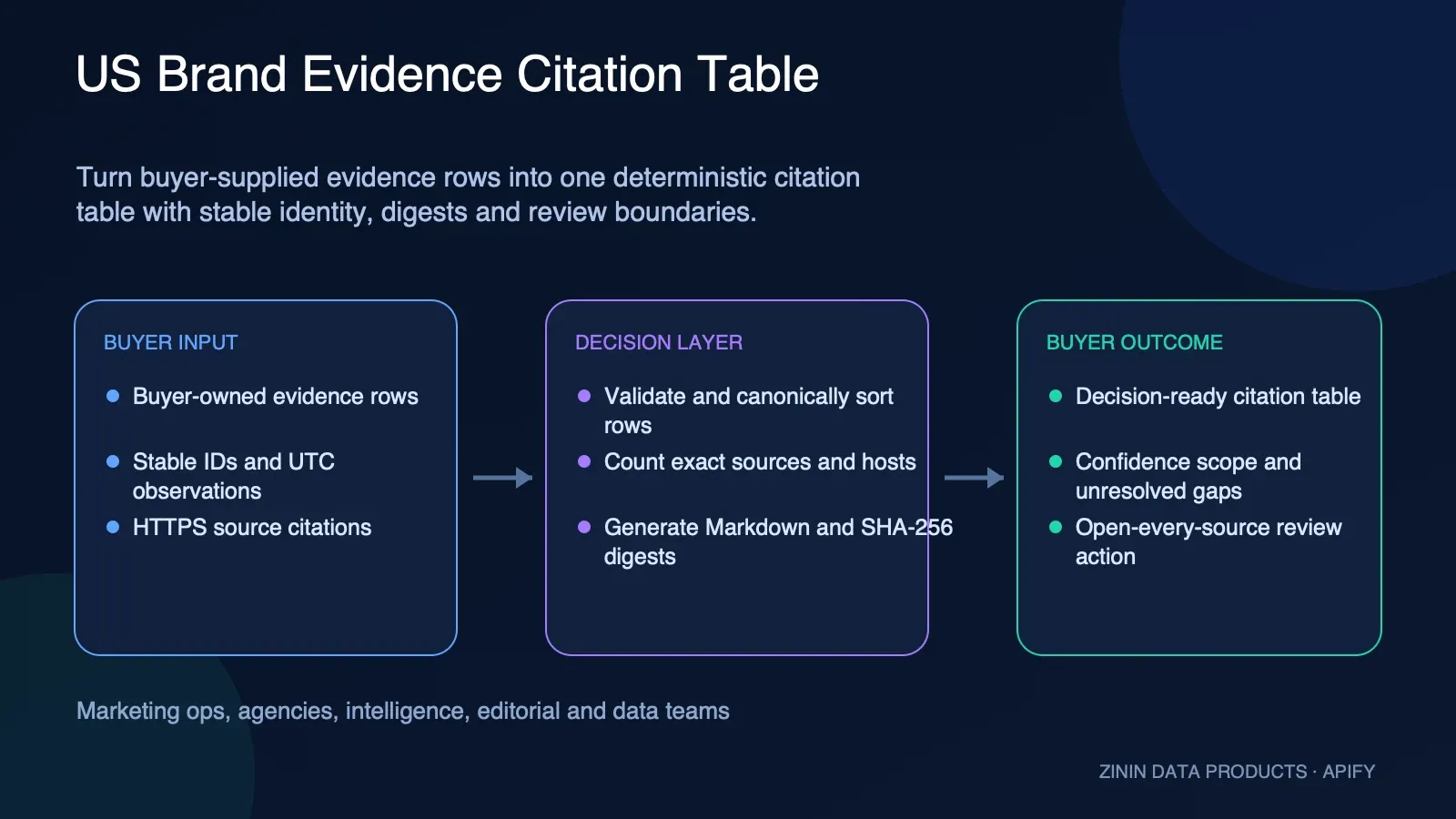
Turn a small, buyer-owned evidence packet into a stable citation table for humans and machine-to-machine workflows. Submit normalized evidence rows and receive one deterministic JSON report, bounded Markdown citations, per-host and per-source counts, explicit limitations, and SHA-256 digests.
This Actor formats the evidence you provide. It does not browse, fetch, verify, rank, enrich, summarize, or infer facts. The facts, excerpts, and URLs are preserved in the JSON citation rows exactly after validation.
What you submit and receive
You submit 1–100 rows. Every row has:
- a unique opaque ASCII
evidenceId; brandName,eventType,sourceName, and a bounded factualexcerpt;observedAtin strict UTC formatYYYY-MM-DDTHH:mm:ssZ;- an HTTPS
sourceUrlwithout credentials, fragments, unsafe schemes, or a port other than 443.
You receive exactly one useful report row in the Dataset containing:
citations, sorted by observed UTC, brand, event, source, URL, and evidence ID;- the original facts and URLs, with no external lookup;
citationMarkdown, a bounded Markdown table;hostCountsandsourceCounts;- fixed warnings that sources were not fetched or verified and excerpts were not interpreted;
- input, citation, count, Markdown, and result SHA-256 digests.
The successful terminal OUTPUT receipt is written only after the named result-found Dataset push is confirmed. Preflight, input, and report failures may write an error OUTPUT before any Dataset push. A delivery uncertainty is reported truthfully and the Actor never retries a possibly paid Dataset push.
Input
Closed limits
The input is inline JSON only. The complete input is limited to 128 KiB UTF-8 and 100 rows. evidenceId is 1–64 ASCII characters. brandName and sourceName are 1–128 normalized characters. eventType is a 1–64 ASCII token. sourceUrl is 12–2,048 characters. excerpt is 1–2,000 normalized characters and at most 8 KiB UTF-8. Empty strings, leading/trailing whitespace, control characters, line breaks, duplicate IDs, invalid Gregorian dates, credentials, fragments, non-HTTPS schemes, and non-443 ports are rejected.
The public JSON schema rejects the expressible shape, length, whitespace, control-character, month/day, host, credential, fragment, scheme, and port errors before submission. Runtime validation remains the final gate for NFC normalization, exact leap-year/Gregorian validity, parsed URL authority semantics, duplicate IDs, and UTF-8 byte limits. Passing the form schema alone does not guarantee a paid report; the platform start event can already be charged before runtime rejects an invalid packet.
The report is limited to 64 KiB UTF-8 and its Markdown section to 48 KiB. A valid packet that cannot fit these output limits fails closed instead of returning a partial citation table.
Output and Dataset
The Dataset has one named result row. citations retains all seven input fields. hostCounts groups by the lower-case parsed URL hostname; sourceCounts groups by the exact source URL and includes that hostname. Counts are reconciled with totalRows, and all arrays are deterministically sorted.
No URL is opened. A valid URL means only that the submitted string passed the closed HTTPS syntax and safety rules; it is not evidence that the URL exists or supports the excerpt.
Pricing
Pay per event: one start charge plus one result-found charge only after one confirmed report Dataset write. The default Dataset event is not charged by this Actor. The run preflight requires a budget for both events and rejects an already-used result counter.
| Tier | Discount | Start | Delivered result |
|---|---|---|---|
| FREE | 0% | $0.00500 | $0.01000 |
| BRONZE | 5% | $0.00475 | $0.00950 |
| SILVER | 10% | $0.00450 | $0.00900 |
| GOLD | 15% | $0.00425 | $0.00850 |
| PLATINUM | 18% | $0.00410 | $0.00820 |
| DIAMOND | 20% | $0.00400 | $0.00800 |
Machine-to-machine use
The Actor is stateless, keyless, and suitable for an agent calling the Apify API or an Apify MCP server. A machine can prevalidate the public schema, send the same public-task-shaped JSON, let the Actor apply the stricter runtime gates above, read a successful single Dataset row, and verify resultDigest without a browser or a human login. The Actor never calls another Actor and never requires a proxy or BYOK key.
Related public Actors
These public Actors can supply adjacent buyer-owned evidence workflows. Links are recommendations only; this Actor does not call them.
| Actor | Use it for |
|---|---|
| US Brand Signal Metrics Aggregator | Aggregate normalized signal rows before creating a citation packet. |
| US Brand Signal Brief Composer | Compose a bounded brief after the citation table has been checked by the buyer. |
| US Brand Action Queue | Turn selected, buyer-approved evidence into next-action rows. |
| US Brand Evidence Snapshot Diff | Compare two buyer-supplied evidence snapshots. |
| US Brand Offer Evidence Normalizer | Normalize offer evidence before citing it. |
FAQ
Does it verify the source? No. It does not fetch URLs or make a claim that a source is real, current, or accurate.
Does it infer a brand or event? No. brandName, eventType, and the excerpt are buyer-provided and preserved.
Why must timestamps be UTC? A closed UTC form keeps sorting and digests reproducible across machines and time zones. Dates must also be valid in the Gregorian calendar, including leap years.
Can I use it from an AI agent? Yes. It is designed for schema-first API/MCP calls and returns a bounded single-row report with machine-verifiable digests.
Why did a valid-looking packet fail? It may exceed the input or output byte limits, contain a duplicate ID, an invalid date, unsafe URL syntax, or a field that is not normalized. The Actor does not truncate or return partial facts.
Why a citation table is a product, not cosmetic formatting
Evidence packets rarely fail because a team cannot draw a Markdown table. They fail because different contributors use different identifiers, timestamps, source labels, URL forms, row orders, and unstated assumptions. A pasted spreadsheet may look usable while remaining difficult to compare, hash, cache, hand to an API consumer, or audit after somebody sorts it differently.
This Actor provides one closed transformation boundary. It accepts a bounded packet, validates every field, applies a published canonical order, groups counts by exact source and normalized host, escapes Markdown cells, and calculates digests over the normalized input and each important output section. The same logical rows therefore produce the same report even when the caller submits them in a different order.
That reproducibility is useful, but it must not be confused with verification. The Actor cannot know whether the named brand is the intended legal entity, whether a publisher is authentic, whether an excerpt is accurate, whether a page changed after collection, or whether the caller has the right to reuse the text. Those gaps remain explicit in every delivered report.
Best-fit users
Marketing operations
Use the table to attach reviewed campaign, offer, launch, pricing, availability, or positioning observations to a brief. A stable evidenceId lets the brief, spreadsheet, Dataset row, and reviewer comments refer to the same observation without relying on row number.
Competitive-intelligence teams
Use it after an authorized collection and normalization step. The output gives analysts one reproducible citation appendix, source distribution counts, exact input and result digests, and an explicit instruction to open every source before consequential use.
Agencies and consultants
Use one run per client question, campaign review, or bounded evidence packet. The report can be exported as JSON for an internal system and as Markdown for a document. Separate packets keep client access boundaries and report digests meaningful.
Content and editorial teams
Use it to structure already-selected source excerpts before a writer prepares a draft. The Actor does not decide what is newsworthy, summarize a source, or approve a claim. Editorial review remains responsible for context, attribution, quotation rights, and accuracy.
Legal and compliance support
Use it only as an administrative evidence-indexing step under a qualified reviewer. The output is not an authentication record, legal conclusion, ownership finding, infringement assessment, admissibility opinion, or substitute for preserving the original material.
Data and automation teams
Use the closed JSON contract to stop malformed evidence at a known boundary. The result is deterministic and bounded, so an upstream test fixture and a downstream consumer can verify the same digests. safeToAutomate remains false because deterministic formatting does not make the underlying facts safe for automatic action.
Product boundary at a glance
| The Actor does | The Actor does not |
|---|---|
| Validate one closed packet of 1–100 rows | Browse, scrape, fetch, render, or dereference a URL |
| Preserve the seven accepted fields | Rewrite, summarize, translate, classify, or infer an excerpt |
| Sort rows deterministically | Decide chronology, causation, importance, or truth |
| Count exact URLs and normalized hosts | Resolve publishers, organizations, domains, or brand ownership |
| Produce bounded JSON and Markdown | Store an unbounded archive or download source documents |
| Expose digests and a stable report identity | Authenticate screenshots, pages, documents, or signatures |
| Reconcile delivery and the named paid event | Estimate business impact, legal risk, or source credibility |
Input contract in plain language
The top-level object accepts only schemaVersion and rows. Extra properties fail instead of being ignored. Each row accepts exactly seven properties.
| Field | Required | Rule | Meaning |
|---|---|---|---|
schemaVersion | yes | Exactly 1.0 | Closed input contract version |
rows | yes | 1–100 rows; packet at most 128 KiB UTF-8 | Evidence supplied for one report |
evidenceId | yes | Unique 1–64 character ASCII token | Caller-controlled stable row identity |
brandName | yes | 1–128 normalized characters | Display label supplied by the caller, not resolved identity |
eventType | yes | 1–64 character ASCII token | Caller-defined event category |
observedAt | yes | Strict valid Gregorian UTC second | When the caller says it observed the evidence |
sourceName | yes | 1–128 normalized characters | Caller-supplied source label |
sourceUrl | yes | Credential-free HTTPS, port 443 only, no fragment | Citation value preserved but never opened |
excerpt | yes | 1–2,000 characters and at most 8 KiB | Caller-supplied factual text preserved without interpretation |
observedAt is not publication time unless the upstream process deliberately made it so. It is not automatically the time a page changed, an offer became effective, or a claim became true. Choose and document that mapping upstream.
Do not put API keys, signed private links, usernames, passwords, cookies, access tokens, or personal data that is unnecessary for the review purpose into any field. URLs with embedded credentials are rejected, but the caller remains responsible for the content of an otherwise valid URL and excerpt.
Canonicalization and stable identity
Rows are ordered by:
observedAt;brandName;eventType;sourceName;sourceUrl;evidenceId.
Object keys are canonicalized before hashing. The report identity is derived from the canonical input digest rather than a random UUID or current clock. Reordering equivalent rows therefore does not create a different logical report.
The stable entityId is useful for caching, deduplicating a review attachment, or confirming that a UI and API consumer refer to the same logical packet. It is not a resolved identifier for a company, trademark, product, publisher, or person.
Decision layer
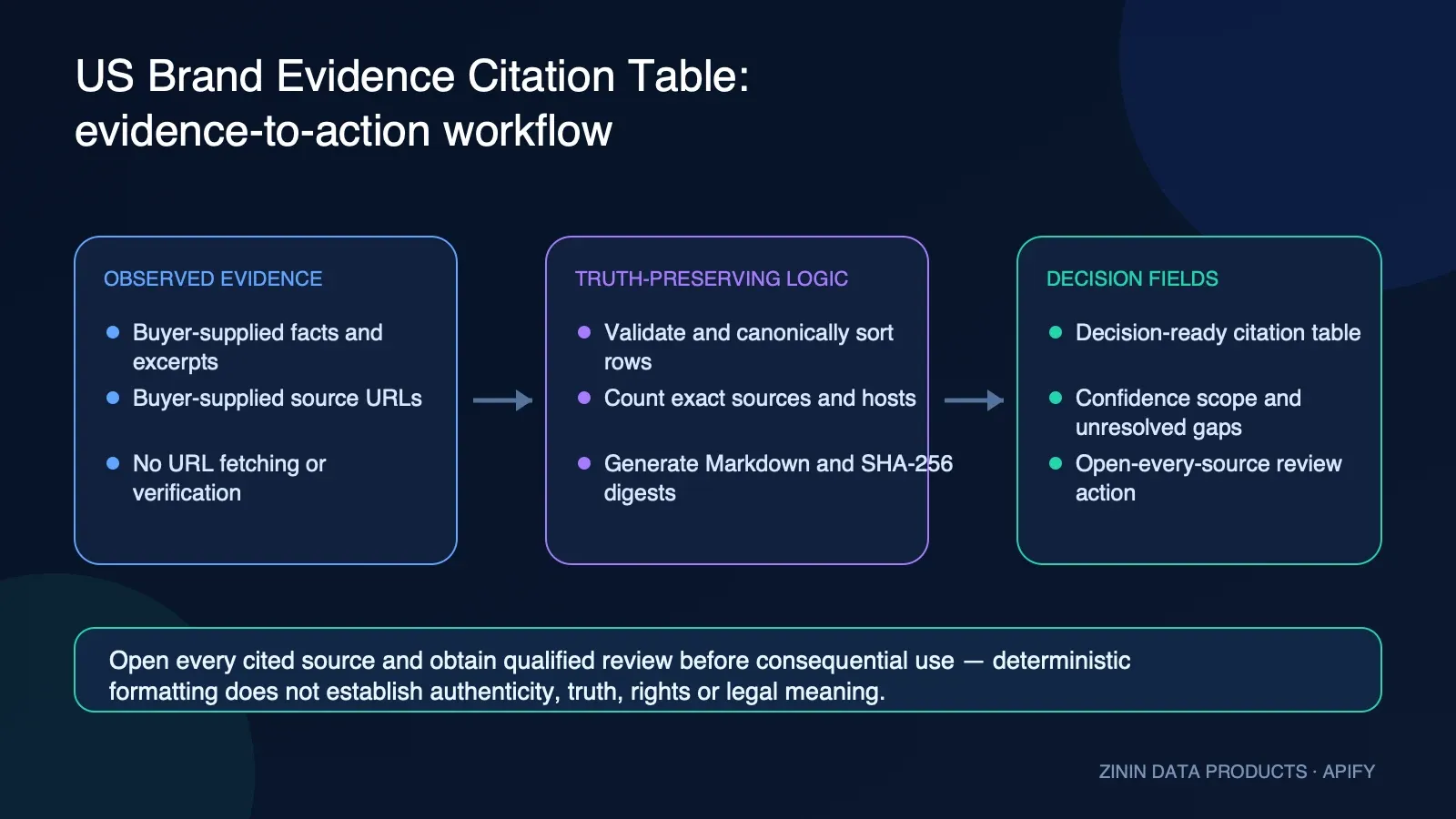
The report adds a compact decision envelope around the original citation product.
| Field | How to read it |
|---|---|
status | success means the complete accepted packet was transformed and delivered |
recordType | Stable row type evidence_citation_table |
decisionSchemaVersion | Version of the additive decision contract |
entityId | Digest-derived identity of the logical packet |
observedAt | Latest buyer-supplied observation timestamp in the packet |
freshness | Explicitly unavailable; the source was not fetched and no current clock was read |
change | Explicitly unavailable; no previous run or source state was loaded |
confidenceScore | Confidence in transformation integrity only |
confidenceBasis | Published boundary for that narrow score |
sourceEvidence | Counts and digests pointing to the included citations without duplicating them |
dataGaps | Source, identity, rights, truth, freshness, and interpretation boundaries |
negativeSignals | Machine-readable no-fetch, no-verification, and no-identity warnings |
recommendedAction | Open every cited source and obtain qualified review |
priority | Review priority, not a legal, reputation, or financial risk score |
safeToAutomate | Always false for consequential action |
summary | Count-based description with the no-verification boundary |
partial | false when all accepted rows are included; it does not mean sources were verified |
failureDiagnostics | null on a delivered report; terminal failures are in KVS OUTPUT |
billing | Exact delivered unit and named event |
The confidence value is intentionally narrow. A high value means the Actor is confident that it applied its deterministic validation, ordering, escaping, counting, and hashing contract. It does not mean a source is credible, a fact is true, the brand is correctly identified, the packet is current, or a legal claim is strong.
Citation, source, and host sections
citations preserves every accepted row. sourceCounts groups by the exact URL string, while hostCounts groups by the lower-case hostname parsed from that URL. Two different paths on the same host are therefore two exact sources but one host.
The counts answer structural questions only:
- how many submitted rows were accepted;
- how many exact URL values appear;
- how many normalized hostnames those values use;
- how many rows cite each exact URL and host.
They do not measure source diversity in an editorial sense. Multiple URLs on one publisher may repeat the same underlying information; two hosts may belong to one organization; a mirrored page may not be independent corroboration. A reviewer must make those judgments.
Markdown safety and limitations
The Markdown table escapes backslashes before pipes so submitted text cannot silently add a column. Control characters and line breaks are rejected at validation. The final Markdown section is capped at 48 KiB and the complete report at 64 KiB.
Markdown is a convenience representation, not a security or rendering sandbox. A downstream system should still treat every cell as untrusted data, follow its own HTML sanitization policy, and avoid automatically opening submitted links.
Digests and reproducibility
The report contains:
inputDigestfor canonical normalized input;citationsDigestfor the sorted citation rows;hostCountsDigestfor normalized host counts;sourceCountsDigestfor exact source counts;markdownDigestfor the Markdown bytes;resultDigestfor the complete report body before that final digest is attached.
Use digests to detect a changed packet between workflow stages, key an internal cache, reconcile an exported attachment, or confirm that two systems processed the same canonical bytes. Do not use a digest as proof of authorship, source authenticity, timestamp accuracy, copyright ownership, or fact truth. It proves consistency of the bytes handled by this Actor.
KVS OUTPUT reconciliation
The terminal OUTPUT object preserves the existing status, report, delivery, and terminal sections and adds a run-level run receipt.
| Run field | Meaning |
|---|---|
input.requestedCount | Number of submitted array rows visible to the bounded counter |
input.uniqueCount | Number of syntactically valid unique evidence IDs visible before full validation |
input.duplicateCount | Repeated valid evidence IDs detected in the submitted packet |
input.invalidCount | Rows without a syntactically valid evidence ID |
attemptedCount / unattemptedCount | Evidence rows entering the successful report transform versus withheld before it |
successfulCount / failedCount | Row-level success or terminal failure accounting |
deliveredRowCount | Confirmed Dataset report rows; maximum one |
paidRowCount | Confirmed delivered Dataset report rows with at least one result-found event; maximum one |
freeRowCount | Confirmed delivered Dataset report rows with zero result-found events; maximum one |
anomalousChargeCount | Confirmed result-event increments beyond the single expected paid report row |
withheldRowCount | A built report not confirmed as delivered |
partial | True for terminal or delivery error receipts |
budgetStopped | True only when the buyer cap cannot cover the bounded paid result |
fatalError | Stable terminal code, otherwise null |
ambiguousDeliveryCount | One when Dataset delivery cannot be proven absent or confirmed |
replaySafe | False after confirmed or ambiguous delivery; inspect before retrying |
safeToAutomate | Always false for consequential follow-up |
On success, the Actor performs exactly one named Dataset push, verifies that the custom result counter increased by one, writes the terminal receipt, and exits. It never retries a possibly paid Dataset push. If delivery is ambiguous, inspect the run Dataset and charge events before deciding whether another run is appropriate.
Failure catalogue
| Code | Stage | Safe response |
|---|---|---|
invalid_input | Input read failed | Correct the submitted object; no report was delivered |
invalid_input_shape | Top-level shape is not closed | Submit only schemaVersion and rows |
invalid_schema_version | Version is not 1.0 | Migrate the caller explicitly |
input_too_large | Packet exceeds 128 KiB | Split it into separate meaningful packets |
invalid_row_count | Fewer than 1 or more than 100 rows | Use the documented bound |
invalid_row_shape | A row has missing or extra fields | Map exactly the seven accepted fields |
duplicate_evidence_id | Two rows share an ID | Fix identity upstream; do not silently renumber |
invalid_observed_at | Timestamp form or calendar date is invalid | Send a real UTC second |
invalid_source_url | URL fails the closed HTTPS rules | Remove credentials/fragments or correct the URL |
invalid_excerpt | Text is empty, unnormalized, unsafe, or too large | Normalize and reduce the caller-owned excerpt |
output_too_large | A valid input cannot fit the report bounds | Split the packet; the Actor does not truncate |
pricing_misconfigured | Deployed PPE contract is not recognized | Stop and inspect Actor pricing |
budget_read_failed | The charging manager cannot prove cap or spend | Stop before delivery; inspect platform billing state |
budget_limit | Buyer cap cannot cover start plus one result | Increase the cap deliberately or do not run |
delivery_unknown | Dataset push or result counter is ambiguous | Inspect Dataset and charged events before retry |
result_uncharged | Delivery occurred without the required result delta | Treat the run as failed and inspect billing |
result_charge_delta | Result counter changed by more than one | Treat as a billing-integrity failure |
output_write_failed_after_delivery | Paid report delivered but success receipt write failed | Do not rerun blindly; inspect the Dataset |
exit_failed_after_delivery | Delivery and receipt completed but terminal exit failed | Use the delivered evidence and inspect run state |
Failures never create a free Dataset citation table. A KVS error object is operational evidence, not a product result.
REST API example
Use an Apify API token through your secret manager. Do not place a real token in source code or the Actor input.
Read the run’s default Dataset for the one report row and the default Key-Value Store record OUTPUT for terminal reconciliation. Do not infer success from HTTP submission alone.
JavaScript client pattern
The code deliberately checks both storage surfaces. A finished run without a successful terminal receipt is not accepted as a delivered report.
Python client pattern
Store the token in an environment variable or managed secret. The Actor itself needs no third-party credential.
No-code and webhook pattern
An Apify Task can hold a reviewed template packet, but static evidence becomes stale. Prefer a workflow that creates a fresh bounded input, assigns durable evidence IDs, runs the Actor, waits for terminal state, reads both Dataset and OUTPUT, and sends the report to a human review queue.
If a webhook consumer receives only the run ID, it should fetch the terminal receipt before processing the Dataset. Route FAILED and AMBIGUOUS receipts to operations. Never trigger publication, enforcement, outreach, pricing changes, or legal notices from the report alone.
Agent and MCP pattern
An agent can call the Actor as a deterministic formatting tool after it has assembled a caller-authorized evidence packet. The agent should retain these rules in its policy:
- never claim that the Actor opened or verified a source;
- never replace stable evidence IDs merely because rows were reordered;
- surface
dataGaps,negativeSignals, andsafeToAutomatewith the table; - compare Dataset and KVS digests before accepting delivery;
- send the result to a person before consequential use;
- inspect ambiguous billing/delivery before retrying.
The Actor is not a research agent, browser, fact checker, retrieval system, or legal reasoning tool.
Cost planning
One successful run creates one result event whether the packet contains 1 or 100 accepted rows. The cheapest configured tier is therefore the published start price plus the published result price for one bounded report. Actual deployed pricing displayed by Apify is authoritative.
Do not combine unrelated clients, matters, brands, or review questions merely to reduce event count. A report digest is most useful when the packet has one coherent review boundary. Separate runs also make retention, access control, deletion, and reviewer assignment easier.
The Actor performs no external HTTP request, proxy call, LLM inference, child Actor run, or paid data-source lookup. Variable runtime cost is therefore limited to the bounded Apify execution and storage path, but account compute and storage charges remain governed by the buyer’s Apify plan.
Privacy and retention
The Actor writes the accepted report to the default Dataset and the terminal receipt to the default Key-Value Store. Those storages may contain brand labels, source URLs, and excerpts supplied by the caller. Use the minimum necessary data, configure access and retention for the organization’s purpose, and remove exports and run storage according to policy.
The Actor is stateless across runs and does not read prior Datasets, Key-Value Stores, cookies, browser profiles, contact lists, or user accounts. It does not send data to an LLM or external enrichment provider. Apify’s platform storage remains an external processing boundary controlled through the run and account settings.
Avoid personal data unless it is necessary, lawful, and covered by the caller’s process. A public URL does not automatically make every person, excerpt, or downstream use unrestricted.
Source rights and lawful use
The caller owns collection, provenance, permissions, and the decision to submit each excerpt. This Actor does not collect the underlying page and cannot determine whether quotation, redistribution, monitoring, or processing is authorized.
Before use, confirm:
- the collection method was authorized and compatible with applicable terms;
- the submitted excerpt is no longer than necessary for the review purpose;
- copyright, database, confidentiality, and privacy obligations are respected;
- the named brand or entity has been resolved by an appropriate process;
- the source is authentic and the cited page supports the submitted text;
- retention and access controls match the client or matter;
- a qualified reviewer approves any consequential conclusion.
The output is a structured index of buyer-supplied assertions. It is not legal advice and does not establish permission, ownership, infringement, liability, deception, endorsement, or evidentiary admissibility.
Quality checklist before accepting a report
- Confirm
status == "success"inOUTPUT. - Confirm
run.status == "COMPLETE"andrun.partial == false. - Confirm exactly one Dataset row and one paid result event.
- Compare Dataset
resultDigestwithOUTPUT.report.resultDigest. - Confirm
input.requestedCount,uniqueCount, andsuccessfulCountreconcile. - Confirm
deliveredRowCount == 1andpaidRowCount == 1. - Preserve
dataGaps,negativeSignals, and the confidence boundary in downstream displays. - Open every cited source and verify the excerpt, context, publisher, date, and identity.
- Confirm the caller has the right and lawful purpose to use the evidence.
- Obtain qualified review before publication, outreach, enforcement, or another consequential action.
Common mistakes
Treating a valid HTTPS string as a verified page. URL validation prevents several unsafe forms; it does not prove that the page exists, is public, is authentic, or contains the excerpt.
Treating the latest observedAt as live freshness. It is the latest timestamp supplied in this packet. The Actor never reads the current clock or source state.
Using confidenceScore as fact probability. It measures deterministic transformation integrity only. Keep confidenceBasis beside it.
Assuming multiple hosts are independent corroboration. Host counts are structural. Ownership, syndication, mirrors, and common sourcing are not resolved.
Changing IDs on every run. Stable IDs make review comments, diffs, and evidence references durable. Change an ID only when the caller’s identity policy says it is a different observation.
Packing unrelated work into one report. It makes the digest, retention boundary, and reviewer responsibility less meaningful.
Retrying an ambiguous delivery automatically. A Dataset write may have succeeded even when the client did not receive confirmation. Inspect the run first.
Publishing the Markdown without review. The table preserves caller-supplied text and links. It does not approve wording, rights, safety, context, or claims.
Extended FAQ
Does it browse the submitted URLs? No. There is no browser, fetch call, proxy, resolver, or child Actor in the runtime.
Does it check whether two URLs are duplicates? It counts exact URL strings and normalized hosts. It does not canonicalize tracking parameters, redirects, mirrored pages, or semantic duplicates.
Does it merge repeated facts? No. Rows are preserved and sorted. Only duplicate evidenceId values are rejected.
Can a source URL contain a fragment? No. Fragments are rejected to keep the closed citation contract consistent.
Can I use HTTP instead of HTTPS? No. The accepted contract requires HTTPS and rejects non-443 ports.
Can the Actor infer eventType? No. It validates the caller’s token but does not classify the evidence.
Can it summarize long pages? No. Submit a bounded, authorized excerpt selected by your upstream process.
Why is partial false if sources are unverified? partial describes completeness of the deterministic transform: every accepted row is present. Verification gaps are separately explicit in dataGaps, negativeSignals, freshness, and safeToAutomate.
Why is replay safety false after success? A new run would create another paid report. The result is deterministic, but billing and storage side effects are not a free idempotent replay.
Can it compare two citation packets? Not in this Actor. Use a dedicated snapshot-diff product after both packets have stable identities and reviewed boundaries.
Can it prove a screenshot or PDF was authentic? No. It accepts text and HTTPS citation values only and never opens the source asset.
Is the report legal evidence? It is a deterministic data artifact. Authentication, preservation, admissibility, legal meaning, and qualified advice are outside its scope.
Can it run on a schedule? Technically yes, but a static buyer-supplied packet does not become fresh by being rerun. Schedule the authorized upstream collection and submit a new packet only when there is genuinely new reviewed evidence.
What should a downstream UI show first? Show the summary, citation rows, source links, data gaps, negative signals, review action, and safeToAutomate=false. Do not lead with the confidence number alone.
Built by Zinin for bounded, auditable evidence workflows.


