

EU ETS Voyage Carbon Exposure Evidence
Pricing
from $0.085 / delivered voyage exposure report
EU ETS Voyage Carbon Exposure Evidence
Calculate deterministic EU ETS voyage exposure from buyer-supplied vessel, route, and fuel facts using pinned official fixtures. Get gas, fuel, segment, truth-ledger, confidence, limitation, and receipt evidence without provider calls or an automatic legal decision.
Pricing
from $0.085 / delivered voyage exposure report
Rating
0.0
(0)
Developer

Tim Zinin
Maintained by CommunityActor stats
0
Bookmarked
1
Total users
0
Monthly active users
25 days ago
Last modified
Categories
Share
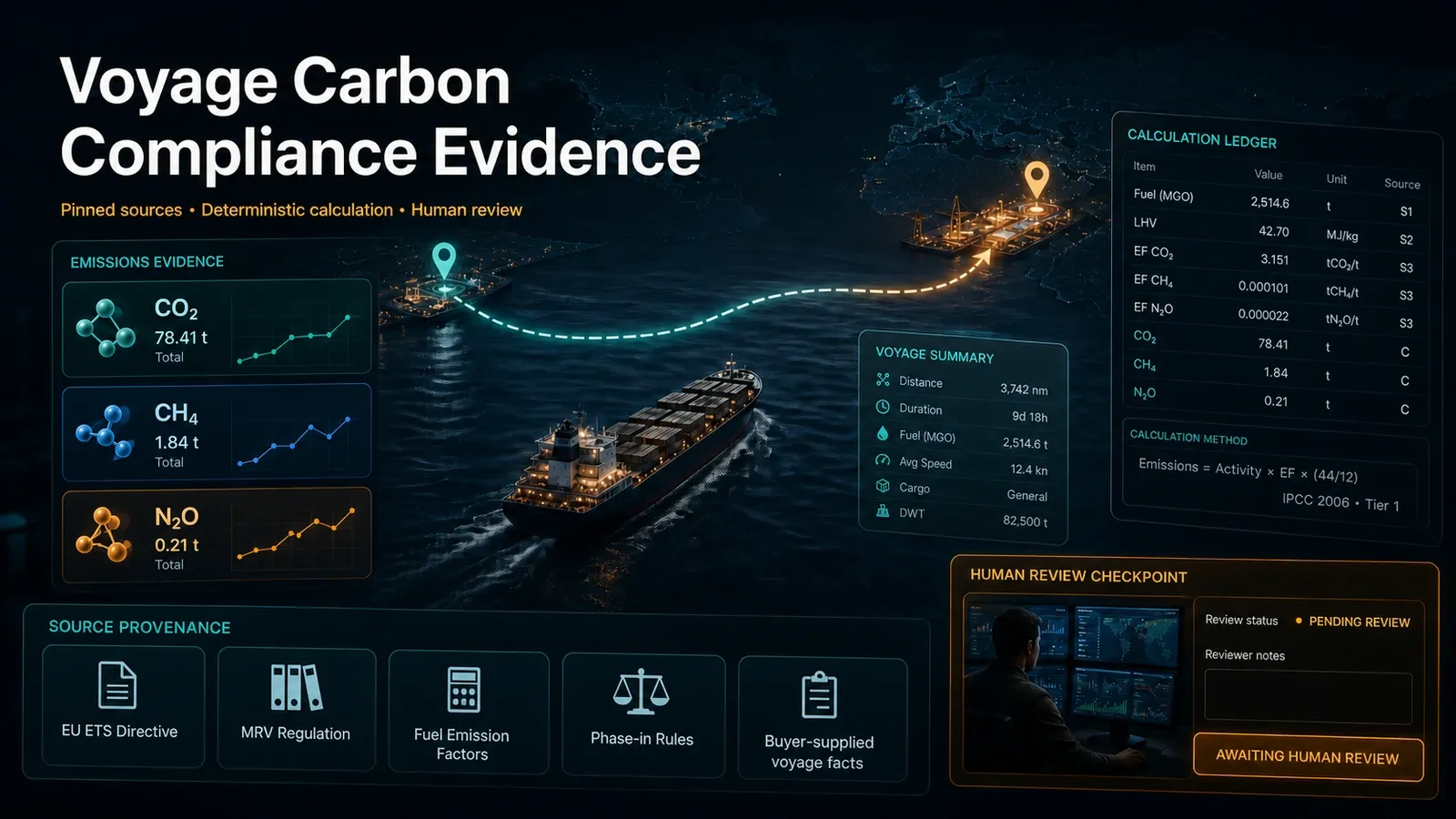
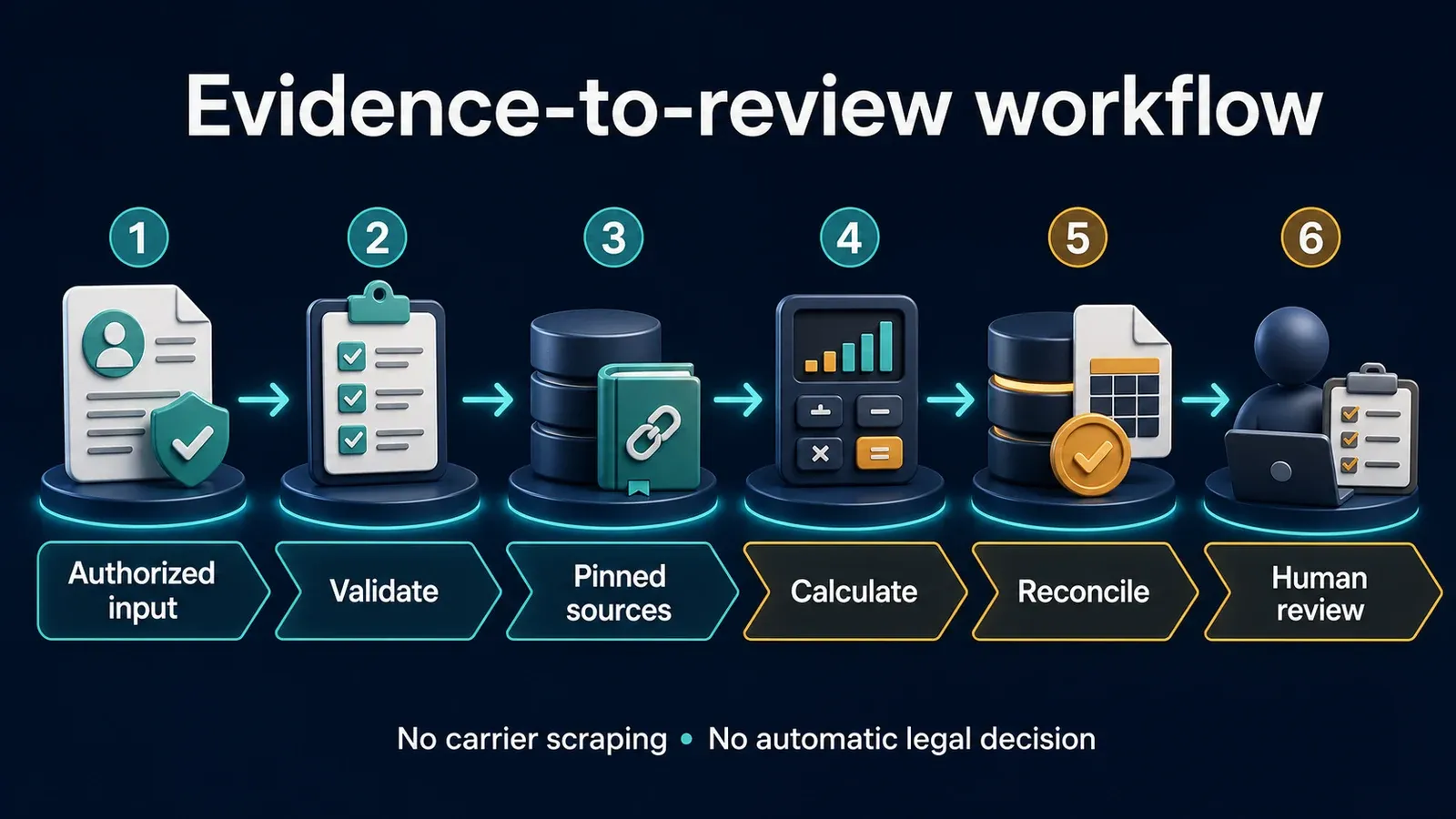
Calculate a deterministic estimate of EU ETS voyage exposure from facts you already own: vessel class and GT, ordered port calls, fuel quantities, optional allowance price, and an optional mass scenario. The result is an evidence ledger with official fixture references, assumptions, limitations, and reproducible digests.
This is derived evidence, not a compliance verdict, MRV verification, legal advice, allowance instruction, or regulatory assurance. It does not decide whether a company is legally liable. Vessel, port, quantity, and price facts remain buyer supplied and unverified.
What goes in and what comes out
You provide one closed decision object with schemaVersion, requestId, reportingYear, vessel, two to nine ordered port calls, one to eight legs, fuel records, optional berth fuel records, optional buyer price, and optional scenario. Decimal quantities are strings such as 100 or 12.345; 1.0, exponent notation, duplicate JSON keys, non-ASCII text, unknown keys, future facts, cross-year intervals, unsupported fuels, and unmodelled legal branches are rejected.
The Actor returns one closed terminal OUTPUT record and one receipt-free prepared Dataset evidence row for a complete decision. The Dataset row is written before the pinned SDK charging operation and carries preparedReportDigest; it never claims that payment or delivery was confirmed. OUTPUT contains the authoritative delivery receipt, exposure totals, gas/fuel/segment breakdowns, the full truth ledger, data-quality and confidence fields, eight base limitations, evidence references and SHA-256 digests. The authoritative ledger is one truthLedger.entries array, with each entry bound to one truth class and a global maximum of 128 entries across classes. verifiedInputs is always exactly [] with verificationReason="mrv_verification_not_performed"; redundant dynamic count claims are absent from public output and Dataset rows. Absent optional price and scenario inputs are represented by explicit missing entries. Decision and prepared rows contain exactly the seven accepted source identities in registry/runtime order; non-decision rows contain no sources. It never stores raw IMO numbers, UN/LOCODEs, port or leg IDs, buyer timestamps, masses, prices, source HTML, credentials, or buyer text.
Every terminal timestamp is canonicalized to strict UTC seconds. After Actor.init, the production run records the platform start event as exactly count 1, obtains the charging-manager pricing context before storage access, and carries that immutable context into fallback terminals. Unknown tier or price fields remain null under a fail-closed reason; they are never reported as zero. Direct library and MCP execution is explicitly off-platform and fail-closed: it cannot claim a platform run, has a null start count and off_platform_no_platform_run reason, and performs no paid operation. One injected 90-second deadline covers the default KVS input/output reads, counters, and delivery; terminal OUTPUT writing has its separate bound. The production runtime has no named persistence, request-queue lock, external service, or cross-run deduplication. Each run is one independent voyage report. stateReceipt.status=not_attempted and reason=single_voyage_no_persisted_state are truthful: raw buyer input is never persisted.
Exact examples
The public Task input is byte-exactly fixtures/public-task-input.json. The decision input is examples/decision.json. The following files are generated by the runtime with the fixed observed time 2026-08-09T20:00:00Z, not hand-authored fixtures:
- examples/demo-output.json is the complete terminal
OUTPUTfor the public Task. - examples/demo-dataset-row.json is its receipt-free demo Dataset row.
- examples/decision-output.json is the complete paid decision
OUTPUT, including the authoritative receipt. - examples/decision-dataset-row.json is the prepared, receipt-free Dataset row pushed before charging.
These files are the exact JSON examples used for contract review. They contain no raw buyer timestamp or price date: effectiveAt and monetaryExposure.priceDate are always null, with private_input_redacted or priceTruth explaining the projection.
Rule boundary
V1 accepts cargo and passenger ships of at least 5,000 GT for reporting years 2024 through 2027. It models HFO, LFO and MDO/MGO with pinned official factors, CO2/CH4/N2O GWPs, route shares and phase-in. Offshore, general cargo, excluded classes, Article 12 treatments, special-port treatments, LNG/Bio-LNG and every other unsupported fuel fail closed.
The calculation uses exact local official fixtures captured from EUR-Lex, the Publications Office and the European Commission. Runtime makes zero provider or network calls. Sources are cited in the output by canonical URL, fixture path, digest, capture time, evidence-manifest digest and attribution. Raw source bytes are never emitted. Source rights are evidence and attribution controls, not a legal guarantee.
The normative ruleSetDigest uses the established evidence-manifest registry order, not lexical sorting. The accepted golden vectors are pinned for reporting years 2024, 2025, 2026 and 2027 in the runtime constants.
Pricing
Pay per event: one apify-actor-start event plus one voyage-report-found event for one complete decision. With pinned apify@3.7.2, a Dataset push with an event also records one implicit apify-default-dataset-item counter; that event is configured at USD 0.000000. The exact six Apify account tiers are FREE, BRONZE, SILVER, GOLD, PLATINUM and DIAMOND. The run cap is checked before the single paid push. A synthetic demo writes one unpriced row and emits zero result events. The confirmed decision records one implicit default-Dataset event and verifies defaultDatasetDeltaEqualsCount=true; response loss, charge failure, or counter mismatch produces nullable ambiguous billing and no retry. A direct rerun is a new run and may produce a new result charge; the Actor makes no cross-run idempotency claim.
Direct Hub reference price is USD 0.15. No external provider spend is required. This product does not renew or use Datalastic.
Machine use and MCP
The package exports voyage_carbon_compliance_evidence.run through ./mcp. MCP calls are an off-platform boundary: the literal output is a truthful fail-closed terminal with lifecycle="off_platform", no platform start count or price, and OFF_PLATFORM_EXECUTION; it cannot claim apify-actor-start or charge an Apify run. contract/mcp.json embeds literal inputSchema and outputSchema objects, so callers do not depend on path-only schema references. The adapter is deterministic and suitable for n8n, Make or another machine caller; the caller must supply buyer-authorized facts and must not send credentials.
The contract/runtime/MCP schemas are authoritative. Apify's UI schema is a deliberately permissive input projection because its editor rejects JSON Schema nullable branches and cross-field oneOf constraints; runtime validation remains fail-closed and enforces the exact two-mode contract.
Fixed synthetic Task
Use the exact object in fixtures/public-task-input.json. It performs no source/provider call, uses no prior state, writes one unpriced demo row, and proves zero voyage-report-found events.
Production runtime amendment R7
The accepted production path is intentionally stateless for this independent-voyage product. It opens only the default per-run KVS for INPUT and OUTPUT, and uses the default Dataset through the pinned SDK. It does not open a named KVS, create a request queue, call a provider, or use an external persistence service. No caller-carried continuation state is required for the current contract. A result charge is attempted once, only after affordability and all output limits pass; the runtime reads counters after the single delivery attempt and never retries inside the run. If delivery or counter confirmation is ambiguous, the terminal result is delivery_unknown with nullable result counters. This is not a successful report and is not charged as a confirmed result.
Limitations
- This is not legal advice, MRV verification, a compliance conclusion, or a surrender instruction.
- Source facts are pinned at the accepted-through-2027 boundary and require a new review before extension.
- Buyer facts are not independently verified; estimated masses and scenarios are explicitly marked.
- The output is not a market allowance quote and does not calculate company-wide aggregation, verifier findings, penalties or transfer pricing.
Related Actors
| Actor | Why it is related |
|---|---|
| Strait of Hormuz Tanker Flow Recovery | Regional maritime flow context. It is not a source for this calculation. |
| Singapore Bunker Tanker Divergence | Separate Singapore bunker signal for a workflow context layer. |
| Panama Canal Queue Transit Imbalance | Separate transit signal; it does not provide vessel compliance facts. |
| Container Exception Evidence | Customer-authorized container evidence workflow; no data is fetched between Actors. |
Support contract
Every terminal status is closed and machine-readable. An unknown fact is null with a closed reason. A source, rights, state, delivery, billing or schema problem prevents a decision rather than producing a guessed number.
What you get
The paid unit is one complete, deterministic voyage-exposure report. A complete report gives an operations or compliance reviewer a bounded calculation package rather than a loose number:
- one stable request digest and one prepared-report digest;
- the accepted reporting year and pinned rule version;
- all-gas calculated CO2e, ETS-eligible CO2e before route scope, covered CO2e, and phase-in-adjusted allowance equivalent;
- gas-level rows for CO2, CH4, and N2O;
- fuel-level and voyage-segment breakdowns;
- an optional buyer-supplied allowance-price scenario, clearly separated from the regulatory calculation;
- an assumption ledger for estimated quantities and scenarios;
- a truth ledger that classifies every mapped input or rule fact as buyer reported, measured as submitted, estimated, official-rule fixture, contract control, or missing;
- seven ordered official-source references with canonical URLs, fixture hashes, evidence-manifest hashes, capture dates, and attribution;
- data-quality and confidence objects with explicit reasons;
- a closed limitations list;
- one receipt-free Dataset row for analysis;
- one authoritative KVS
OUTPUTrecord for terminal, delivery, and billing reconciliation.
The Actor does not emit a regulatory approval flag. result.decision.decisionType="calculated_exposure" means the accepted arithmetic was performed under the pinned model. It does not mean the vessel, company, route, quantities, port classifications, exemptions, or legal obligations were independently verified.
Free and non-result outcomes remain useful. The synthetic public Task writes one free demonstration row. Invalid input, unsupported branches, stale source review, pricing mismatch, budget stop, and off-platform execution return a closed terminal record when the storage boundary remains available. They do not intentionally emit voyage-report-found.
Who uses it
Maritime compliance analysts
Use the report as a reproducible worksheet before a qualified person checks vessel scope, port-call treatment, fuel evidence, reporting-year rules, verifier expectations, and company-level aggregation. The Actor reduces arithmetic and evidence-linking work; it does not replace the analyst.
Shipping and logistics finance teams
Use the allowance-equivalent quantity with a separately supplied planning price to create an internal exposure scenario. The price is buyer asserted, not a live quote. The output is not an invoice, accrual policy, transfer-pricing instruction, or financial statement.
Data engineering teams
Use the closed schemas, deterministic digests, exact decimal rules, and stable source order to test upstream voyage-data pipelines. The report makes missing, rejected, estimated, and buyer-reported facts visible instead of silently coercing them.
Governance and assurance teams
Use source hashes, attribution, accepted-through-year controls, and the truth ledger to review what the calculation relied on. Retain the input under your own policy; the public report deliberately redacts raw vessel, port, timestamp, mass, and price values.
Product and workflow builders
Use Dataset for receipt-free evidence display and KVS OUTPUT for terminal automation. Route all positive reports to human review. Do not trigger allowance purchase, regulatory filing, customer representation, penalty response, or vessel-operating decisions directly from this Actor.
How to run
Start with the fixed synthetic Task if you are evaluating the product. It proves the schema, output shape, free Dataset path, and zero-result billing path without using private voyage data.
For a real calculation, submit one decision object. A minimal production workflow is:
- choose a supported reporting year from 2024 through 2027;
- create a random request ID matching
rq_[0-9a-f]{32}; - supply a supported vessel branch and gross tonnage;
- order two to nine port calls chronologically;
- connect those calls with one to eight legs;
- provide bounded HFO, LFO, or MDO/MGO mass records with a declared truth class;
- optionally provide berth quantities, a planning allowance price, or one mass-multiplier scenario;
- confirm the closed rights and unfetched-reference attestations required by the input schema;
- set a run charge cap that covers the automatic start event and one result event at your current Apify tier;
- after terminal completion, read KVS
OUTPUTfirst and Dataset second.
API pattern:
Poll the returned run ID to a terminal platform state. Do not start another run merely because Dataset is slow to appear. If OUTPUT.status="delivery_unknown", preserve the run, Dataset, KVS, logs, and platform charge counters for manual reconciliation; do not blind-retry.
The Actor is intentionally one-voyage-per-run. Split multiple voyages into separately capped and reconciled runs. This keeps source, input, result, billing, and reviewer evidence attributable to one calculation.
Input contract
The normative contract is contract/input.schema.json. The Apify Input UI is a compatible projection; runtime validation is authoritative where the UI schema cannot express cross-field rules.
Identity and time
schemaVersionis exactly1.1.0.modeisdecisionfor a paid calculation or the fixed synthetic mode for the public Task.requestIdis caller generated and bounded. It is not a vessel identifier.- all timestamps are strict UTC-second strings;
- buyer fact timestamps may not be in the future relative to the run's observed time;
- intervals may not cross the accepted reporting-year boundary;
- duplicate JSON keys, non-ASCII payload bytes, BOMs, unknown fields, and exponent-number shortcuts fail closed.
Vessel branch
The current model is deliberately narrow. It accepts only branches represented by the pinned V1 rule set. Unsupported vessel categories, excluded classes, Article 12 treatments, general-cargo branches, and sub-5,000-GT scope fail before the paid push. A rejection is not a legal conclusion that the voyage is outside EU ETS; it means this model will not calculate that branch.
Port calls and legs
Port calls must be chronologically ordered and legs must connect adjacent accepted calls without overlap. memberStatePort and isPortOfCall are buyer assertions. The Actor does not geocode a UN/LOCODE, verify a port call, determine evasive routing, or resolve neighbouring-transhipment treatment. Any declared special treatment is rejected because the V1 model does not classify it.
Fuel quantities
Each quantity has a stable record ID, a closed fuel type, interval, decimal mass string, and dataTruth. measured means measured as submitted, not independently MRV-verified. buyer_reported and estimated remain distinct. HFO, LFO, and MDO/MGO are supported; LNG, bio-LNG, LPG, methanol, biofuel, and other fuels fail closed until a separately reviewed formula is released.
Optional price and scenario
priceInput is a buyer-supplied planning value. Its date is redacted from persisted output. scenario.alternativeFuelMassMultiplier is an arithmetic what-if input, not an engineering, safety, procurement, or legal recommendation.
Rights and privacy attestations
Submit only facts you control or are authorized to process. Do not submit credentials, charter-party secrets, commercially sensitive narrative, sanctions-sensitive instructions, crew information, personal data, or source-document bytes. The Actor stores digests and derived evidence, but Apify retains run input according to your workspace settings.
Happy, partial, and failure output
Happy decision
For a complete supported request, the Actor creates one prepared Dataset row, attempts one linked voyage-report-found push, reads the named and implicit Dataset counters, and writes terminal OUTPUT. A confirmed report has:
status="decision";resultFound=truein terminal OUTPUT;- one prepared Dataset row whose own
resultFound=falseremains settlement neutral; deliveryReceipt.status="confirmed";- one confirmed result event and one confirmed implicit Dataset operation;
- exact result and Dataset counter deltas of one;
- no persisted baseline or cross-run state;
- one closed truth ledger and seven ordered source rows.
Free synthetic demo
The fixed public Task creates one Dataset demo row and no result event. It is safe for schema exploration, but its numbers are synthetic and must never be used in operations, filings, purchasing, or customer reporting.
Rejected request
Schema, time, vessel, port, fuel, source, or representation problems produce a closed reason and error code. A rejection does not return a partial exposure number. Fix the input or review the unsupported branch; do not reinterpret nulls as zero.
Pricing or budget stop
An unknown pricing tier, malformed event map, mismatched price, unreadable cap, or other pricing inconsistency fails closed before delivery. A budget stop means the current cap could not safely cover the result event after the platform start event. Raise the cap only after reviewing the live pricing panel and current tier.
Delivery unknown
If the linked push throws or required counters are unavailable or inconsistent, the Actor does not retry. OUTPUT records an ambiguous terminal state when it can. Dataset delivery and payment must then be reconciled from the platform run, Dataset, KVS, and event counters. Never assume ambiguous means free, and never assume it means paid.
KVS output failure
An OUTPUT write/read-back failure is a hard runtime failure. The platform run status and retained Dataset/event evidence become the recovery surface. Do not create a second paid run until the first attempt has been reconciled.
The product intentionally has no "partial compliance decision" status. Unsupported or incomplete rule branches are rejected rather than calculated with guessed assumptions.
Field dictionary
| Field group | Meaning | Boundary |
|---|---|---|
requestDigest | Deterministic digest of the accepted normalized request | Does not make the request anonymous or prove ownership |
preparedReportDigest | Digest of the receipt-free Dataset evidence projection | Excludes terminal delivery settlement |
inputIdentity | Digested request, vessel, voyage, and contract identities | Raw private identifiers are not persisted in public output |
rule | Reporting year, phase-in, gases, source and rule-set digests | Not a full legal applicability analysis |
result.decision.scopeTotals | Calculated, eligible, covered, and allowance-equivalent totals | Deterministic model output, not verifier-certified data |
result.decision.byGas | CO2, CH4, and N2O breakdown | Uses pinned V1 factors and accepted fuel branches only |
result.decision.byFuel | Accepted quantity aggregation by fuel | Does not assess fuel sustainability or proof of origin |
result.decision.segments | Route-scope calculation by digested segment | Buyer port classifications remain unverified |
allowanceExposure | Phase-in-adjusted planning quantity | Not a surrender instruction or purchase recommendation |
monetaryExposure | Optional buyer-price scenario | Not a live market quote or accounting conclusion |
scenarioComparison | Optional mass-multiplier comparison | Not an operational fuel-switch recommendation |
assumptionLedger | Every estimated quantity or scenario input | Does not validate the assumption |
truthLedger.entries | Canonical per-fact truth classification | Array entries are authoritative; no redundant count claim |
truthLedger.verifiedInputs | Independently verified buyer inputs | Always empty in V1 |
sources | Seven ordered official-source identities and hashes | Source citation, not official endorsement |
dataQuality | Completeness, truth mix, and mapping reasons | Contract completeness, not real-world accuracy |
confidence | Deterministic confidence level and reasons | Not a legal or statistical probability |
limitations | Closed unsupported and non-verification boundaries | Must travel with downstream use |
billing | Tier, prices, counters, cap, and parity | Terminal OUTPUT only is authoritative |
dataset | Prepared-row write facts | A Dataset row is not a payment receipt |
deliveryReceipt | Expected and confirmed row/result counts | Ambiguous values remain null with reasons |
stateReceipt | Stateless product declaration | V1 does not persist voyage history |
errors | Closed code, field group, and digested detail | Never replace review of platform logs for an ambiguous run |
Evidence and boundaries
Official fixtures
Runtime uses exact local fixture bytes captured from official EU sources and pinned by SHA-256. The source registry binds capture metadata, media type, authoritative and final URLs, clause evidence, an accepted-through-year limit, a current-law inventory, and an independent review artifact. Any missing, altered, stale, out-of-order, or unapproved fixture blocks a decision.
Attribution and reuse
Output cites the instrument or official page, canonical URL, legal version, and attribution required by the registry. It identifies the product as a derived calculation. It does not emit raw HTML, legal prose, page images, EU emblems, logos, or third-party works. Rights metadata supports release governance; it is not legal advice to the buyer.
Buyer facts
Vessel, voyage, port, quantity, price, and scenario facts come from the buyer. The Actor does not fetch AIS, carrier, terminal, MRV verifier, registry, fuel supplier, bunker note, invoice, charter, or allowance-market data. It cannot confirm completeness or detect omitted voyages and quantities.
Freshness
The accepted rule years are bounded through 2027 by the checked artifacts. A new reporting year, amendment, source change, policy change, legal interpretation, or fixture-capture change requires a new source and independent-review release. The runtime will not silently extend itself.
Privacy and confidentiality
Although persisted evidence is digested and redacted, run INPUT is workspace data. Treat vessel schedules, commercial routes, bunker quantities, prices, and contract references as confidential. Apply least privilege, retention limits, deletion controls, and purpose restrictions. Hashing enables linkage and is not anonymization.
Security
The production runtime performs zero provider requests and follows no buyer URL. Citation URLs are data, never fetch targets. There is no browser, proxy, DNS, webhook, email, request queue, or child Actor. This removes SSRF and provider-token exposure from the V1 runtime, but it does not replace workspace access control.
Decision routing
| Terminal state | Human route | Automation boundary |
|---|---|---|
decision | Review scope, truth ledger, sources, limitations, and settlement | May populate a review queue; may not file, buy, certify, or notify automatically |
demo | Product evaluation only | Never use synthetic numbers operationally |
rejected | Correct input or escalate an unsupported branch | Do not coerce nulls or remove validation |
build_hold | Refresh and independently review pinned sources | No calculation or paid delivery |
pricing_misconfigured | Compare exact live event map and tier | No paid push |
budget_stopped | Review cap and price before a new run | Do not infer a result |
delivery_unknown | Reconcile run, Dataset, KVS, and event counters | Never blind-retry |
| off-platform rejection | Invoke as an Apify run for platform settlement | MCP/library call cannot claim paid delivery |
Even a green decision is safeToAutomate=false in business terms. The machine-safe action is to store or route the evidence for review. All legal, filing, payment, procurement, customer, and vessel-operation actions require separately authorized human controls.
Commercial playbooks
Pre-review voyage worksheet
Normalize one voyage, retain the request digest with your source packet, and assign a compliance analyst. Have the reviewer compare every buyer-reported or estimated truth entry with controlled source evidence before using the allowance equivalent.
Finance planning scenario
Supply an internal planning price and preserve its source outside the Actor. Treat monetaryExposure as a scenario. Reconcile it to company policy, currency treatment, allowance position, verifier data, and accounting review before booking or purchasing anything.
Data-pipeline acceptance
Run stable fixtures through staging, compare request and report digests, and monitor rejected field groups. Use rejection rates to improve upstream voyage-data quality. Do not weaken the runtime schema to make a noisy feed pass.
Rule-change impact review
When a source or accepted year changes, freeze the old build, capture new official bytes, update the rights and evidence manifests, conduct an independent review, generate a new rule-set digest, and compare outputs on controlled fixtures. Never patch a factor or phase value directly in production.
Audit packet
Retain the accepted input under access control, build ID, run ID, Dataset ID, KVS ID, terminal OUTPUT, report digest, source manifest, exact fixture revision, and reviewer sign-off. The Actor provides components of an evidence packet; it does not create regulatory sufficiency by itself.
Integration recipes
Dataset consumer
Read the single prepared row only after the run is terminal. Verify status="prepared", recompute or compare preparedReportDigest, require seven source rows in registry order, and retain limitations. Then fetch KVS OUTPUT to determine whether the prepared row settled as a confirmed result.
KVS-first orchestrator
Read OUTPUT.status, resultFound, deliveryReceipt, billing.counterParity, and errors. Continue only for a confirmed decision with expected counters. Route every other state to a manual queue. A missing OUTPUT is a hard stop, not an empty result.
Warehouse model
Store digests as strings, numeric decimal outputs as decimal strings, nested ledgers as JSON, and source rows in a child table if needed. Keep terminal billing facts separate from the receipt-free prepared row. Do not convert exact decimal strings through binary floating point before reconciliation.
Webhook
If your Apify integration emits terminal webhooks, use the webhook only as a signal to fetch current run storage. Do not place buyer input or the entire compliance report in a webhook URL or unrestricted message body.
MCP or direct library
These paths are intentionally off-platform and cannot claim platform billing or a successful Apify result. Use them for schema discovery or fail-closed integration tests. For a commercial report with platform settlement, start an Actor run.
Operating guide
Before each run
- verify that the reporting year is supported;
- verify authorization to process every submitted fact;
- remove unnecessary identifiers and narrative;
- classify quantities honestly as measured-as-submitted, buyer-reported, or estimated;
- confirm port order and leg intervals;
- remove unsupported fuels and legal branches rather than guessing them;
- inspect the live pricing panel and set a bounded cap;
- record your planned reviewer and retention period.
After each run
- wait for terminal platform status;
- read
OUTPUTand confirm it belongs to the current run storage; - inspect
status,errors,deliveryReceipt, and counter parity; - compare Dataset
preparedReportDigestwith the terminal evidence projection; - review truth classes, confidence reasons, assumptions, sources, and limitations;
- preserve ambiguous evidence without retry;
- record human approval or rejection outside the Actor;
- delete input and output according to policy when no longer needed.
Monitoring
Alert on source fixture holds, source freshness holds, pricing mismatches, budget stops, delivery unknown, OUTPUT write failures, counter mismatches, and rising schema rejection. Do not alert on the synthetic demo as if it were a compliance report.
Release management
Treat fixture, rule, contract, pricing, schema, and README changes as reviewed release inputs. Run the full test suite, official Apify schema validator, exact upload projection, one immutable build, one bounded no-retry canary, Dataset/KVS/PPE reconciliation, and only then promote that exact build.
FAQ
Is this an EU or regulator product?
No. It is an independent derived-calculation tool. It is not endorsed by the European Union, European Commission, EUR-Lex, Publications Office, a verifier, carrier, exchange, or authority.
Does it determine legal liability?
No. It calculates a bounded exposure estimate under the pinned model and rejects unsupported branches.
Does it perform MRV verification?
No. verifiedInputs is always empty and the output says mrv_verification_not_performed.
Does it fetch AIS or carrier data?
No. Runtime makes zero provider and network requests.
Are official sources live?
No. Exact reviewed fixture bytes are bundled and hash checked. Their accepted-through-year boundary is explicit.
Is a measured quantity verified?
No. It means measured as submitted by the buyer.
Does a high confidence level mean legal certainty?
No. It is a deterministic assessment of the submitted truth mix and contract coverage.
Can I submit LNG?
Not in V1. LNG and bio-LNG are rejected because methane-slip and related formula branches are not released here.
Can I submit a special-port treatment?
No. The source is pinned as an exclusion boundary, but the Actor does not classify such calls.
Is the allowance price live?
No. It is optional buyer-supplied planning data and is not a quote.
Does the Dataset row prove payment?
No. It is deliberately receipt free. Read current-run KVS OUTPUT.
Can I retry delivery_unknown?
Not blindly. Reconcile the first run's Dataset, KVS, platform counters, and logs first.
Does the Actor deduplicate across runs?
No. Every run is independent and a new run can incur a new start and result charge.
Does it store a named baseline?
No. stateReceipt truthfully records a stateless single-voyage product.
Are hashes anonymous?
No. They are deterministic linkage values and must be handled under the same confidentiality policy as the underlying workflow.
Can the report trigger allowance purchase automatically?
No. It is evidence for human review, not an execution authorization.
What should I retain?
Retain the build/run/storage IDs, accepted input under access control, OUTPUT, Dataset row, digests, source revision, and reviewer decision for the period your policy and law require.
Sources and rights
The bundled source registry identifies the exact legal-primary, amendment, calculation-method, GWP, special-port, official-guidance, and rights-policy materials used by V1. Each row records owner, authoritative URL, legal version, fixture capture, SHA-256, evidence-manifest digest, attribution, terms URL, licence status, accepted use, and prohibited raw redistribution.
The product emits derived numeric and decision-support output plus short attribution. It does not redistribute source HTML or legal prose, use official logos or emblems, or imply endorsement. Third-party works and separately protected material are excluded from the released output. A source row marked approved means the release evidence gate passed under the recorded policy; it is not a legal opinion for a buyer's independent use.
Buyer-provided vessel, route, quantity, and price facts remain the buyer's responsibility. You must have a lawful basis and sufficient contractual rights to submit, process, retain, and share them. Keep credentials and source documents out of input. If your workflow requires a carrier feed, verifier evidence, registry record, invoice, bunker delivery note, or market quote, obtain it through an authorized channel and review its terms separately; this Actor does not fetch or license it for you.
Official-source coverage and rights are bounded by the pinned registry and accepted-through-year value. Before extending the rule year, changing a formula, adding a fuel, handling special-port treatment, or relying on a new legal amendment, recapture authoritative sources, evaluate reuse conditions and third-party exceptions, update attribution, conduct independent review, regenerate schemas and examples, and release a new immutable build.


