

GovDeals Scraper [$0.85/1K💰] | Surplus Auctions | Bids | VIN
Pricing
from $0.80 / 1,000 results
GovDeals Scraper [$0.85/1K💰] | Surplus Auctions | Bids | VIN
Scrape live GovDeals government surplus auctions: current bids, VIN, meter readings, seller agencies and end dates. Filter by keyword, category and US state. Export to JSON or CSV.
Pricing
from $0.80 / 1,000 results
Rating
0.0
(0)
Developer

Ahmed Jasarevic
Maintained by CommunityActor stats
0
Bookmarked
2
Total users
1
Monthly active users
5 days ago
Last modified
Categories
Features
Share
GovDeals Scraper – Government Surplus Auctions, Bids & Lot Data
Extract live US government and municipal surplus auctions from GovDeals as structured rows: lot ID, title, category, current bid, opening bid, bid count, buy-now price, reserve status, make/model/year, VIN, meter reading, seller agency, city/state/ZIP and exact UTC start/end times. $0.85 per 1,000 lots. Filter by keyword, category and state.
What Can You Do With GovDeals Data?
- Equipment and vehicle sourcing – find trucks, excavators, buses and generators before the auction closes
- Resale and arbitrage research – compare current bids against market value for a make, model and year
- Fleet replacement planning – track what agencies in your state are disposing of, and when
- Municipal surplus analysis – see which agencies sell which categories, and how bidding behaves
- Dealer inventory feeds – schedule daily runs and refresh a shortlist of active lots
- Auction monitoring alerts – filter by category or state and watch end dates and bid counts move
How It Works
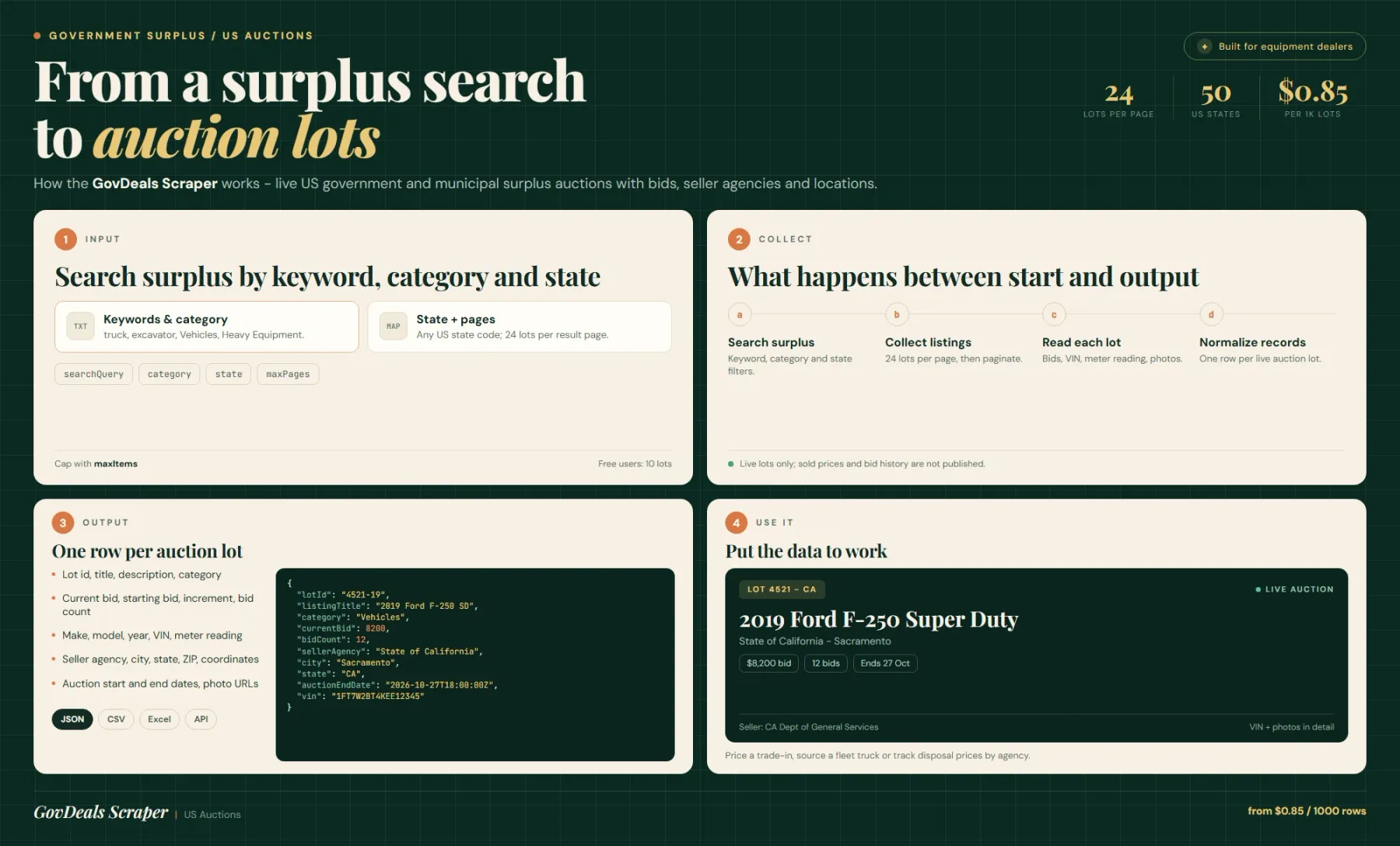
GovDeals publishes live government surplus auctions through a public search API. Provide a keyword, category and state; the Actor reads the published search results, each lot's detail record and its bid box, then writes one row per lot with bids, vehicle details, seller agency and location.
- The search API returns up to 100 lots per page.
- Each lot adds a detail request (VIN, meter reading, description, condition, photos) and a bid-box request (current bid, opening bid, bid count, increment, exact UTC start/end).
- Requests are paced and run in parallel: a 100-lot run finished in about 60 seconds with zero failed requests in testing.
- No browser or headless Chromium is used, so runs stay light on memory and CPU.
Extract Government Surplus Auctions Without A Buyer API
GovDeals publishes an import API for sellers, not a read API for buyers. It accepts listings from agencies; it does not let you query the marketplace. Commercial data providers fill the gap with paid feeds.
This Actor collects the public auction data instead: no seller account, no contract and no per-call vendor. Rows carry the numbers an auction actually turns on — current bid, increment, bid count, reserve status and a real end date.
Filter Surplus Lots By Keyword, Category And US State
searchQuery matches titles and descriptions (truck, excavator, generator). category narrows to a GovDeals category such as Vehicles, Heavy Equipment or Construction. state takes a two-letter code and restricts results to lots physically located there.
maxPages (default 5) controls how many 100-lot result pages are read; maxItems (default 100) caps how many lots are saved. Both are required inputs, so a run always has an explicit budget. maxConcurrency (default 10) and requestDelaySecs (default 0.1) control speed versus rate-limit safety.
Auction Fields: Bids, Reserve Status And Real End Times
Each row carries currentBid, startingBid, bidIncrement, bidCount, buyNowPrice and reserveStatus, so you can separate lots with active bidding from lots with no interest. startingBid is the opening bid published by GovDeals and stays available after bidding starts; bidCount is the live number of bids. auctionStartDate and auctionEndDate are exact UTC ISO 8601 timestamps taken from GovDeals' bid box, and timeRemaining keeps the site's own countdown text.
Vehicle lots add make, model, year, vin and meterReading where the seller published them. Every row includes sellerAgency, sellerType, city, state, zip and coordinates when available, plus the full photos array and listingUrl.
Coverage limit: this actor reads live lots only. Closed auctions with final hammer prices, bid logs and buyer-premium data are not part of it.
Input – Configure A GovDeals Search
| Field | Type | Required | Default | Notes |
|---|---|---|---|---|
searchQuery | string | No | "" | Keywords matched in titles and descriptions; empty browses everything |
category | string | No | "" | GovDeals category, e.g. Vehicles, Heavy Equipment, Construction |
state | string | No | "" | Two-letter US state code; empty includes all states |
maxPages | integer | Yes | 5 | Result pages to read, 100 lots per page |
maxItems | integer | Yes | 100 | Max lots saved. Free users are limited to 10 |
maxConcurrency | integer | No | 10 | Parallel requests, 1-50 |
requestDelaySecs | number | No | 0.1 | Minimum pause between requests, 0-10 seconds; raise it if requests get blocked |
proxy | object | No | Apify Proxy prefilled | Standard Apify proxy configuration. Recommended for reliable runs |
Output – Auction Lot Fields
| Field | Type | Description |
|---|---|---|
lotId | string | GovDeals asset/lot identifier |
listingTitle | string | Lot title |
itemDescription | string | Full description text |
category | string | Category name |
make, model, year | string / number | Vehicle or equipment identity where published |
currentBid | number | Current highest bid (USD) |
startingBid | number | Opening bid |
bidCount | number | Number of bids placed |
bidIncrement | number | Minimum raise |
buyNowPrice | number | Fixed purchase price when offered |
reserveStatus | string | Reserve met / not met / no reserve |
sellerAgency, sellerType | string | Selling agency and its type |
city, state, zip | string | Lot location |
latitude, longitude | number | Coordinates when published |
auctionStartDate, auctionEndDate | string | ISO 8601 timestamps |
timeRemaining | string | Countdown text from the listing |
condition | string | Condition where published |
vin | string | VIN or serial number for vehicles |
meterReading | string | Odometer or hour meter |
photos | array | Image URLs |
listingUrl | string | Direct lot URL |
scrapedAt | string | ISO timestamp of the scrape |
Example Input – Trucks In California
Example Output – One Auction Lot
Export GovDeals Data To JSON, CSV Or Excel And Schedule Runs
Every run writes to the default dataset — JSON, CSV, Excel or XML from the run page, or through the Apify API. At default settings a 100-lot run takes about a minute; larger runs scale with maxItems and maxPages.
Auctions close continuously, so a daily schedule is the useful cadence for sourcing, and a twice-daily run makes sense when you are bidding. At $0.85 per 1,000 lots, 1,000 lots cost $0.85.
Related Actors
- Google Maps Scraper – geocode lot locations and check nearby auction yards
- Website Content Crawler – pull agency disposal policies and terms of sale into clean text
- Google Search Scraper – research an agency's surplus programme or a specific lot number
- CSLB Scraper – another US public-record dataset, useful for verifying contractors and dealers
FAQ
Why use this actor instead of the GovDeals website?
Because a website cannot be filtered into a spreadsheet across hundreds of lots and multiple categories. This actor returns every lot in your search as rows you can sort by bid count, end date or VIN — and it can run on a schedule so you see new lots the day they appear.
Does GovDeals have a public API?
GovDeals publishes an auction import API for sellers, not a documented read API for buyers. This Actor requests the same public JSON data the GovDeals storefront loads in a browser.
Why does a run take about a minute?
Each lot needs a detail request and a bid-box request. The Actor runs them in parallel but paces requests to avoid GovDeals rate limits. A 100-lot run (201 requests) finished in about 60 seconds with zero failures in testing.
Can I get sold prices and bid history?
No. This actor covers live auctions only. Final hammer prices, closed-lot history, bid logs and buyer premiums are not part of the output — treat currentBid as the live state at scrape time.
What are alternatives for government surplus data?
Commercial data providers cover sold lots and bid history at higher cost. This Actor focuses on live lots and returns detail fields such as VIN, meter reading and photos directly.
How many lots can I get per run?
100 lots per result page. maxPages: 5 reads up to 500 lots before filtering; maxItems then caps what is saved. Raise maxPages for broad categories and keep maxItems as the cost guard.
Are free users limited?
Yes, the input schema caps free users at 10 saved lots per run.
For AI Agents & LLM Apps
Returns one row per live GovDeals auction lot with bid state, vehicle identity, seller agency and location.
Minimal working input:
Variant — statewide equipment sweep:
Output fields: lotId, listingTitle, itemDescription, category, make, model, year, currentBid, startingBid, bidCount, bidIncrement, buyNowPrice, reserveStatus, sellerAgency, sellerType, city, state, zip, latitude, longitude, auctionStartDate, auctionEndDate, timeRemaining, condition, vin, meterReading, photos, listingUrl, scrapedAt.
Behaviors an agent should know:
maxPagesandmaxItemsare required in the schema — always send both.maxItemsdefaults to 100 and free users are capped at 10 saved lots.- Empty
searchQuery,categoryandstatemeans "everything" — a broad run takes real time and resources. - The input prefills Apify Proxy for reliable runs; a 100-lot run takes about a minute, so allow a few minutes for larger inputs.
- If requests start returning HTTP 403, raise
requestDelaySecsto0.2-0.35or keep the proxy enabled. - Only live lots are returned; there is no sold-price or bid-history field to query.
currentBidis the bid at scrape time, not a final price.
Billing: pay-per-event at $0.00085 per saved lot ($0.85 per 1,000) plus a small actor-start event. A listing-detail event is configured in the pricing settings for full-detail captures.
Legal & Compliance Disclaimer
This actor is an independent tool. It is not affiliated with, endorsed by, or sponsored by GovDeals, Liquidity Services, or any agency whose surplus is listed.
It collects publicly available auction data — no seller account, no login, no bid placement. It reads lots; it does not bid, buy or interact with any auction on your behalf.
Auction data, photographs and descriptions belong to GovDeals and the selling agencies. Users are responsible for complying with GovDeals' Terms of Service, the site's technical policies and applicable law when they republish listing data or images. Nothing here is legal advice.
SEO Keywords
govdeals scraper, govdeals api, government surplus auctions, government auction data, municipal surplus, surplus vehicles, surplus heavy equipment, auction lot data, govdeals alternative, government auction api, fleet disposal data, police surplus auctions, public surplus auctions, auction bid data, equipment auction scraper, government surplus database, used truck auctions, auction end dates


