
RubyGems Scraper: Gem Metadata & Version History
Pricing
from $0.37 / 1,000 gem scrapeds
RubyGems Scraper: Gem Metadata & Version History
Pull gem data from RubyGems: version, total and per-version downloads, licences, runtime and development dependencies, source code URI and documentation links. Bulk gems, no auth.
Pricing
from $0.37 / 1,000 gem scrapeds
Rating
0.0
(0)
Developer

Arman Hossain
Maintained by CommunityActor stats
0
Bookmarked
1
Total users
0
Monthly active users
2 months ago
Last modified
Categories
Share
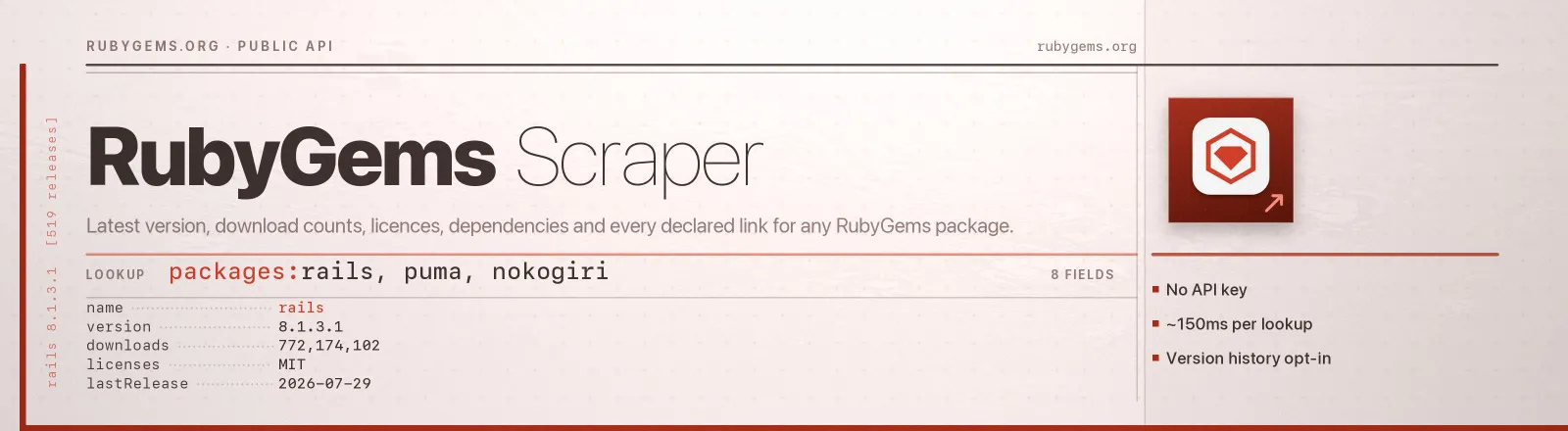
RubyGems Scraper turns any list of gem names into flat, structured records, latest version, total and per-version download counts, licences, runtime and development dependencies, and every link the gem declares: homepage, source, docs, changelog, bug tracker and funding.
It reads the same RubyGems metadata Bundler resolves against. No proxy setup, no browser, no credentials to manage. A gem lookup is a single request.
Agent skill: SKILL.md
What you get
| Output field | Meaning |
|---|---|
name, version, platform | Gem name as RubyGems spells it, latest version, and its platform (ruby, java, …) |
downloads, versionDownloads | All-time downloads for the gem, and downloads for the latest version alone |
lastRelease | When the latest version was pushed |
authors, info | Author line and the gem's description, verbatim from the gemspec |
licenses | Declared SPDX licence identifiers |
yanked, sha | Whether the latest version was withdrawn, plus its checksum |
homepageUri, sourceCodeUri, documentationUri, changelogUri, bugTrackerUri, mailingListUri, wikiUri, fundingUri | The gem's declared links, each null when unset |
projectUri, gemUri | RubyGems page and the direct .gem download URL |
metadata | The raw gemspec metadata map, including flags like rubygems_mfa_required |
runtimeDependencies, developmentDependencies | Dependency name and version requirement for the latest version |
releaseCount, firstRelease, releases | Version history, total count, project age, and per-version detail (opt-in) |
scrapedAt | Run timestamp |
A RUN_SUMMARY record in the key-value store holds per-run counts, the filters used, unknown gem names and any lookup that failed.
Common use cases
- Dependency and licence audits. Resolve a
Gemfile.lockinto licences, maintainership and transitive requirements. - Adoption tracking.
downloadsversusversionDownloadsshows how fast a new release is actually being taken up. - Abandonment detection. A large
releaseCountwith an oldlastReleaseis the signal you are looking for. - Release monitoring. Run with no input on a schedule to capture whatever RubyGems published since the last sweep.
Quick start
Three gems, default depth:
A dependency audit with full history:
Release monitor, no input at all:
Input
| Field | Type | Default | Notes |
|---|---|---|---|
packages | array | [] | Gem names or rubygems.org/gems/. URLs. Empty pulls the most recently published gems from the activity feed. |
includeVersionHistory | boolean | false | Add the releases array and fill in releaseCount and firstRelease. Costs one extra request per gem. |
maxVersions | integer | 20 | Cap on entries in releases, newest first. releaseCount still reports the true total. |
includeDependencies | boolean | true | Include runtimeDependencies and developmentDependencies. They arrive free with the gem lookup. |
maxPackages | integer | 25 | Cap on gems per run. Applies to both an explicit list and the activity-feed fallback. |
Blanks, duplicates and trailing .json are stripped before any request goes out, and two inputs that resolve to the same gem are only saved once.
Gem names are case-sensitive
This trips people up more than anything else about the RubyGems API. rubygems.org/api/v1/gems/RedCloth.json returns 200; the same URL with redcloth returns 404. Paste the name exactly as it appears on the gem's RubyGems page.
As a safety net, a mixed-case name that 404s is retried once in lowercase, so Rails still finds rails. The reverse is not recoverable: nothing about redcloth tells the Actor where the capitals belong.
Output example
API example
Limits and behaviour
authorsis a single string, not a list. RubyGems stores it as free text and plenty of gems use a comma inside one name, "Datadog, Inc.", so splitting on commas would invent authors that do not exist. The field is passed through exactly as published.- Version history is a second endpoint.
releaseCount,firstReleaseandreleasescome from/api/v1/versions/{gem}.json, which is why they arenullunlessincludeVersionHistoryis on. That response is large, Rails returns 519 versions and about 450 KB. - The no-input path costs one request. The activity feed returns fully-formed gem objects, so the 25 default records are built without a single per-gem lookup. It lists a gem once per push, so repeats are collapsed before the cap is applied.
- A missing gem is a per-item failure. RubyGems answers 404 with a plain-text body, not JSON; that name lands in
RUN_SUMMARY.unknownPackagesand the run carries on. The Actor errors out only when every lookup failed. - Transient errors are retried. 429 and 5xx get three attempts with backoff, honouring
Retry-Afterwhen RubyGems sends one. Requests are spaced 200 ms apart, comfortably inside the documented public-API budget. - Dependencies describe the latest version only. The API does not expose historical dependency graphs;
releasesentries carry version, date, downloads and platform, not requirements.
Defaults: 1 GB memory, 15 minute timeout.
FAQ
Do I need a RubyGems account or API key? No. You supply no credentials.
Does it need a proxy? No. There is nothing for a proxy to solve.
Why is versionDownloads so much smaller than downloads? downloads is all-time across every version ever published; versionDownloads counts only the latest one. Their ratio is a decent proxy for upgrade velocity.
Can I get metadata for a specific old version? Turn on includeVersionHistory, each entry carries its own date, download count, Ruby requirement and checksum.
What does platform mean? Most gems are ruby (pure Ruby, any platform). Native extensions publish per-platform variants such as java or x86_64-linux, and each is a separate row in the version history.
Can I schedule it? Yes. Diff on version or lastRelease between runs to detect new releases, and use the empty-input mode to catch gems you weren't already tracking.
Can I integrate it with something else? Yes, Apify API, client libraries, webhooks, scheduled runs, dataset exports (JSON/CSV/Excel) or MCP. Output is structured JSON.


