

OpenAlex Research Papers Scraper: citations, abstracts, PDFs
Pricing
$0.50 / 1,000 works
OpenAlex Research Papers Scraper: citations, abstracts, PDFs
Survey a field or feed AI agents with author IDs, institutions, topics and plain-text summaries of monographs and drafts. No login, no proxy.
Pricing
$0.50 / 1,000 works
Rating
0.0
(0)
Developer

BEPO Labs
Maintained by CommunityActor stats
0
Bookmarked
2
Total users
1
Monthly active users
8 days ago
Last modified
Categories
Share
🎓 What is OpenAlex Research Papers?
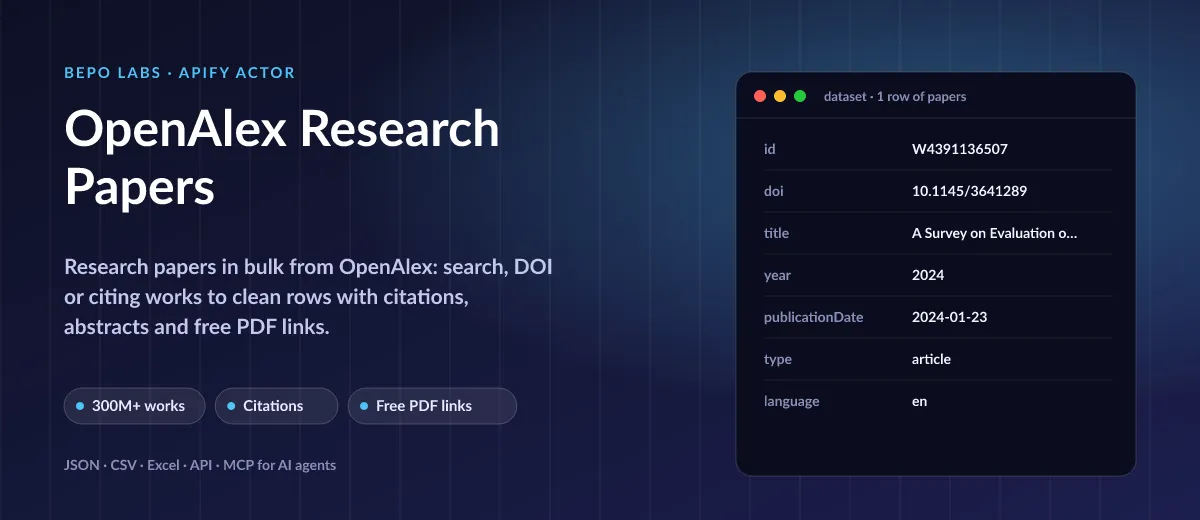
Build a reading list in minutes: this Actor turns keywords, DOIs or one seed paper into a tidy table of publications from OpenAlex, the open catalogue of over 300 million research papers and more (CC0). Each row brings venue, ORCID-tagged authors, citations, openness terms and the free PDF where one exists.
- Literature reviews: the most relevant or most cited open-access papers on a topic since a given year, in one spreadsheet
- Citation tracking: every new paper that cites your own study, a rival lab's or a landmark one, on a schedule
- AI, RAG and research agents: abstracts and free PDF links for a reading list of DOIs, ready for ChatGPT, Claude or a vector database
- Research intelligence: who publishes on a topic, at which institutions, in which journals
- Reference checks: resolve a list of DOIs to clean metadata and spot retracted papers
✨ Why use this Actor?
- ✅ Three ways in: search terms, direct DOI or OpenAlex id lookups, and "works citing this paper"
- ✅ Abstracts in plain words: OpenAlex stores each as a word index; the Actor rebuilds the readable passage
- ✅ Free reading copies located: open-access flag, the preferred location and the PDF address where one exists
- ✅ Clean people data: each contributor with OpenAlex id, ORCID and institutions
- ✅ Filters that matter: years, work type, open access only, sorted by relevance, citations or newest
- ✅ Cheap and fair: 0.5 USD per 1,000 works, deduped across your searches; you pay only for works saved
📦 What data can you get with OpenAlex Research Papers?
| 📄 Title | 🔖 DOI and OpenAlex id | 📅 Year and publication date |
| 🏛️ Journal or venue and publisher | 👩🔬 Authors with ORCID | 🏫 Author institutions |
| 📈 Times cited | 📚 Reference count | 🔓 Open-access status and link |
| 📥 PDF link | ⚖️ Licence | 🧭 Topic and field |
| 📝 Abstract (plain text) | 🚫 Retraction flag | 🔗 OpenAlex and landing page URL |
🚀 How to use OpenAlex Research Papers
OpenAlex Research Papers works in a few clicks, no coding needed:
- Create a free Apify account (the free plan includes 5 USD of monthly credit).
- Open OpenAlex Research Papers and click Try for free.
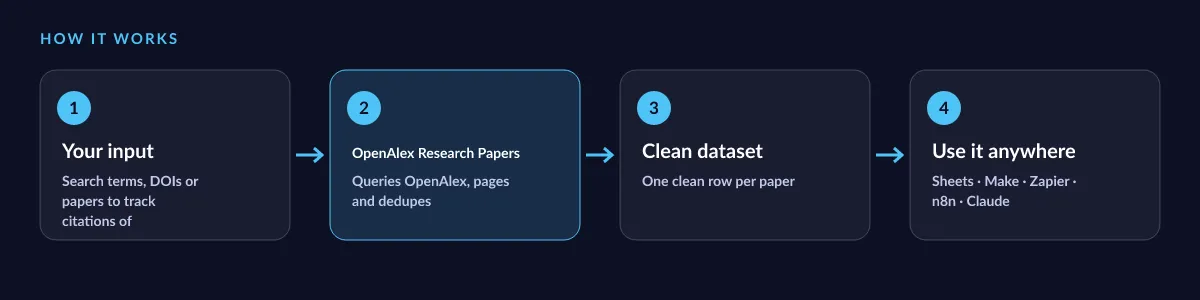
- Enter keywords, DOIs or the papers whose citing works you want. Set the years, type and how many works each.
- Click Start and wait for the run to finish (most runs take seconds).
- Download your data as JSON, CSV, Excel, XML or HTML, or send it straight to Google Sheets, Make, Zapier or your AI agent.
⬇️ Input
Give at least one search term, DOI or OpenAlex work id, up to 200 per run. Everything else is optional.
Search, look up or follow citations
queries runs a full-text search over titles, abstracts and full texts. works looks up DOIs (10.1038/nature14539, https://doi.org/...) or OpenAlex ids (W2194775991) directly, 50 per call. citingWorksOf returns the works that cite each DOI or id.
Filters and sorting
Narrow with fromYear, toYear, type (article, review, preprint, book, book-chapter, dissertation, dataset) and openAccessOnly. Order by relevance, cited (most cited first) or newest. Citing lists are ranked by citations when relevance is chosen.
Free OpenAlex API key for big runs
OpenAlex gives every caller a small free daily budget. For runs of thousands of works, add your own free token from openalex.org/settings/api in apiKey; the Actor then pages with a cursor. If OpenAlex answers "rate limited", the run summary says so.
| Field | Type | What it does | Default |
|---|---|---|---|
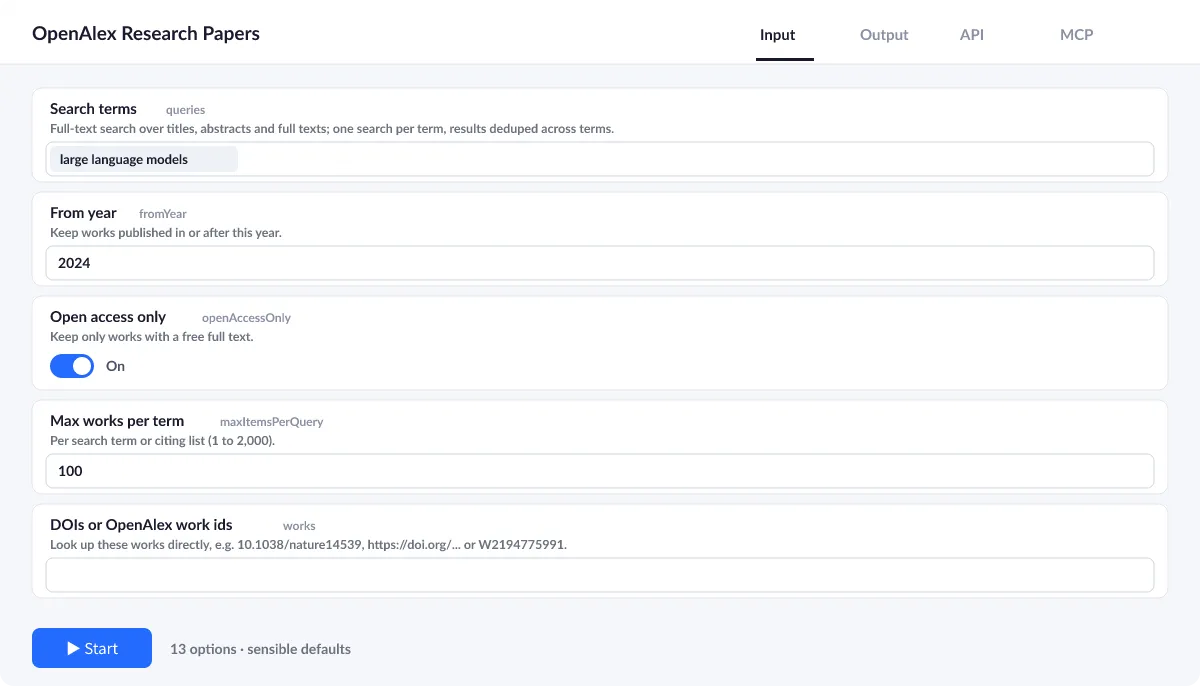
Search terms (queries) | array | Full-text search over titles, abstracts and full texts; one search per term, results deduped across terms. | ["large language models"] |
DOIs or OpenAlex work ids (works) | array | Look up these works directly, e.g. | |
Works citing these (citingWorksOf) | array | DOIs or OpenAlex work ids; returns the works that cite each one. | |
Sort (sort) | string | relevance (search terms only; citing lists use cited), cited (most cited first) or newest. | "relevance" |
From year (fromYear) | integer | Keep works published in or after this year. | 2023 |
To year (toYear) | integer | Keep works published in or before this year. | 2026 |
Type (type) | string | Return only works of this type, for example "article", "review", "preprint", "book", "book-chapter", "dissertation" or "dataset". | |
Open access only (openAccessOnly) | boolean | Keep only works with a free full text. | false |
Include abstract (includeAbstract) | boolean | Add the abstract text where OpenAlex has it. | true |
Max works per term (maxItemsPerQuery) | integer | Per search term or citing list (1 to 2,000). | 100 |
OpenAlex API key (apiKey) | string | Optional, free at openalex.org/settings/api. | |
Contact email (email) | string | Optional; OpenAlex asks for one in heavy use. | |
Max retries (maxRetries) | integer | Per request, on timeouts, rate limits and server errors. | 3 |
Input example
⬆️ Output
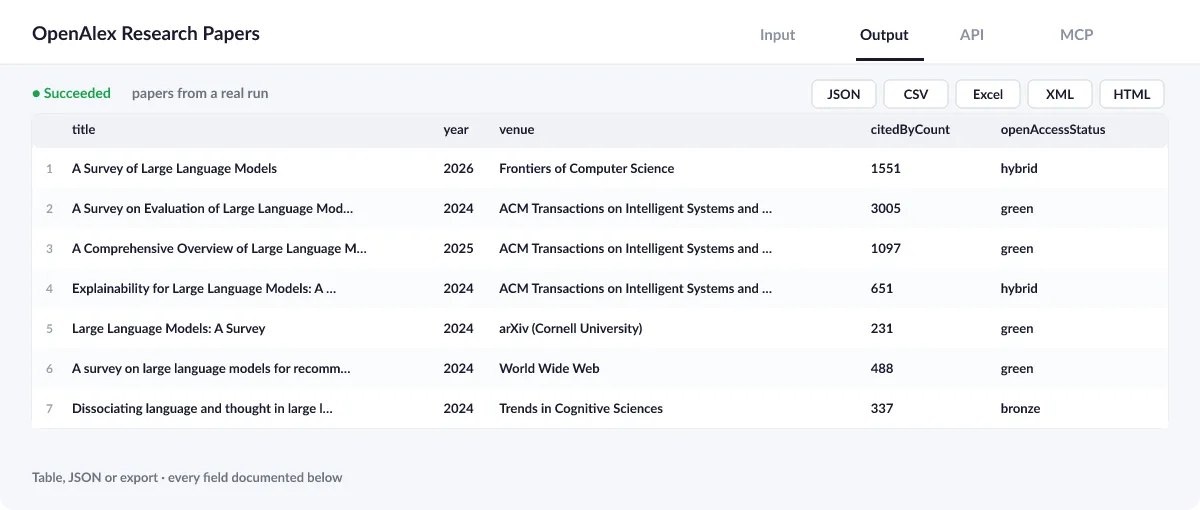
Every work becomes one row with the same fields, whichever route led to it; source names the search term, lookup or citing list. Works reached twice are kept once. The run summary in the key-value store (OUTPUT) lists every entry with its yield and the error if one failed.
Output example
One row of the dataset (search "large language models", open access, since 2024; authors and abstract shortened):
Run summary (OUTPUT)
The key-value store record OUTPUT has the self-check and one line per query, so a failure is never silent:
View the results as a table or JSON in the Output tab and download them as JSON, CSV, Excel, XML, HTML or RSS, all fields or only those you pick.
💰 How much does OpenAlex Research Papers cost?
OpenAlex Research Papers is priced per event: 0.5 USD per 1,000 works (0.0005 USD each), with no monthly rental. Each work saved to the dataset is billed once, even if two searches reached it; a search without hits is free.
| You get | You pay |
|---|---|
| 100 works | 0.05 USD |
| 1,000 works | 0.5 USD |
| 10,000 works | 5 USD |
| 100,000 works | 50 USD |
💡 Apify's free plan gives you 5 USD of credit every month, enough for about 10,000 works at no cost. Set a spending limit per run and the Actor stops there.
⚖️ OpenAlex Research Papers vs. the alternatives
| OpenAlex Research Papers | Search engine scrapers | Manual export from a database | |
|---|---|---|---|
| Source | ✅ open API, no scraping | scraped result pages, can break | web interface |
| DOI lookup and citing works | ✅ both | search only | one paper at a time |
| Authors with ORCID and institutions | ✅ | names only | varies |
| Abstract and free PDF link | ✅ | snippet only | often paywalled |
| Licence of the data | ✅ CC0, reuse freely | unclear | licence terms apply |
| API, schedules and MCP for AI agents | ✅ | ✅ | ❌ |
🔌 Integrations, API and MCP
Connect OpenAlex Research Papers to your AI agent (MCP)
Give Claude, ChatGPT, Cursor or any MCP client direct access to OpenAlex Research Papers through the Apify MCP server. Add this URL to its settings:
For Claude Desktop, add it under mcpServers in claude_desktop_config.json:
Then ask: "Find the 20 most cited open-access papers on retrieval-augmented generation since 2024 and summarise what each one found."
Run it from your code
Python (pip install apify-client):
JavaScript (npm install apify-client):
No-code integrations
Send results to Google Sheets, Slack, Airtable, HubSpot, Make, Zapier, n8n and more from the Integrations tab, start runs on a schedule, or trigger your own endpoint with a webhook when a run finishes. The Apify API gives you full control over runs and datasets.
❓ FAQ
Where does the data come from?
From the official OpenAlex API. OpenAlex is a free, open index of scholarly works run by the non-profit OurResearch; it builds on Crossref, PubMed, arXiv, institutional repositories and more.
How many papers can I get?
Up to 2,000 works per search term or citing list and up to 200 terms, DOIs and ids per run. Split bigger pulls by year with fromYear and toYear.
Do I need an OpenAlex API key?
No for small runs. OpenAlex gives every caller a modest free daily allowance; for regular or large runs add your own free key in apiKey so you never share it.
Can I get the full text?
The Actor gives you the abstract plus open-access and PDF addresses where OpenAlex knows one. Feed those to a document-to-text Actor for the full text.
How do I track new citations of my paper?
Put its DOI in citingWorksOf, set sort to newest and schedule the Actor weekly.
Is it legal to use OpenAlex Research Papers?
Yes. OpenAlex data is released under CC0 and the Actor reads it through OpenAlex's official public API. Abstracts and linked full texts stay under their publishers' and authors' terms: check the license field before you republish them.
What if something is missing or does not work?
Open an issue on the Issues tab; we read each one and reply. Feature requests are welcome too.
💬 Your feedback
Tell us what OpenAlex Research Papers should add on the Issues tab or leave a review; your notes decide what we work on next.
🔗 Related Actors
| Actor | What it does |
|---|---|
| 📄 PDF to Text and Markdown | PDFs to clean text and Markdown, per page, per document or as RAG chunks, with columns in reading order and headers and footers removed. |
| 🔤 Image OCR | Extract text from images in 29 languages: plain text, clean Markdown and every word with its pixel box and confidence. |
| 🏛️ SEC EDGAR Filings | Tickers or CIK numbers to SEC filings: 10-K, 10-Q, 8-K, Form 4 and any other form, with document links. |
| 📝 Website to Markdown | Any web page or docs site to clean Markdown for LLMs, RAG and AI agents, with headings, links and ready-made chunks. |
| 📈 Wikipedia Pageviews | Daily or monthly views of any Wikipedia article in any language, with totals and averages, from the official Wikimedia API. |


