

GitHub Scraper
Pricing
from $30.00 / 1,000 results
GitHub Scraper
Scrapes GitHub repositories, users, trending repos, issues and code via the GitHub REST API v3. Supports authentication tokens for higher rate limits (5000 req/hr vs 60 req/hr unauthenticated). Includes smart analytics: language distribution, license distribution, stars histogram, activity scores...
Pricing
from $30.00 / 1,000 results
Rating
0.0
(0)
Developer

Yuliia Kulakova
Maintained by CommunityActor stats
0
Bookmarked
4
Total users
2
Monthly active users
4 months ago
Last modified
Categories
Share
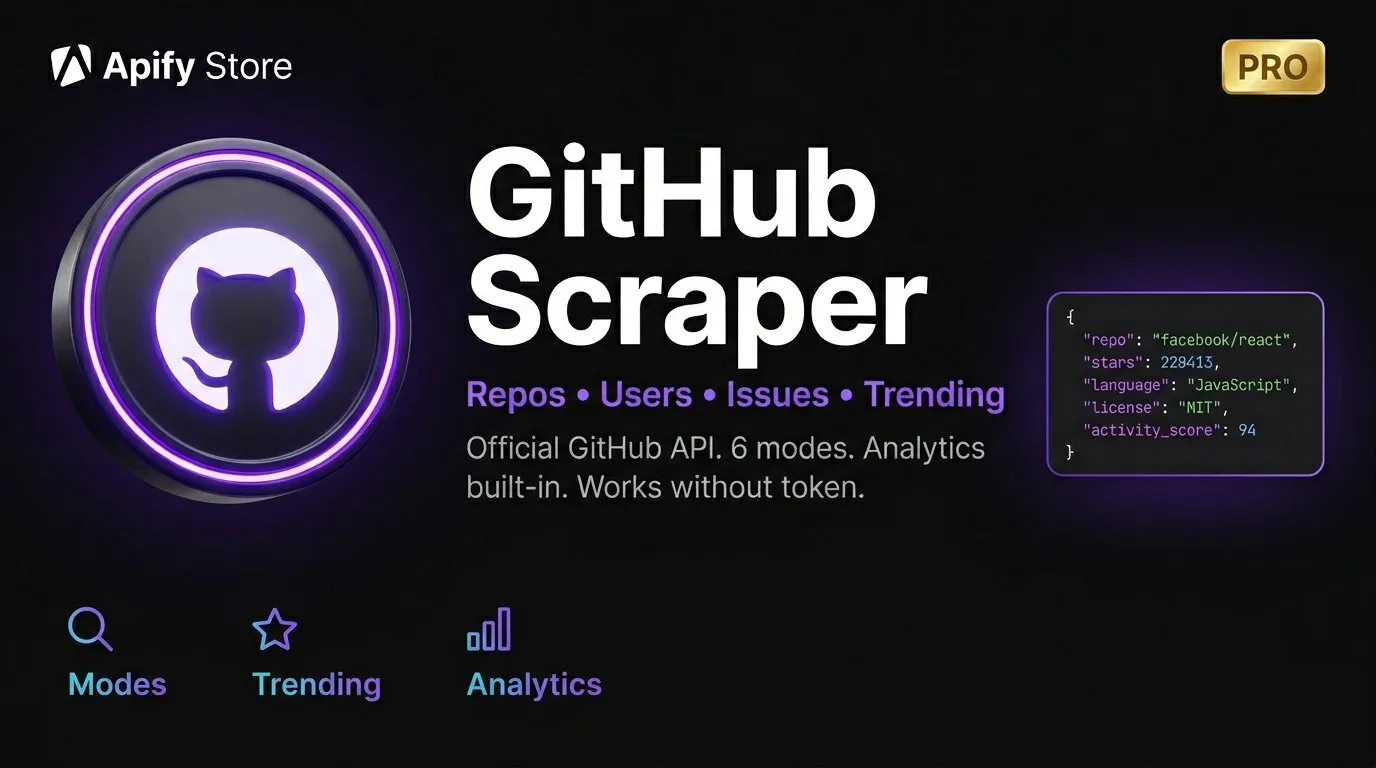
Collect structured data from GitHub — repositories, developers, issues, and trending projects. Get everything you need for market research, competitive analysis, and tech talent sourcing in one place.
What can you scrape?
🔍 Search Repositories
Find repositories by keywords, language, stars, forks, date range, and topics. Perfect for mapping the competitive landscape or discovering open-source tools in any domain.
👥 Search Users
Discover developers and organizations by keyword. Ideal for tech recruiting, community research, and identifying key contributors in specific technology areas.
🐛 Search Issues & Pull Requests
Find open issues and PRs across all of GitHub. Great for tracking bugs, feature requests, and contribution opportunities in your target projects.
🔥 Trending Repositories
See what's hot on GitHub right now — daily, weekly, or monthly trending repos with growth rates. Filter by programming language to focus on your tech stack.
📦 Repository Details
Deep-dive into any repository with full metadata: contributors, latest releases, language breakdown, open PR count, commit count, and more.
👤 User Details
Get complete developer profiles with their public repositories, contribution stats, and activity overview.
Built-in analytics
Every scrape automatically includes a summary with:
- Language distribution — which programming languages dominate your results
- License breakdown — MIT, Apache, GPL and other license usage
- Stars histogram — distribution from small projects to mega-repos
- Activity scores — identify the most actively maintained projects
- Top topics — most popular tags across your results
- Growth rates — star growth trends for trending repos
How much does it cost?
The GitHub Scraper is available on a pay-per-result basis at $0.03 per result. Each repository, user, or issue returned counts as one result. The analytics summary is included with every run at no extra charge.
Example costs:
| Scenario | Results | Cost |
|---|---|---|
| Top 100 ML repos | 100 | $3.00 |
| Daily trending repos | ~25 | $0.75 |
| Single repo deep-dive | 1 | $0.03 |
| 1000 Python repos | 1000 | $30.00 |
Powerful filtering options
- Language filter — focus on Python, JavaScript, Rust, Go, or any language
- Stars & forks minimums — skip small projects, find established ones
- Date ranges — repos created or updated within specific timeframes
- Topics — filter by tags like "machine-learning", "api", "devops"
- Sort options — by stars, forks, update date, or best match
Enrich your data
Enable optional enrichment for deeper insights:
- Contributors — top 30 contributors with commit counts
- Releases — latest release info with download counts
- Language breakdown — bytes and percentages per language
- Commit count — total commits in the repository
- Open PRs — number of open pull requests
Works without a token
The scraper works out of the box — no GitHub account or token required. For larger scrapes, add your Personal Access Token to increase the rate limit from 60 to 5,000 requests per hour.
Use cases
Market research — Map the open-source landscape in any technology area. Compare frameworks, libraries, and tools by popularity, maintenance activity, and community size.
Tech recruiting — Find active developers in specific technologies. Identify top contributors to popular projects and review their public profiles.
Competitive intelligence — Track trending projects, monitor star growth, and discover emerging tools before they go mainstream.
Academic research — Collect datasets about open-source software ecosystems, collaboration patterns, and technology adoption trends.
Investment analysis — Evaluate open-source traction for developer tools and infrastructure startups by tracking stars, forks, and community engagement.
Input examples
Search for machine learning repos with 1000+ stars:
Get daily trending repos:
Deep-dive into a specific repo:
Output sample
Each repository result includes:


