

PubMed Biomedical Paper Scraper
Pricing
from $30.00 / 1,000 results
PubMed Biomedical Paper Scraper
Scrapes PubMed biomedical papers using the official NCBI Entrez API. Extracts full metadata including abstracts, MeSH terms, authors with affiliations, citations, grants, and more. Includes smart analytics for author networks, topic trends, and geographic distribution.
Pricing
from $30.00 / 1,000 results
Rating
0.0
(0)
Developer

Yuliia Kulakova
Maintained by CommunityActor stats
0
Bookmarked
2
Total users
0
Monthly active users
5 months ago
Last modified
Categories
Share
PubMed Scraper — Biomedical Research, Abstracts & Citations
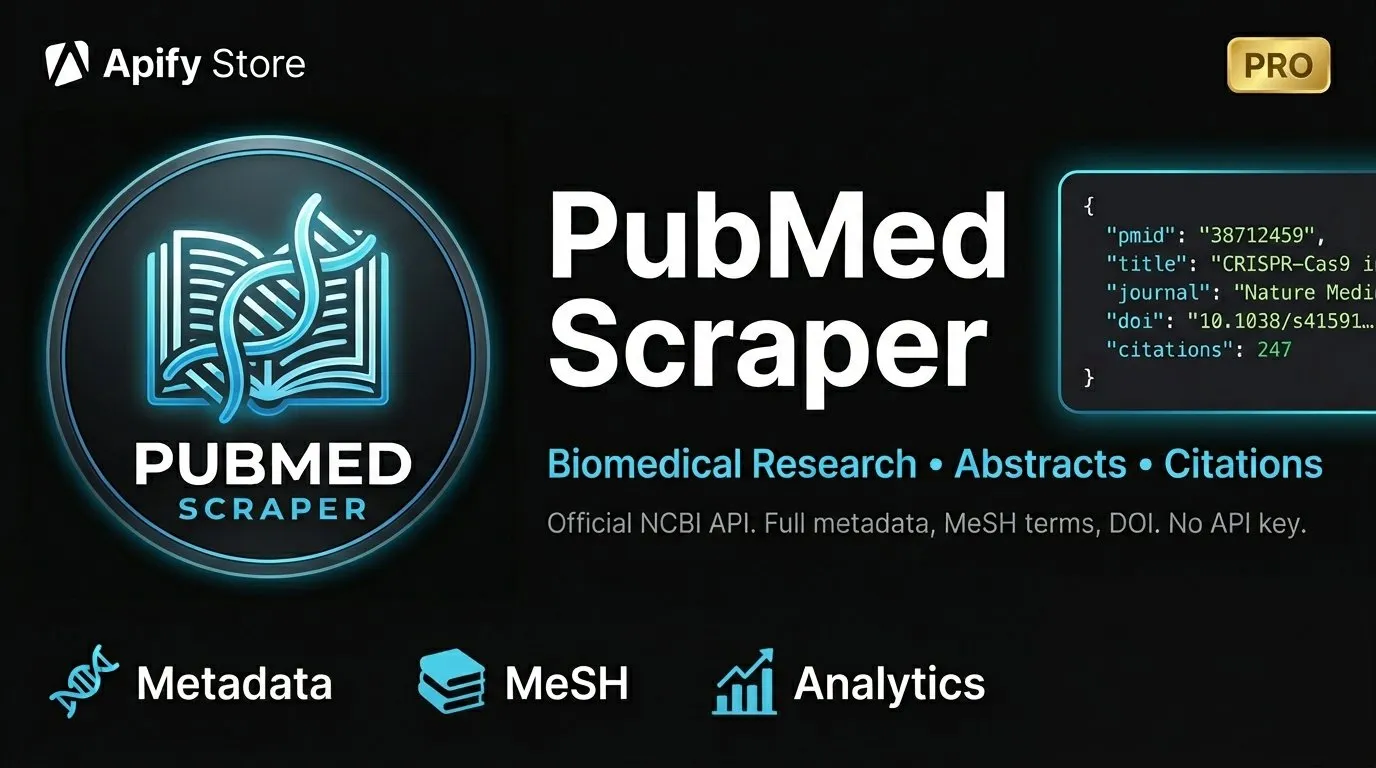
Search and extract biomedical research papers from PubMed — the world's largest database of life sciences and biomedical literature. Get full metadata, abstracts, MeSH terms, citations, author networks, and smart analytics. Powered by the official NCBI Entrez API.
What can this scraper do?
- Search by any query — use simple keywords or advanced PubMed syntax with MeSH terms and field tags
- Full metadata extraction — authors with affiliations and ORCID, journal info, DOI, publication types, grants, chemicals
- Abstracts — complete structured abstracts for every article
- MeSH terms — Medical Subject Headings with major topic indicators and qualifiers
- Citation data — cited-by counts and reference PMIDs
- Smart analytics — author networks, topic trends by year, top journals, funding agencies, geographic distribution
- Multiple databases — PubMed, PubMed Central (PMC), Gene, Protein
- No API key required — works out of the box, optional API key for faster rate limits
Why use PubMed Scraper?
| Use case | How it helps |
|---|---|
| Literature review | Collect hundreds of papers on any topic with full abstracts and metadata |
| Competitive intelligence | Track research output from specific institutions or authors |
| Pharma & biotech research | Monitor clinical trials, drug targets, and therapeutic areas |
| Grant landscape analysis | Identify top funding agencies and grant patterns in your field |
| Bibliometric analysis | Analyze publication trends, co-authorship networks, and journal distributions |
| Academic research | Build structured datasets for systematic reviews and meta-analyses |
| Trend monitoring | Track emerging topics through MeSH term trends over time |
Output data
Article data
Each article includes all available metadata:
| Field | Description |
|---|---|
| PMID & PMCID | PubMed and PubMed Central identifiers |
| Title | Article title |
| Authors | Full list with last name, first name, affiliations, and ORCID |
| Abstract | Complete abstract text |
| Journal | Name, abbreviation, ISSN, volume, issue, pages |
| Publication date | ISO format date |
| DOI | Digital Object Identifier |
| Publication types | Journal Article, Review, Clinical Trial, Meta-Analysis, etc. |
| MeSH terms | Descriptors with qualifiers and major topic flags |
| Keywords | Author-provided keywords |
| Grant info | Grant IDs, agencies, and countries |
| Chemicals | Registry numbers and substance names |
| Full text URL | PMC link for open access articles |
| Cited-by count | Number of citing articles (when enabled) |
| References | First 10 reference PMIDs (when enabled) |
| Language & country | Publication language and journal country |
| Clinical trial ID | Associated trial registry number |
| Retraction status | Whether the article has been retracted |
| Conflict of interest | Author disclosures |
Smart analytics
Every run can include an automatic analytics summary:
| Analytics | What you get |
|---|---|
| Top authors | Most prolific authors with collaborator counts |
| Author networks | Co-authorship connections and top collaborators |
| Topic trends | MeSH major topics by year |
| Journal distribution | Top journals by article count |
| Funding agencies | Top grant sources |
| Geographic distribution | Articles by country |
| Publication types | Breakdown by article type |
| Open access rate | Percentage of open access articles |
| Publications by year | Yearly publication volume |
Filters & options
| Filter | Options |
|---|---|
| Date range | From/to dates (YYYY/MM/DD format) |
| Sort by | Relevance, Publication date, Most cited |
| Species | All, Human only, Animal only |
| Language | Filter by publication language (eng, fre, de, etc.) |
| Publication type | Journal Article, Review, Clinical Trial, Meta-Analysis, etc. |
| Database | PubMed, PMC, Gene, Protein |
| Include abstract | Full abstract text (on by default) |
| Include MeSH | Medical Subject Headings (on by default) |
| Include citations | Cited-by counts and references |
| Include full text links | PMC open access URLs |
| Include analytics | Smart analytics summary |
How much does it cost?
PubMed Scraper uses a pay-per-result model at $0.03 per result. No monthly fees — you only pay for the data you collect.
| Results | Cost |
|---|---|
| 100 articles | $3.00 |
| 500 articles | $15.00 |
| 1,000 articles | $30.00 |
| 10,000 articles | $300.00 |
Platform costs are included in the per-result price.
Input examples
Basic search
Advanced PubMed syntax with date filter
Multi-query research with citations
Systematic review — specific publication types
PubMed Central full text search
Tips for best results
- Start small — test with 10-20 results to verify your query before scaling up
- Use PubMed syntax — field tags like
[MeSH],[tiab],[au]give precise control over search results - API key — get a free NCBI API key to increase rate limits from 3 to 10 requests/second
- Citations wisely — enable
includeCitationsonly when needed, it requires extra API calls - Species filter — use
humanfor clinical research,animalfor preclinical studies - Sort by citations —
cited_by_counthelps find the most impactful papers in your field - Combine queries — use multiple queries to cover different aspects of your research topic
Limitations
- PubMed API returns up to 9,999 results per query (NCBI hard cap). For larger datasets, split into narrower date windows
- Citation counts are approximate and may not reflect the latest data
- Full text is only available for open access articles in PMC
- Rate limits: 3 requests/second without API key, 10 requests/second with key
- Analytics summary is included as the last record in the dataset (field
type: "analytics")


