

Quora Scraper: Answers, Upvotes, Views & Authors, No Login
Pricing
from $0.65 / 1,000 answers
Quora Scraper: Answers, Upvotes, Views & Authors, No Login
Scrape Quora questions and answers by question URL or topic: answer text, author, credential, upvotes, views, shares, comments and dates. Find content ideas, experts and what people ask about your market. No login, public data only.
Pricing
from $0.65 / 1,000 answers
Rating
0.0
(0)
Developer

Cliqto Media
Maintained by CommunityActor stats
0
Bookmarked
2
Total users
1
Monthly active users
7 days ago
Last modified
Categories
Security
Limited permissionsShare
Quora Scraper reads public Quora questions and topics and returns their answers: text, author, credential, upvotes, views, shares, comments and dates. No login, cookies or API key. The example run reads 1 question with 5 answers in under 10 seconds and costs $0.0175 on the Free tier.
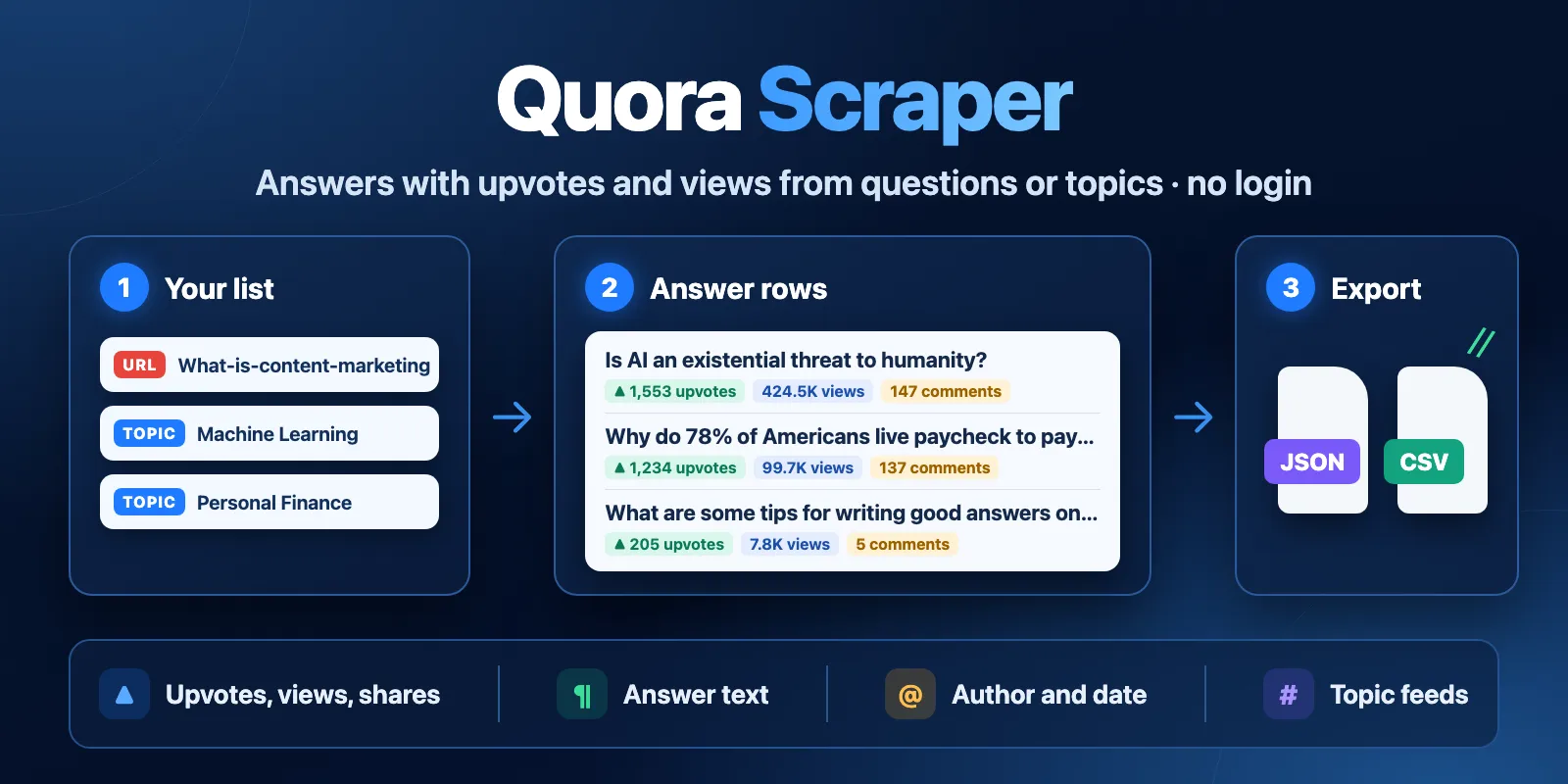
Table of contents
- What it does
- How it works
- Data you get
- Quick start
- Use cases
- Input
- Input examples
- Output
- Pricing
- Scheduled runs
- API, export and integrations
- Coming from another Quora scraper
- Limits
- Troubleshooting
- FAQ
- Related Actors
- Support
What it does
The Actor opens public Quora pages as a logged-out visitor. Choose one mode:
- Question URLs (
question) — paste question links, such ashttps://www.quora.com/What-is-content-marketing. Answer links (…/answer/Name) work too: you get the answers of their question. - Topic (
topic) — give topic names or topic links, such asContent Marketing. The Actor reads the questions of each topic and their answers.
Each answer is one row with the fields of its question. A question without answers is one row too, so you always see what happened to every input.
Good fit
- Find what people ask and answer about your product, market or keyword topic.
- Collect answers with upvotes and views to pick content ideas or measure interest.
- Find active authors and their credentials in a topic.
- Feed real questions and answers to research, SEO or AI tools.
Not a fit
- Keyword search. Quora search needs a login, so use a topic instead.
- All answers of a big question. Quora hides some answers from logged-out visitors (see Limits).
- Profiles, Spaces, followers or private content. The Actor does not log in and does not bypass a login, CAPTCHA or paywall.
- Quora in other languages (
fr.quora.com,de.quora.comand others). Only Englishwww.quora.comis supported.
How it works
- The Actor opens each question or topic page on
www.quora.comas a logged-out visitor, through a residential proxy by default. - It reads the answers Quora shows on that page and its next pages, up to your limit, and skips Quora's own AI bot answers.
- It saves one row per answer (or one row per question without answers) to the Dataset, and counts, stop reason and warnings to
RUN_SUMMARY.
Data you get
Each row is one answer: question, questionUrl, questionAnswerCount, answerId, answerUrl, text, author (authorName, authorProfileUrl, authorCredential, authorIsAnonymous), metrics (upvotes, views, shares, comments), createdAt, updatedAt, language, and for topic runs topic and topicUrl. Every row also has status, error, sourceInput and fetchedAt.
A missing number is null, not 0. 0 means Quora shows zero.
The run report RUN_SUMMARY (in the Key-value store) has counts, the stop reason and warnings.
This Actor is independent. It is not made or endorsed by Quora. Answers belong to their authors; check the Quora Terms of Service before you reuse the text. Quora's terms and robots.txt restrict automated collection and reuse of its content, including for training AI models; make sure your use is allowed.
Quick start
-
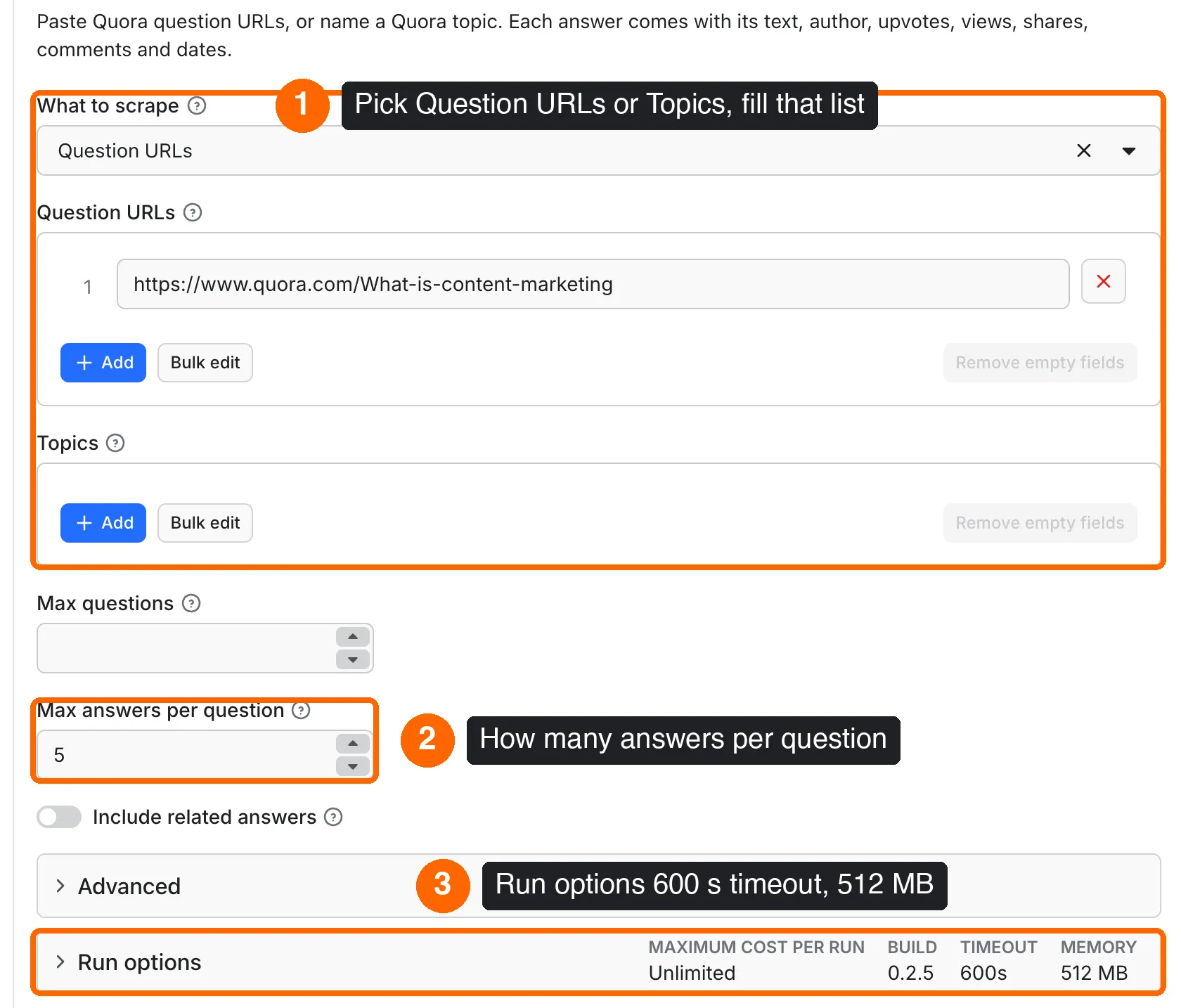
Open the Input tab. Keep What to scrape (
mode) atQuestion URLsand the prefilled Question URLs (questionUrls)https://www.quora.com/What-is-content-marketing, or paste your own links. For a topic, chooseTopicand fill Topics (queries) instead (box 1). -
Keep Max answers per question (
maxAnswersPerQuestion) at the prefilled 5, or set up to 50 (box 2). -
Keep the run options: 600 seconds timeout and 512 MB memory. The residential proxy is already set under Advanced (box 3).
-
Click Start in the bar at the bottom of the page, then open the Output tab. The Answers view shows the answer text, author, upvotes and views of each answer (box 4).
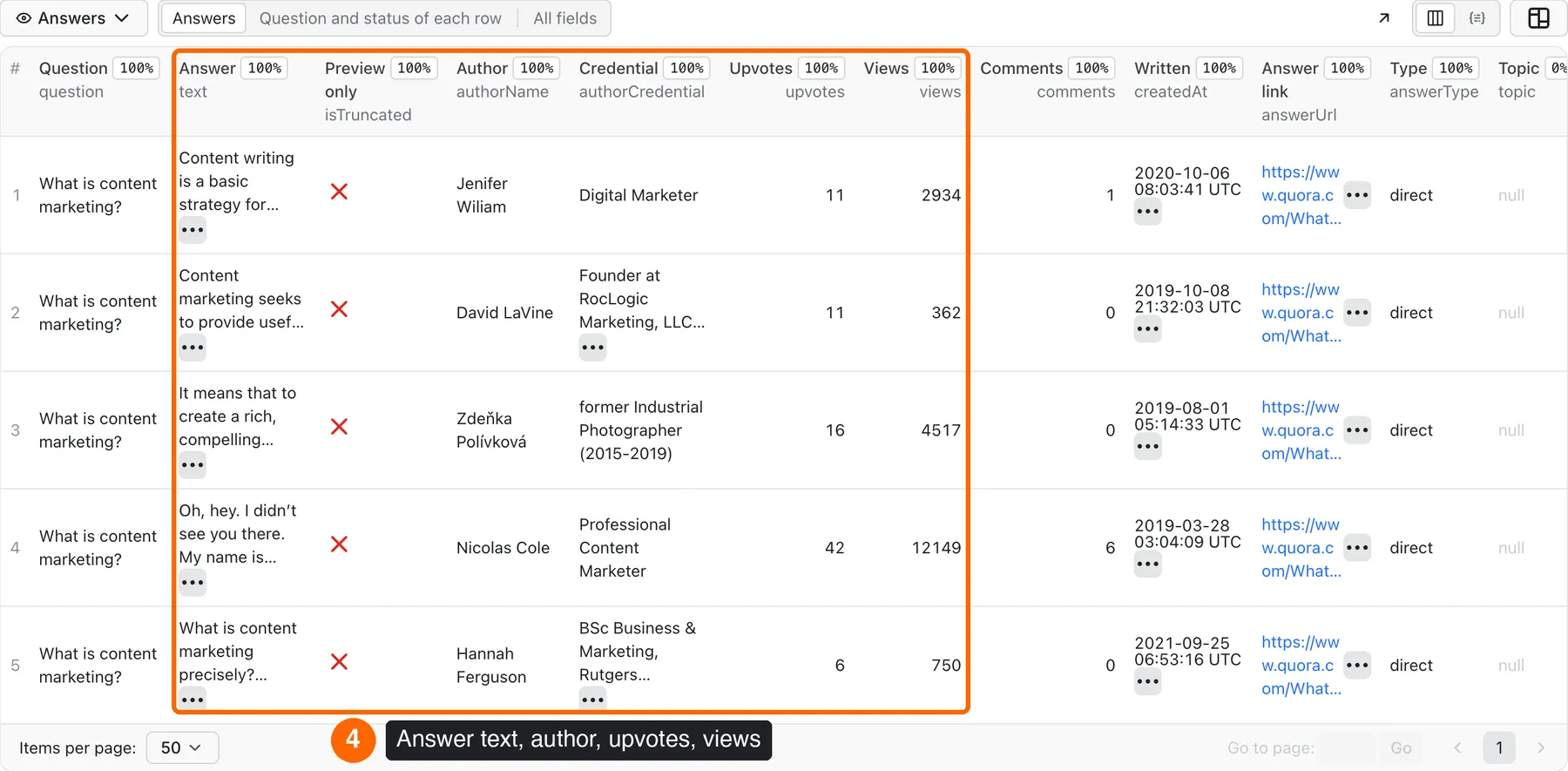
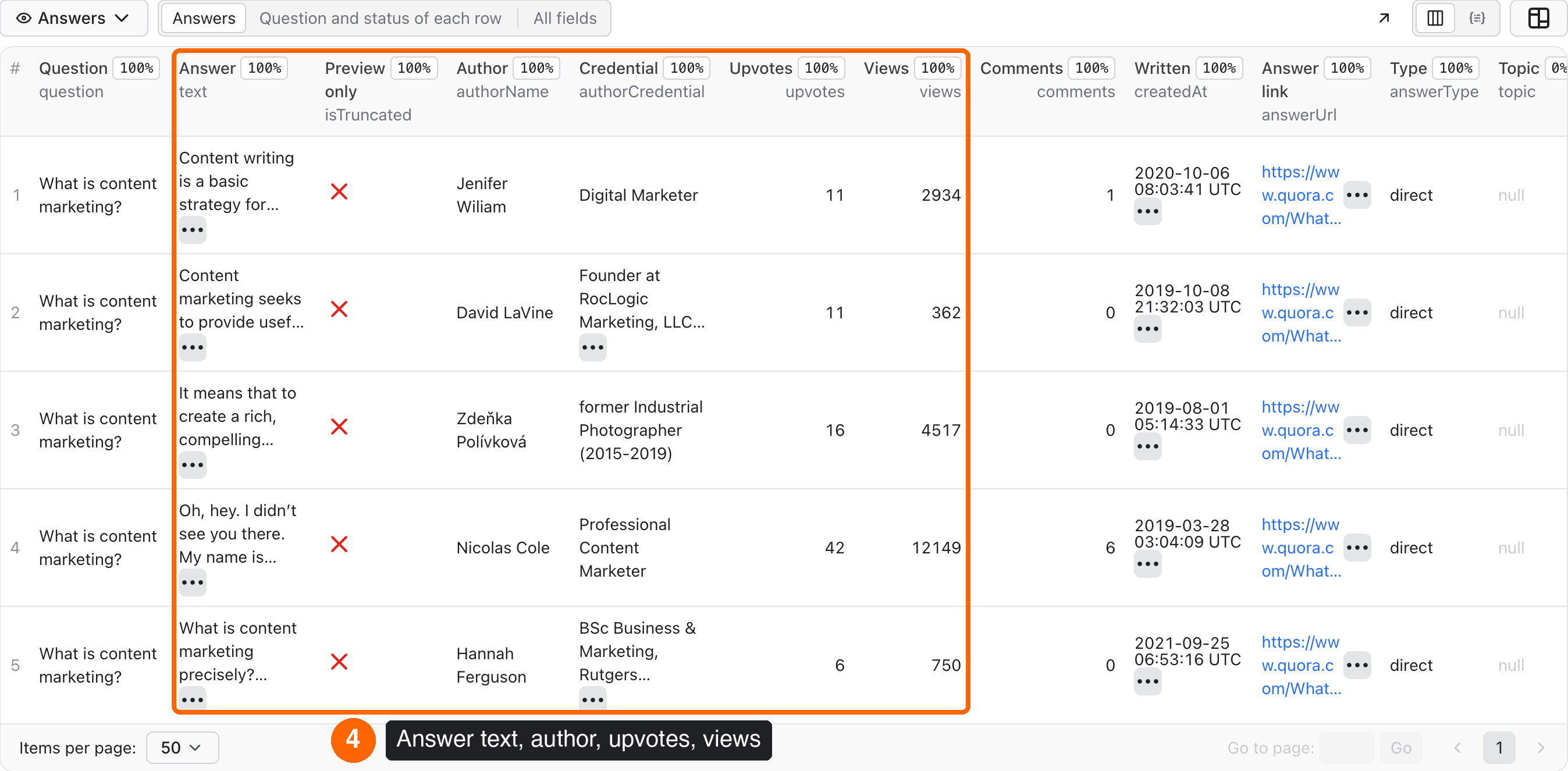
Expected result: 5 answers of the question in under 10 seconds, each with status: "complete".
Use cases
| Job | Input | Key fields |
|---|---|---|
| Content ideas from real questions | topic mode, maxAnswersPerQuestion: 0 | question, questionAnswerCount |
| See which answers people like | question URLs | upvotes, views, text |
| Find experts in a topic | topic mode | authorName, authorCredential, authorProfileUrl |
| Brand or competitor mentions in answers | question URLs about your market | text, createdAt, answerUrl |
| Data for AI and research | topic mode | question, text, language |
Input
| Field | Name in Console | Type | Default | Allowed | What it does |
|---|---|---|---|---|---|
mode | What to scrape | string | question | question, topic | Question links or topics. |
questionUrls | Question URLs | list of strings | — (example: 1 URL) | up to 100 quora.com question or answer URLs | Questions to read in question mode. |
queries | Topics | list of strings | — | up to 5 topic names or topic URLs | Topics to read in topic mode. |
maxQuestions | Max questions | integer | empty | 1–100 | Topic: questions per topic (empty = 20). Question URLs: only the first N URLs (empty = all). |
maxAnswersPerQuestion | Max answers per question | integer | 5 | 0–50 | Answers per question in Quora's order. 0 returns the question only. |
includeRelatedAnswers | Include related answers | boolean | false | — | Also return answers Quora shows from similar questions (answerType: "related"). |
proxyConfiguration | Proxy | object | Apify residential, US | — | Quora blocks most datacenter traffic. Keep the default. |
Other notes:
- The Actor uses only the list of the chosen mode. In
questionmodequeriesis ignored, intopicmodequestionUrlsis ignored. - Duplicate URLs (
?share=1,m.quora.com, answer links of the same question) are read once.RUN_SUMMARYcounts them asduplicatesSkipped. - A bad URL (not Quora, a profile, a topic in question mode) is a free row with
status: "error". The run goes on. - More than 100 URLs, more than 5 topics, or limits out of range: the run stops at once with an input error.
Input examples
Answers of a few questions
Expected result: up to 10 answers for each question, ordered as Quora shows them.
Questions and answers of a topic
Expected result: up to 20 questions per topic with up to 3 answers each, about 1–2 minutes.
Only the questions of a topic
Expected result: one row per question with question, questionUrl and questionAnswerCount, no answers.
Output
Output example
One answer row from the example run (text shortened). The question has 371 answers on Quora; the example asks for 5.
Output fields
| Field | Type | Can be null? | Meaning |
|---|---|---|---|
recordType | string | no | answer, question (a question row without answers) or topic (a topic that does not exist or could not be read). |
status | string | no | complete, partial (the run stopped while reading this question), not_found (Quora says the question or topic does not exist) or error (bad input or Quora could not be read). |
questionUrl | string | yes | Question page on www.quora.com. |
questionId | number | yes | Quora question ID. |
question | string | yes | Question title. |
questionAnswerCount | number | yes | Answer count Quora shows for the question. It can be bigger than the answers you can get as a visitor. |
answerId | number | yes | Quora answer ID. null on question rows. |
answerUrl | string | yes | Link to the answer. |
answerType | string | yes | direct (posted on this question) or related (from a similar question, only with includeRelatedAnswers). |
relatedQuestionUrl, relatedQuestion | string | yes | The similar question of a related answer. |
text | string | yes | Answer text as plain text. Lists and line breaks are kept. |
isTruncated | boolean | yes | true when Quora shows only a preview of this answer to visitors who are not logged in (some Quora+ answers); text then ends with "...". null on question and topic rows. |
authorName | string | yes | Author name. null for anonymous answers. |
authorProfileUrl | string | yes | Author profile link. |
authorCredential | string | yes | Author credential shown with the answer, such as a job title. |
authorIsAnonymous | boolean | yes | true when the answer is anonymous. |
upvotes, views, shares, comments | number | yes | Metrics Quora shows. null = Quora did not give the number. |
createdAt, updatedAt | string (ISO 8601) | yes | When the answer was posted and last changed. |
language | string | yes | Answer language code, such as en. |
isAiAnswer | boolean | yes | true when Quora marks the author as an AI account. null when the author is unknown. |
topic, topicUrl | string | yes | The topic of the row in topic mode. |
sourceInput | string | no | The input line this row comes from. |
source | string | no | Always quora.com. |
fetchedAt | string (ISO 8601) | no | When the row was read. |
error | string | yes | What went wrong on error rows. null otherwise, also on not_found. |
Where to find results
- Answers view — the main table: question, text, preview flag, author, credential, upvotes, views, comments, date, and the
statusanderrorof each row. - Question and status of each row view — one look at every input: question, answer count, topic,
statusanderror. - Key-value store →
RUN_SUMMARY— counts (answers,questions,topics,notFound,errors,hiddenAnswers,duplicatesSkipped),stopReasonandwarnings.
Pricing
You pay per event. Prices on the Free plan (higher plans pay less):
| Event | Price | When |
|---|---|---|
| Actor start | $0.01 per GB of memory, at least $0.01 | Once per run. The default 512 MB run = $0.01. The start fee grows with memory: a 2 GB run pays $0.02. |
| Question | $0.0035 | Each question Quora returns, with or without answers, or says it does not exist. |
| Answer | $0.0008 | Each answer row. |
| Topic | $0.005 | Each topic Quora returns, with or without questions, or says it does not exist. |
Free: rows with status: "error" (bad input, Quora could not be read), duplicate URLs and questions the run did not reach. Apify platform usage is included in the event prices.
Cost examples
| Run | Events | Cost on Free plan |
|---|---|---|
| Example: 1 question, 5 answers | start + 1 question + 5 answers | $0.0175 |
| 10 questions, up to 50 answers (measured: 269 answers) | start + 10 questions + 269 answers | $0.2602 |
| 1 topic, 20 questions, 5 answers each | start + 1 topic + 20 questions + 100 answers | $0.165 |
1 topic, 50 questions, questions only (maxAnswersPerQuestion: 0) | start + 1 topic + 50 questions | $0.19 |
| 1 question URL that does not exist | start + 1 question | $0.0135 |
| Only bad URLs, or Quora could not be read | start only | $0.01 |
To cap a run, set Maximum charge per run in the run options. The run stops at the cap with status: "partial" and stopReason: "CHARGE_LIMIT" and keeps the rows it already saved.
Scheduled runs
Use Apify schedules to read the same topics every day or week. Every run returns what Quora shows at that time; it does not remember earlier runs. To keep only new answers, compare answerId with your earlier data.
API, export and integrations
- API: start the Actor with the Apify API and the same JSON input. Read rows from the run's default dataset.
- Export: download the dataset as JSON, CSV, Excel, XML or HTML.
- Integrations: send results to Google Sheets, Make, Zapier, n8n or a webhook when the run ends.
Use with AI agents (MCP)
- MCP server with only this Actor:
https://mcp.apify.com?tools=cliqtomedia/quora-scraper(Apify MCP docs). - Smallest useful input:
{"mode": "question", "questionUrls": ["https://www.quora.com/What-is-content-marketing"], "maxAnswersPerQuestion": 5}. - Key output fields:
question(question title),text(answer text),upvotesandviews(interest),authorNameandauthorCredential(who answers),status(complete,not_found,error). - A small run takes under 10 seconds and costs about $0.0175. Limits: up to 100 question URLs or 5 topics, up to 100 questions per topic, up to 50 answers per question. The default run timeout is 600 seconds.
Coming from another Quora scraper
Rows here are flat: one row = one answer with its question. If your old tool had nested fields, map them like this:
| Nested field | This Actor |
|---|---|
answer.text, text | text |
answer.url | answerUrl |
answer.id | answerId |
answer.posted_at, posted_at | createdAt |
author.name, author.url, author.credential | authorName, authorProfileUrl, authorCredential |
metrics.upvotes, metrics.views, metrics.shares, metrics.comments | upvotes, views, shares, comments |
question.title, question.url, question.id | question, questionUrl, questionId |
question.metrics.answers | questionAnswerCount |
The text keeps list markers and line breaks, so it can differ in formatting from tools that join everything into one line.
Limits
- Hidden answers. For big questions Quora shows only part of the answers to logged-out visitors. When a question gives fewer answers than you asked for and fewer than its
questionAnswerCount,RUN_SUMMARYcounts it inhiddenAnswersand adds a warning. The Actor does not log in to get the rest. - Quora+ previews. Some answers are Quora+ content. Quora sometimes shows a logged-out visitor only the first lines of such an answer. Then
textends with "..." andisTruncatedistrue. The Actor does not log in or bypass the paywall to get the full text. - Quora's AI bot answers are skipped. They are not posts of Quora users.
RUN_SUMMARYcounts them asmachineAnswersSkipped. - Empty topics. Some topics show no questions to a logged-out visitor. You get a warning and no rows for that topic.
- Timeout. The default timeout is 600 seconds: in measured runs, 100 question URLs with up to 10 answers took 350 seconds and 5 topics × 100 questions with up to 5 answers took 985 seconds. For bigger runs, raise the timeout in the run options. When time runs out, the run stops on its own: you keep the saved rows,
RUN_SUMMARYhasstopReason: "TIMEOUT", and the question being read ispartial. - Answer order is Quora's order. The Actor does not sort by upvotes or date.
Troubleshooting
Fewer answers than maxAnswersPerQuestion
The question may have fewer answers, or Quora hides some from visitors. Check questionAnswerCount and hiddenAnswers in RUN_SUMMARY.
A row has status: "not_found"
Quora says the question or topic does not exist. Open the link in a private browser window. For topics, try the exact topic URL from Quora, such as https://www.quora.com/topic/Search-Engine-Optimization-SEO.
A row has status: "error"
Read error. Most often the line is not a Quora question URL (a profile, a Space, another language site). Fix the line and run again.
The run failed with "Quora could not be read"
Quora blocked the connection. Keep the default residential proxy and run again later.
FAQ
Do I need a Quora account?
No. The Actor reads only what a logged-out visitor sees.
Can I search Quora by keyword?
No. Quora search needs a login. Use a topic close to your keyword instead.
Why is the answer count bigger than the answers I got?
questionAnswerCount is Quora's own count. Quora shows only part of the answers to visitors on big questions.
Why is there a question fee and not only an answer fee?
Each question needs its own page load through a residential proxy, even when it has no answers. The question fee pays for that work, so the answer price can stay low.
Why is a metric null and not 0?
null means Quora did not give the number. 0 means Quora shows zero.
Related Actors
- Reddit Scraper — posts and comments from subreddits, the other big place where people ask and answer.
- Stack Overflow & Stack Exchange Q&A Scraper — questions and answers from Stack Overflow and other Stack Exchange sites.
- Hacker News Scraper — stories and comment threads from Hacker News.
- Google Autocomplete Scraper — the questions people type into Google, next to the ones they ask on Quora.
- Medium Article Scraper — long-form articles by tag, author or publication.
Support
For help, open an issue on this Actor's Issues tab in Apify Store. Share the run ID and your input. Remove tokens and private information.


