AI Brand Visibility Tracker (GEO/AEO)
Pricing
from $44.00 / 1,000 prompt checkeds
AI Brand Visibility Tracker (GEO/AEO)
Track how visible your brand is in AI answer engines — are you recommended when people ask AI, and how do you compare to competitors? Actively maintained. · More no-code data tools → datatools-hub.vercel.app
Pricing
from $44.00 / 1,000 prompt checkeds
Rating
0.0
(0)
Developer

Fredrik Hansson
Maintained by CommunityActor stats
0
Bookmarked
2
Total users
1
Monthly active users
7 hours ago
Last modified
Share
When people ask AI "what's the best X?", does it recommend YOU — or your competitors?
As AI answer engines (ChatGPT, AI search, Perplexity-style tools) replace classic search, buyers increasingly get a single AI answer instead of ten blue links. If the AI doesn't mention your brand, you're invisible — and most companies have no idea where they stand. This Actor measures it.
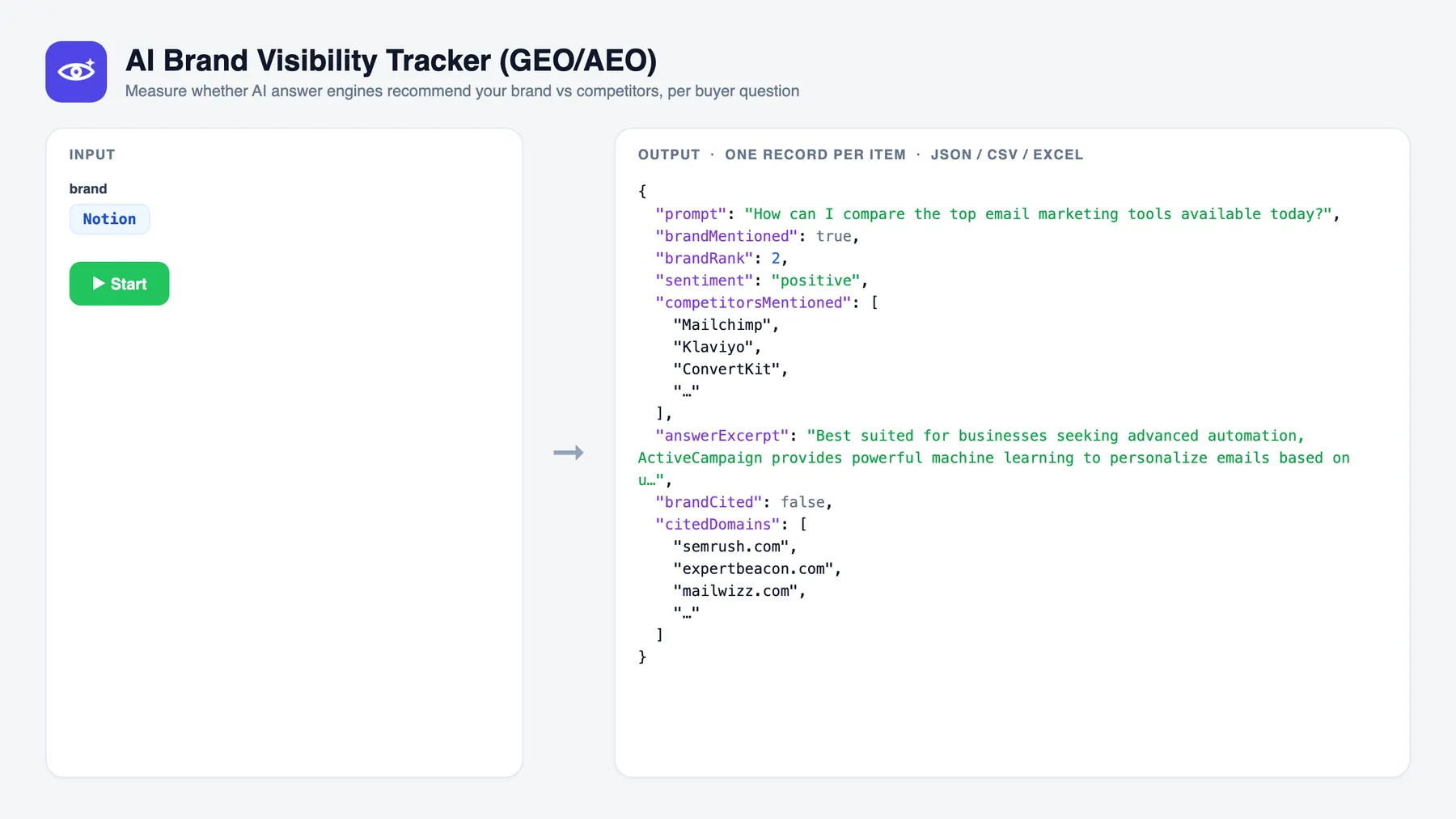
Quick start
- Fill in the input — set the fields in the input tab (prefilled with a working example).
- Click Start — the Actor runs and writes one record per item to the dataset.
- Get your data — export to JSON, CSV or Excel, or pull it via the API.
👉 Make this continuous with Citely
This Actor gives you a one-time report — a snapshot of where you stand today. Citely turns that snapshot into an always-on SEO + AEO system that runs continuously and auto-applies fixes for you: a self-learning CTR title/meta optimizer that auto-applies to your pages, weekly AI-citation tracking with share-of-voice trends, Google Search Console insights with click-collapse alarms, and JSON-LD validation. Connect once, it runs daily.
→ https://datatools-hub.vercel.app/citely
Give it your brand (and optionally competitors). It asks an AI with live web search a set of realistic buyer questions, then detects — per question — whether your brand is recommended, its rank, the sentiment, which competitors show up, and which sources the AI cites. It rolls that up into a visibility score and share of voice.
This is Generative/Answer Engine Optimization (GEO/AEO) — the new SEO — in a single run.
Plus an aggregate report in the run's SUMMARY: visibilityScore, citationRate, averageRank, shareOfVoice, sentimentBreakdown, topCompetitors.
Why this matters now
- New, urgent need — every marketing/SEO team is suddenly asking "are we visible in AI answers?" and has no tooling for it.
- Universal — any brand in any category.
- Track over time — run it weekly/monthly to see your AI visibility trend and whether your GEO efforts work.
- Competitive — share of voice shows exactly who the AI favours over you.
Use cases
- GEO/AEO monitoring — benchmark and track your brand's presence in AI answers.
- Competitive intelligence — see which competitors the AI recommends and how often.
- Content strategy — the
citedDomainsshow which sources the AI trusts for your category, so you know where to get mentioned. - Agent tool — via the Apify MCP server, an agent can check "is brand X recommended by AI for Y?" on demand.
Input
| Field | Type | Default | Description |
|---|---|---|---|
brand | string | — (required) | Brand/company to track. |
domain | string | — | Your domain — detects when the AI cites your own site. |
topic | string | — | Category; used to auto-generate prompts. |
prompts | string[] | — | Your own buyer-intent questions. Leave empty to auto-generate. |
promptCount | integer | 5 | How many prompts to generate when none are supplied. |
competitors | string[] | — | Competitor names to watch for (drives share of voice). |
model | string | gpt-4o-mini | OpenAI model for web search + analysis. |
Output
One dataset item per prompt (see example above), plus an aggregate visibility report in the run's SUMMARY key-value record.
Pricing
Pay-per-event: one prompt-checked event per question analysed (each includes a web‑search answer + analysis).
Environment variables
| Variable | Required | Purpose |
|---|---|---|
OPENAI_API_KEY | Yes | Powers the web‑search answers and analysis. |
Notes
- Answers come from an AI with live web search, which reflects how modern AI answer engines respond — results naturally vary over time, which is exactly what you track.
- If web search is unavailable on your OpenAI account, it falls back to the model's own knowledge (less current) and reports no cited sources.
- Use consistent prompts across runs to track a clean trend.
Run it locally
License
ISC.
Related actors
- AI Share of Voice — Multi-Engine GEO Tracker — Track your brand's visibility and share of voice across AI answer engines, with
- AI Brand Accuracy Monitor (Wrong Facts) — Catch wrong, outdated and hallucinated facts that AI answer engines state about your
- AI Citation Source Miner (GEO/AEO) — Discover which websites AI answer engines cite for your category — so you know where to