

B2B Intent Radar — AI Buying-Signal & Intent Scoring
Pricing
from $110.00 / 1,000 company analyzeds
B2B Intent Radar — AI Buying-Signal & Intent Scoring
Give target company domains and what you sell; the radar orchestrates firmographic, technographic and news organs, then AI synthesizes a buying-intent score (0-100), concrete signals, the best outreach angle and a paste-ready cold-email hook per company.
Pricing
from $110.00 / 1,000 company analyzeds
Rating
0.0
(0)
Developer

Fredrik Hansson
Maintained by CommunityActor stats
0
Bookmarked
2
Total users
1
Monthly active users
4 hours ago
Last modified
Categories
Share
Stop guessing which accounts to call first. Hand this Actor a list of target company domains and one line about what you sell. It quietly runs three research "organs" against every company — firmographics, technology stack and recent news — then an AI reads all of it together and returns a buying-intent score (0–100), the concrete signals behind that score, the single best outreach angle, and a paste-ready cold-email hook. You get a prioritised account list instead of a flat spreadsheet.
You bring the domains and your pitch. It hands back a ranked call sheet with the opener already written.
🔗 Chain it after your scraper
Already building target lists with Google Maps Scraper (compass/crawler-google-places), LinkedIn Jobs Scraper (curious_coder/linkedin-jobs-scraper) or LinkedIn Company Details Scraper (harvestapi/linkedin-company)? Pipe the dataset straight in — paste its dataset ID (via the Integrations tab) and get every account scored 0–100 with the signals, best angle and a ready cold-email hook. Works with any Maps, LinkedIn or company scraper's output.
Quick start
- Fill in the input — set the fields in the input tab (prefilled with a working example).
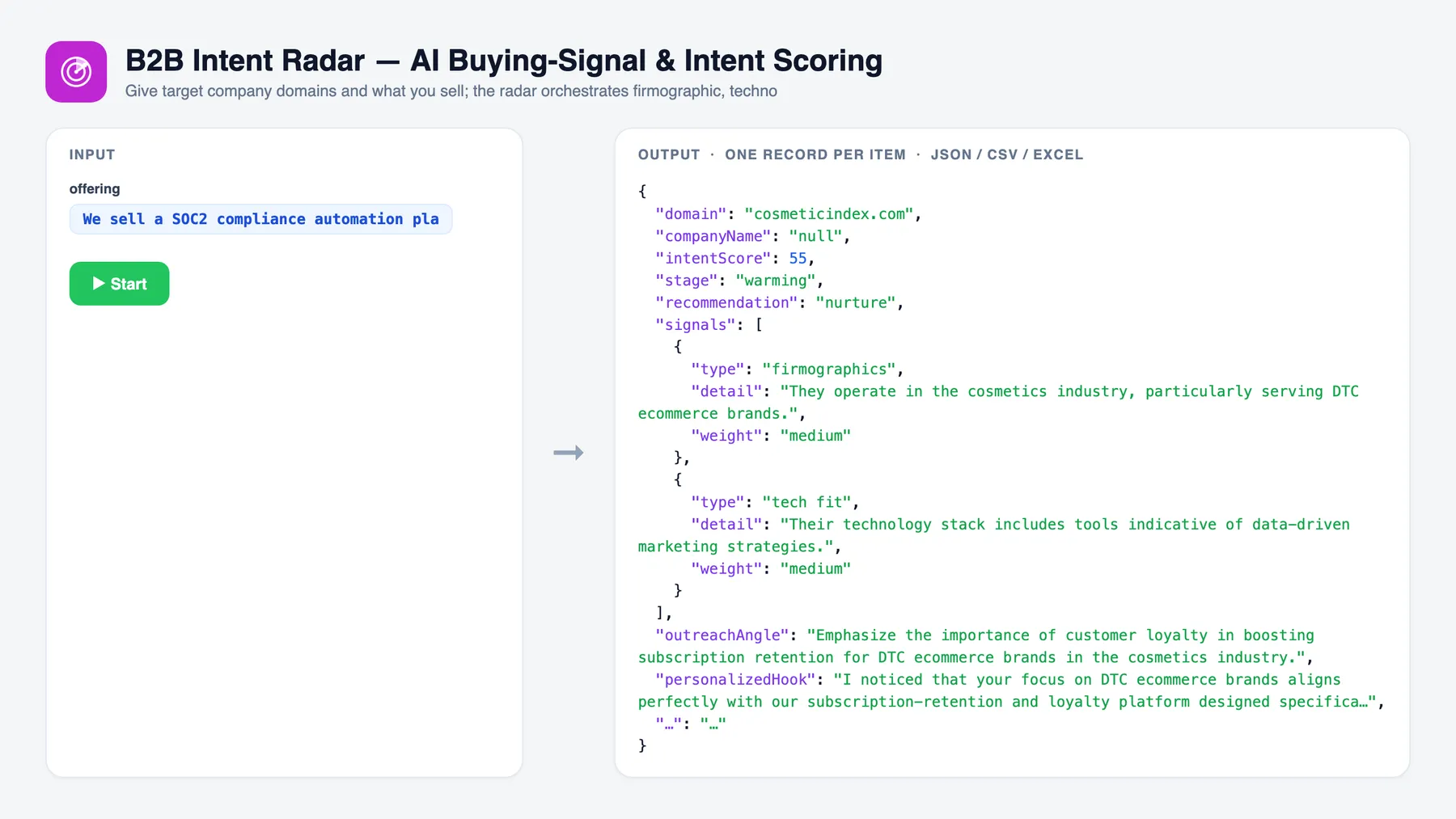
- Click Start — the Actor runs and writes one record per item to the dataset.
- Get your data — export to JSON, CSV or Excel, or pull it via the API.
The flow
- Paste your target domains and describe your
offering(what you sell). That one line drives the ICP fit, the scoring and the angle. - The radar gathers signals by calling other fuze Actors as organs — once per organ, batched across the whole list. Each organ is optional and degrades gracefully: if one returns nothing, the run continues on whatever signals remain.
- An AI synthesizes each company into an intent score, the signals it found, a recommended angle and a ready-to-send hook — grounded only in the gathered data, never invented.
What you get per company
For every target company, the Actor returns:
intentScore(0–100) — how likely this company is in-market, and how good a time it is to reach out, for your specific offering.stage— where they sit in the buying journey:cold·aware·warming·in-market.recommendation— a blunt verdict for your pipeline:prioritize·nurture·skip.signals— the concrete evidence behind the score, each with atype, adetailand aweight(low/medium/high). Examples: a hiring push, fresh funding, a technology they just adopted, an expansion announcement, or a clean ICP match. Every signal is drawn from real gathered data.outreachAngle— one sentence: the single best angle to open with.personalizedHook— one or two sentences you can paste straight into a cold-email opener, anchored to a real signal about that company.bestTiming— a short read on when to reach out (e.g.now,next quarter).- Supporting context —
icpFitScore,topTechnologies,recentNews(headlines),companyName, andsourcesUsedso you can see exactly which organs fired for each company.
Three ways people use it
- SDR / outbound teams — turn a raw list of target accounts into buying intent data with the opener pre-written. Work
prioritizeaccounts first, dropskipaccounts, and never open a cold email with "I hope this finds you well" again. - Account-based marketing (ABM) — score and tier your named-account list by real sales intent signals before spending ad or BDR budget. A lightweight, pay-as-you-go take on what Bombora / 6sense-style intent platforms do, with no annual contract.
- Founders & solo sellers — point it at 25–50 dream customers, get an instant account prioritization pass that tells you who's warming, what the hook is, and the right cold outreach timing — in minutes, for a few dollars.
How the orchestration works
Intent Radar is a thin orchestrator: the intelligence lives in other fuze Actors that it calls via the Apify API (Actor.call) and then reads back from their datasets. Each organ is independently toggle-able and fails soft (returns nothing rather than breaking the run):
| Organ | Actor called | Signal it adds |
|---|---|---|
| Firmographics | fuze/ai-company-enrichment | What they do, size, industry, target customers, ICP fit |
| Technographics | fuze/b2b-tech-stack-detector | Technology stack, maturity, inferred team signals |
| News | fuze/google-news-scraper | Funding, expansion, launches, leadership changes |
Organs are called once per run (batched across all domains), so costs and runtime stay flat as your list grows.
Input
| Field | Type | Notes |
|---|---|---|
domains | array | Target company domains, website URLs or emails (the domain is extracted). One per line. |
offering | string | Required. What you sell — drives ICP fit, the intent score and the outreach angle. |
maxResults | integer | Max companies to analyze. Default 25. One pay-per-event charge per company. |
maxConcurrency | integer | Companies synthesized in parallel. Orchestration is heavy — keep it low. Default 3. |
model | string | Override the OpenAI model. Default gpt-4o-mini. |
useEnrichment | boolean | Call the firmographic organ. Default true. |
useTechStack | boolean | Call the technographic organ. Default true. |
useNews | boolean | Call the news organ for recent buying signals. Default true. |
Minimal input example
Output example
A company for which only some organs return data still comes back scored — sourcesUsed tells you exactly what the score was built on, and thin data yields an honestly low score.
Pay-per-event pricing
This Actor uses pay-per-event billing with a single event:
| Event | Charged when |
|---|---|
company-analyzed | Once per company successfully synthesized into an intent score + recommendation. |
One company-analyzed charge bundles all three orchestrated sub-actor runs (enrichment + tech stack + news) plus the AI synthesis for that company — so it comes in far cheaper than buying each signal from a separate tool. The Actor logs its OpenAI token usage and estimated AI cost at the end of every run; the AI cost is a tiny fraction of the event price, the rest covers the organ compute.
Setup
The synthesis step calls the OpenAI API, so set the environment variable / secret OPENAI_API_KEY on the Actor. The orchestrated organs run on your Apify account automatically — no extra wiring needed.
Use it from an AI agent (Apify MCP server)
This Actor is available through the Apify MCP server, so AI agents (Claude, ChatGPT, or anything that speaks MCP) can call it as a tool — hand it domains and an offering, and read back scored, ranked accounts with ready-to-send hooks — with no custom integration code.
Run it locally
Related actors
- Company Enrichment (AI) — Turn a list of domains into structured company profiles: firmographics, contacts, socials and ICP fit.
- B2B Tech Stack Detector (AI) — Detect the technology stack behind any domain — CMS, ecommerce, analytics, CRM, pixels, framework, email provider — with AI buying-signals.
- AI Prospecting Pipeline — End-to-end cold-outreach pipeline: domains or Maps search → ICP leads → verified emails → personalized drafts.
- Google News Scraper — Fetch recent news articles for any set of queries — the news organ behind this radar.


