

B2B Account Brief — AI Pre-Call Research for Sales Reps
Pricing
from $110.00 / 1,000 company briefeds
B2B Account Brief — AI Pre-Call Research for Sales Reps
Give target company domains + what you sell; get a polished one-page AI account brief per company — overview, priorities, talking points, discovery questions and a cold opener — for pre-call sales research.
Pricing
from $110.00 / 1,000 company briefeds
Rating
0.0
(0)
Developer

Fredrik Hansson
Maintained by CommunityActor stats
0
Bookmarked
2
Total users
1
Monthly active users
4 hours ago
Last modified
Categories
Share
Paste in the accounts you're about to call and get back a one-page brief for each one. This Actor is a sales-enablement super-actor: give it a list of target company domains plus a line about what you sell, and for every company it orchestrates three research "organs" — firmographics, technology stack and recent news — then an AI synthesizes a polished pre-call account brief your account executive can read in two minutes before the meeting. Overview, what they do, likely priorities, tailored talking points, smart discovery questions, the right stakeholders to target, red flags, and a grounded cold-open line — plus a clean markdown version ready to paste straight into your CRM or Slack.
You bring the account list. It hands back a call-ready briefing.
🔗 Chain it after your scraper
Already pulling accounts with Google Maps Scraper (compass/crawler-google-places), LinkedIn Company Details Scraper (harvestapi/linkedin-company) or LinkedIn Jobs Scraper (curious_coder/linkedin-jobs-scraper)? Pipe the dataset straight in — paste its dataset ID (via the Integrations tab) and get a call-ready, one-page pre-call brief per account. Works with any Maps, LinkedIn or company scraper's output.
Quick start
- Fill in the input — set the fields in the input tab (prefilled with a working example).
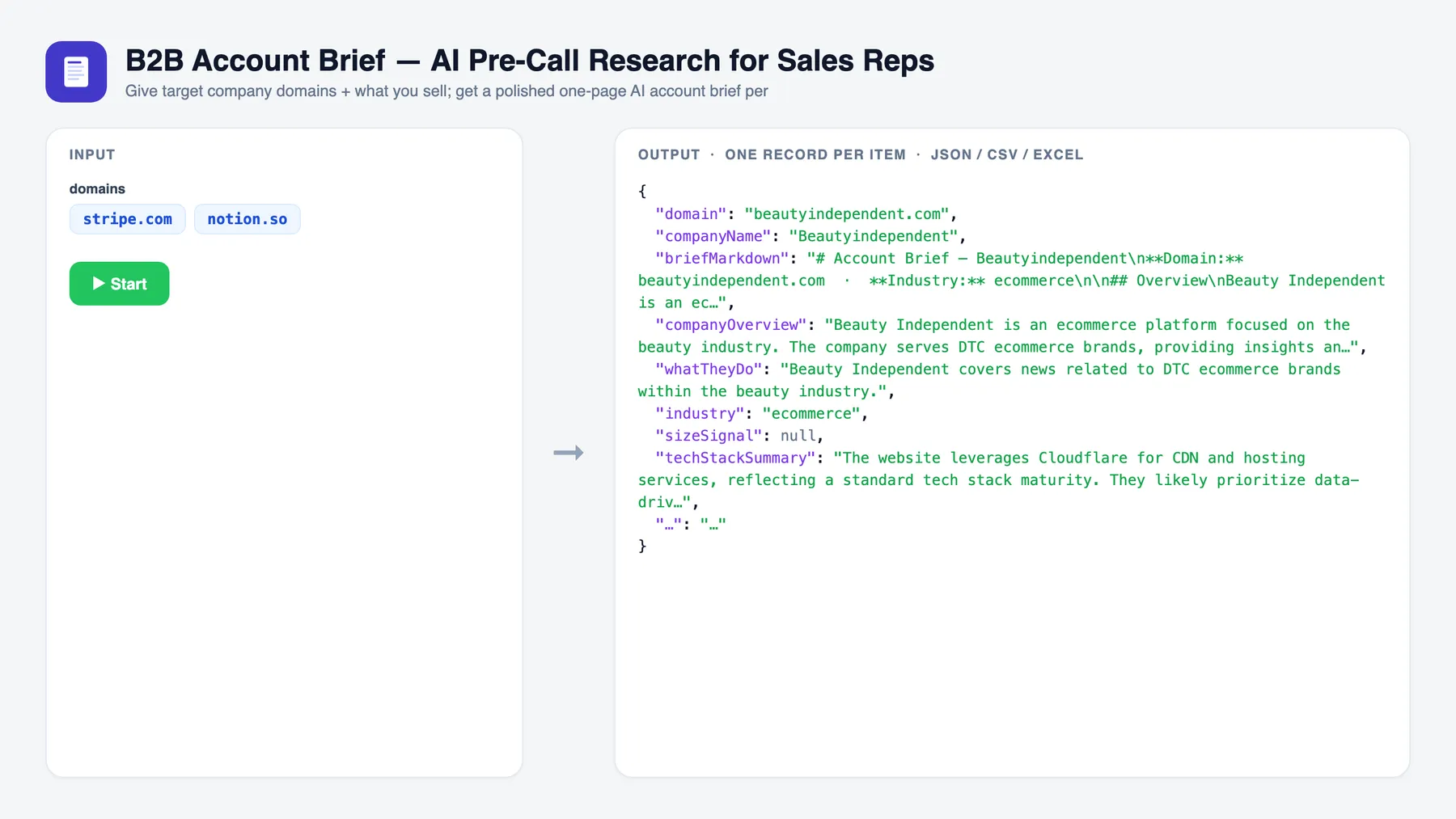
- Click Start — the Actor runs and writes one record per item to the dataset.
- Get your data — export to JSON, CSV or Excel, or pull it via the API.
The flow
- Paste your target accounts into
domainsand describe youroffering. - The Actor runs each research organ once across the whole list (gracefully skipping any that return nothing).
- Per company, an AI writes a grounded brief and assembles a clean
briefMarkdownone-pager.
What you get per company
For every company the brief contains:
companyOverview— 2–3 factual sentences on who they are.whatTheyDo— one tight sentence.industryandsizeSignal— category and size read.techStackSummary— 1–2 sentences on their detected stack (ornull).recentDevelopments— short bullets drawn only from recent news ([]if none).likelyPriorities— inferred business priorities to anchor the conversation.talkingPoints— tailored to yourofferingwhen provided.discoveryQuestions— smart, specific questions the rep can ask on the call.stakeholdersToTarget— role titles likely relevant (e.g. "VP Engineering", "Head of Security").redFlags— concrete reasons it may not be a fit ([]if none).oneLineOpener— a single grounded cold-open line referencing one verifiable detail.briefMarkdown— the entire brief as a clean one-page markdown doc, ready to paste into a CRM or Slack.
Every statement is grounded strictly in the research data — the AI never invents facts, customers or news.
Three ways people use it
- Sales reps / AE pre-call research — stop googling five tabs before every call. One run gives you pre-call briefing for your whole day's pipeline, with discovery call prep questions already written. This is account research and sales intelligence on autopilot.
- Account-based selling / ABM — brief an entire target account list at once for account planning, align the team on priorities and stakeholders, and personalize outreach at scale.
- SDR territory prep — hand a new rep a territory of domains and get back a stack of briefs with openers and talking points, so account research and prospecting ramp from day one.
Input
| Field | Type | Notes |
|---|---|---|
domains | array | Required. Company domains, website URLs or emails (domain is extracted). One per line — these are the accounts to brief. |
offering | string | What you sell. Tailors talking points, red flags and the opener to each account. |
maxResults | integer | Cap how many companies to brief. Default 25, max 1000. One charge per company. |
maxConcurrency | integer | How many companies to synthesize in parallel. Default 3, max 10. |
model | string | OpenAI model override. Default gpt-4o-mini. |
useEnrichment | boolean | Call fuze/ai-company-enrichment for firmographics. Default true. |
useTechStack | boolean | Call fuze/b2b-tech-stack-detector for the tech stack. Default true. |
useNews | boolean | Call fuze/google-news-scraper for recent developments. Default true. |
Minimal input example
Output example
How the orchestration works
This Actor is a super-actor: it doesn't scrape anything itself. It calls proven public organs via Actor.call and fuses their output with an LLM:
| Organ | Actor | Provides |
|---|---|---|
| Firmographics | fuze/ai-company-enrichment | What they do, industry, size, offerings, target customers |
| Technographics | fuze/b2b-tech-stack-detector | Detected tech stack, maturity, inferred team signals |
| Recent news | fuze/google-news-scraper | Latest headlines + snippets per company |
Each organ runs once across your whole domain list. Any organ that errors or returns nothing is skipped gracefully — the brief is still written from whatever data came back, and sourcesUsed always reflects reality.
Pay-per-event pricing
This Actor uses pay-per-event billing with a single event:
| Event | Price | Charged when |
|---|---|---|
company-briefed | $0.25 | Once per company researched and briefed. This one charge bundles up to three orchestrated sub-actor runs (firmographics, tech stack, news) plus the OpenAI synthesis into a finished one-page brief. |
The Actor logs its OpenAI token usage and the estimated AI cost at the end of every run, so the event price always stays safely above the model cost.
Setup
The AI synthesis layer calls the OpenAI API. Set the environment variable / secret OPENAI_API_KEY on the Actor. Without it the run stops early — the brief synthesis needs the model.
Use it from an AI agent (Apify MCP server)
This Actor is available through the Apify MCP server, so AI agents (Claude, ChatGPT, or anything that speaks MCP) can call it as a tool — hand it domains and an offering, and read back finished account briefs — with no custom integration code.
Run it locally
Related actors
- B2B Intent Radar — Surface buying-intent signals for your target accounts.
- AI Company Enrichment — Turn domains into structured firmographic profiles with contacts and ICP fit.
- B2B Tech Stack Detector — Detect the technology stack behind any company's website.
- AI Cold Email Personalizer — Turn a list of domains into personalized cold-email openers.


