
openFDA Scraper | FDA Recalls, Drug & Device Records
Pricing
from $1.89 / 1,000 fda records
openFDA Scraper | FDA Recalls, Drug & Device Records
Get FDA recalls (recall number, hazard class, status, recalling firm, reason) for food, drugs and devices, plus drug labels, adverse events, 510(k) clearances, approvals, NDC and shortages. Filters by class, state, firm, date. No API key.
Pricing
from $1.89 / 1,000 fda records
Rating
0.0
(0)
Developer

Flowo
Maintained by CommunityActor stats
0
Bookmarked
2
Total users
1
Monthly active users
7 days ago
Last modified
Categories
Features
Share
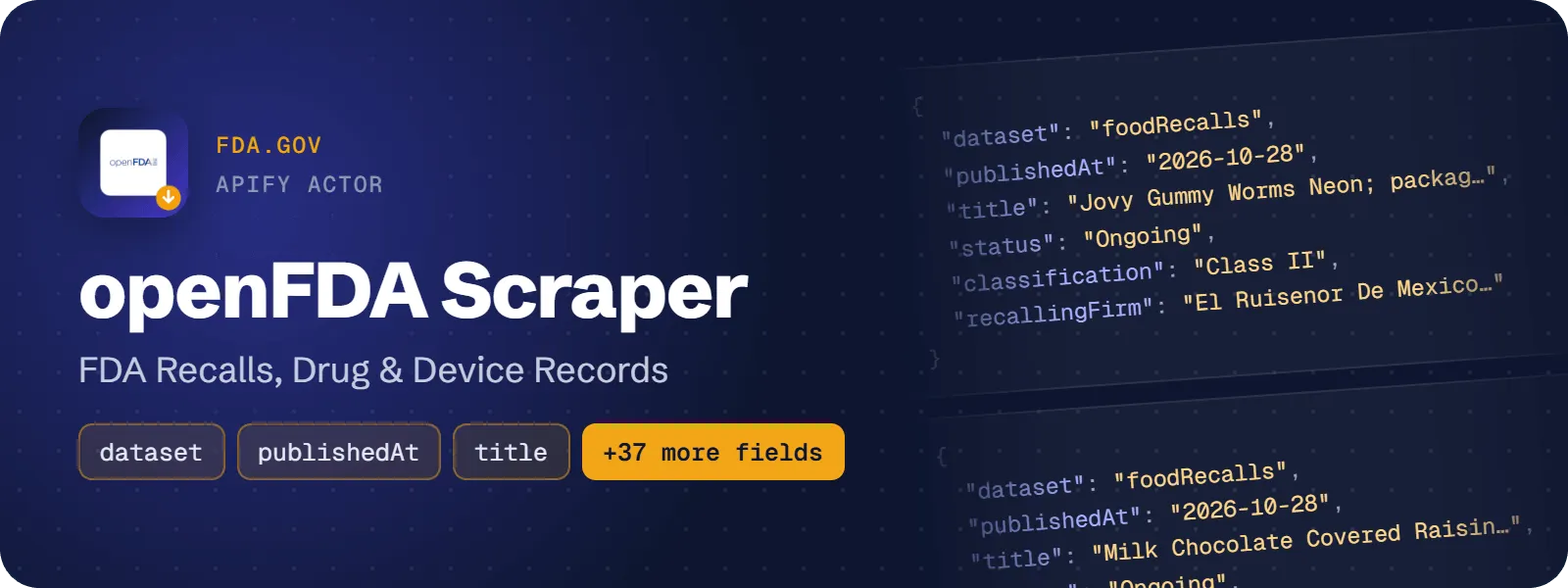
Search FDA recalls and public openFDA records in one run. Each row has the recall number, hazard class (Class I, II or III), recall status, the recalling firm and the reason for the recall, plus dates and a link to the record. The same actor also returns drug labels, drug and device adverse events, 510(k) clearances, Drugs@FDA approvals, NDC products and drug shortages.
What does openFDA Scraper do?
The actor queries the official openFDA API (api.fda.gov) and saves flat, spreadsheet-ready rows with ISO dates. You choose one or more of 11 datasets, add search terms and optional filters, and get one dataset with every record labelled by its source dataset. It is built for food-safety and quality teams, pharma regulatory and pharmacovigilance analysts, med-tech teams and anyone who monitors supplier recalls. No login or API key is needed.
Datasets: food recalls, drug recalls and device recalls (FDA Enforcement Reports), device recall details (CDRH: root cause and the firm's action), drug labels, drug adverse events (FAERS), device adverse events (MAUDE), device 510(k) clearances, drug approvals (Drugs@FDA), the NDC directory and drug shortages.
How to scrape FDA recalls and openFDA records
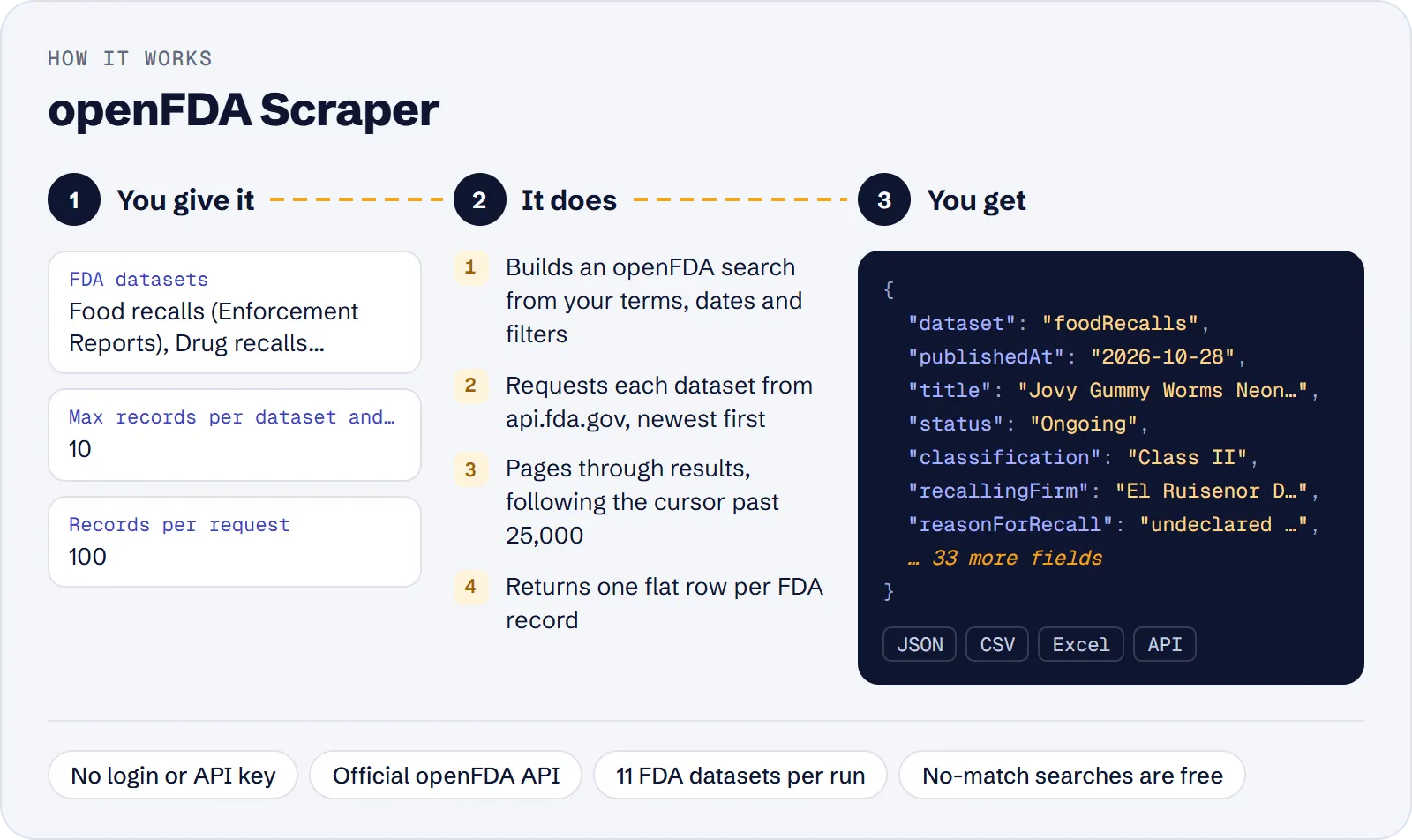
- Open the actor in Apify Console and go to Input.
- Pick the FDA datasets to search. The default is food, drug and device recalls.
- Add Search terms, one per line (for example
listeria,metformin,pacemaker). Leave empty to get the newest records that match your filters. - Optionally set a date range, recall class, recall status, the firm's US state or the recalling firm's name.
- Set Max records per dataset and search term and click Start.
- Download the results as JSON, CSV, Excel or HTML from the Output tab, or read them through the API.
How much does it cost to scrape FDA records?
Price per event by Apify plan:
| Event | Free | Bronze | Silver | Gold and above |
|---|---|---|---|---|
| FDA record | $2.70 per 1,000 | $2.43 per 1,000 | $2.16 per 1,000 | $1.89 per 1,000 |
| Run start | $0.00005 | $0.00005 | $0.00005 | $0.00005 |
A test run with the API example input below returned 30 rows in 27 s.
You pay per saved record (the fda-record event) plus a very small run-start fee. Searches with no matches are free. A record found again by a later search term in the same dataset is saved and charged only once. The record price is $0.0027, which is $2.70 per 1,000 records.
| Scenario | Records | Cost on the Free plan |
|---|---|---|
| Newest Class I recalls of one month | 100 | about $0.27 |
| Default run with empty input (100 newest of each recall dataset) | 300 | about $0.81 |
| One drug's labels, adverse events and recalls | 1,000 | about $2.70 |
| Medtronic 510(k) clearances since 2024, large pull | 10,000 | about $27 |
The run-start fee ($0.00005 per GB of memory) is negligible and already included in these round figures.
Input
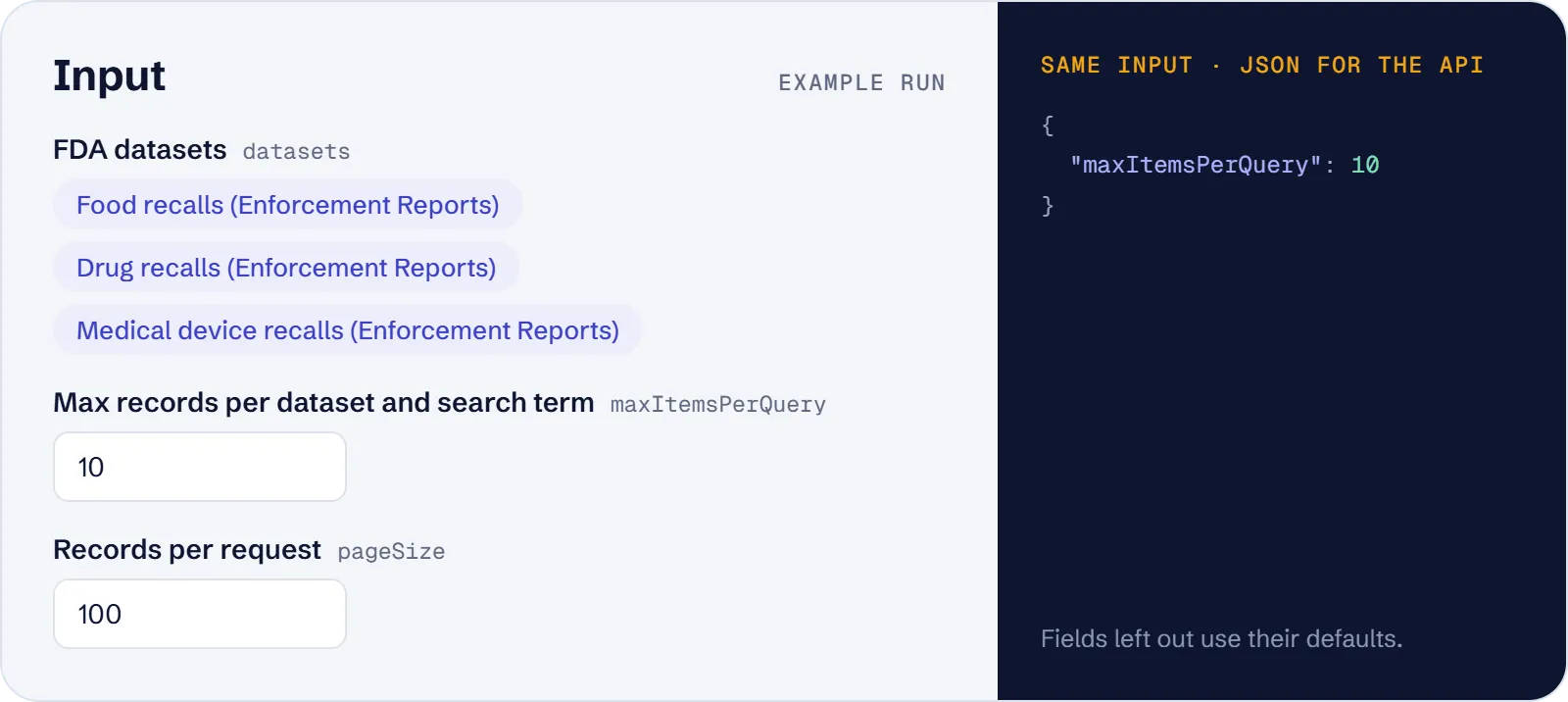
No field is required. Main fields:
datasets— which FDA datasets to search (several per run).queries— search terms; free text or openFDA syntax such asopenfda.brand_name:"tylenol". Several words mean OR; put phrases and hyphenated values in double quotes.dateFrom,dateTo— inclusive date range on each dataset's main date (recall report date, label effective date, adverse event received date, 510(k) decision date and so on).classifications,recallStatus,states,recallingFirm— recall filters.maxItemsPerQuery,maxItems,pageSize— limits.proxyConfiguration— spreads openFDA's per-IP daily quota; on by default.
What data can you extract from openFDA?
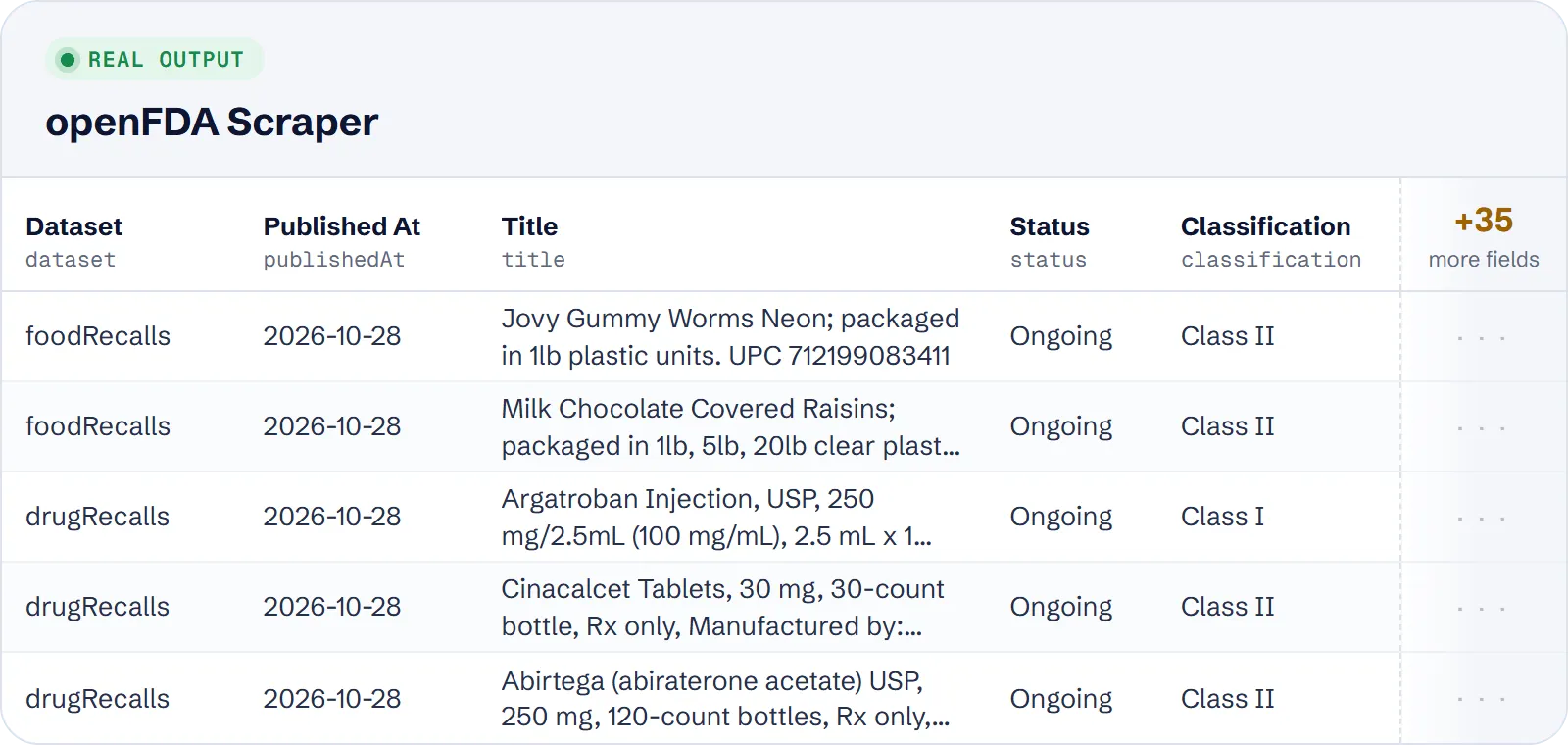
Every row has dataset, id, url, title, publishedAt and scrapedAt. Other fields depend on the dataset; a field that is empty at the source is null.
| Field | Description |
|---|---|
recallNumber, eventId | FDA recall number and the event grouping all products of one recall |
classification, status | Hazard class and recall status (or drug shortage status) |
productDescription, reasonForRecall | The recalled product and why it was recalled |
recallingFirm, city, state | The company and where it is located |
recallInitiationDate, reportDate, terminationDate | Recall dates, as YYYY-MM-DD |
rootCauseDescription, action | Device recall details: root cause and the firm's action |
brandName, genericName, productNdc | Drug names and NDC codes (labels, NDC, approvals, drug recalls) |
reactions, seriousOutcomes | Drug adverse events: reported reactions and serious outcomes |
applicant, decisionDate, deviceName | Device 510(k) clearances |
totalMatches, query | Number of records openFDA has for the search, and the term that found the row |
Example row (shortened):
Use cases
- Recall monitoring: new Class I food and drug recalls this month, newest first.
- Hazard search across product types: everything recalled for listeria or salmonella since 2025, in food, drug and device recalls.
- Supplier watch: ongoing recalls by a named firm, or by firms in one US state.
- Drug safety profile: label, adverse events, recalls, approvals, NDC listings and shortages for one drug in a single run.
- Med-tech intelligence: a competitor's 510(k) clearances and MAUDE adverse event reports for a device type.
Limitations
- The data is what openFDA publishes; the actor adds no risk scores or interpretation.
- Recall filters (class, status, state, firm) work only with recall datasets; class works only with food, drug and device recalls. Combining them with other datasets stops the run with an input error before any request.
- Date filters are not available for drug shortages. Drug approvals are filtered by any submission action date and are not sorted.
- A search term that uses a field the dataset does not have returns no rows for that dataset and logs a warning.
- Texts longer than 20,000 characters are cut. Device recall datasets are fetched at most 25 records per request because single records can be megabytes long.
- Some fields (for example
recallNumberfor very new recalls,state,postalCode) can benull. - openFDA allows about 1,000 keyless requests a day per IP; very large runs may end partially, keeping the rows already saved.
- The same device recall can appear once in device recalls and once in device recall details.
Tips and troubleshooting
- Zero rows means openFDA found no match. Check the log: it names the dataset and term, and whether a field name does not exist in that dataset.
- Quote phrases and hyphenated values (
"F-0276-2017","peanut butter"); unquoted they are matched as OR and give broad results. - For a drug across datasets, use field syntax that exists in each dataset, or a plain word such as
metformin. - Beyond 25,000 records per search the actor follows the openFDA cursor; if openFDA gives none it stops with a warning. Narrow the search by date.
- Keep the proxy on for larger runs. Lower
pageSizeonly if requests time out. - To fetch only new records, set
dateFromto your last run date.
API, MCP and integrations
Run the actor from your code with the same JSON input as in Console. Your API token is in Console → Settings → API & Integrations.
Python (pip install apify-client):
Node.js (npm install apify-client):
HTTP — one request runs the actor and returns the results (runs up to 5 minutes; longer ones: run asynchronously):
AI agents (MCP). Add the actor as a tool of the Apify MCP server. Claude Code:
Claude Desktop, Cursor or VS Code: {"mcpServers": {"apify": {"url": "https://mcp.apify.com?tools=genial_candlestand/openfda-recalls-scraper"}}}. Then ask, for example:
- "Get new Class I food and drug recalls since 2026-10-01"
- "List ongoing recalls by firms in CA"
- "Get Medtronic 510(k) clearances since 2024"
Integrations. Run it on a schedule with Apify Schedules and send the results to Google Sheets, Slack, Zapier, Make, n8n or your webhook — see Apify integrations.
FAQ
Is it legal to scrape FDA data?
The data comes from the official openFDA API, which FDA publishes for public use. You are responsible for how you use it. Adverse event reports are as FDA publishes them.
Do I need an openFDA API key?
No. The actor works without one and uses the proxy to stay within the keyless per-IP quota.
Can I search several datasets and several terms in one run?
Yes. Each term runs on every selected dataset, and each row carries its dataset and query.
How is it different from other openFDA actors?
It returns food, drug and device recalls plus CDRH device recall details and seven other record datasets in one run, with typed filters, cursor paging past 25,000 records, and a flat output. It charges $2.70 per 1,000 records with no per-request event.
Also useful
- SEC EDGAR Filings Search — find US regulatory filings of the companies behind recalls
- Google News Scraper — follow news coverage of a recall or a recalling firm
- Trustpilot Reviews Scraper — read customer ratings and company replies for a recalling brand


