

SEC Event Intelligence
Pricing
$8.00 / 1,000 cited sec events
SEC Event Intelligence
Extract material business events from SEC filings for the companies you track. Every event is classified by 8-K item, quotes the filing's own words, and links to the primary document on sec.gov. Built for account research, sales prep, and signal feeds.
Pricing
$8.00 / 1,000 cited sec events
Rating
0.0
(0)
Developer

Clance Hoskin
Maintained by CommunityActor stats
0
Bookmarked
2
Total users
1
Monthly active users
a month ago
Last modified
Categories
Share
Evidence-linked business events from SEC filings — classified, quoted, and cited — for the companies you track.
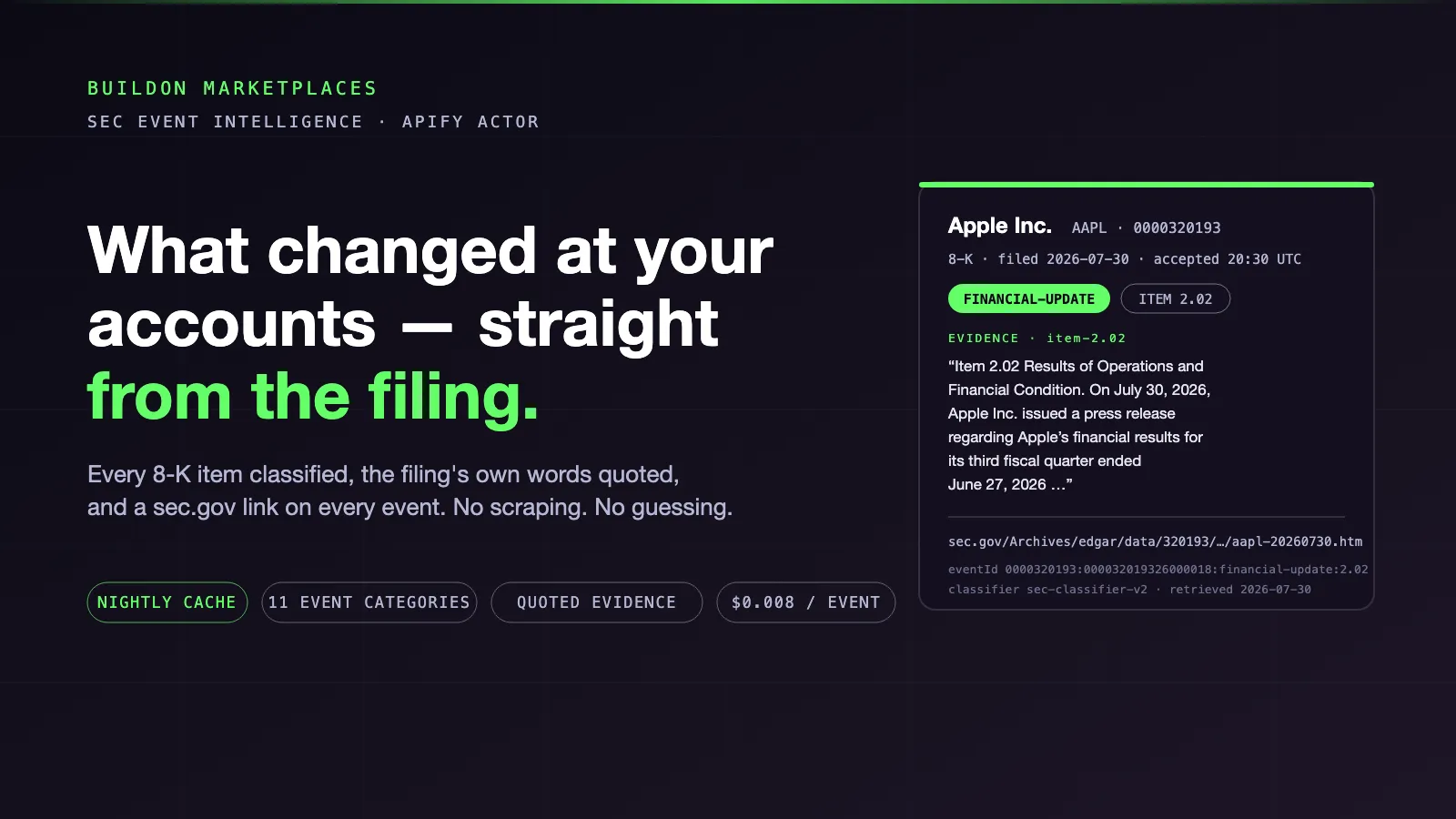
Every result is one material event from a company's 8-K (or periodic) filing: what happened, which SEC item it was filed under, the exact section of the filing that says so, and a link to the primary document on sec.gov. No scraping, no summarisation, no speculation. The evidence is the SEC's own words.
Who it's for
- Sales and account-research teams who need to know what changed at an account before the next call — a new CFO, an acquisition, a restructuring charge, a cybersecurity incident.
- Investment-research teams who want a clean, structured feed of material events instead of reading every filing.
- Data and RevOps teams building account-signal pipelines who need a source they can cite, not a summary they have to trust.
If you have ever opened EDGAR, searched a company, opened five 8-Ks, and skimmed each one for the item that mattered — this Actor does that step for you, for any company you ask about, and keeps the answer current.
What you get
One dataset item per event. Every field is populated from the filing itself; the evidence excerpt is the text of the specific item section, and primaryDocumentUrl opens the filing on sec.gov.
| Field | What it holds |
|---|---|
eventId | Stable identifier: CIK, accession number, category, item — safe to de-duplicate on |
companyName, ticker, cik | The registrant as SEC names it |
form, filedAt, acceptedAt | Form type and the SEC filing and acceptance timestamps |
eventTypes | One or more of the 11 categories below |
items | The 8-K item numbers that triggered the event (e.g. 2.02) |
headline | A fixed, category-level headline — never generated text |
accessionNumber, filingUrl, primaryDocumentUrl | Where to verify it, on sec.gov |
evidence[] | The quoted item section (text), its locator, and its sourceUrl |
retrievedAt, classifierVersion | When the evidence was captured and which classifier produced the category, so results are reproducible |
Sample item
Freshness
Alongside the dataset, the run's OUTPUT record carries a freshness object reporting what the cache did for each company this run:
| Field | Notes |
|---|---|
source | cache if every requested company was already fresh; mixed if at least one was refreshed, first fetched, or could not be refreshed this run. |
stale | true if any company fell back to a cached answer, or came back empty because it could not be fetched, or a first fetch stopped at the filing cap before reaching the newest filings (companies[].detail says so). |
lastSuccessfulRefresh | The most recent refresh timestamp among the companies checked this run, when there was one. |
companies[] | Per requested company: cik, outcome, lastCheckedAt, and an optional detail explaining a stale_served or unavailable outcome. |
Event categories
Every current Form 8-K item maps to exactly one category, so nothing material is silently dropped. Periodic filings (10-K, 10-Q, 20-F, 6-K) are classified as periodic-filing.
| Category | 8-K items | What it usually means |
|---|---|---|
financial-update | 2.02, 2.03, 2.04, 4.01, 4.02 | Results announced, new debt or obligations, auditor change, restatement |
executive-change | 5.01, 5.02 | Directors or officers appointed, departed, or changed compensation; change of control |
material-agreement | 1.01, 1.02 | A material contract signed or terminated |
acquisition-disposition | 2.01 | An acquisition or disposal of assets completed |
impairment-restructuring | 1.03, 2.05, 2.06 | Restructuring costs, impairments, bankruptcy |
cybersecurity | 1.05 | A material cybersecurity incident |
listing-compliance | 3.01 | Delisting notice or listing-standard failure |
regulation-fd | 7.01 | Regulation FD disclosure |
other-8k | 1.04, 3.02, 3.03, 5.03–5.08, 6.xx, 8.01 | Governance housekeeping, securities changes, "other events" |
periodic-filing | — | Annual and quarterly reports |
insider-transaction | — | Reserved for Form 4 coverage |
How it works
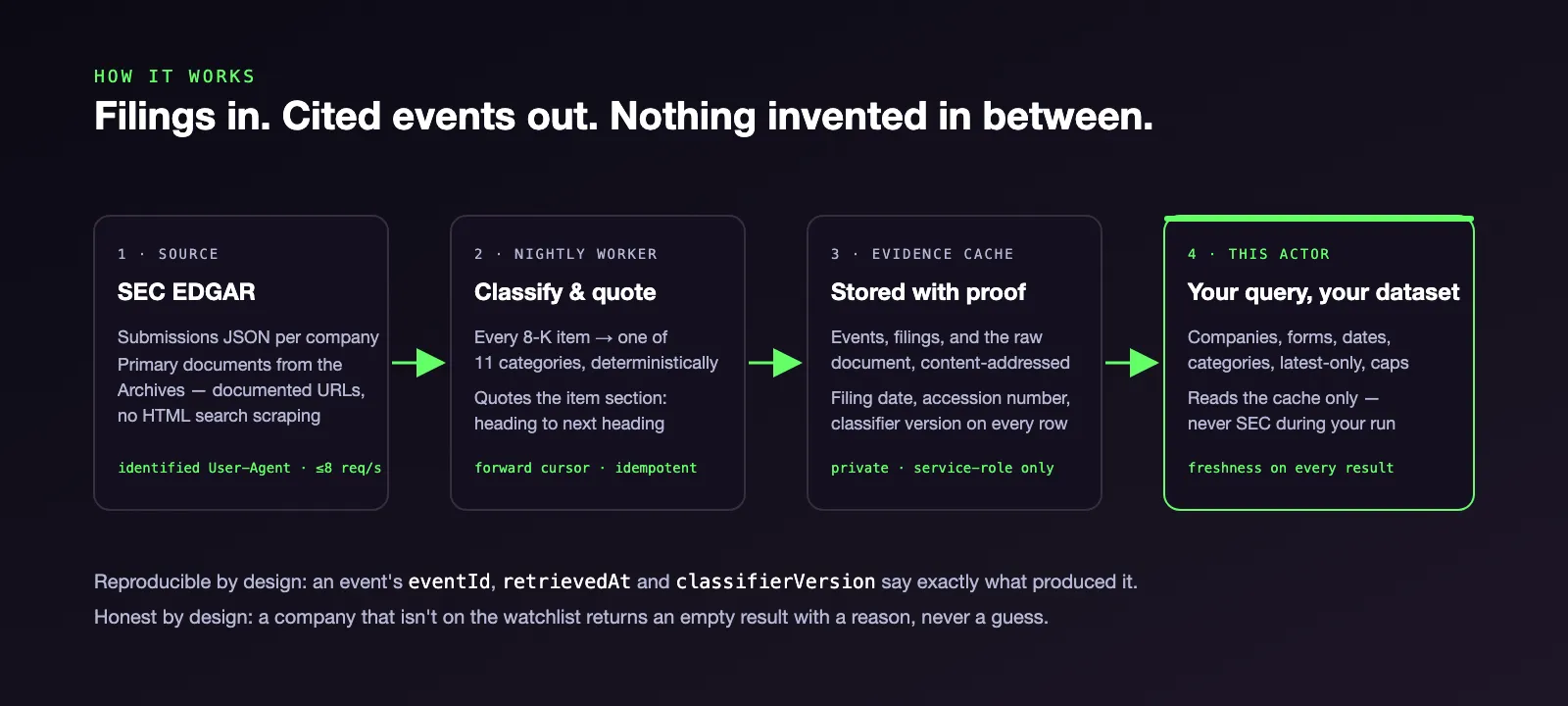
- A run checks SEC for each company you ask about. The first request for a company fetches its 8-Ks from the last 12 months (up to 60 filings) and takes longer; after that a company is refreshed on request when its last check is older than a day, and served from the cache otherwise. One refresh at a time per company, at most 25 companies refreshed per run, the longest-unchecked first.
- A deterministic classifier maps the filing's items to categories and quotes the item section — from its heading to the next heading, cross-references excluded.
- Events are stored in a cache with the filing date, accession number, and a content-addressed copy of the source.
- A run serves the cache and refreshes what is out of date. Companies checked within the last day come straight from the cache; the others are refreshed from SEC first, inside your run, one company at a time and inside SEC's request limits — and every result carries
freshnessmetadata saying which happened for each company.
The Actor identifies itself to SEC with a descriptive User-Agent and stays inside SEC's published request limits. Nothing is scraped from HTML search pages; everything comes from SEC's documented submissions JSON and archive URLs.
Input
| Field | Notes |
|---|---|
companies | One or more SEC CIKs (1–10 digits; normalised to ten). Ticker and legal name are display hints. Find a CIK with SEC's company search. |
forms | Optional. Default is every form in the cache; ["8-K"] for current reports only. |
startDate, endDate | Optional inclusive YYYY-MM-DD bounds on the filing date. |
eventCategories | Optional filter from the table above. |
includeExcerpts | Attach the quoted item section to each event (default true). |
latestOnly | Return only the newest event per company — for "what changed?" checks. |
maxEventsPerCompany, maxTotalEvents | Caps; the run summary reports truncated: true if a cap was hit. |
Three ways people use it
- Account list, on your schedule. Schedule the Actor with your account list and
latestOnly: true; each run refreshes what is older than a day — up to 25 companies, the longest-unchecked first, so a bigger list converges over a few runs. - Pre-call prep. One company,
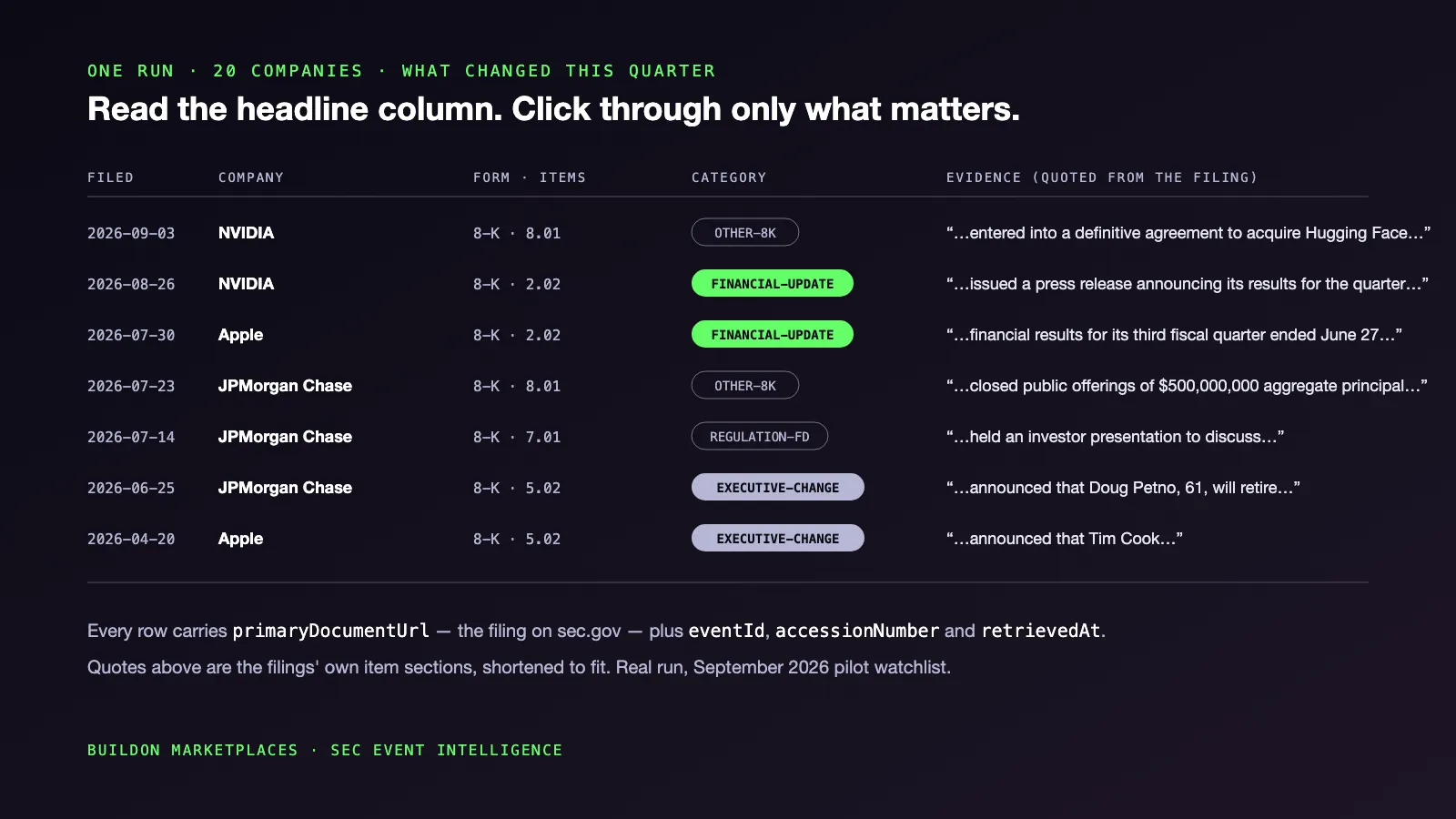
startDatea year back, all categories — read theheadlinecolumn and click through theprimaryDocumentUrls that matter. - Signal feed.
eventCategories: ["executive-change", "acquisition-disposition", "impairment-restructuring"]across your whole territory, exported by API into a CRM field.
Pricing
Pay per event: US$0.008 per event returned (event). A run that returns nothing costs nothing beyond Apify's minimal compute.
If the run reaches the spend limit you set when starting it, the dataset holds only the events you were charged for, and the run summary reports charging.limitReached: true with the counts.
| Use | Events | Cost |
|---|---|---|
| Pre-call prep on one company, one year | ~10 | ~$0.08 |
Scheduled latestOnly check on 25 accounts | ≤25 | ≤$0.20 |
| Two-year history for a 20-company territory | ~450 | ~$3.60 |
Limits — please read
- Coverage is any US filer with 8-Ks on EDGAR. The first request for a company fetches its last 12 months (up to 60 filings) and takes longer; after that a company is refreshed on request when its last check is older than a day, and served from the cache otherwise.
- At most 25 companies are refreshed per run, never-checked and longest-unchecked first; the rest are served from the cache as
stale_servedwithdetail: 'per-run refresh cap reached'. Split a larger list across runs or let a schedule work through it. - If SEC is unavailable during a run you get the cached events with
freshness.stale = trueand the reason per company infreshness.companies. A company that has never been fetched and cannot be fetched returns no events and is named insummary.emptyReason. - 8-K items are the unit. A filing with three items yields one event with three items and the categories they map to; the quoted excerpt is the first classified item's section.
- Excerpts are item sections, not whole filings. Use
primaryDocumentUrlfor the full document and exhibits. - No interpretation. Headlines are fixed category labels; nothing in the output is generated text or a prediction.
- History depth is 12 months from the first request; deeper history is added by the operator's backfill.
Compared with doing it by hand
| EDGAR by hand | Generic "SEC scraper" | SEC Event Intelligence | |
|---|---|---|---|
| Time to find what changed at 20 accounts | hours | minutes, then reading | one run, read the headline column |
| Source access | manual | HTML scraping, brittle | SEC's documented JSON + archive, rate-limited, identified |
| Evidence | you find it | usually none | quoted item section + primaryDocumentUrl on every event |
| Reproducible | no | no | eventId, retrievedAt, classifierVersion on every event |
FAQ
Does it read the exhibits (the press release itself)? No — it quotes the 8-K item section and links the primary document. Exhibits are one click away on sec.gov.
Can I get any company? Any US filer with 8-Ks. Give its CIK (ticker and name optional). The first run for it takes longer.
Is anything generated by an AI? No. This Actor is deterministic. If you want a written brief with cited sentences, see the companion Actor, SEC Account Briefs, which builds on this data.
How current is "current"? At most a day old when served from the cache; freshness.companies[] says when each company was last checked and whether this run refreshed it.
What about Form 4 insider transactions? The insider-transaction category is reserved; Form 4 coverage is not part of this version.
Support
Issues and coverage requests: use the Actor's Issues tab. Include the CIK and, for a wrong classification, the accession number — every event carries both.
Changelog
- 0.1 — Private build. Every current Form 8-K item classified; item-section excerpts; 21-company pilot, cache filled on demand.


