
LinkedIn Company Data Scraper & LinkedIn Company Search
Pricing
from $1.70 / 1,000 company (page read)s
LinkedIn Company Data Scraper & LinkedIn Company Search
LinkedIn company scraper and LinkedIn company search, no login: company details by URL, name, domain or id (employees, followers, industry, size, headquarters, website, locations, similar pages, posts, open jobs) and company search by keywords, industry or place. Misses free.
Pricing
from $1.70 / 1,000 company (page read)s
Rating
0.0
(0)
Developer
Hyperbach
Maintained by CommunityActor stats
0
Bookmarked
2
Total users
1
Monthly active users
3 days ago
Last modified
Categories
Features
Share
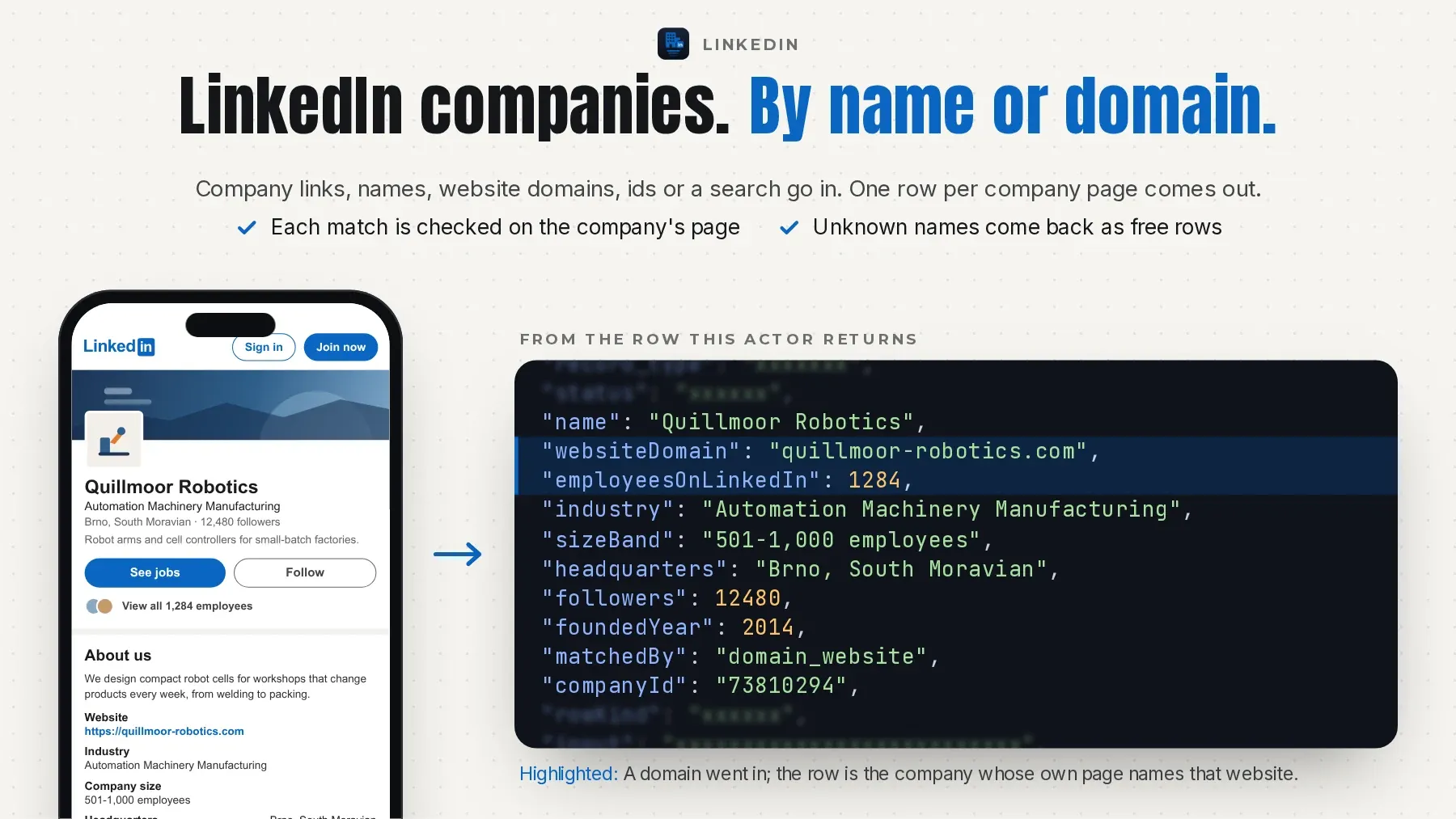
LinkedIn company pages as data, logged out: company links, names, website domains, company ids or a company search in, one row per company out — id, universal name, name, tagline, description, website, industry with LinkedIn's industry id and hierarchy, size band, the exact employee count on LinkedIn, followers, headquarters with its address, founded year, type, specialties, logo and cover, every office location, similar and affiliated pages, the recent posts, the employee preview, the products, the jobs link and on request the open jobs count — with how each input matched its company. A name, a domain or an id is delivered only when the company's own page checks; a company that does not exist, a name nobody carries and a value that names nothing are free rows. No login, no LinkedIn account, no cookie, no API key, proxies handled for you.
From $3.40 per 1,000 rows (company) on the Free plan, $2.89 on Starter; every row and add-on is priced under Pricing below. A run start is $0.001118. The default input returns about 3 rows for about $0.011317. A company that does not exist, a name nobody carries and a value that names nothing are free rows.
How it compares
- Cheaper than apimaestro's Company Detail Scraper for LinkedIn, with more data: $2.75 per 1,000 companies, against $5.00; 35 fields per company, against 13. It is faster: 3 companies in 2.8 s, against our 5.0 s.
- datadoping's Linkedin Company Details Scraper is faster and 2 times cheaper: 3 companies in 3.6 s, against our 5.0 s; $1.30 per 1,000 companies, against our $2.75. We give more data: 35 fields per company, against 26.
- johnvc's LinkedIn Company API is faster and 118 times cheaper: 3 companies in 3.8 s, against our 5.0 s; $0.023 per 1,000 companies, against our $2.75. We give more data: 35 fields per company, against 23.
- 2 times faster than harvestapi's LinkedIn Company Details Scraper, with more data: 3 companies in 5.0 s, against 12 s; 35 fields per company, against 31. The price is about the same: $2.75 per 1,000 companies, against $3.02.
- 7 times faster and cheaper than automation-lab's LinkedIn Company Scraper, with more data: 3 companies in 5.0 s, against 37 s; $2.75 per 1,000 companies, against $4.01; 35 fields per company, against 25.
Measured on 2026-11-18. Each line compares one job, run by both scrapers at the same time. Prices are per 1,000 companies: Apify Actors at the Scale plan's prices.
Tested head-to-head on 2026-11-18
The job: The company pages of Google, Microsoft and Apify by their links (the input schema's example). Every Actor ran on it the same day from the same harness; every run's cost is at the Scale plan's prices: a rival's charged events at its price for that plan, this Actor's at its list price. Fields counts the filled fields of a typical row. Each rival reads the same three company links: harvestapi/linkedin-company is the most used, apimaestro/linkedin-company-detail the next company-row seller, automation-lab, datadoping and johnvc the strongest on the logged-out page, on id inputs and on price. Re-measured monthly.
| Actor | Rows | First row | Run time | Cost | Fields | Failures |
|---|---|---|---|---|---|---|
| this Actor | 3 | 4.5 s | 5.0 s | $0.008 | 35 | none |
harvestapi/linkedin-company | 3 | 6.6 s | 12 s | $0.009 | 31 | none |
apimaestro/linkedin-company-detail | 3 | 2.9 s | 2.8 s | $0.015 | 13 | none |
automation-lab/linkedin-company-scraper | 3 | 5.1 s | 37 s | $0.012 | 25 | none |
datadoping/linkedin-company-scraper | 3 | 2.2 s | 3.6 s | $0.004 | 26 | none |
johnvc/linkedin-company-api | 3 | 3.5 s | 3.8 s | $0.0001 | 23 | none |
Why this LinkedIn company scraper
- No login, ever. Every company is read from LinkedIn's public company page as a logged-out visitor sees it: no cookie, no account to lose, nothing of yours sent to LinkedIn.
- The right company or a free row, never a silent guess. A name goes through LinkedIn's own company suggestions to the company of that exact name, a domain to the page whose own website is that domain, an id to the page whose own id it is, and the page is read and checked before the row is charged. The row says how it matched (
matchedBy) and lists the suggestions (candidates); when several companies carry the exact name, the one LinkedIn ranks first is delivered and the row names the others, or a freeambiguousrow lists them when none is ranked first. - The whole public page. Every office location with its address parts (Google: 48), the similar and affiliated pages (Google: 63 affiliated), the recent posts with their dates, the employee preview, the products, LinkedIn's industry id and hierarchy for the page's industry, the size band with its bounds, and the exact employee count and followers read fresh on every run, never from a cache.
- Every input gets its row, in your order. A company link in any form (a country host, a sub-page, a showcase or a school page, the bare name in the link), a name, a domain or an id: one row each, in the order you gave them; a company two of your inputs name is delivered and charged once, the other input's free
duplicaterow naming the first. - Company search past 1,000. A search goes through a search engine's index of LinkedIn company pages, about 1,000 a query, then the same query on LinkedIn's country hosts; every company found is read from its own page, the industry, location, size and type filters are checked on that page, and a free summary row states what the engine listed and why the list ended.
Who it's for
- Sales and lead-generation teams — a list of target accounts by name or website domain resolved to their LinkedIn pages, with industry, size band, exact employee count, headquarters, website and the open jobs count as a hiring signal.
- Investors and market researchers — company search by keywords with industry, location, size and type filters, each company's employee count and followers read the same day, the founded year, the specialties and the similar pages for the next lead.
- Recruiters — the companies behind a list of employers, their locations, the open jobs count worldwide and the link to their jobs search.
- Developers and data teams — company links, names, domains or ids in, typed rows out keyed by LinkedIn's company id, a free row for every input that names no company, the leader's input names read as they are, a run summary to check a pipeline against.
Quick start
Companies by link: the full row for each
Companies by name or website domain
A company search with filters: 50 software companies in Berlin
With the open jobs count
Switching from harvestapi/linkedin-company or harvestapi/linkedin-company-search?
Your input works as it is. Each name in the left column is read as this Actor's own field and the run log says so (read <theirs> as <ours>); a name marked not read is ignored with a note. A value in the other Actor's shape, an object list or its own date form, is read too.
| harvestapi/linkedin-company / harvestapi/linkedin-company-search | this Actor | what to know |
|---|---|---|
companies | companies | The same name: company links in any form, or the name in the link. |
searches | companyNames | Company names, each resolved to the company of that exact name and checked on its page. |
searchQuery | searchQueries | The search leader's words, as one search; searchQueries takes several, one a line. |
maxItems | maxItems | The same name: the charged rows of the run. |
scraperMode | not read | Not read under this name: Short is readCompanyPages off (the engine's rows alone), Full is the default (every company's page read). |
What differs:
- The leaders log in to LinkedIn; this Actor never does. The logged-in fields (peopleStats headcount insights, pageVerified, callToActionUrl, the logged-in similar list) and LinkedIn's own company search with its facets are not offered; the search goes through a search engine's index of LinkedIn company pages and the filters are checked on each company's page.
- A name is delivered only when a company carries it exactly (LinkedIn's first suggestion of that name when there are several), checked on its page; the leader's name job returns its search's first company.
- Every input gets a row in your order, a company not found or not resolved included, free; the leader drops such an input with no row.
- The search leader's scraperMode Short is readCompanyPages off here, Full is readCompanyPages on.
Output
One row per company you give (and one per company a search finds, plus a free summary row per search):
| field | meaning |
|---|---|
record_type | company on a company row (charged when status is ok); search on a search's free summary row. |
status | ok, or why the input gave no charged row: not_found, not_resolved, ambiguous, invalid_input, failed, duplicate, not_read. |
statusNote | Why the row has its status; on an ok row of a name that several companies carry, the other pages of that name. |
rowKind | page (the company page read) or search (the search engine's row alone, readCompanyPages off). |
input | The value you gave that this row answers (a search's words on its rows). |
inputType | url, name, domain, id or search: the input list the value came from. |
matchedBy | How the input matched the company: url, typeahead+page_id, typeahead_top+page_id, jobs_cards+page_id, engine+page_id, engine+page_name, domain_website, domain_name, jobs_title+…, search. |
companyId | LinkedIn's numeric company id (urn:li:organization). |
universalName | The company's name in its LinkedIn link (google). |
linkedinUrl | The company page's canonical link. |
pageType | company, showcase or school. |
name | The company's name. |
tagline | The company's slogan as its page shows it; null when it set none. |
description | The page's About text. |
website | The company's website from the page's About block (LinkedIn's redirect removed). |
websiteDomain | The website's host without www. |
industry | The page's industry. |
industryId | LinkedIn's industry id for that industry (LinkedIn's published industry table). |
industryHierarchy | The industry's place in LinkedIn's industry tree, from the top group down. |
sizeBand | The company size band the page shows (51-200 employees). |
sizeMin | The band's lower bound. |
sizeMax | The band's upper bound; null for the top band (10,001+). |
employeesOnLinkedIn | The exact count of LinkedIn members who list the company, as the page shows it at readAt. |
followers | The page's follower count. |
headquarters | The headquarters as the About block shows it (city, region). |
headquartersAddress | The headquarters address from the page's record: street, city, region, postalCode, countryCode. |
foundedYear | The founded year; null when the page shows none. |
companyType | The company type as LinkedIn names it (Privately Held, Public Company, Nonprofit, …). |
specialties | The page's specialties, split on its commas. |
logoUrl | The 200-px logo (LinkedIn's signed media link). |
coverImageUrl | The cover image (LinkedIn's signed media link). |
locations | Every office the page lists: address, street, city, region, postalCode, countryCode, isHeadquarters. |
similarPages | The page's Similar pages: name, industry, location, linkedinUrl, universalName, pageType. |
affiliatedPages | The page's affiliated pages (showcase pages, subsidiaries): name, industry, location, linkedinUrl, universalName, pageType. |
recentPosts | The recent posts the page shows: url, activityId, postedAt (from the post's id), timeText, edited, text, reactions, comments, isReshare. |
employeesPreview | The employee cards the page shows (up to 4): name, title where shown, profileUrl. |
products | The products the page lists: name, category, url. |
openJobs | With includeOpenJobs: the company's open jobs on LinkedIn worldwide (a floor when openJobsIsFloor). |
openJobsIsFloor | True when LinkedIn shows the count as a floor (2,000+). |
openJobsStatus | served, not_asked, refused or not_shown. |
jobsUrl | The company's LinkedIn jobs search, worldwide. |
candidates | On a name, domain or id row: LinkedIn's company suggestions (companyId, name) the match was chosen from. |
duplicateOf | On a duplicate row: the input that gave the company first. |
searchQuery | On a search's rows: the engine query sent. |
position | On a search's rows: the company's place in the search's list. |
host | On a search's rows: the LinkedIn host of the result (www.linkedin.com, uk.linkedin.com, …). |
snippet | On a search's rows: the engine's snippet. |
followersFromSearch | On a search's rows: the follower count in the engine's snippet (an older copy than the page's). |
searchTitle | On a search's rows: the engine's title. |
verdict | On a search row: COMPLETE, TRUNCATED or PARTIAL (statusNote says why). |
resultsServed | On a search row: the distinct companies the engine listed. |
rowsDelivered | On a search row: the companies it delivered (charged). |
duplicates | On a search row: companies another input or search gave first. |
dropped | On a search row: companies the filters dropped (free). |
notRead | On a search row: companies listed and left at your limit. |
slicesRead | On a search row: the country-host slices read past the engine's 1,000. |
pagesRead | On a search row: the engine's result pages read. |
readAt | When this row was read (UTC). |
Example record:
Pricing
Pay for the companies a run delivers, plus one run start. No platform usage is billed to you, and the price falls with your Apify plan.
| event | unit | Free | Starter | Scale | Business |
|---|---|---|---|---|---|
Company (company) | per 1,000 | $3.40 | $2.89 | $2.38 | $1.70 |
Search row (search-result) | per 1,000 | $1.70 | $1.445 | $1.19 | $0.85 |
Run start (start) | per run | $0.0011175 | $0.0011175 | $0.0011175 | $0.0011175 |
A company read from its page is $3.40 per 1,000 on the Free plan ($0.0034 a company) and $2.89 on Starter, with everything its row carries, whether it came from a link, a name, a domain, an id or a search, and with the open jobs count when you ask for it (includeOpenJobs adds no charge). A search row with readCompanyPages off (the search engine's fields alone, no page read) is $1.70 per 1,000 ($0.0017 a row). Each run that delivers a charged row pays the run start, $0.0011175 once.
So the example (Google, Microsoft and Apify by link) costs $0.0113175 on the Free plan and $0.0097875 on Starter; 100 companies of a search with their pages $0.3411175 and $0.2901175; 100 search rows without the pages $0.1711175 and $0.1456175. Free: a company LinkedIn does not have (404), a name, domain or id with no checked company page, a name several companies carry when LinkedIn ranks none of them first, a value that names nothing, a company the run already delivered (one row, one charge), a search result your filters or the query's words leave out, every search's summary row, an input left unread at a cap, and a run that delivered no charged row (no run start either). A run that stops early (a timeout, an abort, the charge limit) is charged for the companies it delivered.
Before the first request the log names the prices at your plan and what the run can cost: "at most" under the bounds the run holds (one row a link, name, domain or id, maxItemsPerSearch a search, maxItems the run) and your charge limit; a search with maxItemsPerSearch 0 and no maxItems has no row cap, so the line names the rate and that the search reads the engine's list (about 1,000 companies a query) and then LinkedIn's country hosts. Enterprise plans have their own rates: the Actor's Pricing tab shows the price for your plan.
Usage patterns
- Company links, names, domains and ids —
companiestakes LinkedIn company links in any form: www or a country host (uk., de., m.), a sub-page (/about/, /jobs/, /people/, /posts/), with parameters, a link wrapped in a redirect, a showcase page (/showcase/…) or a school page (/school/…; a /company/ link that is a school's is read as the school), or the bare name in the link (google). A number or a URN in it is read as an id, and a company's own website as a domain.companyNamesare resolved through LinkedIn's company suggestions to the company of that exact name (case, accents, punctuation and legal suffixes such as Inc. or GmbH aside);domainsthrough a search engine's LinkedIn results to the page whose own website is the domain;companyIds(1441, urn:li:organization:1441) through LinkedIn's public jobs pages. Each is read from the company's own page and checked there (the page's id, or its website) before the row is delivered;matchedBysays how. Every value gets one row, in the order you gave them. - Company search —
searchQueries(one search a line) goes to a search engine's index of LinkedIn company pages as written (site:linkedin.com/company+ your words; quotes keep a phrase). The engine lists 10 results a page and stops near 1,000 a query (its last page repeats): the walk reads to that end, and when the list reached that cap, reads the same query on LinkedIn's country hosts (in, uk, ca, au, de, br, fr, es, nl, za, sg, ae, mx, it, ie, pk, lk), every company once. Every company found is read from its own page.industries,locations,companySizesandcompanyTypesare checked on that page as whole words ("IT" is in "IT Services and IT Consulting", not in "Hospitals"; a country name such as United Kingdom, UK or Deutschland also matches the country code the page writes), and a company that does not match is dropped free. One industry and one location also go into the search as quoted words; several values of one filter (Berlin, Munich) are one search each, merged with every company once. A result that shows none of your words, neither in the engine's title and snippet nor on the company's own page (name, tagline, description, industry, specialties), is left out free: the engine pads a narrow query with unrelated companies, and the summary row counts them. When a whole results page shows none of your words, it is read again on another connection, and when the second read agrees, the search ends there and says so; the search also stops when the filters keep fewer than one company in 10 read.maxItemsPerSearch(100 by default) caps one search,maxItemsthe whole run.readCompanyPagesoff delivers the engine's rows alone: the name, the link, the engine's snippet and its follower count (an older copy than the page's), charged as a search row, only for results whose title, snippet or link shows one of your words;companySizesandcompanyTypesneed the page, so a run that sets them withreadCompanyPagesoff is refused before any call, free. - What a row is —
record_type=company,status=ok: one company (charged),rowKindpage(the company page read) orsearch(readCompanyPagesoff). A freecompanyrow with anotherstatussays why instatusNote:not_found(LinkedIn answered 404 for the page on two connections),not_resolved(no checked page for the name, domain or id;candidateslists LinkedIn's suggestions),ambiguous(several companies carry the exact name and LinkedIn ranks none of them first;candidates),invalid_input(a value that names no company),failed(the page could not be read on several connections),duplicate(another input of the run gave the company, or the same value was given twice;duplicateOf),not_read(left atmaxItems, the charge limit or the run's time limit).record_type=search: the free summary of a search — the engine query,resultsServed,rowsDelivered,duplicates,dropped,notRead,pagesRead,slicesRead, and theverdict: COMPLETE (the engine's list ended), TRUNCATED (your limit, or the engine's 1,000 with the country hosts read), PARTIAL (the run's time limit, an abort or a refusal). - Options —
includeOpenJobsaddsopenJobs, the company's open jobs on LinkedIn worldwide from LinkedIn's public jobs search (an exact count under 1,000, else a floor such as 2,000+ withopenJobsIsFloor;openJobsStatussays whether it was served): one more request per company, about one second.maxConcurrencysets the company pages read at once (8 by default, at most four on one connection).
Input configuration
| field | type | default | what it does |
|---|---|---|---|
companies | array | [] | LinkedIn company links in any form: www or a country host (uk.linkedin.com), a sub-page (/about/, /jobs/, /people/), with parameters, a link wrapped in a redirect, a showcase page (/showcase/...) or a school page (/school/...), or the bare name in the link such as google. A number or urn:li:organization: |
companyNames | array | [] | Company names such as Stripe or Greenberg Traurig. Each is resolved through LinkedIn's company suggestions to the company of that exact name, and the page's own id is checked before the row is delivered. When several companies carry the exact name, the one LinkedIn ranks first is delivered and the row names the others; when none is ranked first, a free ambiguous row lists the candidates. |
domains | array | [] | Company websites such as stripe.com or https://www.apify.com/store. The company page whose own website is that domain is delivered (matchedBy says how it matched); when no page read names it, a free not_resolved row. |
companyIds | array | [] | LinkedIn's numeric company ids such as 1441, or urn:li:organization:1441 / urn:li:fsd_company:1441. The row is delivered only when the page's own id is the one you gave. |
searchQueries | array | [] | One company search per line, sent to a search engine's LinkedIn company results as written (quotes keep a phrase). Each search lists up to about 1,000 companies, then the country hosts (in, uk, ca, au, ...) past that; every company found is read from its own page. Each search also gets a free summary row with its depth and verdict. |
industries | array | [] | Keep only companies whose LinkedIn industry (or a level of its hierarchy) holds one of these values as whole words, for example Software Development or Hospitals. Checked on each company's own page; a company that does not match is dropped free. Each value is also searched as a quoted word, one search each. Searches only. |
locations | array | [] | Keep only companies with a headquarters or an office in one of these places as whole words, for example Berlin, California or United Kingdom (a country name also matches the page's country code). Checked on each company's own page; a company that does not match is dropped free. Each value is also searched as a quoted word, one search each. Searches only. |
companySizes | array | [] | Keep only companies of these LinkedIn size bands: 1, 2-10, 11-50, 51-200, 201-500, 501-1000, 1001-5000, 5001-10000, 10001+. Checked on each company's own page, so it needs readCompanyPages on; a company of another band is dropped free. Searches only. |
companyTypes | array | [] | Keep only companies of these types, as LinkedIn names them: Public Company, Privately Held, Nonprofit, Self-Employed, Self-Owned, Partnership, Government Agency, Educational. Checked on each company's own page, so it needs readCompanyPages on; a company of another type is dropped free. Searches only. |
maxItemsPerSearch | integer | 100 | The most charged companies one search delivers; 0 = no cap (up to about 1,000 a query, then the country hosts). |
readCompanyPages | boolean | true | On: every company a search finds is read from its own page for the full row. Off: the search rows alone, from the engine's results (the name, the link, the engine's snippet and its follower count), charged as a search row, only for results that show one of your words; industries and locations then go into the search as quoted words only, and companySizes or companyTypes are refused. |
includeOpenJobs | boolean | false | Adds openJobs, the company's open jobs on LinkedIn worldwide (an exact count, or a floor such as 2,000+ with openJobsIsFloor), from LinkedIn's public jobs search: one more request per company, about 1 second. |
maxItems | integer | 0 | The most charged company rows of the whole run; 0 = no cap beyond your charge limit. Free rows (a company not found or not resolved, a duplicate, a value that names nothing, the search summary rows) do not count. |
maxConcurrency | integer | 8 | Company pages read in parallel, at most four on one connection. |
feedback | string | A note to the people who maintain this Actor: what you needed and did not get. For example a missing field, a wrong or empty result, or the Actor you switch from or to, and why. The run does not read it: the rows and the charges stay the same. A person reads every note. |
Errors
A run does not fail because of your input. When an input cannot be used — a date that is not a date, an id in the wrong form, two settings that contradict each other — the run ends Succeeded, charges nothing, and says what to change:
- the status message starts with
INPUT REJECTED; - the dataset holds one row,
{"error": true, "code": "…", "message": "…"}, and no results; - the key-value store record
ERRORholds the same object.
From code, check error on the first row before reading results.
An input that names no company is not an error: its free row says why (not_found, not_resolved, ambiguous, invalid_input) and nothing is charged. A run that ends Failed is a fault on our side, never your input; it charges nothing, and we are alerted.
FAQ
Does it need a LinkedIn account, cookies or an API key?
No. Everything is read logged out with a plain HTTP client from LinkedIn's public company pages; no member cookie is accepted and none is used.
What if two companies have the same name?
The name goes through LinkedIn's own company suggestions. When exactly one suggestion carries the exact name, that company is read and its page's id is checked. When several carry it and LinkedIn ranks one of them first, that one is delivered and its statusNote names the others (they are in candidates); when none is ranked first, a free ambiguous row lists them, and nothing is charged. Give the company's link or id to pick one.
Why are funding, phone and the call-to-action link not in the row?
None of them is on LinkedIn's logged-out company page: on 61 pages read in our study, Crunchbase funding and a phone number were on none, and the company's own button link on none of 40. The leading company Actor logs in to LinkedIn and fills the phone on some companies (1 of 4 in our test) and the button link on most; its funding was empty on every company we read. The row has what the public page shows, never a value from somewhere else.
Can I follow companies over time?
Yes: save a task with your companies and schedule it. Every row carries the exact employee count on LinkedIn, the followers, the open jobs count when asked, and readAt, the time of the read, so the rows of each run are a dated reading of the same companies.
Is there a minimum number of companies?
No. One company is one row, and a run of one company costs one row (plus the run start, once). A value that names no company is a free row.
What if Apify moves my run to another server?
A run that Apify migrates or restarts reads its own dataset first: the companies already delivered are not delivered or charged again, the inputs already answered are not read again, and maxItems counts the rows of both parts.
What timeout should I give a run?
At least 60 seconds. A run needs its first connections and pages before its first row: 2.7 to 34.7 s over 23 runs of build 0.1.6 with a row (2026-11-18; the 34.7 s was a search whose first search-engine call hung 25 s before another connection answered), and a run stopped earlier by its own timeout delivers nothing. 20 company links took 5 to 17 s, 10 domains 16.5 s, and a search read to its end with every page (295 companies) 181 s. A run cut by its timeout delivers every company it has read, charges only those, and gives every other input a free not_read row.
Are the similar pages the same as in the LinkedIn app?
They are the public page's Similar pages list (10 companies a page with their industry and location). A logged-in member sees another list: 41 of 190 companies were shared on 19 companies we compared.
Is the employee count exact?
employeesOnLinkedIn is the page's own count of members who list the company, read fresh on every run (Google: 330,327 at one read, 330,344 at the next hour); sizeBand is the band the company chose (10,001+ employees) with sizeMin and sizeMax. Neither comes from a cache.
Which status is which?
A company row: ok (charged), not_found, not_resolved, ambiguous, invalid_input, failed, duplicate, not_read (each free; statusNote says why). A search row: ok with its verdict, failed (the search engine refused the run's connections; free).
Do I need Apify Proxy or my own proxy?
No. The Actor uses its own connections, at no extra cost to you.
Integration
Every call carries maxItems: a run from code charges at most that many companies, whatever its input.
JavaScript
Python
CLI
REST
AI agents and MCP
Apify's MCP server offers this Actor as a tool to Claude, Cursor, VS Code and any other MCP client. Connect https://mcp.apify.com?tools=hyperbach/linkedin-company-scraper and ask, for example: "Get the LinkedIn company pages of Stripe, Notion and Figma with their employee counts, followers, industries, headquarters and websites". The agent fills the input from the table above and reads the rows from the run's dataset. A field under the name another Actor gives it is read as this Actor's own: startUrls, urls, companyUrls, linkedinUrls as companies; searches, names, companyName, name as companyNames; websites, domain, website, companyDomains as domains; ids, companyId, organizationIds, urns as companyIds (and more). An agent or a person can add feedback to any run and say what was needed and not delivered: a missing field, a wrong or empty result, the Actor switched from or to, and why. The run returns the same rows at the same price, and a person reads every note.
n8n, Make and Zapier
The Apify node in n8n, the Apify app in Make and the Apify integration in Zapier run this Actor on a schedule or from a trigger and read its dataset. A webhook on the run's end (Integrations on the Actor page) sends the rows on to your own endpoint. Nothing to install on our side.
Support
Disagree with a charge? Write to apify@hyperbach.com with the run ID. We will ask Apify to compensate you, and the charge comes back to your Apify account as platform credit.
Did it do the job? A short review on the Store, at any rating, helps the next buyer choose.
See also
- LinkedIn Jobs Scraper — LinkedIn job listings for keywords and a location, with the applicants count, the salary block and the company's facts.
- LinkedIn Ad Library Scraper — every ad a company runs on LinkedIn, with the full detail page: payer, impressions by country and the targeting the advertiser chose.
- LinkedIn Profile Scraper & People Search — LinkedIn profiles logged out, by link or people search: name, headline, location, about, followers, connections, companies and schools.
- LinkedIn Posts Scraper — LinkedIn posts logged out, by profile, company or post link or by search words: text, author, date, reactions, comments and media.
This page is generated from the Actor's schemas and a live sample — it cannot describe a field the Actor does not have.


