

Belt & Chain Drive Calculator (V-Belt, Roller Chain Sizing)
Pricing
Pay per event
Belt & Chain Drive Calculator (V-Belt, Roller Chain Sizing)
V-belt and roller chain drive calculator from plain text: belt or chain selection, rated power per belt or strand, belts or strands needed, tensions, belt life, chain length and center distance, and safety, by Shigley's chapter 17 methods.
Pricing
Pay per event
Rating
0.0
(0)
Developer

Jumble Mog
Maintained by CommunityActor stats
0
Bookmarked
2
Total users
1
Monthly active users
16 days ago
Last modified
Categories
Features
Share
Which belt or chain, and how many? Describe the drive in one line and find out. Type 10 hp motor at 1750 rpm, 7.4 in and 11 in sheaves, 3 B112 belts, service factor 1.3 or roller chain: 90 hp at 300 rpm, ratio 2, moderate shock, design factor 1.5. You get back:
- V-belt drives (classical A to E): belt speed, the rated power per belt from Shigley's Table 17-12 corrected for the wrap angle and belt length, the number of belts needed, the tight, slack and initial tensions per belt, the factor of safety, and the belt life in hours.
- Roller chain drives (ANSI No. 25 to 240, or ISO 04C to 48A): the power one strand carries before link-plate fatigue or roller-bushing impact, the strands needed, the chain length in links rounded to an even number, the true center distance, chain speed, pull and the chordal speed variation.
- Selection: leave out the belt or chain and it picks one. V-belts: every section and standard sheave with the nearest standard belt, most compact first. Chains: the lightest chain and strand count that carries the load, with the alternatives.
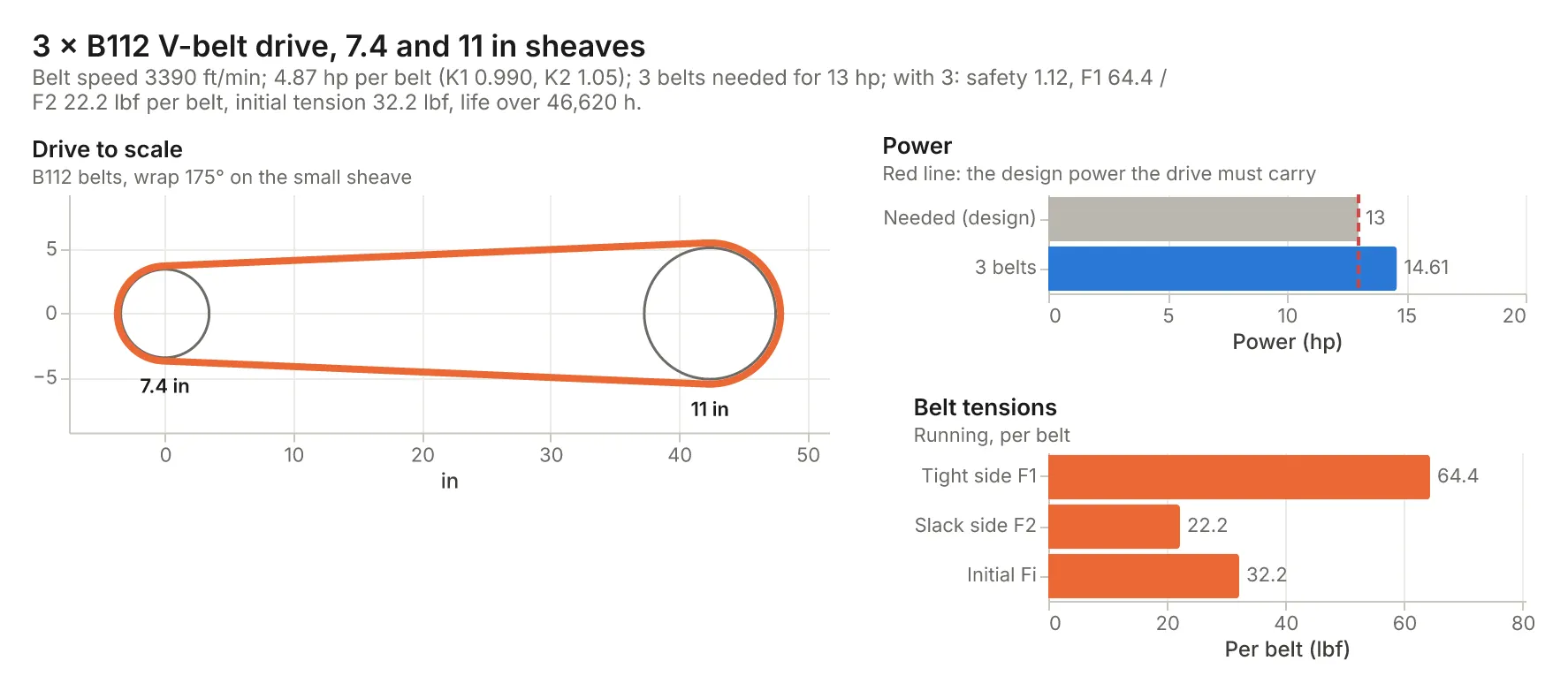
- A chart: the drive drawn to scale, next to the power needed and carried and the belt tensions.
Service factors come from the load (uniform, light, medium or heavy shock) and the driver (electric motor or engine), or you give one. Metric (kW, mm) or inch (hp, in): results come back in the units you wrote.
It's made for:
- Mechanical designers and millwrights laying out conveyor, fan, pump and machine drives.
- Maintenance teams checking whether an existing drive is overloaded or needs another belt or strand.
- Engineering students working Shigley-style belt and chain problems.
- AI agents that need real drive numbers instead of a guess.
How to use it
- Write Drives, one per entry. The form has examples.
- Optionally set a default load, service factor, design factor or the Units.
- Click Start. Each drive is a row in the results, with its summary, chart and report.
Writing a drive
| You write | It means |
|---|---|
10 hp, 7.5 kW | the power transmitted |
1750 rpm | the speed of the driving wheel |
ratio 2, driven 580 rpm | the speed ratio |
7.4 in and 11 in sheaves, small pulley 180 mm | V-belt sheave pitch diameters |
B112, 3 B112 belts, B section, 3 belts | the belts |
No. 60 chain, 08A, duplex, 3 strands | the chain |
17 and 34 teeth, 19 tooth sprocket | sprocket teeth |
center distance 600 mm, C/p 30, 76 links | the center distance or chain length |
uniform, light shock, medium shock, heavy shock, diesel engine | the service factor class |
service factor 1.3, design factor 1.5 | factors given directly |
design ... (or no belt or chain) | choose the belt or chain |
Objects work too; see Input.
Examples
All of these ran on this Actor; the numbers are from the results.
| Drive | Result |
|---|---|
10 hp motor at 1750 rpm, 7.4 in and 11 in sheaves, 3 B112 belts, service factor 1.3 (Shigley Example 17-4) | 4.87 hp per belt, 3 belts needed, safety 1.12; F1 64.4, F2 22.2, Fi 32.2 lbf; life over 46,600 h, as in the book |
design a V-belt drive: 15 kW at 1450 rpm, driven 580 rpm, center distance about 600 mm, medium shock | 4 × C96 belts on 241 and 603 mm sheaves at 564 mm centers; 4.93 kW per belt |
V-belt, 5 hp at 1750 rpm, ratio 3, light shock | 3 × A68 belts on 5.4 and 16.2 in sheaves at 16.8 in centers |
roller chain: 90 hp at 300 rpm, ratio 2, 17 tooth sprocket, moderate shock, design factor 1.5, C/p 25 (Shigley Example 17-5) | Design power 175.5 hp; single No. 200, double No. 160 or triple No. 140 (72.4 hp per strand, book 72.2); 76 links |
No. 60 chain, 17 and 34 teeth, 600 rpm, 10 hp, center distance 30 in | 11.6 hp rated, safety 1.16; 106 links, 30.12 in centers |
find the chain: 7.5 kW at 1450 rpm, ratio 3, light shock | No. 50 (10A) single strand on 17 and 51 teeth, 116 links, 11 kW rated |
The tests check that:
- Shigley's Example 17-4 comes out: center distance, belt speed, Htab, K1, K2, e^(fφ), Fc, F1, F2, Fi, belts needed, safety and life.
- Table 17-12 is interpolated correctly, and the length and center distance formulas invert each other.
- The chain power equations give Example 17-5's 72.2 hp for No. 140 at 300 rpm, its 76 links, and the roller-bushing limit taking over at high speed.
- Selection, metric and ISO chain names, speed-up drives and the text reader work.
How-to examples
Each example is a complete input; the results are from runs of the Actor (also listed under Examples).
How to design a V-belt drive
Result: 4 × C96 belts on 241 and 603 mm sheaves at 564 mm centers, 4.93 kW per belt.
How to check how many V-belts a drive needs
Result: this is Shigley's Example 17-4: 4.87 hp per belt, 3 belts needed, safety 1.12; F1 64.4, F2 22.2 and Fi 32.2 lbf; life over 46,600 h, as in the book.
How to choose a roller chain and sprockets
Result: No. 50 (10A) single strand on 17 and 51 teeth, 116 links, rated 11 kW.
How to let an AI agent pick belts and chains
Add this Actor to the Apify MCP server with https://mcp.apify.com/?tools=jumblemog/belt-chain-drive-calculator. The agent describes the drive in one line and answers with the belt or chain, the wheel sizes, the length and the rating.
FAQ
Which belts does it cover? Classical V-belts (A to E sections). Narrow, banded, timing and flat belts aren't covered.
Which chains? ANSI No. 25 to 240 or ISO 04C to 48A roller chains in one or more strands, rated for link-plate fatigue and roller-bushing impact by Shigley's equations.
Are sheave sizes outside or pitch diameters? Pitch diameters.
What does a chain rating assume? Proper lubrication for the speed and a 15,000 hour life. Check the maker's catalog for exact ratings before buying.
Input
| Field | What it is |
|---|---|
drives | Drives, as text or objects. |
shock | Default load class (uniform). |
serviceFactor | Default service factor, overriding the class. |
designFactor | Default design factor (1). |
units | in (hp and inches, default) or mm (kW and mm), for numbers written without a unit. |
charts | Draw charts (default on). |
A drive as an object takes:
type(v-beltorchain),mode(analyzeordesign),title.power,rpm, andratioordrivenRpm.- V-belts:
driverDiameter,drivenDiameter,section,belt(likeB112) orbeltLength,belts,maxSheave. - Chains:
chain(ANSI number or ISO code),strands,teeth1,teeth2,links. centerDistanceorcenterPitches;shock,driver(electric motororengine),serviceFactor,designFactor;units;text(a line of text, with the other fields overriding what it says).
Output
One dataset item per drive, also saved together in the run's OUTPUT record:
Chain drives have chain, geometry, power, chainPull, staticSafety and safetyFactor; designs add alternatives. Every item has warnings, notes (the formulas and assumptions), a Markdown report and links to the chart and report. A request that can't be computed has "status": "failed" and the reason in error, and isn't billed.
How it works
- Reading: each line is read for the power, speeds, wheels, belt or chain and factors; numbers carry their units.
- V-belts: Lp from the inside length (Table 17-11); C from Lp; wrap φ = π − 2 sin⁻¹((D − d)/2C); Htab from Table 17-12 at the small sheave's diameter and belt speed; Ha = K1·K2·Htab; belts Nb ≥ Hd/Ha with Hd = H·Ks·nd; Fc = Kc(V/1000)², ΔF = 63,025(Hd/Nb)/(n·d/2), F1 = Fc + ΔF·e^(fφ)/(e^(fφ) − 1) with f = 0.5123; life from Table 17-17's durability constants (Shigley section 17-3).
- Chains: per strand H1 = 0.004·N1^1.08·n1^0.9·p^(3 − 0.07p) (link plates) and H2 = 1000·Kr·N1^1.5·p^0.8/n1^1.5 (rollers and bushings); the smaller, times the strand factor (1, 1.7, 2.5, 3.3); length and center distance from eqs. 17-34 and 17-35 (Shigley section 17-5).
- Selection: V-belts try every section and standard small sheave, take the shortest standard belt at or past the center distance, and rank by compactness; chains take the fewest strands each size needs and rank by weight.
Results are engineering estimates for the stated assumptions; check the maker's catalog for exact ratings, sheave and sprocket sizes, and lubrication before buying.
Pricing
You pay one low price per drive, at the price shown on this page. It includes the chart and the report. Requests that can't be computed are never charged. If you set a maximum cost per run, the Actor stops before a request that wouldn't fit.
Speed
A drive takes a few milliseconds, plus the chart. A run through the API answers in about 5 to 10 seconds, including the cloud container starting.
Tips and limits
- Sheave sizes are pitch diameters, not outside diameters.
- Classical V-belts only: narrow (3V, 5V, 8V, SPZ to SPC), banded, synchronous (timing) and flat belts aren't covered.
- Chain ratings assume proper lubrication (manual or drip at low speeds, oil bath or stream at high speeds, per the maker's table) and a 15,000 hour life.
- Speed-up drives are rated at the small wheel's speed.
- Limits: 500 drives per run.
For AI agents and developers
This Actor works with the Apify MCP server, so AI agents can call it as a tool. Pass drives as plain text and read summary, safetyFactor, belt or chain, geometry and warnings. A direct API call that waits for the answer:
run-sync instead returns the run's OUTPUT: the status, the counts and every result as JSON.
In Python, with the apify-client package:
Credits
- Charts: Vega-Lite and vl-convert (BSD-3-Clause), with the Inter font (SIL Open Font License).
- Method: Budynas and Nisbett, Shigley's Mechanical Engineering Design, chapter 17, with its Gates V-belt and ANSI roller chain data.


