

Shaft Calculator (Fatigue, Goodman, Diameter Sizing)
Pricing
Pay per event
Shaft Calculator (Fatigue, Goodman, Diameter Sizing)
Shaft fatigue calculator from plain text: endurance limit with Marin factors, notch and stress concentration, von Mises stresses, safety by DE-Goodman, Gerber, ASME elliptic and Soderberg, yield, life, and diameter sizing.
Pricing
Pay per event
Rating
0.0
(0)
Developer

Jumble Mog
Maintained by CommunityActor stats
0
Bookmarked
2
Total users
1
Monthly active users
16 days ago
Last modified
Categories
Features
Share
Will the shaft last? Describe the section in one line and find out. Type 30 mm shaft, 1050 CD, machined, bending moment 140 N·m, steady torque 120 N·m, rounded shoulder, 99% reliability or find the diameter: 1045 CD, M 200 N·m, T 150 N·m, keyseat, safety 2. You get back:
- The endurance limit with every Marin factor shown: surface (ka), size (kb), load (kc), temperature (kd) and reliability (ke).
- The stress concentration: Kt and Kts for the notch (from Shigley's first-iteration table for shoulders, keyseats and ring grooves, or your own), the notch sensitivity q from the Neuber constant, and the fatigue factors Kf and Kfs.
- The stresses: bending, torsion and axial, alternating and mean, combined into von Mises σa′ and σm′, and the peak stress.
- Safety factors by all four classic criteria: DE-Goodman, DE-Gerber, DE-ASME elliptic and DE-Soderberg, plus first-cycle yield.
- The life in cycles when the shaft isn't infinite-life.
- For design requests: the smallest standard diameter that meets your safety target, and the exact DE-Goodman diameter.
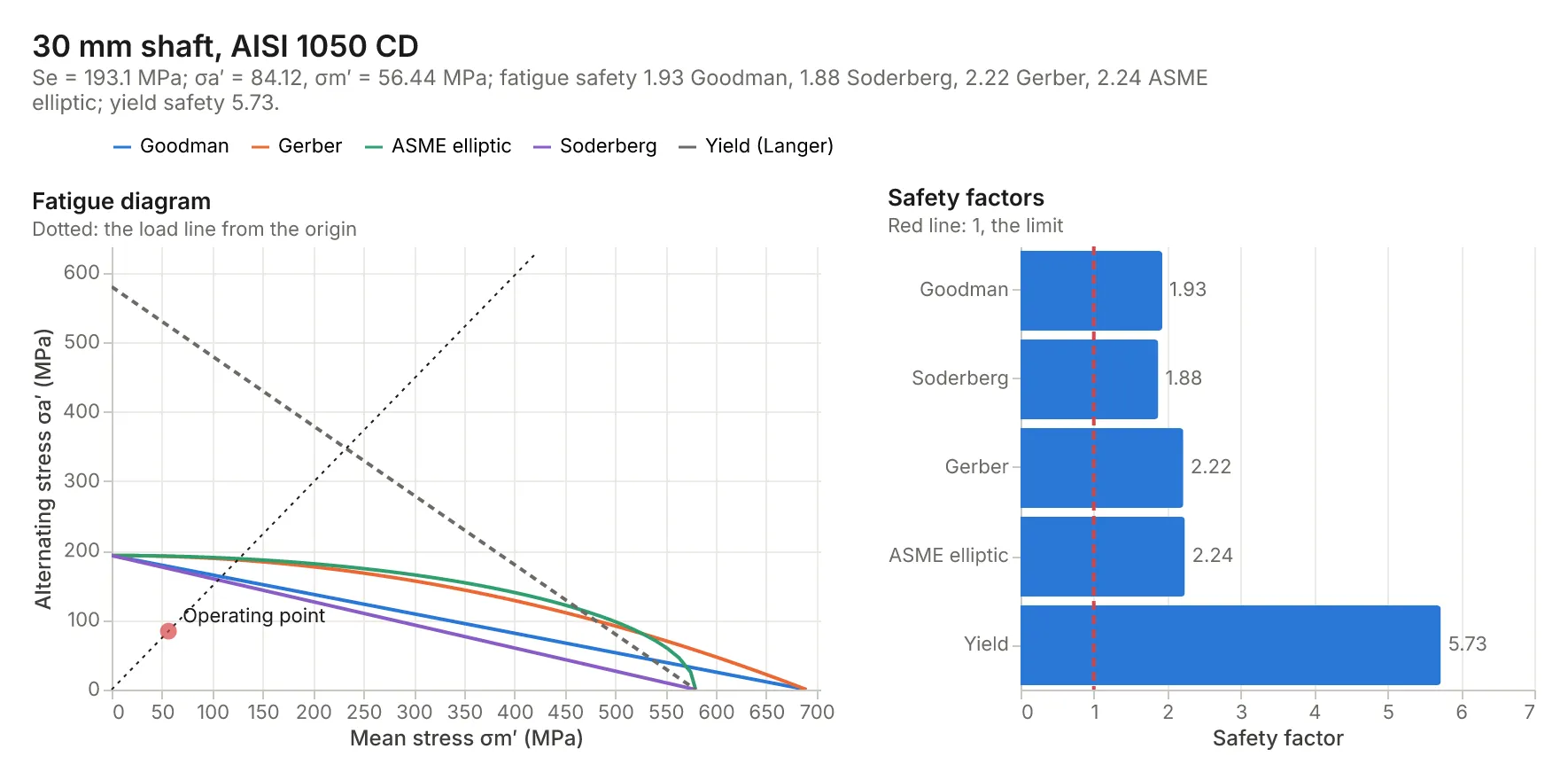
- A chart: the fatigue diagram with the four failure lines, the yield line, the load line and the operating point, next to the safety factors.
Loads are written the way they act:
- A bending moment on a rotating shaft reverses every turn, so it's all alternating.
- A torque is steady unless you say alternating or give a range (
T 50 to 150 N·m). - Stationary shafts and axles keep steady bending as a mean stress.
- Axial forces add to the bending stress.
Materials: the AISI carbon steels from 1006 to 1095, hot-rolled or cold-drawn, with Shigley's minimum strengths; any steel by Sut and Sy; or a Brinell hardness (Sut ≈ 3.4·HB). Metric (mm, N·m, MPa) or inch (in, lbf·in, kpsi): results come back in the units you wrote.
It's made for:
- Mechanical designers checking gearbox, pump, motor and conveyor shafts.
- Engineering students working Shigley-style shaft problems.
- Maintenance engineers judging a shaft that keeps breaking.
- AI agents that need real fatigue numbers instead of a guess.
How to use it
- Write Shafts, one section per entry. The form has examples.
- Optionally set a Default material, surface, reliability, the Main criterion or the Units.
- Click Start. Each section is a row in the results, with its summary, chart and report.
Writing a section
| You write | It means |
|---|---|
30 mm shaft, d = 1.25 in, axle 40 mm | the diameter at the section |
1045 CD, AISI 1020 HR, Sut 105 kpsi, Sy 82 kpsi, 300 HB | the material |
ground, machined, cold-drawn, hot-rolled, forged | the surface (machined if not given) |
rounded shoulder, sharp shoulder, keyseat, sled-runner keyseat, retaining ring groove | the notch (Shigley Table 7-1) |
Kt 1.68, Kts 1.42, fillet radius 0.11 in | your own stress concentration and notch radius |
M 140 N·m, bending moment 1260 lbf·in | bending moment |
T 120 N·m, steady torque ..., alternating torque ..., T 50 to 150 N·m | torque |
axial 5 kN | axial force |
99% reliability, at 200 C, stationary | reliability, temperature, a non-rotating shaft |
find the diameter ..., safety 2, gerber | size it, the target, the main criterion |
Objects work too; see Input.
Examples
All of these ran on this Actor; the numbers are from the results.
| Section | Result |
|---|---|
30 mm shaft, 1050 CD, machined, bending moment 140 N·m, steady torque 120 N·m, rounded shoulder, 99% reliability | Se 193 MPa (ka 0.798, kb 0.862, ke 0.814); Kf 1.59, Kfs 1.44; σa′ 84.1, σm′ 56.4 MPa; safety 1.93 Goodman, 2.22 Gerber, 2.24 ASME, 1.88 Soderberg; yield 5.73 |
1.1 in shaft, Sut 105 kpsi, Sy 82 kpsi, machined, Kt 1.68, Kts 1.42, fillet radius 0.11 in, M = 1260 lbf·in, T = 1100 lbf·in (Shigley Example 7-1) | q 0.85, Kf 1.58, ka 0.787, kb 0.868, Se 35.9 kpsi, as in the book; safety 1.93 Goodman, 2.25 Gerber; yield 4.50 |
find the diameter: 1045 CD, M 200 N·m, T 150 N·m, keyseat, safety 2 | 38 mm (exact DE-Goodman diameter 35.4 mm); safety 2.45 at 38 mm |
| Gearbox output shaft, 25 mm, 300 HB, Sy 800 MPa, ground, retaining ring groove, M 80 N·m, T 50 to 150 N·m | Safety only 1.16 Goodman: the ring groove's Kt of 5 dominates, and a warning says so |
20 mm shaft, 1020 HR, hot-rolled, M 250 N·m | Safety 0.44 and yield 0.66: it yields at once and would last about 1,700 cycles |
The tests check that:
- The Marin factors, notch sensitivity and endurance limit of Shigley's Example 7-1 come out.
- Goodman, Soderberg and ASME elliptic match their formulas, and the Gerber result lies on the Gerber parabola.
- The material table, hardness rule, rotating and stationary loads, ranges and qualifiers are read correctly.
- The design diameter is the smallest standard size that works, and the exact diameter gives a safety of exactly the target.
How-to examples
Each example is a complete input; the results are from runs of the Actor (also listed under Examples).
How to check shaft fatigue at a shoulder (Goodman, Gerber, ASME)
Result: Se 193 MPa (ka 0.798, kb 0.862, ke 0.814); Kf 1.59 and Kfs 1.44; safety 1.93 Goodman, 2.22 Gerber, 2.24 ASME elliptic and 1.88 Soderberg; yield safety 5.73.
How to find the shaft diameter you need
Result: 38 mm, where the exact DE-Goodman diameter is 35.4 mm; safety 2.45 at 38 mm.
How to reproduce Shigley's Example 7-1
Result: q 0.85, Kf 1.58, ka 0.787, kb 0.868 and Se 35.9 kpsi, as in the book; safety 1.93 Goodman and 2.25 Gerber; yield 4.50.
How to let an AI agent check shafts
Add this Actor to the Apify MCP server with https://mcp.apify.com/?tools=jumblemog/shaft-calculator. The agent describes the section in one line and answers with the endurance limit, the notch factors and the safety factor by each criterion.
FAQ
Which notches does it know? Shoulders (sharp or rounded), keyseats, retaining ring grooves and others, with Shigley's Table 7-1 first estimates, or your own Kt, Kts and fillet radius.
Does it estimate life? Yes. When the safety is under 1, it gives the cycles to failure from Basquin's line.
Does it check deflection or critical speed? No: one section's stresses only. Check deflection, critical speed, keys and hubs separately.
Does it work for aluminum? No. The endurance rules are for steel; aluminum and other metals have no endurance limit.
Input
| Field | What it is |
|---|---|
shafts | Shaft sections, as text or objects. |
material | Default material (AISI 1045 CD if unset). |
surface | Default surface (machined). |
reliability | Default reliability in % (50). |
criterion | Main criterion: goodman (default), gerber, asme or soderberg. |
units | mm (default) or in, for numbers written without a unit. |
charts | Draw charts (default on). |
A section as an object takes:
diameter,mode(analyzeordesign),safety(design target, default 1.5),criterion.material, orsutandsy, orhardness(HB).surface,reliability,temperature,miscFactor.notch, orkt,kts,ktAxial, andnotchRadius.moment,momentAlternating,momentMean,torque,torqueAlternating,torqueMean,axial(each a value or a range like"50 to 150 N·m"),rotating(default true).units,title, andtext(a line of text, with the other fields overriding what it says).
Output
One dataset item per section, also saved together in the run's OUTPUT record:
A design adds design with the target, the standard and the exact diameter. Every item has warnings, notes (the formulas and assumptions), a Markdown report and links to the chart and report. A request that can't be computed has "status": "failed" and the reason in error, and isn't billed.
How it works
- Reading: each line is read for the diameter, material, surface, notch, loads and options; numbers carry their units.
- Endurance limit: Se′ = 0.5·Sut (700 MPa above 1400 MPa), times ka = a·Sut^b for the surface, kb = 1.24·d^−0.107 (or 1.51·d^−0.157 above 51 mm), kc, kd from the temperature polynomial and ke for the reliability (Shigley eqs. 6-8 and 6-18 to 6-27).
- Notches: Kf = 1 + q(Kt − 1) with q = 1/(1 + √a/√r) from the Neuber constant for bending and torsion; Table 7-1 notches use their typical r/d.
- Stresses: σa′ = √((32·Kf·Ma/πd³)² + 3(16·Kfs·Ta/πd³)²) and the same for the mean, with axial stress added to bending.
- Criteria: the four distortion-energy criteria along a load line from the origin (Shigley eqs. 7-8 to 7-15); yield against the peak von Mises stress; life from Basquin's line through 0.9·Sut at 10³ cycles and Se at 10⁶ with the Goodman equivalent stress.
- Design: standard diameters from small to large until the main criterion and yield both reach the target, recomputing kb and any r/d-based notch radius each time.
Results are engineering estimates for the stated assumptions; check deflections, critical speeds and the real notch geometry before building.
Pricing
You pay one low price per section, at the price shown on this page. It includes the chart and the report. Requests that can't be computed are never charged. If you set a maximum cost per run, the Actor stops before a request that wouldn't fit.
Speed
A section takes a millisecond and a diameter search a few, plus the chart. A run through the API answers in about 5 to 10 seconds, including the cloud container starting.
Tips and limits
- One section per entry: check each shoulder, keyseat and groove along the shaft, with the moment and torque at that point (the Beam & Frame Calculator gives the moment diagram).
- Table 7-1 notch values are first estimates. For a final check, read Kt and Kts from the real fillet radius and diameter ratio and enter them with the radius.
- Steels only: the endurance rules here are for steel. Aluminum and other metals have no endurance limit.
- Not covered: deflection and slope at bearings and gears, critical speed, keys and hub stresses.
- Limits: 500 sections per run.
For AI agents and developers
This Actor works with the Apify MCP server, so AI agents can call it as a tool. Pass shafts as plain text and read summary, safety, yieldSafety, infiniteLife, lifeCycles, warnings and, for designs, design.standardDiameter. A direct API call that waits for the answer:
run-sync instead returns the run's OUTPUT: the status, the counts and every result as JSON.
In Python, with the apify-client package:
Credits
- Charts: Vega-Lite and vl-convert (BSD-3-Clause), with the Inter font (SIL Open Font License).
- Method: Budynas and Nisbett, Shigley's Mechanical Engineering Design, chapters 6 and 7 (Marin factors, notch sensitivity, Table 7-1 stress concentration estimates, distortion-energy fatigue criteria, yield and life), and Table A-20 for carbon steel strengths.


