

Home Electrical Load Calculator (NEC 220)
Pricing
Pay per event
Home Electrical Load Calculator (NEC 220)
NEC Article 220 home electrical load calculation from plain text: standard and optional methods, service size and conductors, and whether an existing panel can take a new EV charger, heat pump or appliance.
Pricing
Pay per event
Rating
0.0
(0)
Developer

Jumble Mog
Maintained by CommunityActor stats
0
Bookmarked
2
Total users
1
Monthly active users
4 days ago
Last modified
Categories
Security
Limited permissionsShare
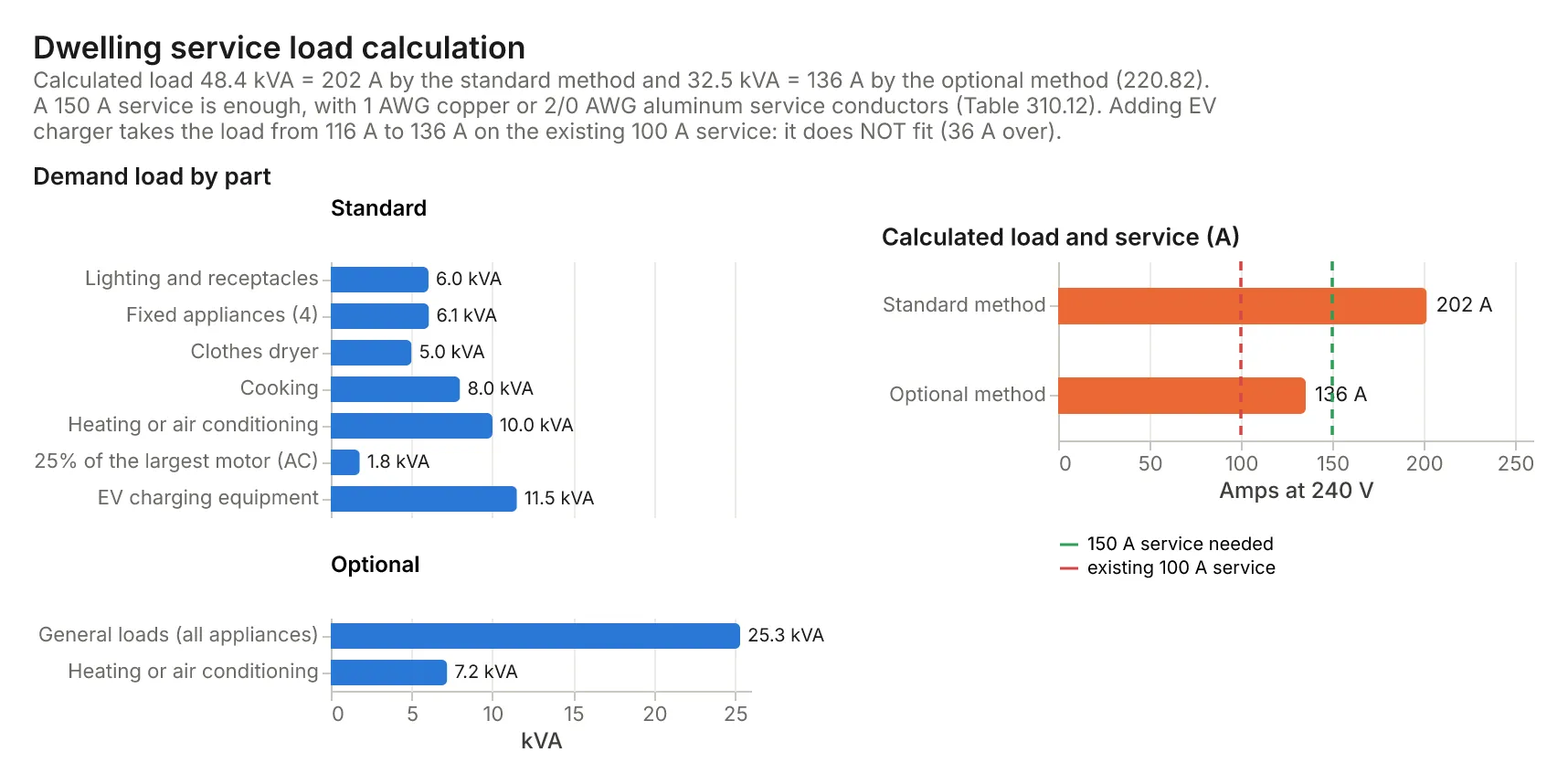
Work out a home's electrical load and service size by NEC Article 220, or whether the existing panel can take a new EV charger, heat pump or hot tub, from one line of text. Ask 2,400 sq ft house, electric range 12 kW, dryer 5 kW, water heater 4.5 kW, AC 30 A, electric furnace 10 kW or 1,800 sq ft home with gas heat, AC 24 A, dishwasher, disposal, microwave, 200 A panel, can I add a 48 A EV charger and you get back:
- Both NEC methods, line by line: the standard method (general lighting and receptacles with the Table 220.45 demand factors, small-appliance and laundry circuits, fixed appliances at 75% when there are four or more, dryers, cooking by Table 220.55, the larger of heating or cooling, 25% of the largest motor, EV chargers) and the optional method of 220.82 (10 kVA at 100% and the rest at 40%, plus heating or cooling by 220.82(C)).
- The service size: the calculated amps at 240 V, the standard service rating that covers it (at least 100 A) and the service conductors in copper and aluminum from Table 310.12.
- An existing panel check: spare or missing amps, and for appliances marked
addornew, the load before and after. - A chart and a Markdown report showing every number with its NEC section.
It's made for:
- Electricians, EV charger and heat pump installers checking whether a panel upgrade is needed before quoting.
- Homeowners, builders, inspectors and students who want the load calculation done and explained.
- AI agents, quoting tools and energy apps that need a code-based service size they can cite.
How to use it
- Write Homes, one per entry. The form has examples.
- Optionally choose the Default method: both (the service is sized by the lower, as the NEC allows), standard or optional.
- Click Start. Each home is a row in the results, with its summary, chart and report.
What you can write
| You write | It means |
|---|---|
2,400 sq ft, 220 m2 | Floor area (3 VA per ft², 220.41) |
range 12 kW, cooktop 7 kW, 2 wall ovens 4 kW each | Cooking (a cooktop and ovens count as one range, Table 220.55 Note 4) |
dryer 5 kW, water heater 4500 W, dishwasher, disposal, microwave 12 A at 120 V | Appliances; amps are at 240 V unless you write 120 V |
AC 30 A, 3 ton AC, mini-split 15 A, heat pump 25 A | Cooling and heat pumps |
10 kW heat strips, electric furnace 10 kW, 6 baseboard heaters 1.5 kW each | Electric heat (central or separately controlled units) |
48 A EV charger, well pump 1 hp, pool pump 1.5 hp, hot tub 50 A | EV chargers, motors and others |
gas heat, gas range | Not electric: left out |
200 A service, 100 amp panel | The existing service, checked against the load |
add a 48 A EV charger, new heat pump 25 A | New loads: the load before and after |
3 small-appliance circuits, 2 laundry circuits | More than the minimum 2 and 1 |
optional method, standard method | One method only |
An appliance without a rating gets a typical one, listed in the notes. The same as an object: {"area": 2000, "appliances": ["range 12 kW", {"name": "dryer", "kw": 5}, {"name": "EV charger", "amps": 40, "new": true}], "existingService": 100}.
Examples
2,400 sq ft house, electric range 12 kW, dryer 5 kW, water heater 4.5 kW, dishwasher 1.2 kW, disposal 0.9 kW, microwave 1.5 kW, AC 30 A, electric furnace 10 kW→ standard 36.9 kVA = 154 A; optional 27.9 kVA = 116 A; a 125 A service with 2 AWG copper or 1/0 aluminum.1,800 sq ft home with gas heat, AC 24 A, dishwasher, disposal, microwave, 200 A panel, can I add a 48 A EV charger→ the charger takes the load from 72 A to 91 A: it fits with 109 A to spare.3,000 sq ft, heat pump 25 A with 10 kW heat strips, cooktop 7 kW, 2 wall ovens 4 kW each, dryer 5.5 kW, water heater 4500 W, 100 A service→ 141 A by the optional method: the 100 A service is 41 A short; 150 A needed.1,200 sq ft cabin, 6 baseboard heaters 1.5 kW each, range 8 kW, water heater 4.5 kW, well pump 1 hp→ 78 A by the optional method (40% of four or more separately controlled heaters): the 100 A minimum service.
How-to examples
Each example is a complete input; the results are from runs of the Actor (also listed under Examples).
How to calculate a home's electrical load and service size (NEC 220)
Result: standard method 36.9 kVA = 154 A; optional method 27.9 kVA = 116 A; a 125 A service with 2 AWG copper or 1/0 aluminum. Every number comes with its NEC section.
How to check if a panel can take an EV charger
Result: the charger takes the load from 72 A to 91 A, so it fits with 109 A to spare.
How to find out if a service needs an upgrade for a heat pump
Result: 141 A by the optional method, so the 100 A service is 41 A short and a 150 A service is needed.
How to let an AI agent do load calculations
Add this Actor to the Apify MCP server with https://mcp.apify.com/?tools=jumblemog/electrical-load-calculator. The agent lists the house and its appliances in one line, the way the owner described them, and answers with the amps, the service size and whether the panel has room.
FAQ
Which method does it use? Both NEC Article 220 methods, standard and optional, line by line, from the 2023 NEC.
Can it check an existing panel? Yes. Give the panel size and mark new appliances with add or new, and it gives the load before and after and the spare amps.
Does it size the service wires? Yes, in copper and aluminum, from Table 310.12.
Is it a permit calculation? It's a design aid. Use the equipment's nameplate ratings; the authority having jurisdiction and local amendments have the final word.
Input
| Field | What it is |
|---|---|
requests | Homes, as lines of text or objects (up to 200 per run) |
method | both, standard or optional, when a request doesn't say |
charts | Draw a chart for each request (default on) |
Output
One dataset item per request, also saved together in the run's OUTPUT record:
With an existing service, service also has existing, spareAmps, existingOk and, when there are new appliances, beforeNewAmps. Every item has warnings, notes (every assumption), a Markdown report and links to the chart and report. A request that can't be computed has "status": "failed" and the reason in error, and isn't billed.
How it works
- Standard method (Article 220 Part III): 3 VA per ft² plus 1,500 VA per small-appliance and laundry circuit, with 3,000 VA at 100% and the rest at 35% (Table 220.45); fixed appliances at 75% when four or more (220.53); dryers at 5,000 W or nameplate (220.54); cooking by Table 220.55 (8 kW up to 12 kW, plus 5% per kW over); heating or cooling, whichever is larger, at 100% (220.60); 25% of the largest motor (220.50); EV chargers at 7,200 W or nameplate (220.57).
- Optional method (220.82): everything except heating and cooling at nameplate, 10 kVA at 100% and the rest at 40%, plus the largest of 100% of cooling, the heat pump with 65% of its supplemental heat, 65% of central electric heat, or 65% (under four) or 40% (four or more) of separately controlled heaters.
- Service: amps = VA ÷ 240, the next standard rating of at least 100 A (230.79(C)), and the Table 310.12 conductors for it.
Pricing
You pay one low price per request, at the price shown on this page. The chart and report are included. Requests that can't be computed are never charged. If you set a maximum cost per run, the Actor stops before a request that wouldn't fit.
Speed
A request takes milliseconds. A run through the API answers in about 10 seconds, including the cloud container starting.
Tips and limits
- This is a design aid. Use the nameplate ratings of the actual equipment; the authority having jurisdiction and your local code amendments have the final word.
- One dwelling unit on a 120/240 V single-phase service. Multifamily buildings (220.84), commercial services, three-phase and 208 V services aren't covered.
- Tons are turned into about 1.2 kVA per ton when no amps are given; the nameplate minimum circuit ampacity is better.
- Not included: the neutral load (220.61), the measured-load method for existing homes (220.87) and EV energy management systems (625.42), which can let a charger fit a smaller service.
- Limits: 200 requests per run.
For AI agents and developers
This Actor works with the Apify MCP server, so AI agents can call it as a tool. Pass requests as plain text and read summary, service and warnings. A direct API call that waits for the answer:
run-sync instead returns the run's OUTPUT: the status, the counts and every result as JSON.
In Python, with the apify-client package:
Credits
- Method: NFPA 70, National Electrical Code, 2023 edition: Article 220, 230.79, Table 310.12 and Table 430.248. This Actor is not affiliated with the NFPA.
- Charts: Vega-Lite and vl-convert (BSD-3-Clause), with the Inter font (SIL Open Font License).


