

Heat Transfer Calculator: Heat Exchangers, Insulation, U-Values
Pricing
Pay per event
Heat Transfer Calculator: Heat Exchangers, Insulation, U-Values
Heat exchanger rating and sizing (effectiveness-NTU, LMTD and F, steam and refrigerants), pipe and tank insulation heat loss and thickness (ASTM C680), and wall U-values (ISO 6946). JSON in, numbers and charts out. For AI agents.
Pricing
Pay per event
Rating
0.0
(0)
Developer

Jumble Mog
Maintained by CommunityActor stats
0
Bookmarked
2
Total users
1
Monthly active users
3 days ago
Last modified
Categories
Security
Limited permissionsShare
Three everyday heat transfer calculations in one tool:
- Heat exchangers: rate an exchanger you have, size one for a duty, or find the flow one side needs. It works for counterflow, parallel, shell-and-tube, crossflow and plate exchangers, including steam and refrigerant condensers.
- Insulation on pipes, tanks and ducts: heat loss or gain, surface temperature, money saved against bare, and the thinnest standard thickness that keeps a surface safe to touch or above the dew point.
- Walls, roofs and floors: the U-value from the layers, the heat flow, the temperature at every layer, and how much insulation reaches a target U.
Write units the way you normally would (120 l/min, 65 C, 3 barg, 350 W/m2K, 2 in mineral wool, R-13 batt). Results come back in SI or US units, with a chart and a Markdown report.
It's made for:
- Mechanical, process and HVAC engineers doing quick checks and first sizing.
- Energy auditors pricing insulation upgrades.
- Architects and builders checking U-values against code.
- Students checking homework.
- AI agents that need real heat transfer numbers instead of guessed ones.
What it does
Heat exchangers
Each exchanger has a hot side and a cold side. For each side you give the fluid, the flow, and the inlet and outlet temperatures you know. The calculator works out the rest:
- Rating: give UA (or U and area) and both flows. You get both outlet temperatures, the duty, the effectiveness and the NTU.
- Sizing: give one side's flow and both its temperatures (or the duty), plus the other side's inlet. You get:
- the other side's outlet temperature or flow;
- UA, the LMTD and the correction factor F;
- the area for your U. Without a U, you get an area range from typical U values for that service.
- Finding a flow: give UA and one outlet temperature, and leave one flow out. You get the flow that reaches that temperature, for example the cooling water an existing exchanger needs.
- Condensing and boiling: mark a side
condensingorboiling, or writesteamwith only a pressure. That side stays at its saturation temperature. If you leave its flow out, you get the flow needed, such as the steam consumption.
Duties come from enthalpy changes (CoolProp), so heat capacities that change with temperature are handled. The calculator also:
- Stops impossible duties: if a duty can't be reached, the error says how far the exchanger type can go and what would work instead, such as "Use 5 shells in series, or counterflow".
- Warns about tight designs: an F below 0.75, a temperature cross, a very close approach, or a stream that would boil part way.
Fluids: water, steam, seawater, air, nitrogen, natural gas, CO₂, ammonia, propane, refrigerants (R134a, R410A, R32, R1234yf and more), ethylene and propylene glycol, brine, diesel, gasoline, kerosene, crude and fuel oil, hydraulic oils, glycerin and milk. You can also give a custom fluid by its cp.
Insulation
For a pipe (4 in sch 40, DN100, 2 in type L copper, or an outside diameter) or a flat surface (vertical, top or bottom), you get:
- Heat loss or gain per meter (or per m²) and in total, against the bare surface.
- Temperatures: the surface temperature and the temperature at every layer.
- Surface coefficients: natural or forced convection plus radiation, with the jacket's emissivity.
- Yearly energy and cost, with the hours, energy price and boiler efficiency you give.
- The fluid's temperature change along the run, when you give its flow.
Finding a thickness: set a layer's thickness to find. You get the thinnest standard thickness (10, 13, 19, 25 ... 300 mm, or ½, ¾, 1, 1½ ... 12 in) that meets one of these:
maxSurfaceTemperature, orpersonnelProtection: truefor 60 °C (ASTM C1055 touch limit);maxHeatLoss, per meter, per m² or in total;relativeHumidity, for a cold pipe that must stay above the dew point.
Materials: mineral wool, fiberglass, calcium silicate, cellular glass, elastomeric foam, PIR, PUR, phenolic, aerogel, perlite, XPS, EPS, polyethylene foam and ceramic fiber. Each one's conductivity changes with temperature, and the result warns when a layer goes past its service temperature.
Jackets: aluminum, stainless steel, galvanized steel, painted, PVC, all-service jacket, canvas, mastic, or a given emissivity.
Walls, roofs and floors
List the layers from inside to outside, as text or objects. You get:
- The U-value and total R, in SI and as a US R-value.
- Each layer's R and its share of the total.
- Heat flow: the heat flux and the heat flow over the area.
- Temperatures: at each layer, the inside surface temperature, and the temperature factor fRsi.
- Condensation check: whether the inside surface is below the dew point at the inside humidity.
- Insulation for a target: with
targetU(ortargetR) and one layer's thickness set tofind, the thickness needed, exact and rounded up.
It follows ISO 6946:
- Surface resistances depend on whether heat flows up, sideways or down.
- Unventilated air layers use Table 8.
- A ventilated cavity drops the layers outside it.
- Studs or rails (
bridging: "15% softwood") use the combined method.
Layers can be written like 102 mm brick, 100 mm mineral wool batt, 25 mm air gap, R-13 batt, RSI 2.5, k 0.035 W/mK 120 mm. There are about 50 building materials to choose from.
How to use it
- Fill in Heat exchangers, Insulation and Walls, roofs and floors. Each list is optional, and the form has examples of each.
- Choose Units, or leave it on automatic.
- Click Start. Each calculation is a row in the results, with its summary, chart and report.
Examples
All of these ran on this Actor; the numbers are from the results.
| Request | Result |
|---|---|
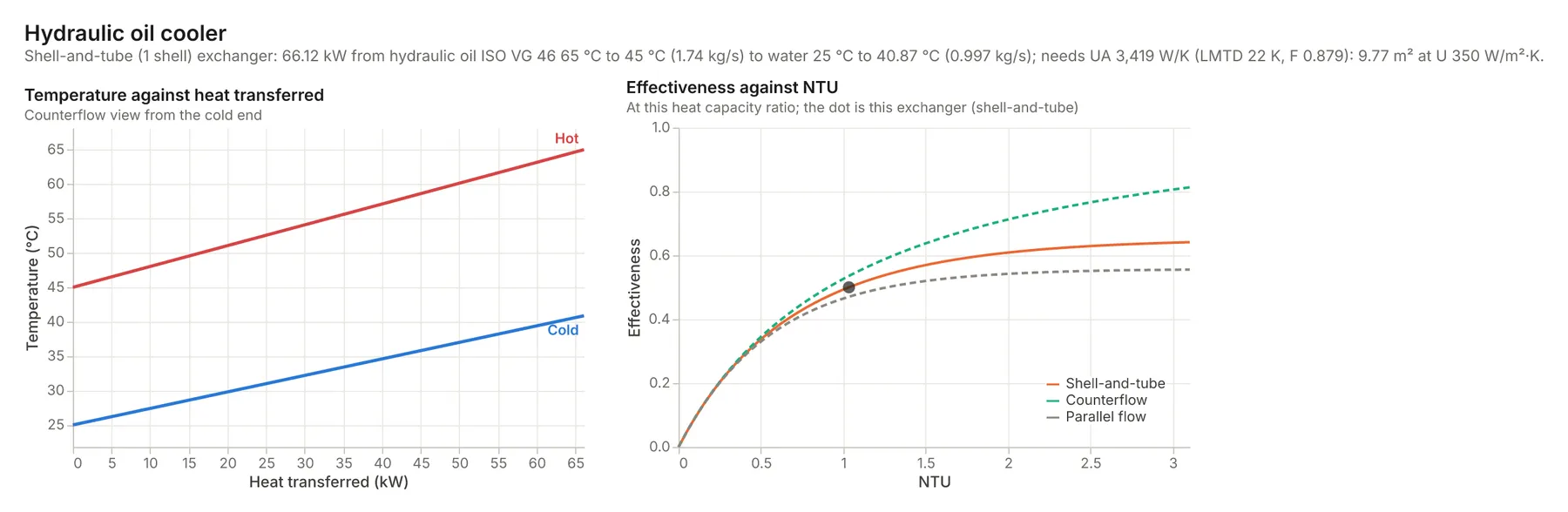
| Shell-and-tube oil cooler: hydraulic oil ISO VG 46, 120 l/min, 65 → 45 °C; water 60 l/min at 25 °C; U 350 W/m²·K | 66.12 kW, water out at 40.87 °C, UA 3,419 W/K, LMTD 22 K, F 0.879, 9.77 m² |
| Steam heater: steam at 3 barg, water 20 m³/h from 15 to 80 °C, U 1500 W/m²·K with 0.0002 m²·K/W fouling | 1,510 kW, steam condensing at 143.7 °C, 0.708 kg/s of steam, 14.15 m² at U 1,154 W/m²·K |
| Plate exchanger rating: water 10 m³/h at 80 °C, glycol 30% 8 m³/h at 10 °C, U 4000 W/m²·K, 2.5 m² | 345.7 kW, water out at 49.42 °C, glycol out at 49.86 °C, effectiveness 0.569 |
| 4 in steam line at 180 °C, 50 mm mineral wool, aluminum jacket, outdoors, 150 m | 76.66 W/m (11.5 kW), surface 15.94 °C, 96% less than bare |
| 2 in copper chilled-water pipe at 6 °C in 30 °C air at 80% RH, thickness to find | 25 mm elastomeric foam: surface 27.4 °C, above the 26.17 °C dew point |
| Tank wall at 250 °C, 4 m tall, keep the surface under 50 °C | 100 mm mineral wool, surface 49.69 °C, 111.5 W/m² |
| Cavity wall: plaster, 100 mm lightweight block, 100 mm mineral wool, 50 mm air gap, brick | U 0.267 W/m²·K, 534 W over 80 m² at 20 / -5 °C, inside surface 19.13 °C |
| Roof to U 0.15 with PIR between plasterboard and plywood | 157 mm of PIR (160 mm rounded up) |
The tests check that:
- Rating matches the closed-form effectiveness-NTU result.
- F matches Fakheri's formula, and the duty balances on both sides.
- Insulation conduction equals what the surface loses.
- The integral-mean k matches a numerical average.
- A found thickness is the thinnest that works.
- Wall U-values match the ISO 6946 sum.
How-to examples
Each example is a complete input; the results are from runs of the Actor (also listed under Examples).
How to size a shell-and-tube heat exchanger
Result: 66.12 kW, water out at 40.87 °C, UA 3,419 W/K, LMTD 22 K, F 0.879 and 9.77 m² of area. Give area instead of an outlet to rate an exchanger you have: a 2.5 m² plate exchanger with water at 80 °C and 30% glycol at 10 °C gives 345.7 kW.
How to find the insulation thickness that stops condensation on a cold pipe
Result: 25 mm of elastomeric foam keeps the surface at 27.4 °C, above the 26.17 °C dew point. For a hot pipe, a 4 in steam line at 180 °C with 50 mm of mineral wool loses 76.66 W/m, 96% less than bare.
How to calculate a wall's U-value from its layers (ISO 6946)
Result: U 0.267 W/m²·K, 534 W over 80 m² at 20 / -5 °C, and 19.13 °C on the inside surface. With "thickness": "find" and a targetU, it finds the insulation: a roof to U 0.15 needs 157 mm of PIR.
How to let an AI agent do heat transfer calculations
Add this Actor to the Apify MCP server with https://mcp.apify.com/?tools=jumblemog/heat-transfer-calculator. The agent fills in the exchanger, pipe or wall with units as people write them (120 l/min, 3 barg, R-13 batt) and answers with the duty, area, heat loss or U-value.
FAQ
Which exchanger types does it handle? Counterflow, parallel, shell-and-tube (1-2, 2-4), crossflow (mixed or unmixed), plate and double pipe, including steam and refrigerant condensers.
Where do the fluid properties come from? They're built in: water, steam, seawater, air, natural gas, refrigerants, glycols, brine, fuels, hydraulic oils and more, so you name the fluid instead of giving its properties. Any other fluid can be given by its cp.
How is insulation heat loss calculated? By the ASTM C680 method: each layer's k at its mean temperature, outside convection by Churchill-Chu or Churchill-Bernstein, and radiation to the surroundings.
Can it find a safe-to-touch thickness? Yes: set maxSurfaceTemperature, or personnelProtection: true for the 60 °C ASTM C1055 limit, and it gives the thinnest standard thickness that works.
Input
| Field | What it is |
|---|---|
exchangers | Heat exchangers, as objects (see below). |
insulation | Insulation on pipes or flat surfaces, as objects. |
walls | Walls, roofs and floors, as objects. |
units | auto, SI or US, for bare numbers and the results. |
charts | Draw charts (default on). |
An exchanger takes:
type:counterflow,parallel,shell and tube,1-2,2-4,crossflow,crossflow hot mixed,crossflow cold mixed,plateordouble pipe.shells.hotandcold, each withfluid,flow,inlet,outlet,pressure,cp,density,condensing/boiling,latentHeatandtemperature(the saturation temperature).U,fouling,area,UA,dutyandtitle.
Insulation takes:
- The surface:
pipe(oroutsideDiameter) andlength; orsurface: "flat"withorientation,height,widthandarea. - Temperatures and air:
processTemperature,ambientTemperature,location(indoororoutdoor) orwind. - The insulation:
layers, andjacketoremissivity. - Limits, for a thickness to find:
maxSurfaceTemperature,personnelProtection,maxHeatLoss,relativeHumidity. - Cost:
hoursPerYear,energyPrice,efficiency. - The pipe's contents:
fluid,flow.
A wall takes:
layers, from inside to outside, andorder("outside in"if you list them the other way).position:wall,rooforfloor.insideTemperature,outsideTemperature,areaandinsideHumidity.targetUortargetR.
Output
One dataset item per calculation, also saved together in the run's OUTPUT record. An exchanger, shortened:
The other two kinds:
- Insulation:
heatFlow,heatFlowTotal,surfaceTemperature,layers(with each layer's mean k and temperatures),bare,reduction,yearly,dewPoint,foundThicknessandfluidOutletTemperature. - Walls:
U,totalR,usRValue,layers,heatFlux,heatFlow,temperatures,insideSurfaceTemperature,temperatureFactorandfoundThickness.
Every number's unit is in unitLabels. A calculation that can't be done has "status": "failed" and the reason in error, and isn't billed.
How it works
- Exchangers:
- Effectiveness-NTU relations from the ht library: counterflow, parallel, TEMA E shell-and-tube with shells in series, and single-pass crossflow.
- Each side's heat capacity rate comes from its enthalpy change, and rating iterates until the duty settles.
- F is the duty divided by UA times the counterflow LMTD.
- Insulation, by the ASTM C680 method:
- Each layer's k is taken at its integral-mean temperature.
- Outside convection uses the Churchill-Chu (still air) and Churchill-Bernstein (wind) correlations, with air properties at the film temperature.
- Radiation goes to surroundings at the ambient temperature.
- The heat flow is solved so that conduction equals what the surface loses.
- Walls, by ISO 6946: the layers' resistances are added to the surface resistances. Bridged layers average the upper and lower limits.
- Charts are drawn with Vega-Lite and rendered with vl-convert.
Pricing
You pay one low price per calculation, at the prices shown on this page:
- one price per heat exchanger;
- a lower one per insulation system or wall.
Each includes the chart and the report. Calculations that can't be done are never charged. If you set a maximum cost per run, the Actor stops before a calculation that wouldn't fit.
Speed
A calculation takes well under a second, plus its chart. A run through the API answers in about 5 to 15 seconds, including the cloud container starting.
Tips and limits
- Typical values: material conductivities, oil properties and the typical-U area ranges are typical figures. A product data sheet or a measured U is better. You can give
k,cporUto override. - Exchanger U is an input. The calculator doesn't work out film coefficients from tube geometry, so give U from a vendor, a past design or a reference table.
foulinglowers it. - Phase change is modeled as pure condensing or boiling at the saturation temperature. Subcooling and superheat are not included. A single-phase stream that would boil is stopped with a message.
- Insulation takes the pipe surface at the process temperature, ignoring the inside film and the pipe wall. This gives a slightly high, safe-side loss. Check touch limits in still air, the hottest case.
- Walls are steady-state, with no thermal mass, moisture transport or ground coupling. For floors on the ground, use ISO 13370.
- Limits: 500 calculations per run.
For AI agents and developers
This Actor works with the Apify MCP server, so AI agents can call it as a tool. Read summary for the answer in one sentence, and the named fields for the numbers. A direct API call that waits for the answer:
run-sync instead returns the run's OUTPUT: the status, the counts and every result as JSON.
In Python, with the apify-client package:
Credits
- Heat transfer correlations and effectiveness-NTU: ht and fluids by Caleb Bell (MIT).
- Fluid properties: CoolProp (MIT).
- Root finding: SciPy (BSD-3-Clause).
- Charts: Vega-Lite and vl-convert (BSD-3-Clause), with the Inter font (SIL Open Font License).
- Methods and data:
- ASTM C680, Standard Practice for Estimate of the Heat Gain or Loss and the Surface Temperatures of Insulated Flat, Cylindrical, and Spherical Systems.
- ISO 6946, Building components and building elements: Thermal resistance and thermal transmittance.
- ISO 10456, and CIBSE Guide A, for the design conductivities.
- Fakheri, A. (2003), An alternative approach for determining log mean temperature difference correction factor and number of shells of shell and tube heat exchangers, J. Enhanced Heat Transfer 10(4).
- Incropera, F. P. et al., Fundamentals of Heat and Mass Transfer, Wiley.


