

HVAC Duct Calculator: Duct Sizing, Pressure Loss, CFM
Pricing
Pay per event
HVAC Duct Calculator: Duct Sizing, Pressure Loss, CFM
HVAC duct sizing from plain text: round and rectangular ducts by friction rate or velocity, duct run pressure loss with fittings, filters and diffusers, and the airflow (cfm or L/s) for a load or air changes, with a friction chart.
Pricing
Pay per event
Rating
0.0
(0)
Developer

Jumble Mog
Maintained by CommunityActor stats
0
Bookmarked
2
Total users
1
Monthly active users
4 days ago
Last modified
Categories
Security
Limited permissionsShare
HVAC duct sizing from one line of text. Type size a round duct for 1000 cfm, 500 L/s, 1 Pa/m, max height 300 mm, 1200 cfm, 14 in round, 80 ft, 4 elbows, 1 tee, filter 0.3 in wc or cooling load 24000 Btu/h, supply 55 F, room 75 F. You get back:
- Duct sizes: the standard round size and the exact diameter for a friction rate (equal friction), a maximum velocity, or both; the sizes around it with their velocity and friction; and up to five rectangular options (least sheet metal first, aspect ratio up to 4, or a height you set).
- Duct checks: velocity, velocity pressure, friction rate, Reynolds number, hydraulic and equivalent diameters for any round or rectangular duct.
- Duct run pressure loss: friction over the length, fittings (elbows, tees, wyes, takeoffs, dampers, transitions, exits) from typical ASHRAE loss coefficients, and components like filters, coils and diffusers at their pressure drops; several sections in series for the path to the farthest outlet.
- Airflow: cfm or L/s for a sensible heating or cooling load at a temperature difference, or for air changes per hour in a room, and the duct that carries it.
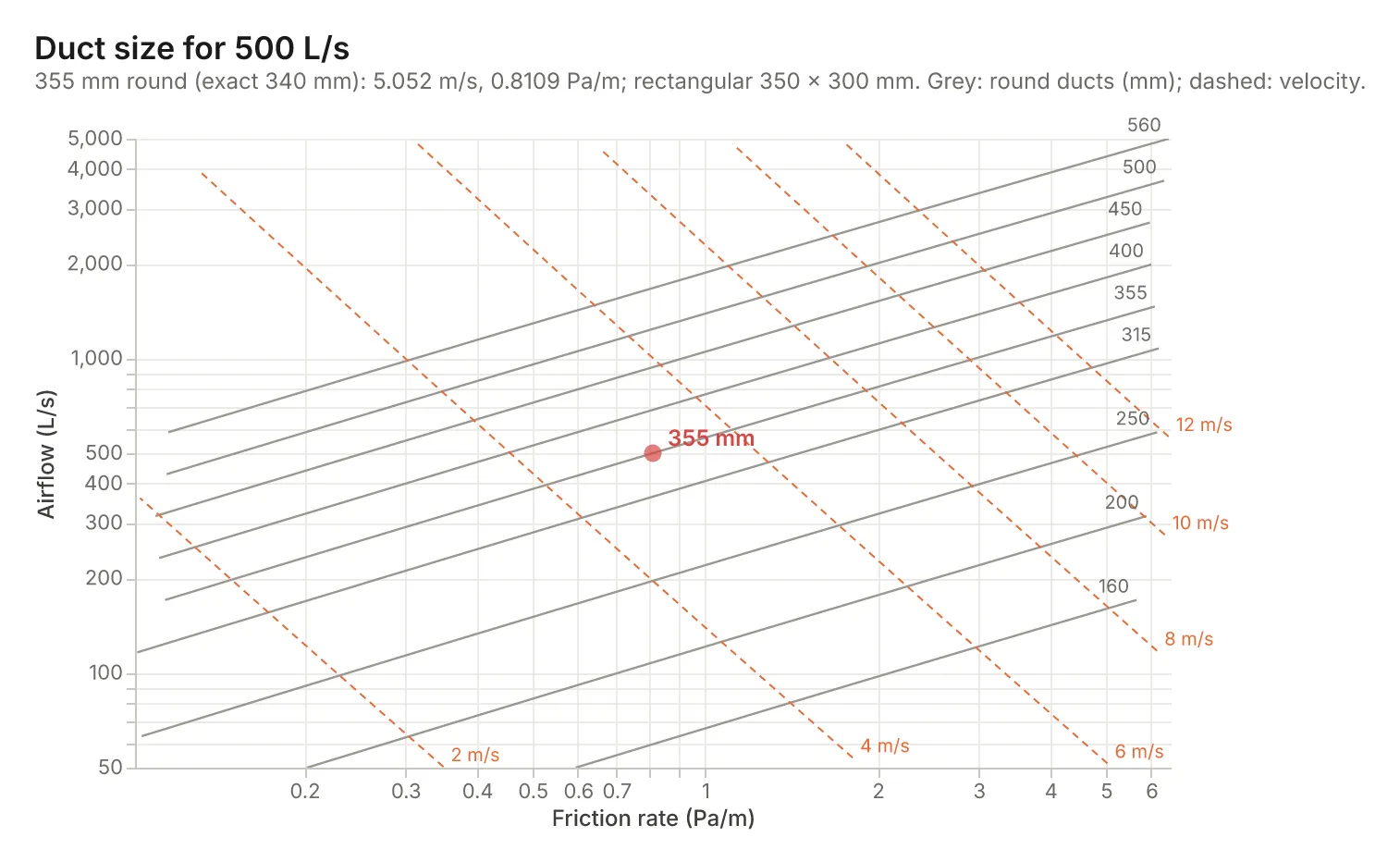
- A chart: the duct friction chart (round ducts and velocity lines) with your duct on it, or the pressure drop of each section split into friction, fittings and components.
US (cfm, in, ft, fpm, in. w.c.) or metric (L/s, m³/h, mm, m, m/s, Pa): results come back in the units you wrote. Air at other temperatures and altitudes, and galvanized, aluminum, PVC, duct board, lined or flex duct.
It's made for:
- HVAC designers, mechanical engineers and contractors sizing ductwork.
- Estimators and installers checking existing ducts and fan static pressure.
- HVAC students learning the equal friction method.
- AI agents that need real duct numbers instead of a rule of thumb.
How to use it
- Write Ducts, runs and airflows, one per entry. The form has examples.
- Optionally set the Units for numbers written without one.
- Click Start. Each request is a row in the results, with its summary, chart and report.
What you can write
| You write | It means |
|---|---|
1000 cfm, 500 L/s, 1800 m3/h | The airflow |
0.08 in wc/100 ft, 1 Pa/m | Friction rate to size for (0.1 in/100 ft or 0.8 Pa/m by default) |
max velocity 900 fpm, 5 m/s | Velocity limit to size for |
max height 12 in, depth 300 mm | A fixed side for rectangular options |
12 in round, 250 mm duct, 400 x 250 mm, 24 x 12 in | A duct to check (or to use in a run) |
80 ft, 25 m long | Length of the run |
4 elbows, 1 tee, 2 vaned elbows, mitered elbow, 45 elbow, wye, takeoff, damper, exit | Fittings |
filter 0.3 in wc, coil 120 Pa, diffuser 25 Pa | Components and their pressure drops |
flex, duct board, lined, aluminum, pvc | Duct material (galvanized by default) |
air at 120 F, altitude 5000 ft | Air conditions (20 °C at sea level by default) |
24000 Btu/h, 2 tons, 5 kW with supply 55 F, room 75 F or delta T 20 F | Airflow for a sensible load |
room 20 x 15 x 9 ft, 6 ACH | Airflow for air changes |
Several sections go as an object: {"type": "system", "sections": [{"name": "Main", "q": "2000 cfm", "w": "24 in", "h": "12 in", "length": "60 ft", "fittings": {"vaned elbow": 2}}, {"name": "Branch", "q": "400 cfm", "d": "10 in", "length": "30 ft", "fittings": {"takeoff": 1, "elbow": 2}, "components": {"diffuser": "0.08 in wc"}}]}.
Examples
size a round duct for 1000 cfm→ 14 in round (13.7 in exact) at 935 fpm and 0.088 in. w.c./100 ft; rectangular 14 x 12 in.500 L/s, 1 Pa/m, max height 300 mm→ 355 mm round at 5.05 m/s; rectangular 350 x 300 mm.rectangular duct for 2000 cfm, max velocity 1000 fpm, max height 12 in→ 24 x 12 in.1200 cfm, 14 in round, 80 ft, 4 elbows, 1 tee, filter 0.3 in wc, diffuser 0.05 in wc→ 0.56 in. w.c. (friction 0.10, fittings 0.11, components 0.35).cooling load 24000 Btu/h, supply 55 F, room 75 F→ 1107 cfm; a 15 in round duct.
How-to examples
Each example is a complete input; the results are from runs of the Actor (also listed under Examples).
How to size a round or rectangular duct for a cfm
Result: 14 in round (13.7 in exact) at 935 fpm and 0.088 in. w.c. per 100 ft, or a 14 x 12 in rectangular duct. In metric, 500 L/s, 1 Pa/m, max height 300 mm gives 355 mm round or 350 x 300 mm.
How to calculate the pressure loss of a duct run
Result: 0.56 in. w.c. in total: 0.10 friction, 0.11 fittings and 0.35 components.
How to find the airflow for a cooling load
Result: 1107 cfm, carried by a 15 in round duct.
How to let an AI agent size ducts
Add this Actor to the Apify MCP server with https://mcp.apify.com/?tools=jumblemog/duct-calculator. The agent passes the airflow or load in one line and answers with the duct size, velocity and friction rate, instead of reading a duct calculator wheel from memory.
FAQ
Which sizing method does it use? Equal friction, a maximum velocity, or both, with the standard round size, the exact diameter and rectangular equivalents.
Where do the fitting losses come from? Typical ASHRAE loss coefficients for elbows, tees, wyes, takeoffs, dampers, transitions and exits.
Does it work in metric? Yes. Results come back in the units you wrote: cfm, in and in. w.c., or L/s, mm and Pa.
Can I change the duct material or air temperature? Yes: galvanized steel, aluminum, PVC, duct board and other linings, and air at other temperatures and altitudes.
Input
| Field | What it is |
|---|---|
requests | The ducts, runs and airflows, as lines of text or objects (up to 200 per run) |
units | For numbers without a unit: m (metric) or ft (US) |
charts | Draw a chart for each request (default on) |
Output
One dataset item per request, also saved together in the run's OUTPUT record:
Checks have duct and flow; runs have sections, fittings, components and total; airflows have airflow and the duct for it. Every item has air, units, summary, warnings, notes (the method and assumptions), a Markdown report and links to the chart and report. A request that can't be computed has "status": "failed" and the reason in error, and isn't billed.
How it works
- Air: density from the temperature and the barometric pressure at the altitude; viscosity by Sutherland's law.
- Friction: Darcy-Weisbach, Δp/L = f/D · ρV²/2, with the Colebrook friction factor and ASHRAE's roughness for the material (galvanized 0.09 mm); rectangular ducts use the hydraulic diameter, and Huebscher's equivalent diameter (1.30·(ab)^0.625/(a+b)^0.25) is given for comparison. This reproduces the ASHRAE friction chart.
- Sizing: the diameter where the friction rate meets the limit (and the velocity stays under its limit), rounded up to the standard sizes (US 4 to 60 in, EN 1506 63 to 1600 mm); rectangular sides from standard sizes.
- Fittings: Δp = C × velocity pressure, with typical coefficients from the ASHRAE Duct Fitting Database (smooth elbow r/D 1.5: 0.15, mitered elbow: 1.2, tee branch: 0.8...).
- Airflow: Q = load / (ρ·cp·ΔT), the 1.08 rule at standard air.
Fitting coefficients depend on the exact geometry and flow split; look up the exact fitting for final design and fan selection.
Pricing
You pay one low price per request, at the prices shown on this page; airflows cost less than duct sizes and runs. The chart and report are included. Requests that can't be computed are never charged. If you set a maximum cost per run, the Actor stops before a request that wouldn't fit.
Speed
Each request takes a few milliseconds. A run through the API answers in about 10 seconds, including the cloud container starting.
Tips and limits
- Velocity: it warns above 2500 fpm (12.7 m/s), where low-pressure duct gets noisy, and when a duct is far larger than needed.
- Flex duct is taken fully stretched; sagging or compressed flex loses several times more.
- Systems add sections in series. For the fan's external static pressure, give the path to the farthest (or most resistive) outlet.
- Flat oval ducts and duct leakage aren't modelled.
- Limits: 200 requests per run.
For AI agents and developers
This Actor works with the Apify MCP server, so AI agents can call it as a tool. Pass requests as plain text and read summary, flow, round, rectangular, total, airflow and warnings. A direct API call that waits for the answer:
run-sync instead returns the run's OUTPUT: the status, the counts and every result as JSON.
In Python, with the apify-client package:
Credits
- Charts: Vega-Lite and vl-convert (BSD-3-Clause), with the Inter font (SIL Open Font License).
- Methods: ASHRAE Handbook, Fundamentals, chapter 21 (Duct Design) and the ASHRAE Duct Fitting Database; Colebrook (1939); Huebscher (1948); EN 1506 round duct sizes.


