

HVAC Superheat & Subcooling Calculator (Refrigerant Charge)
Pricing
Pay per event
HVAC Superheat & Subcooling Calculator (Refrigerant Charge)
Refrigerant charge checks from plain text: superheat and subcooling from gauge readings with the piston or TXV target and an add, recover, restriction or airflow verdict, target superheat, pressure-temperature charts for 15 refrigerants including R-410A, R-454B and R-32, and line set charge.
Pricing
Pay per event
Rating
0.0
(0)
Developer

Jumble Mog
Maintained by CommunityActor stats
0
Bookmarked
2
Total users
1
Monthly active users
4 days ago
Last modified
Categories
Security
Limited permissionsShare
Check an air conditioner's or heat pump's refrigerant charge, look up refrigerant pressure-temperature values, or work out the extra charge for a long line set, from one line of text. Ask R-410A piston, suction 118 psig, suction line 60 F, liquid 340 psig, liquid line 98 F, 63 wet bulb, 85 outdoor or R-454B at 120 psig and you get back:
- Superheat and subcooling from your gauge pressures and line temperatures, with the evaporator and condensing saturation temperatures (dew point for superheat and bubble point for subcooling on blends with glide, such as R-454B and R-407C).
- The target: fixed-orifice (piston, capillary) target superheat from the indoor wet bulb and outdoor temperature, or TXV/EEV target subcooling.
- A verdict: charge OK, undercharged (add), overcharged (recover), a likely restriction or an airflow problem, with the condenser approach, evaporator TD and temperature split when you give the air temperatures.
- Pressure-temperature (PT) lookups and charts for 15 refrigerants: R-410A, R-454B, R-32, R-22, R-452B, R-513A, R-134a, R-407C, R-404A, R-507A, R-1234yf, R-290, R-600a, R-744 (CO2) and R-717 (ammonia).
- Line set charge: how much refrigerant to add for line set beyond what the factory charge covers, by liquid line size.
- Charts (superheat and subcooling gauges, target superheat curves, the PT curve) and a Markdown report.
It's made for:
- HVAC technicians and apprentices checking a charge or a PT value on the job.
- Contractors, trainers and students learning to read gauges and diagnose a system.
- AI agents, service apps and field tools that need charging numbers they can show their work for.
How to use it
- Write Requests, one per entry. The form has examples.
- Optionally set a Default refrigerant and Default metering device.
- Click Start. Each request is a row in the results, with its summary, chart and report.
What you can write
| You write | It means |
|---|---|
R-410A, R-454B, R-22, puron, puron advance | The refrigerant |
piston, fixed orifice, cap tube / TXV, EEV | The metering device (charge by superheat / by subcooling) |
suction 118 psig, suction line 60 F | Suction pressure and suction line temperature (superheat) |
liquid 340 psig, head pressure 340, liquid line 98 F | Liquid pressure and liquid line temperature (subcooling) |
63 wet bulb, 85 outdoor, return 75 F, supply 57 F | Indoor wet bulb, outdoor temperature and the air across the coil |
superheat 15 F, subcooling 4 F, target subcooling 9 | Readings you already have, or the nameplate target |
R-454B at 120 psig, R-407C 45 F, PT chart for R-32 | A pressure-temperature lookup or a whole chart |
R-410A line set 50 ft, 3/8 liquid line, 15 ft included, 0.6 oz per ft, factory charge 6 lb 4 oz | Line set charge |
8.5 bar, 600 kPa, 12 C, in celsius | Metric: answers in °C and bar(g) |
The same as an object: {"refrigerant": "R-22", "metering": "piston", "suctionPressure": "58 psig", "suctionLineTemp": "65 F", "wetBulb": 62, "outdoor": 90}.
Examples
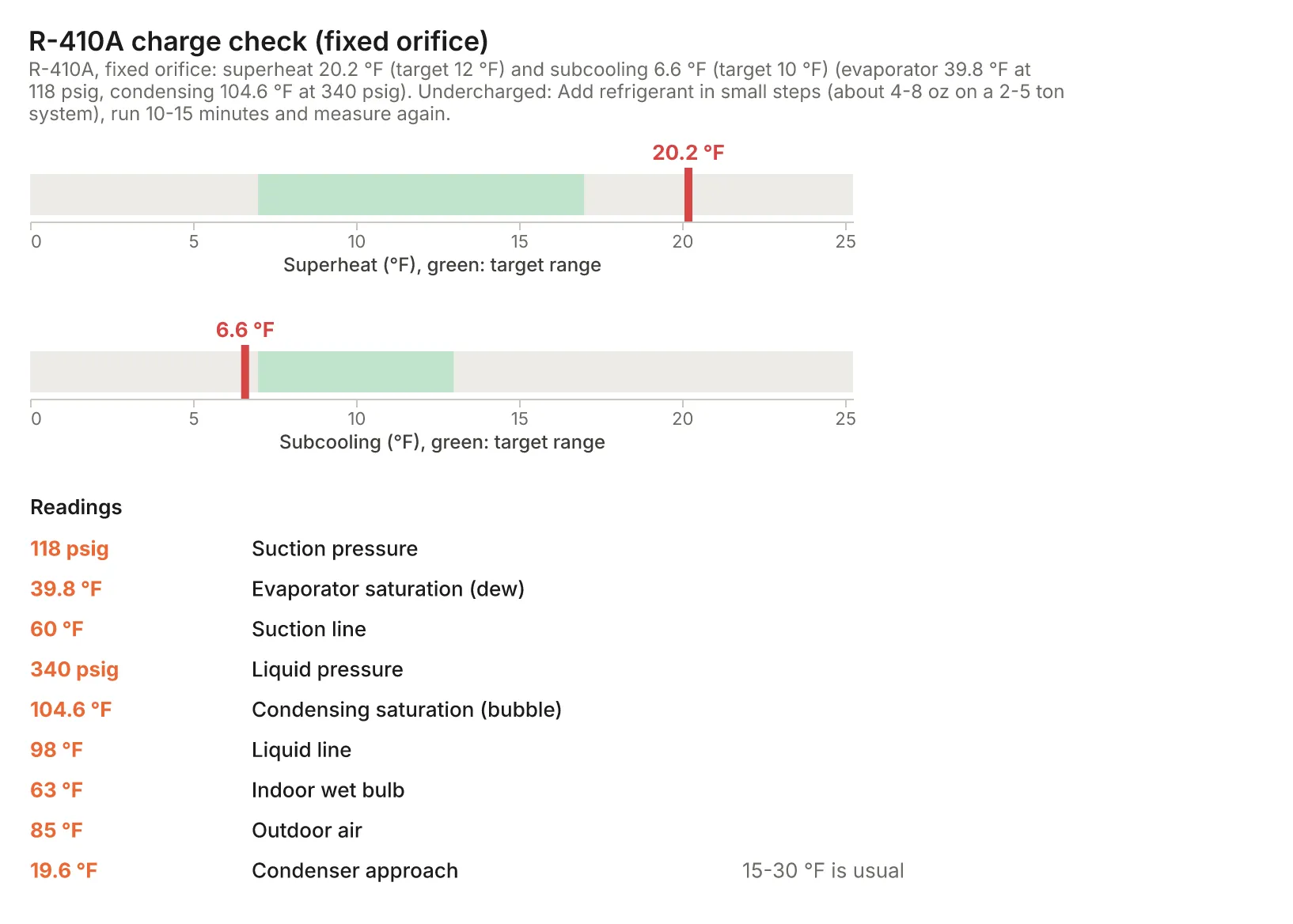
R-410A piston, suction 118 psig, suction line 60 F, liquid 340 psig, liquid line 98 F, 63 wet bulb, 85 outdoor→ evaporator 39.8 °F, superheat 20.2 °F against a 12 °F target, subcooling 6.6 °F: undercharged, add refrigerant in small steps.R-454B TXV, suction 115 psig, suction line 55 F, liquid 400 psig, liquid line 105 F, target subcooling 9→ evaporator 43.5 °F (dew), condensing 120.5 °F (bubble), subcooling 15.5 °F: overcharged, recover.R-410A piston, superheat 30, subcooling 20, 63 wb, 85 odb→ high superheat with high subcooling: a restriction, not the charge.target superheat, 63 wet bulb, 85 outdoor→ 12 °F.R-407C at 45 F→ 88.8 psig liquid (bubble), 70.7 psig vapor (dew).R-410A line set 50 ft, 3/8 liquid line, 15 ft included→ add 19 oz (1 lb 3 oz) for 35 ft at 0.54 oz per ft.
How-to examples
Each example is a complete input; the results are from runs of the Actor (also listed under Examples).
How to check an AC's refrigerant charge with superheat (piston)
Result: evaporator 39.8 °F, superheat 20.2 °F against a 12 °F target, and subcooling 6.6 °F: undercharged, so add refrigerant in small steps.
How to check charge by subcooling on a TXV system
Result: evaporator 43.5 °F (dew), condensing 120.5 °F (bubble) and subcooling 15.5 °F: overcharged, so recover some. High superheat with high subcooling is flagged as a likely restriction, not the charge.
How to work out the extra charge for a long line set
Result: add 19 oz (1 lb 3 oz) for the 35 extra feet, at 0.54 oz per ft.
How to let an AI agent help with charging
Add this Actor to the Apify MCP server with https://mcp.apify.com/?tools=jumblemog/refrigerant-charge-calculator. The agent passes the gauge readings in one line and answers with the superheat, subcooling, target and verdict, using the refrigerant's real pressure-temperature data.
FAQ
Which refrigerants does it know? 15: R-410A, R-454B, R-32, R-22, R-452B, R-513A, R-134a, R-407C, R-404A, R-507A, R-1234yf, R-290, R-600a, R-744 (CO2) and R-717 (ammonia).
Does it handle blends with glide? Yes. Superheat uses the dew point and subcooling the bubble point.
Can it give PT chart values? Yes: R-407C at 45 F gives 88.8 psig liquid (bubble) and 70.7 psig vapor (dew).
Where does the target superheat come from? For fixed-orifice systems, from the indoor wet bulb and outdoor temperature: target superheat, 63 wet bulb, 85 outdoor gives 12 °F. TXV and EEV systems use a target subcooling.
Input
| Field | What it is |
|---|---|
requests | Charge checks, target superheats, PT lookups or line sets, as lines of text or objects (up to 200 per run) |
refrigerant | Refrigerant when a request doesn't name one |
metering | Fixed orifice or TXV when a request doesn't say |
charts | Draw a chart for each request (default on) |
Output
One dataset item per request, also saved together in the run's OUTPUT record:
A target has target and table; a PT request has refrigerant, point, critical and table; a line set has lineset, list and sizes. Every item has warnings, notes (every assumption and default), a Markdown report and links to the chart and report. A request that can't be computed has "status": "failed" and the reason in error, and isn't billed.
How it works
- Saturation: CoolProp 8 Helmholtz equations of state. R-410A, R-407C, R-404A and R-507A are CoolProp's pseudo-pure blends with their own bubble and dew curves; R-454B, R-452B and R-513A are mixed from their components and their bubble and dew curves traced to the critical point.
- Superheat = suction line temperature − dew point at the suction pressure; subcooling = bubble point at the liquid pressure − liquid line temperature. Gauge pressures are against sea-level atmosphere.
- Fixed-orifice target superheat = (3 × indoor wet bulb − 80 − outdoor dry bulb) / 2 °F, the line manufacturers' charging charts follow, ± 5 °F; no value under 5 °F.
- TXV/EEV: charged to the nameplate subcooling (10 °F by default) ± 3 °F; its superheat is only flagged under 3 °F or over 20 °F.
- Verdict: high superheat and low subcooling = undercharged; low superheat and high subcooling = overcharged; both high = restriction; low superheat without high subcooling = low indoor airflow.
- Line set: ACR copper inside volume × saturated liquid density at 95 °F per foot beyond the length the factory charge covers (15 ft unless you say).
Pricing
You pay one low price per request, at the price shown on this page: a charge check costs a little more than a target superheat, PT lookup or chart, or line set charge. The charts and report are included. Requests that can't be computed are never charged. If you set a maximum cost per run, the Actor stops before a request that wouldn't fit.
Speed
A request takes milliseconds. A run through the API answers in about 10 seconds, including the cloud container starting.
Tips and limits
- Follow the manufacturer. The unit's charging chart, nameplate subcooling and line set table come first; this is the check and the arithmetic behind them.
- Measure right: run the system 15 minutes with clean filters and the right airflow, and clamp an insulated pipe thermometer near the service valves.
- Only certified technicians (EPA Section 608 in the US) may add or recover refrigerant.
- Limits: 200 requests per run; saturation up to just below each refrigerant's critical point.
For AI agents and developers
This Actor works with the Apify MCP server, so AI agents can call it as a tool. Pass requests as plain text and read summary, readings, diagnosis and warnings. A direct API call that waits for the answer:
run-sync instead returns the run's OUTPUT: the status, the counts and every result as JSON.
In Python, with the apify-client package:
Credits
- Properties: CoolProp (MIT License), Bell et al., Ind. Eng. Chem. Res. 53 (2014) 2498-2508.
- Charts: Vega-Lite and vl-convert (BSD-3-Clause), with the Inter font (SIL Open Font License).


