
Wire Size & Voltage Drop Calculator (NEC and IEC)
Pricing
Pay per event
Wire Size & Voltage Drop Calculator (NEC and IEC)
Wire and cable sizing for electrical circuits: NEC ampacity (AWG, kcmil) or IEC 60364 (mm²) with derating, breaker, voltage drop, ground wire and fault current. Text or JSON in. For AI agents.
Pricing
Pay per event
Rating
0.0
(0)
Developer

Jumble Mog
Maintained by CommunityActor stats
0
Bookmarked
2
Total users
1
Monthly active users
5 hours ago
Last modified
Categories
Features
Share
Size the wire for any circuit from one line of text. Type 30 A continuous, 240 V single phase, 150 ft, copper THHN or 11 kW, 400 V three phase, 80 m, XLPE. You get back:
- The wire size: the smallest conductor that carries the current, is protected by a standard breaker, and keeps the voltage drop within your limit (3% unless you say otherwise).
- The voltage drop in volts and percent, the voltage at the load, the losses, and the longest run that size allows.
- The breaker and the grounding conductor, upsized in proportion when the wire was upsized for voltage drop.
- Which limit decided: ampacity or voltage drop, and the sizes each one alone would need.
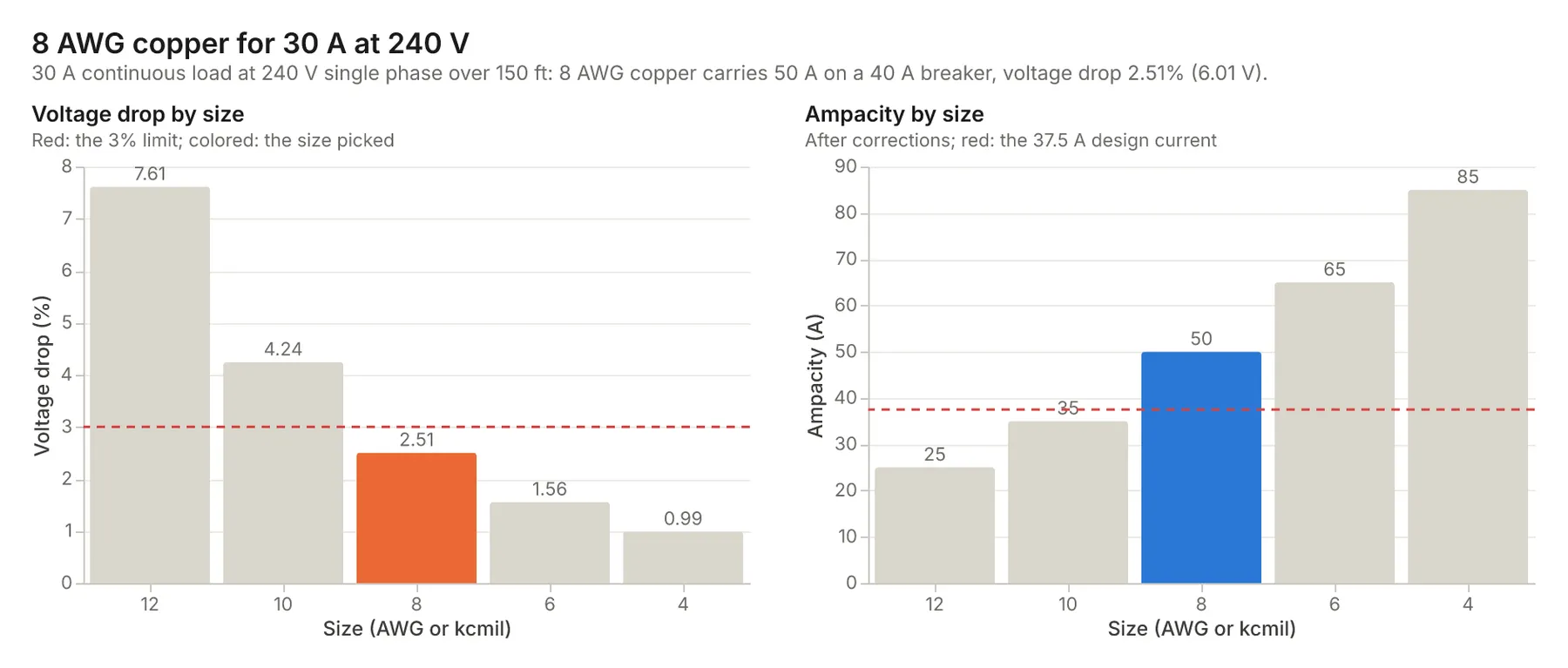
- A chart of voltage drop and ampacity for the sizes around the pick.
Two rule sets:
- NEC (US): AWG and kcmil, Table 310.16 at 60, 75 or 90 °C. It applies ambient and bundling factors, the terminal temperature limit, the small-conductor breaker limits and the next-size-up rule. Continuous loads are taken at 125%, and motors get their current from Tables 430.248 and 430.250.
- IEC 60364-5-52 (UK, EU and most of the world): mm² for PVC or XLPE cable, in conduit (method B1) or clipped to a wall (method C). It applies ambient and grouping factors, and the breaker meets Ib ≤ In ≤ Iz.
It also:
- Checks a size you name:
check 4 AWGtells you whether it works and why not. - Finds the fault current at the load from the source's fault level or a transformer's kVA and impedance.
- Turns loads into amps: kW with power factor, kVA, or motor horsepower.
It's made for:
- Electricians, electrical engineers and contractors doing quick checks and takeoffs.
- Solar and EV-charger installers, and DC runs for RVs, boats and off-grid systems.
- Facility managers and students.
- AI agents that need a real wire size instead of a guess.
How to use it
- Write Circuits, one per line, such as
40 A, 120 V, 200 ft, copper. The form has examples. - Optionally set the Code, a Default voltage, a Default conductor or a Default voltage-drop limit.
- Click Start. Each circuit is a row in the results, with its summary, chart and report.
Writing circuits
A line can hold any of these, in any order:
- The load:
30 A,10 kW,15 kVA,20 hp motor, pluscontinuousandpf 0.85. - The supply:
240 V,single phase,three phaseorDC. - The length: one way, such as
150 ftor45 m. - The conductor:
- The metal:
copperoraluminum. - The insulation:
THHN,THWN,XHHW-2,TW,NM-B,UF,PVCorXLPE. - Or a rating, such as
75 C rated.
- The metal:
- Conditions:
40 C ambient.- Grouping:
6 current-carrying conductors(NEC) or3 circuits grouped(IEC). method C.2 parallel sets.
- Limits and checks:
2% drop,check 4 AWGorcheck 6 mm2, and a source fault level such as65 kA.
Objects work too, with the same fields named; see Input.
The code is picked from what you write: feet, AWG and 120/208/240/277/480 V mean the NEC; meters, mm² and 230/400 V mean IEC. You can also set it.
Examples
All of these ran on this Actor; the numbers are from the results.
| Circuit | Result |
|---|---|
30 A continuous, 240 V single phase, 150 ft, copper THHN | 8 AWG on a 40 A breaker (37.5 A design current; 10 AWG carries only 35 A at 75 °C), 2.51% drop |
40 A, 120 V, 200 ft, copper | 3 AWG for voltage drop (8 AWG carries the current but drops 9.42%), 2.86% drop, 4 AWG ground wire upsized by 250.122(B) |
20 hp motor, 480 V three phase, 300 ft, copper THWN | 27 A from Table 430.250, 10 AWG, 2.97% drop |
100 A, 480 V 3 phase, 500 ft, aluminum XHHW-2, 6 current-carrying conductors, 40 C ambient, check 4 AWG | 3/0 AWG aluminum (128 A after 0.91 and 0.8 factors), 2.38% drop. The 4 AWG asked about fails on both counts |
11 kW, 400 V three phase, 80 m, XLPE, pf 0.85, 3 circuits grouped | 18.7 A: 4 mm² (25.9 A after grouping) on a 20 A breaker, 2.86% drop |
| 200 A at 208 V three phase, 250 ft, copper THHN, from a 150 kVA 4% transformer | 250 kcmil for voltage drop, 2.71%. Fault current 10.4 kA at the transformer, 4.57 kA at the load |
The tests check that:
- Areas match ASTM B258.
- Resistance matches NEC Chapter 9 Table 8 (12 AWG: 1.98 Ω/kft at 75 °C).
- Correction factors match Table 310.15(B)(1) and IEC Table B.52.14.
- The 75 °C terminal rule, the 240.4(D) small-conductor limits and the next-size-up rule are applied.
- Voltage drop matches the hand formula, for AC and DC.
- Motor currents match the tables, and IEC sizes match the tables.
How-to examples
Each example is a complete input; the results are from runs of the Actor (also listed under Examples).
How to find what size wire you need for a circuit (NEC)
Result: 8 AWG on a 40 A breaker. The design current is 37.5 A, and 10 AWG carries only 35 A at 75 °C. The voltage drop is 2.51%.
How to calculate voltage drop on a long run
Result: 3 AWG for voltage drop, at 2.86%. 8 AWG carries the current but drops 9.42%. The ground wire is upsized to 4 AWG by NEC 250.122(B).
How to size a cable in mm² (IEC 60364)
Result: 18.7 A, so 4 mm² (25.9 A after grouping) on a 20 A breaker, with a 2.86% drop. Motors work from horsepower too: 20 hp motor, 480 V three phase, 300 ft, copper THWN gives 27 A from Table 430.250 and 10 AWG.
How to let an AI agent size wires
Add this Actor to the Apify MCP server with https://mcp.apify.com/?tools=jumblemog/wire-size-calculator. The agent passes the circuit as one line and answers with the size, the breaker and the voltage drop from the code tables, instead of a rule of thumb.
FAQ
Which codes does it follow? The NEC (US) with Table 310.16, and IEC 60364-5-52 for mm² cables in the UK, EU and most of the world. The code is picked from the units you use, or set code.
Does it apply derating? Yes: ambient temperature and bundling or grouping factors, the 75 °C terminal rule, the small-conductor breaker limits and the next-size-up rule.
Can it check a wire size I already have? Yes. Add check 4 AWG and it says whether that size passes and why not.
Does it do aluminum and DC? Yes, copper or aluminum, AC single or three phase, and DC.
Is it a substitute for an electrician? No. It's a calculation to plan and check against; local codes and an inspector have the final word.
Input
| Field | What it is |
|---|---|
circuits | Circuits, as text lines or objects. |
code | auto, NEC or IEC. |
voltage, material, maxVoltageDrop | Defaults for circuits that don't give them. |
charts | Draw charts (default on). |
A circuit as an object takes:
- Load:
current, orload("10 kW","15 kVA","20 hp");powerFactor;continuous;motor. - Supply:
voltageandphase(1,3ordc). - Run:
length(one way);parallelSets;reactance(Ω/km or Ω/kft);cable(multicore, for a lower reactance). - Conductor:
material;insulationortemperatureRating;terminalRating(NEC, default 75 °C). - Conditions:
method(IEC:B1orC);ambient;conductorsInRaceway(NEC) orcircuitsGrouped(IEC). - Limits and checks:
maxVoltageDrop;size(to check one). - Source:
faultCurrent, ortransformer({"kVA": 150, "impedance": "4%"}). - Other:
code,title, andtext(a line to start from, which the other fields override).
Output
One dataset item per circuit, also saved together in the run's OUTPUT record:
checked has the size asked about, and faultCurrent has the fault current at the source and at the load, in amps. Lengths are in feet for the NEC and meters for IEC (see unitLabels). A circuit that can't be sized has "status": "failed" and the reason in error, and isn't billed.
How it works
- Reading the circuit: the line is split into its parts. Loads become amps:
- kW use the power factor;
- kVA use the voltage;
- horsepower uses the NEC motor tables.
- Ampacity of each standard size:
- NEC: the table value at the insulation's temperature column, times the ambient factor and the bundling factor. The result is held to the terminal column.
- IEC: the Annex B value for the method and the number of loaded conductors, times the ambient factor and the grouping factor.
- The breaker for each size: the smallest standard rating at or above the design current, checked against the conductor's ampacity.
- Voltage drop for each size:
- The formula is k·I·L·(R cos φ + X sin φ), with k = 2 for single phase and DC and √3 for three phase.
- R is taken at the conductor's estimated operating temperature, from its area and the metal's resistivity.
- X defaults to 0.15 Ω/km for single conductors in a raceway and 0.08 Ω/km for multicore cable.
- The pick is the smallest size that passes both checks.
- Charts are drawn with Vega-Lite and rendered with vl-convert.
Pricing
You pay one low price per circuit, at the price shown on this page. It includes the chart and the report. Circuits that can't be sized are never charged. If you set a maximum cost per run, the Actor stops before a circuit that wouldn't fit.
Speed
Each circuit takes a few milliseconds plus its chart. A run through the API answers in about 5 to 10 seconds, including the cloud container starting.
Tips and limits
- Check your local code and the equipment's instructions. This tool applies the main sizing rules; an inspector applies all of them.
- Not included: conduit fill; the NEC's own Table 9 impedances (resistance is computed from the metal instead, which matches Table 8 within about 2%); and the IEC methods other than B1 and C.
- IEC aluminum capacities are taken as 78% of copper's, typical of the IEC tables. IEC aluminum sizes start at 16 mm².
- Motors: conductors are sized at 125% of the table current. Size the short-circuit protection by NEC 430.52 and the overload protection from the nameplate.
- Fault current: a bolted fault with the conductors at 20 °C. The source X/R is taken as 4.
- Limits: 500 circuits per run, 1 to 20 parallel sets.
For AI agents and developers
This Actor works with the Apify MCP server, so AI agents can call it as a tool. Pass circuits as plain text and read summary, recommended.size, recommended.breaker and recommended.voltageDropPercent. A direct API call that waits for the answer:
run-sync instead returns the run's OUTPUT: the status, the counts and every result as JSON.
In Python, with the apify-client package:
Credits
- Charts: Vega-Lite and vl-convert (BSD-3-Clause), with the Inter font (SIL Open Font License).
- Rules and tables:
- NFPA 70, National Electrical Code: Tables 310.16, 310.15(B)(1) and (C)(1), 240.4(D), 240.6(A), 250.122, 430.248 and 430.250, and Chapter 9 Table 8.
- IEC 60364-5-52, Selection and erection of electrical equipment: Wiring systems, Annex B.
- IEC 60364-5-54, Table 54.2.
- ASTM B258, Standard Specification for Standard Nominal Diameters and Cross-Sectional Areas of AWG Sizes.