

Shopee Product Scraper — No Login
DeprecatedPricing
from $4.80 / 1,000 complete shopee products
Shopee Product Scraper — No Login
DeprecatedExtract Shopee product data without login: local price/currency, seller, rating, optional seller-rating scope when available, availability, IDs, and canonical URL. Choose 14 official Shopee storefronts; Singapore is Verified and 13 are Beta pending market-local canaries. Incomplete rows are skipped.
Pricing
from $4.80 / 1,000 complete shopee products
Rating
0.0
(0)
Developer

KazKN
Maintained by CommunityActor stats
0
Bookmarked
39
Total users
10
Monthly active users
a month ago
Last modified
Categories
Share
Shopee Scraper — Products, Prices & Sellers
Use this Shopee scraper to search products by keyword or public URL across 14 official storefronts and export identity-checked product data to JSON, CSV, or Excel. Every accepted row includes the observed local price and currency, seller, rating, availability evidence, IDs, and canonical URL. The optional seller-rating scope is included when the source identifies it; incomplete candidates are skipped instead of exported. No Shopee login, user-supplied cookies, or user proxy configuration is requested from you.
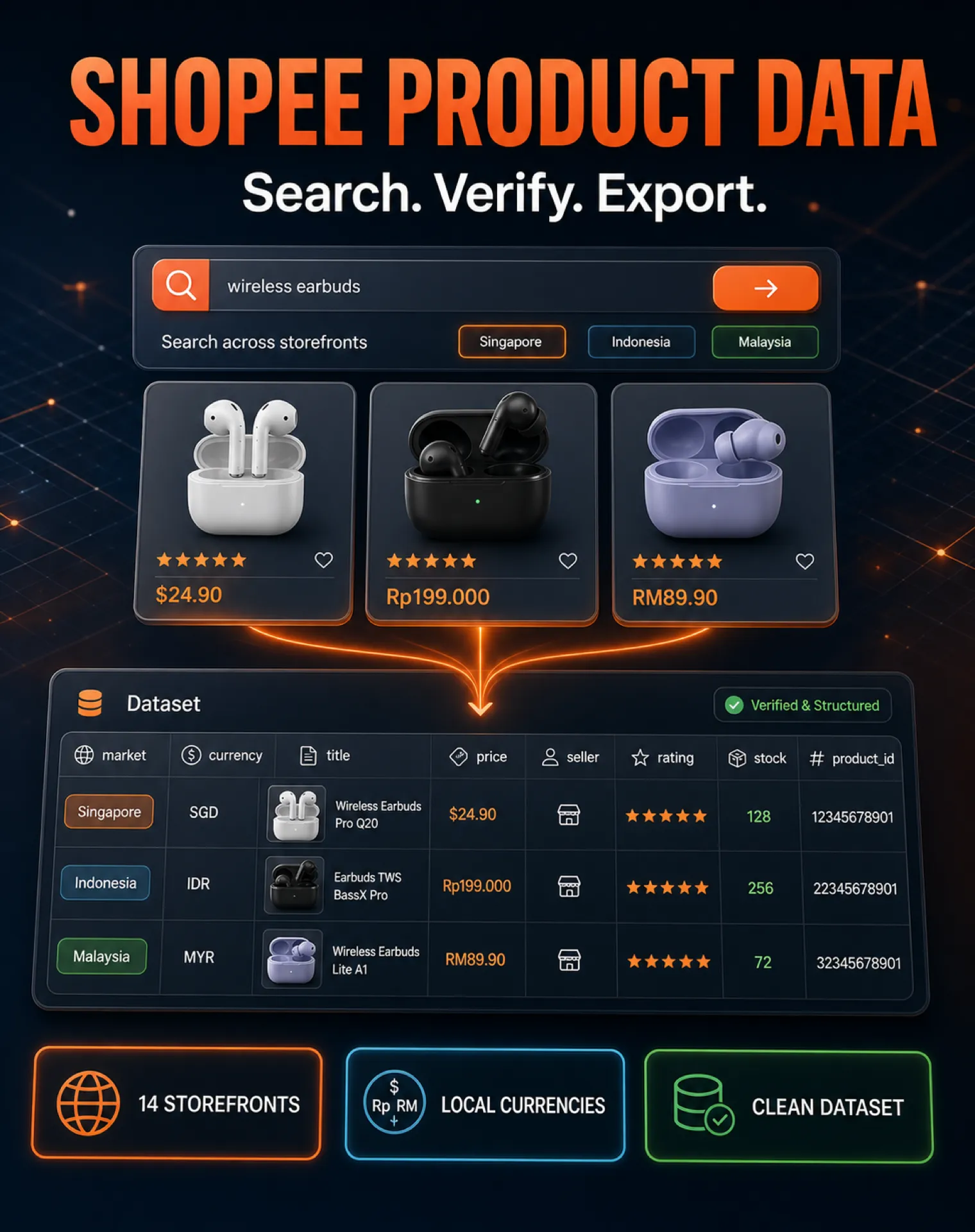
Choose your Shopee scraper workflow
| What you want | Use this input | What you get |
|---|---|---|
| Discover products | Keyword search | Bounded storefront search; only identity-checked complete rows are written |
| Check one known product | Public product URL | One exact complete product row, or a clear missing-field diagnostic |
Quick start
The form is ready for a fast, verified product check when it opens:
- Choose a Shopee storefront. Singapore is selected by default and is the Verified route. Beta storefronts are labeled in the selector.
- Keep the verified product URL or replace it. The Singapore sample is already filled in. The default returns one complete product and checks one page, which keeps the automated health test fast and deterministic.
- Start the run and download the dataset. Export JSON, CSV, Excel, XML, RSS, or JSONL, or retrieve the Dataset through the Apify API.
To discover products by keyword instead, clear the URL and enter one or more product phrases. Keyword mode remains available, but it is not used as the automated health-check prefill because public search results can change.
Storefront coverage
The selector exposes the 14 official Shopee storefronts below. Singapore is Verified by the current canary. The other 13 are Beta · unverified and need a market-local canary before their transport and parser behavior can be called verified. This README does not promise that every Beta market returns a complete row yet.
| Storefront | Code | Official host | Currency | Evidence status |
|---|---|---|---|---|
| Indonesia | id | shopee.co.id | IDR | Beta · unverified |
| Singapore | sg | shopee.sg | SGD | Verified |
| Malaysia | my | shopee.com.my | MYR | Beta · unverified |
| Thailand | th | shopee.co.th | THB | Beta · unverified |
| Philippines | ph | shopee.ph | PHP | Beta · unverified |
| Vietnam | vn | shopee.vn | VND | Beta · unverified |
| Brazil | br | shopee.com.br | BRL | Beta · unverified |
| Taiwan | tw | shopee.tw | TWD | Beta · unverified |
| Mexico | mx | shopee.com.mx | MXN | Beta · unverified |
| Colombia | co | shopee.com.co | COP | Beta · unverified |
| Chile | cl | shopee.cl | CLP | Beta · unverified |
| Cambodia | kh | shopeekh.com | KHR | Beta · unverified |
| Argentina | ar | shopee.com.ar | ARS | Beta · keyword unavailable |
| Laos | la | shopee.com.la | LAK | Beta · unverified |
Best proven entry points
Start with the storefront that matches the local catalog and currency you want to analyze. These are the clearest starting points backed by current product evidence; they are not a ranking of total market demand:
| Storefront and currency | Best first workflow | Evidence boundary |
|---|---|---|
Singapore — sg — SGD | Keyword search or a known product URL | Verified route; one bounded URL canary is documented below |
Indonesia — id — IDR | Keyword product discovery and local-price export | Beta; a bounded 10-row keyword run succeeded, with 9-of-10 relevance |
Malaysia — my — MYR | Keyword search for catalog, seller, and price research | Beta; a bounded three-row keyword run succeeded |
| Every other selectable market | Start with a small market-local keyword run | Beta; each still needs a market-local canary before any reliability claim |
Acquisition research priority
Fresh Google Keyword Planner research used both required paths across eight priority countries. Its September 2026 hypothetical Maximize clicks model ordered the acquisition opportunity as:
Indonesia → Vietnam → Malaysia / Thailand → Philippines / Brazil → Singapore → Mexico
Indonesia accounted for most of the modeled clicks; Vietnam was the next largest signal. Singapore remained valuable as the Verified technical entry point but carried the highest modeled CPC. This was a planning forecast under a hypothetical EUR 10 average daily budget—not observed organic demand, an Actor reliability guarantee, or a recommendation to spend. No campaign was created and no advertising spend was incurred.
The remaining storefronts stay available through the selector with the exact status shown above. Beta means use a small test run first; it does not mean that every field, listing, or query has already been verified.
Choose one storefront explicitly for keyword runs. For a direct URL run you
can choose 🌐 Detect from URL — one storefront per run; the URL host must be
one of the official hosts above, and mixed storefront hosts are rejected. The
default remains Singapore (sg) for compatibility with earlier API clients.
The user-facing flow asks you for no Shopee login, no user-supplied cookies, and no user proxy configuration. This is an input boundary, not a claim that every upstream transport is cookie- or proxy-free. Argentina keyword search is currently unavailable and fails before any network request.
When the optional Decodo fast-search credential is configured by the deployment, eligible canonical URLs can use a Google-indexed product source for detail reads. Other discovery and detail lanes keep their guarded fallback behavior. Provider availability is an implementation detail and is not a promise of complete results for every storefront.
KazKN commerce intelligence suite
| KazKN · Commerce intelligence suite • Shopee, Shopify, Vinted & Vestiaire data | |||
 Shopee Products ↗ Shopee Products ↗➤ You are here Prices, sellers + stock evidence |
 Shopify Apps ↗ Shopify Apps ↗Products, reviews + installed apps |
 Vinted Smart ↗ Vinted Smart ↗Cross-market resale arbitrage |
 Vestiaire ↗ Vestiaire ↗Live + sold luxury market data |
Copy to your AI assistant
Copy the entire block below into ChatGPT, Claude, Claude Code, Codex, Kimi Code, or your IDE assistant. It already contains the Actor reference, a ready-filled Malaysia keyword input, the Python call, Dataset retrieval, the live schema endpoint, and the token setup link.
What the output contains
Verified identity and provenance fields are returned first so every row can be used even when a public page exposes only a subset of product details:
- Product title,
product_id, andshop_idwhen present market, localcurrency, product/source links, andsource_modedata_statusplusmissing_fieldsfor transparent completeness checks; incomplete candidates are skipped before Dataset push- Price, discount, seller, rating, stock, shipping, images, reviews, and sold counts when Shopee exposes those values to the selected source
rating_scopeis optional: it issellerwhen the source explicitly identifies the seller rating scope, andnullwhen no scope is available- Stock can include
available_variantsand the evidence labelindexed_variations_availablefor indexed variation availability, orpublic_variant_labels_available/public_variations_availablefor explicit public PDP variant availability. A public keyword card can instead usepublic_search_listing_availableto report that the listing was currently available in Shopee search. In each case,stock.quantityremainsnull: neither variation nor listing availability is an exact unit quantity.
Details are source-bound: a required value must be observed and identity checked before a row is emitted. If the selected public page or index does not expose it, the candidate is skipped and the run summary names the missing field.
When keyword discovery identifies a canonical product URL, the Actor sequentially enriches bounded candidates through the configured detail lane. Only identity-matching values observed on the canonical result are merged; a blocked, mismatched, stale, or incomplete detail response is skipped rather than emitted as an incomplete row.
Price comparison is conditional: compare rows only when price is present and
use the accompanying currency and data_status values. Do not compare local
amounts across markets without converting the currencies yourself.
source_fetched_at records when the selected source supplied the observation.
Indexed results can become stale between indexing and collection, so use this
timestamp when freshness matters and do not treat an indexed observation as a
live inventory guarantee.
Shopee scraper for product search and price data
Use this Shopee product scraper, Shopee keyword scraper, or Shopee search scraper to collect structured product data from a phrase or a known public URL. Each accepted row keeps the storefront's local price and currency beside the product IDs, seller, rating, availability evidence, canonical URL, and source timestamp. That makes price observations useful for catalog monitoring, product research, seller analysis, or your own currency-normalized comparison workflow.
Download the Dataset as JSON, CSV, or Excel, or retrieve it through the Apify API. A Shopee price scraper run never converts currencies automatically: filter and compare products within one storefront, or apply your own exchange-rate logic downstream. Rows that do not satisfy the identity and completeness contract are skipped instead of being exported with invented values.
Limits and useful options
- Up to 20 keyword searches and 100 public Shopee URLs per run
- Up to 5,000 unique products and 100 opened pages per run
- The configured Actor uses 1,024 MB by default, accepts 512 MB as its minimum,
and caps each run at 1,024 MB. A run-level memory override cannot exceed this
Actor maximum (or a lower Apify platform clamp), so the configured
$0.005setup event remains based on one billed GB. - Search ordering: best match, best-selling, newest, price low-to-high, or price high-to-low
- Products are deduplicated by marketplace, shop ID, and product ID
- Large Shopee identifiers are kept as exact strings for downstream joins
- Keyword enrichment is sequential and bounded; each candidate is emitted only after an identity-matching complete-detail check
Pay-per-result pricing
This Actor uses pay-per-event pricing: one $0.005 setup charge per run, then one result charge for every complete product row written to the Dataset:
| Apify plan | Setup per run | Complete product |
|---|---|---|
| Free | $0.005 | $0.0080 |
| Bronze | $0.005 | $0.0068 |
| Silver | $0.005 | $0.0058 |
| Gold | $0.005 | $0.0048 |
| Platinum | $0.005 | $0.0048 |
| Diamond | $0.005 | $0.0048 |
Example Actor charges (Free / Bronze / Silver / Gold; Platinum and Diamond use the Gold result rate) are $0.013 / $0.0118 / $0.0108 / $0.0098 for one complete product, $0.045 / $0.039 / $0.034 / $0.029 for five, $0.805 / $0.685 / $0.585 / $0.485 for 100, and $8.005 / $6.805 / $5.805 / $4.805 for 1,000.
Apify platform usage is included in the active Actor price and is not billed
separately to you. The Actor is capped at 1,024 MB, so the
apify-actor-start setup event is charged once
per run. The apify-default-dataset-item result event is charged only after a
complete row has passed validation and is written to the Dataset. A candidate missing a required value is skipped before Dataset push and is not charged as a result.
The minimalMaxTotalChargeUsd value of $0.05 is the minimum charge-limit
setting accepted for a run. It is not a minimum spend, subscription, or extra
fee; the actual event charges still depend on the number of complete products
returned.
Shopee scraper API, Python, n8n, and exports
Use the API tab for generated Shopee scraper API and Python examples. Use the Dataset link for JSON, CSV, or Excel exports. For n8n, Make, Zapier, or a custom workflow, call the Actor through Apify or consume the Dataset after the run finishes. Apify Tasks and schedules can repeat the same saved input.
Limits and data boundaries
The Actor asks you for no Shopee login, user-supplied cookies, credentials, or
user proxy configuration. Public pages can render different fields, challenge
automated traffic, or return indexed search results instead of a full product
page. Public listing candidates are labeled
source_mode: shopee_public_search; indexed candidates use
source_mode: search_index. Both are emitted only after the required identity,
local price/currency, seller, seller-rating, and availability checks pass.
The 13 enabled public-search storefronts are fail-closed and do not start an
unbounded browser retry; if no complete row is proven, the Actor returns no
result. Argentina keyword search currently returns MARKET_NOT_READY before
any network request. This user-input boundary does not assert that every
upstream transport is cookie- or proxy-free.
Live market proof
These are bounded, point-in-time runs—not an availability or relevance guarantee for later listings:
- Singapore: A bounded canary v58 (build
iUSCPMZU19SBHqMN4, runaJ6d7aw73WzvTjUj6) observed one product only: shop/item47620/28778086815, title “Shokz OpenFIT 2 Open-Ear Air Conduction Technology True Wireless Earbuds”, price268.90 SGD, sellerp2oMobile, seller rating4.939463, and two public variant labels. Its normalized canonical URL washttps://shopee.sg/product-i.47620.28778086815. - Indonesia: bounded run
BCVMtYvdl9bTBCXz6returned 10 complete IDR rows forairpods; 9 of 10 titles matched AirPods and one adjacent iPhone result was also returned. This is disclosed rather than presented as perfect search precision. - Malaysia: bounded run
IERkI8IWo6cFb7HhYreturned 3 complete MYR rows forairpods, each with seller, seller rating, availability evidence, exact IDs, and a canonical product URL.
The local and canary checks also cover input validation, deduplication, pagination, retries, output records, and browser isolation. This is not a promise that every Singapore listing exposes these fields, and the Indonesia and Malaysia observations do not verify the remaining Beta storefronts.
FAQ and support
How do I scrape Shopee product data?
Choose a storefront, keep or replace the example keyword, and start the Actor. It writes only identity-checked, complete Shopee data rows to the Dataset. For a known listing, clear the keyword and paste its public product URL instead.
Can I search Shopee products by keyword?
Yes. Choose one storefront, add one or more product phrases, and keep Best match unless you need a different order. Each phrase runs within the same storefront and shares the overall product and page limits.
Can I export Shopee prices to CSV or Excel?
Yes. Open the run's Dataset and choose CSV, Excel, or JSON. Keep the currency
column with every price, because amounts use the selected storefront's local
currency and are not converted by the Actor.
How do I call the Shopee product scraper from the Apify API?
Use the exact Actor reference kazkn/shopee-product-scraper-no-login with the
Apify API. The examples above show a synchronous call and Dataset retrieval;
load APIFY_API_TOKEN from an environment variable and never paste or share it.
Do I need a Shopee account?
No Shopee login is requested from you. You do not need to supply user cookies or a user proxy configuration for the input form.
Why is a field empty?
Shopee pages and indexed results differ by listing and storefront. Check
data_status and missing_fields; unavailable public values are returned as
null instead of being invented. A Beta storefront may be skipped until its
market-local canary passes.
Can I use the results in an automation?
Yes. Download the dataset in the format you need, call the Actor through the Apify API, or connect a Task, schedule, webhook, Make, Zapier, or spreadsheet workflow.
Where can I report a problem?
Use the Actor's Issues tab and include the marketplace, input type, run ID,
and observed data_status. Never include account credentials or cookies.


