

SEC Form D Funding Leads & Change Monitor
Pricing
from $1.63 / 1,000 form d filings
SEC Form D Funding Leads & Change Monitor
Export and monitor official SEC Form D and D/A fundraising filings with structured issuer, offering, amount, exemption, related-person, recipient, and amendment data.
Pricing
from $1.63 / 1,000 form d filings
Rating
0.0
(0)
Developer

Luka
Maintained by CommunityActor stats
0
Bookmarked
1
Total users
0
Monthly active users
11 days ago
Last modified
Categories
Share
Turn official SEC Form D and D/A filings into structured fundraising leads, or monitor the same filing scope for new notices, amendments, and confirmed source corrections. All filing data comes from official SEC EDGAR records.
Start in 60 seconds
- Keep Get current filing leads selected.
- Keep All Form D filings to scan the market, or choose an issuer/accession target.
- Leave the previous 30 completed UTC days and the 100-row limit unchanged for the first run.
- Run the Actor, then open the Dataset for records and
OUTPUTfor coverage and summary links.
The rolling window ends on the previous UTC date. This prevents an incomplete current-day EDGAR index from being described as a completed day.
Choose the workflow
| Workflow | Use it for | First run | Repeat run | Maximum delivered rows |
|---|---|---|---|---|
| Baseline | One-time funding-lead exports and current filing research | Returns filing rows | Returns the selected filing scope again | 10,000 |
| Standard changes | Normal issuer or market monitoring | Establishes the comparison baseline | Returns up to 200 verified changes | 200 |
| Bulk changes | High-volume market monitoring | Establishes the comparison baseline | Returns up to 10,000 verified changes | 10,000 |
Changes runs compare only identical scopes. The scope includes the workflow, discovery target, rolling or fixed date window, every filter, result and scan limits, result style, and optional monitoring label. Changing one of those values creates a new comparison scope instead of mixing unrelated histories.
Output: funding leads and verified changes
The Dataset contains one typed row per accepted SEC accession or one explicitly typed monitoring event. recordType distinguishes filing, change, and optional free unchanged audit rows. changeType identifies NEW_NOTICE, AMENDMENT_FILED, SOURCE_CORRECTION_UPDATED, or UNCHANGED.
Each filing keeps:
- Canonical accession number, CIK, issuer name, form, filing date, official SEC links, and stable identities.
- Issuer and co-issuer groups, previous names, entity type, jurisdiction, business address, and filed phone when present.
- Offering dates and type, securities, exemptions, industry/fund type, offering amount, amount sold, minimum investment, and filed investor counts.
- Related persons and disclosed roles without relabeling them as investors.
- Sales-compensation recipients, solicitation jurisdictions, and signatures.
- Source-native groups corresponding to
FORMDSUBMISSION,ISSUERS,OFFERING,RECIPIENTS,RELATEDPERSONS, andSIGNATURES, or their current XML equivalents. - Official filing links and explicit coverage.
OUTPUT contains the run status, coverage details, requested scope, delivered counts, state outcome, and optional tracker summaries. Numeric tracker sums add the filed values of each returned accession. D/A rows are not deduplicated against earlier D filings, so these sums are not a measure of unique capital raised. Missing or indefinite amounts are not turned into zero.
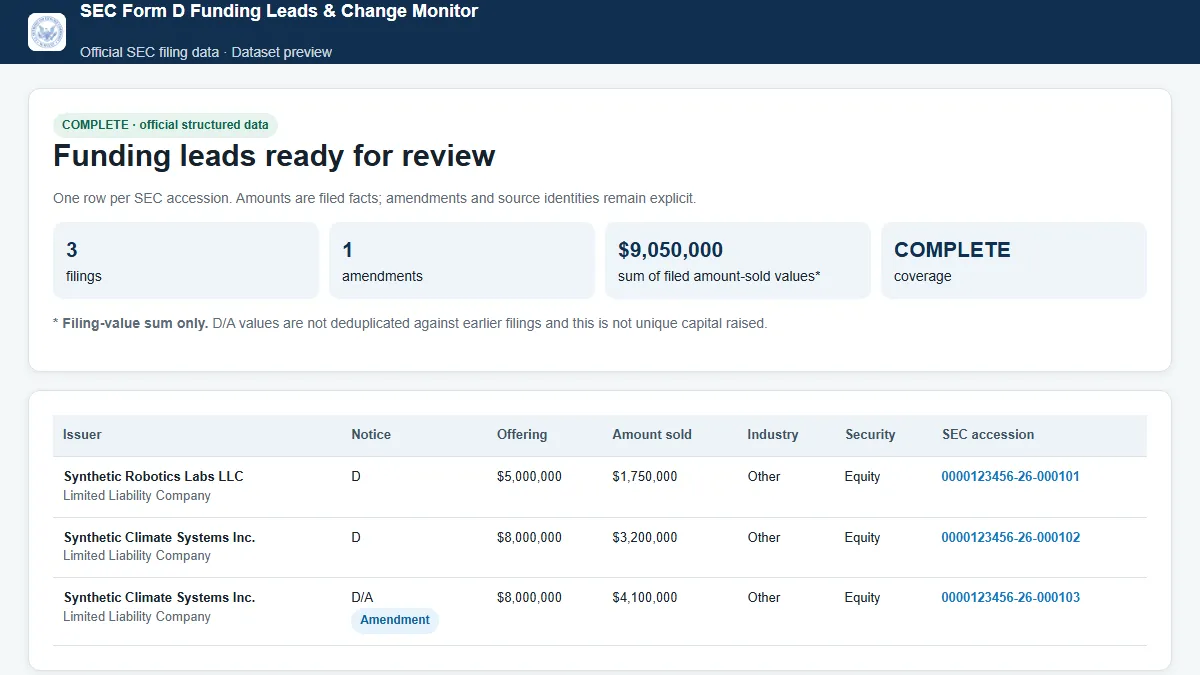
The screenshot above comes from the Actor's real Dataset presentation using clearly labeled synthetic fixtures. The example below is also synthetic and is not linked to a live issuer.
What each change means
| Change | Trigger |
|---|---|
NEW_NOTICE | A new Form D accession appears after a valid comparison baseline. |
AMENDMENT_FILED | A new D/A accession appears with the official previous-accession reference. |
SOURCE_CORRECTION_UPDATED | Buyer-relevant normalized content changes for the same accession after official reconciliation. |
UNCHANGED | Optional audit row; it is not a delivered paid change. |
Amendment chains use the official PREVIOUSACCESSIONNUMBER field only. Missing, outside-scope, cross-CIK, and cyclic relationships remain explicit. The Actor does not guess links from issuer names or dates, and it does not invent ENDED, REMOVED, “round closed,” or “offering completed” events.
Input guide
The first section contains the workflow, result style, discovery method, and all primary targets. All Form D filings needs no target. Selected issuers needs at least one CIK or company-name fragment. Exact accession numbers needs at least one accession.
| Input | What it changes | Effect on work and results |
|---|---|---|
workflow | Baseline, Standard changes, or Bulk changes | Selects one-time output or stateful monitoring and its row maximum. |
discovery | Whole market, selected issuers, or exact accessions | Issuer and accession searches are narrower; market mode covers the full filing search job. |
ciks | Up to 100 exact issuer identities | Avoids name ambiguity and usually reduces source work. |
companyNames | Up to 25 filed-name fragments | May require broader official scanning than CIK lookup. |
accessionNumbers | Up to 100 exact filing identities | Goes directly to official filing archive directories. |
daysBack, startDate, endDate | Rolling or fixed inclusive filing window | Wider history covers more filing dates. |
searchQuery | Text across official structured filing groups | May inspect more filings before enough matches are found. |
| issuer, geography, entity, fund, security, exemption, and amendment filters | Keeps matching official values | Every filter is part of the monitoring identity. |
| amount, investment, and investor minimums | Keeps rows at or above filed numeric values | Missing or indefinite values do not satisfy a positive minimum. |
maxResults | Maximum delivered filing/change rows | Standard changes stops at 200; Baseline and Bulk changes support 10,000. |
maxTrackedAccessions | Comparison-state capacity | Must be at least the requested Changes result limit; maximum 10,000. |
maxFilingsScanned | Maximum official records inspected | Reaching it produces CAPPED; Changes state does not advance. |
includeUnchanged | Adds unchanged audit rows to Changes | Adds Dataset rows but no delivered-change unit. |
monitorLabel | Separates otherwise identical watches | Use one stable label per business watch. |
For repeatable historical work, set both dates. For a moving watch, keep daysBack and rerun the same normalized input. Use CIK whenever you know it; a name fragment is convenient but less precise.
Pricing and cost controls
The active pay-per-event schedule is transparent. Baseline uses one verified-completion unit plus one unit per delivered filing. Standard Changes uses one completed-check unit that covers a confirmed quiet check or atomically includes the first delivered change; only additional changes use the per-change unit. Bulk Changes uses one completed-check unit plus one unit per delivered change. Optional unchanged audit rows are free. A run with PARTIAL, CAPPED, BLOCKED, or FAILED coverage is not charged as a completed official check and does not advance comparison state as if the check completed.
| Event | Free | Bronze | Silver | Gold | Platinum | Diamond |
|---|---|---|---|---|---|---|
| Verified official SEC run | $0.01285995 | $0.01285995 | $0.01285995 | $0.01285995 | $0.01285995 | $0.01285995 |
| Baseline filing | $0.00177235 | $0.00177235 | $0.00177235 | $0.00162890 | $0.00105890 | $0.00071690 |
| Standard watch check | $0.00139005 | $0.00067755 | $0.00005000 | $0.00005000 | $0.00005000 | $0.00005000 |
| Additional Standard change | $0.00950000 | $0.00902500 | $0.00854914 | $0.00806694 | $0.00777762 | $0.00758474 |
| Bulk watch check | $0.04414005 | $0.04414005 | $0.04414005 | $0.04414005 | $0.04414005 | $0.04414005 |
| Bulk change | $0.07600000 | $0.07600000 | $0.07600000 | $0.07600000 | $0.07600000 | $0.07600000 |
Examples on Free: 100 Baseline filings cost $0.01285995 + 100 x $0.00177235 = $0.19009495; a complete Standard check with zero or one delivered change costs $0.00139005; five Standard changes cost $0.00139005 + 4 x $0.00950 = $0.03939005; and five Bulk changes cost $0.04414005 + 5 x $0.076 = $0.42414005.
Use maxResults to bound delivered units and maxFilingsScanned to bound broad filtered searches. Exact accessions and CIK targets usually require less source traversal than a whole-market text search. A larger maximum is a ceiling, not a promise that matching filings exist.
Coverage and reliability
Every run exposes one explicit coverage state:
COMPLETE: every required official branch reached the expected shape and the requested scope was exhausted.FILTERED: official traversal completed, but buyer filters reduced the delivered rows.EMPTY_CONFIRMED: every required branch completed with zero matching filings.CAPPED: a declared result, scan, request, byte, runtime, state, or delivery guard stopped completion.PARTIAL: trustworthy rows exist, but at least one requested official branch did not complete.BLOCKED: SEC access was unavailable or rate-limited.FAILED: source shape, reconciliation, state, or another required contract failed.
Baseline can return trustworthy rows with a non-complete warning. Changes never emits paid changes or advances state from PARTIAL, CAPPED, BLOCKED, or FAILED source coverage. Read OUTPUT.coverage before treating a quiet run as proof that nothing changed.
Official-source contract
- Completed historical quarters use official SEC Form D ZIP packages with all six required TSV tables.
- The accession archive CIK and filed primary issuer CIK are separate output fields. Real SEC Form D filings can contain different official values; the Actor reports
accessionIssuerCikRelationinstead of discarding the filing or pretending they match. - Requests use one identifying User-Agent and a maximum of four requests per second across the run.
Access denial, rate limiting, unexpected source shape, reconciliation conflict, unsafe ZIP paths, encryption, truncation, or resource-guard breaches fail closed instead of silently weakening output.
Automation and repeat runs
Download JSON, JSONL, CSV, Excel, XML, or RSS from the Dataset UI, or use the Dataset API URL exposed in Actor Output. OUTPUT.tracker adds counts and clearly labeled sums of filed accession values when outputMode is tracker; its amountValueAggregation receipt states that amendments are not deduplicated and the sums do not represent unique capital raised.
For monitoring:
- Save one complete Changes input, including its target, filters, limits, and
monitorLabel. - Run that scope once. The first run establishes the comparison baseline and normally emits no historical changes.
- Invoke the exact same input sequentially. Each repeat run compares the current official filing state with the last confirmed delivered state.
- Read
OUTPUT.coveragebefore acting on zero changes. - Do not overlap runs for the same scope. State commits only after confirmed delivery, so sequential execution preserves a clear comparison history.
Changing a target, filter, date-window form, output mode, or relevant limit creates a new state identity. Keep separate labels for separate business watches rather than reusing one history for unrelated issuer groups.
Form D contains filed facts. It does not provide email addresses, named investors, valuation, sentiment, lead scores, buying intent, or proof that a fundraising round closed.
FAQ
Does “amount sold” mean the funding round closed?
No. It is the issuer's filed Form D value. The Actor does not infer closing, retention, valuation, funding stage, or money received after the filing date.
Why is an amendment a separate row?
SEC accepts D/A as a separate accession and asks the filer for current answers. Keeping it separate preserves the official filing identity and makes the transition auditable.
What if the previous accession is outside my date window?
The amendment remains a valid filing row with an explicit outside-scope link status. The Actor does not fetch unlimited history or guess the missing chain.
Why did a run return no rows?
Check OUTPUT.coverage. EMPTY_CONFIRMED means the requested official scope completed with zero matches. FILTERED means source traversal completed but filters removed records. CAPPED, PARTIAL, BLOCKED, and FAILED are not confirmed-empty results.
Can I use issuer names instead of CIKs?
Yes. Company-name fragments match official filed issuer names, but CIK is the more precise target and normally requires less broad source work.
How do I keep monitoring reliable?
Keep the same normalized input and stable monitoring label, run one identical scope at a time, and inspect coverage before treating a quiet run as a confirmed no-change result.


