

DEX New Pairs & Top Pairs Scraper (DexScreener Data)
Pricing
from $3.00 / 1,000 pair discovereds
DEX New Pairs & Top Pairs Scraper (DexScreener Data)
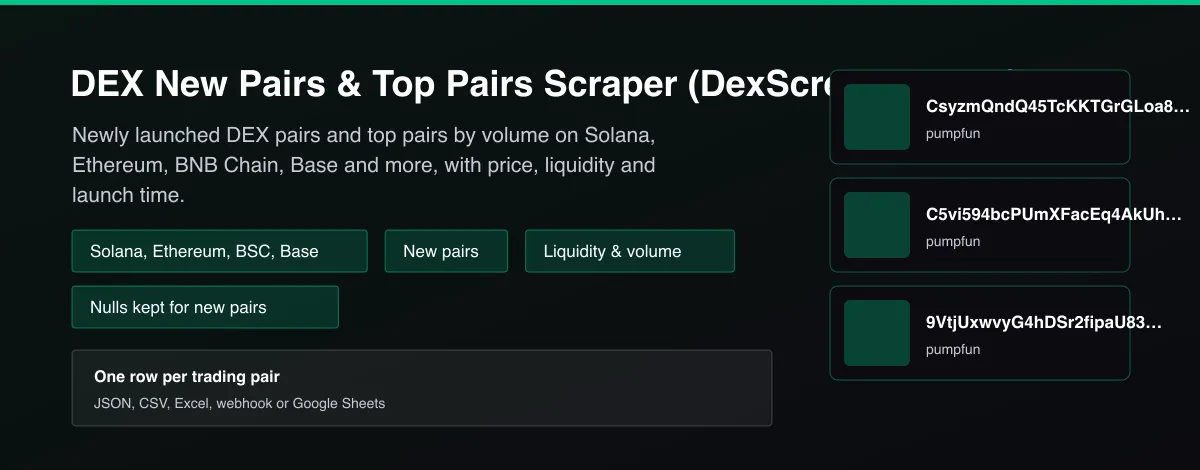
New token pairs, top pairs by volume and pair lookups across Solana, Ethereum, BNB Chain, Base and more: price, liquidity, 24h volume and launch time. Brand-new pairs kept with nulls. No API key.

What does DEX New Pairs & Top Pairs Scraper (DexScreener Data) do?
DEX New Pairs & Top Pairs Scraper returns decentralized exchange trading pairs as one row each, with the DEX, base and quote token, USD price, liquidity, 24-hour volume, 24-hour price change and the time the pair was created. It has three modes: new pairs launched within the last N hours, the top pairs by 24-hour volume, and a lookup of specific pair addresses. It supports Solana, Ethereum, BNB Chain, Base, Arbitrum, Polygon, Avalanche, Optimism, Sui and Blast.
Why use DEX New Pairs & Top Pairs Scraper (DexScreener Data)?
- Discovery and lookup in one Actor: new pairs, top pairs by volume and specific pairs.
- Figures come from DexScreener's public API, so they match what traders see on DexScreener.
- Brand-new pairs are kept with nulls when liquidity is not indexed yet, because a new pair with no liquidity is itself a signal.
- Every row is stamped with the exact collection time, so you know how fresh the liquidity figure is.
- No account or API key needed.
What makes this different
Most DEX scrapers only read a fixed leaderboard. This Actor discovers pairs by launch time or volume on ten chains, adds DexScreener figures for each pair, and keeps very new pairs as rows with null fields instead of dropping them.
Who can use the DEX Pair Scraper and how?
- Token launch hunters: monitor new pairs on Solana, Base and other chains within minutes of launch and filter by minimum liquidity.
- Trading bot builders: feed a bot with fresh pairs, prices and liquidity through a schedule and the Apify API.
- Market data analysts: snapshot the top pairs by volume on each chain and track liquidity and volume over time.
- Researchers: study launch activity, liquidity at launch and price change across chains.
- Community and alert channels: post new-pair alerts to Telegram or Discord from a webhook.
- Portfolio trackers: look up the current price, liquidity and volume of specific pair addresses in bulk.
How it works
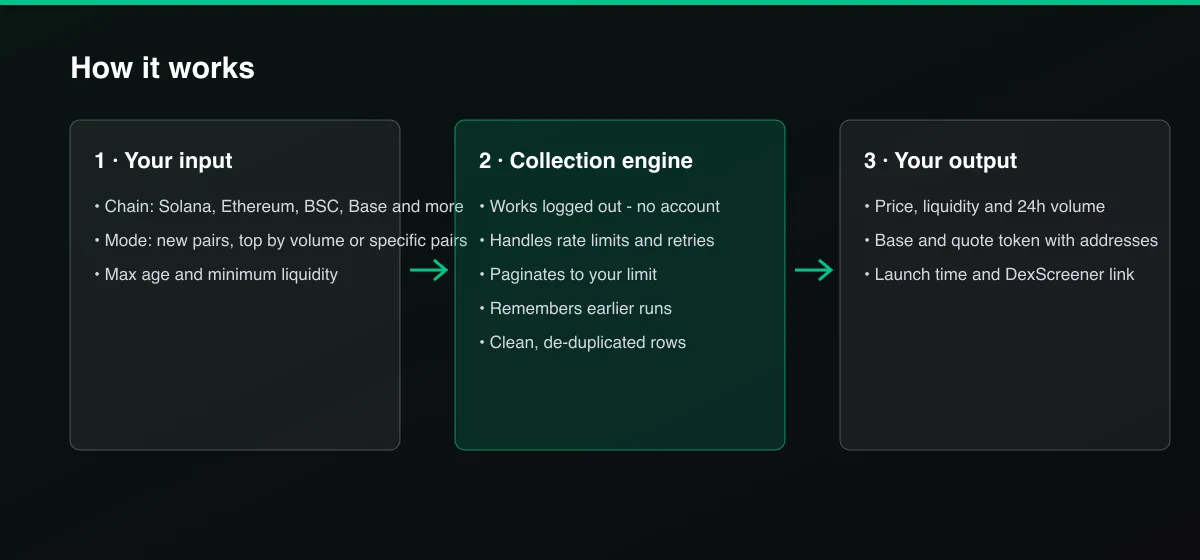
- Your input — choose a chain and a mode: new pairs, top by volume or specific pairs.
- The Actor collects it — the Actor finds the pairs and reads their current price, liquidity and volume.
- Your output — you get one row per pair, stamped with the collection time.
What data can you extract?
The dataset has 22 fields per row:
| Field | Type | Description |
|---|---|---|
chain | string | Chain id, for example solana or ethereum. |
dex | string | DEX name with version when available, for example uniswap_v3. |
pair_address | string | Pair or pool address. |
base_token | object | Base token: symbol, address, name. |
quote_token | object | Quote token: symbol, address. |
price_usd | number | Base token price in USD. |
liquidity_usd | number | Liquidity in USD, null when not indexed yet. |
volume_24h_usd | number | Trading volume over 24 hours in USD. |
pair_created_at | string | When the pair was created (ISO 8601). |
price_change_24h_pct | number | Price change over 24 hours in percent. |
pair_url | string | DexScreener link to the pair. |
price_change_1h_pct | number | Price change over 1 hour in percent. |
volume_1h_usd | number | Trading volume over 1 hour in USD. |
txns_24h_buys | number | Buy transactions in 24 hours. |
txns_24h_sells | number | Sell transactions in 24 hours. |
fdv_usd | number | Fully diluted valuation in USD. |
market_cap_usd | number | Market capitalization in USD. |
data_notes | array | Plain-language notes about missing or fallback data. |
fetch_path | string | dexscreener_api, or pool_index_fallback when the pair was not indexed by DexScreener yet. |
source | string | dexscreener, or geckoterminal for fallback rows. |
scraped_at | string | Collection time (ISO 8601). |
actor_version | string | Output schema version. |
How to use DEX New Pairs & Top Pairs Scraper (DexScreener Data)
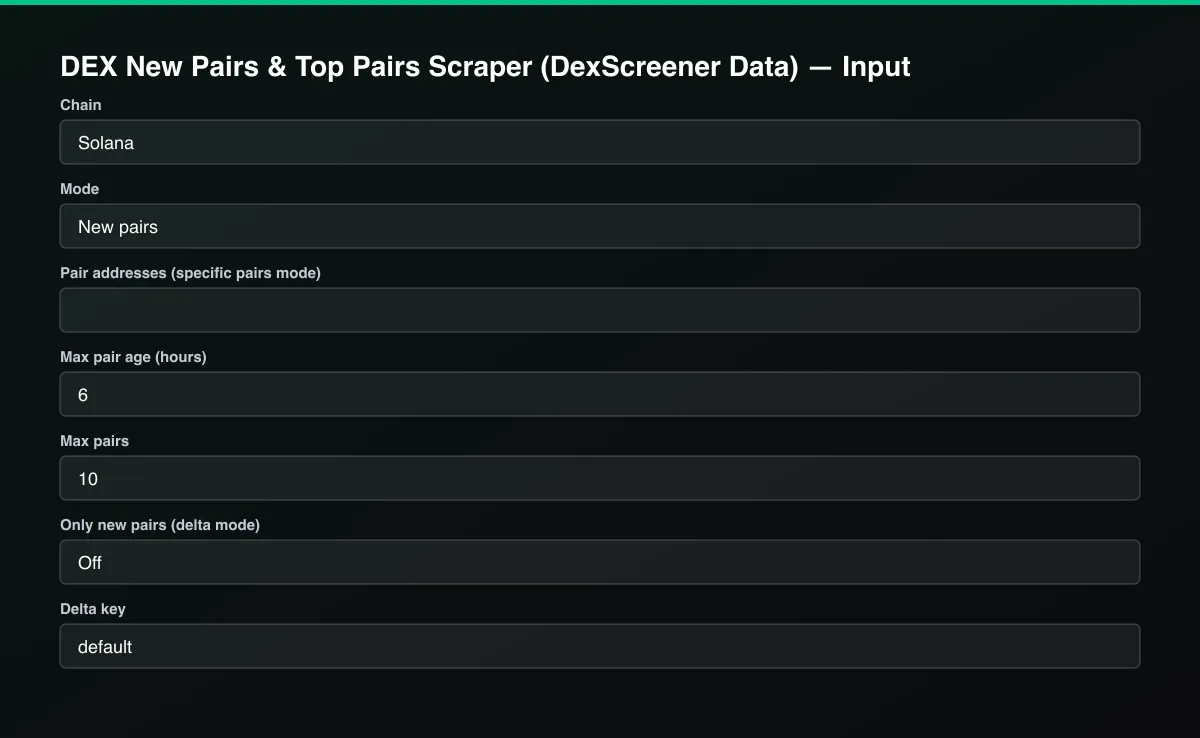
- Open the Actor and go to the Input tab.
- Choose a Chain and a Mode, set Max pair age for new pairs or paste Pair addresses for a lookup, and set Max pairs.
- Optionally set filters and a Max results limit.
- Click Start. A default run finishes in under a minute.
- Open the Output tab, then download the dataset or connect it to your tools.
Input Parameters
| Parameter | Type | Required | Default | Description |
|---|---|---|---|---|
chain | string | No | "solana" | Blockchain to read pairs from. |
mode | string | No | "new_pairs" | New pairs lists recently launched pairs, top by volume lists the most traded pairs, specific pair looks up the pair addresses you provide. |
pairAddresses | array | No | [] | Pool or pair addresses to look up, one per line. Only used in specific pairs mode. |
maxAgeHours | integer | No | 6 | New pairs mode only: keep pairs launched within this many hours. |
minLiquidityUsd | number | No | — | Skip pairs with less liquidity than this. Pairs whose liquidity is not indexed yet are skipped when a minimum is set. Leave empty to keep everything. |
maxItems | integer | No | 10 | Maximum number of pairs returned. Default is 10 for a quick test; the limit per run is 200. |
deltaMode | boolean | No | false | Return and bill only pairs not delivered by an earlier run with the same delta key. Ideal for a scheduled new-pair feed. |
deltaStateKey | string | No | "default" | Name of the tracked stream. Use a different key per feed. |
proxyConfiguration | object | No | {"useApifyProxy":false} | Optional proxy. Public market data normally works without one. |
Output Data
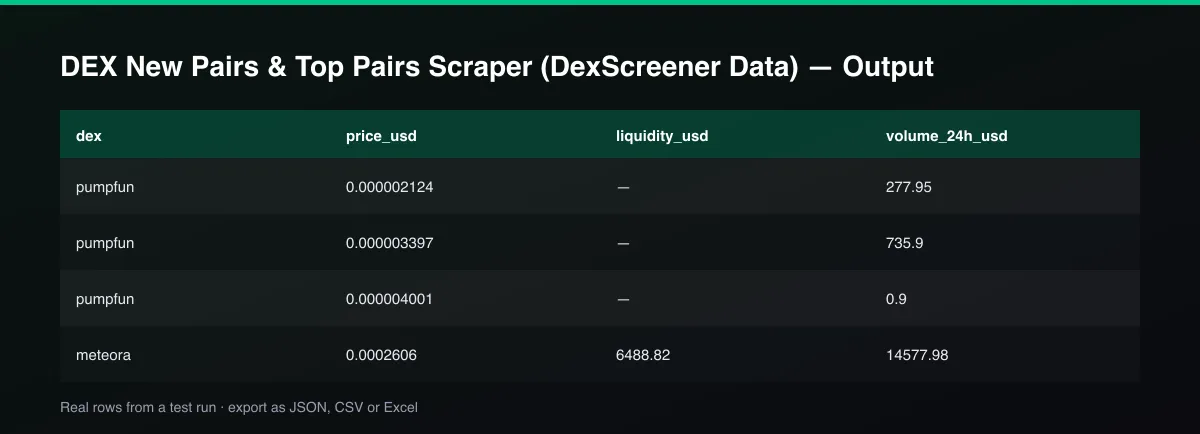
price_usd, liquidity_usd and volume_24h_usd are US dollar figures at collection time (scraped_at, to the second). Fields that the source has not produced yet, such as liquidity for a pair that launched seconds ago, are null, and data_notes explains why. dex includes the version when the DEX has one, for example uniswap_v3.
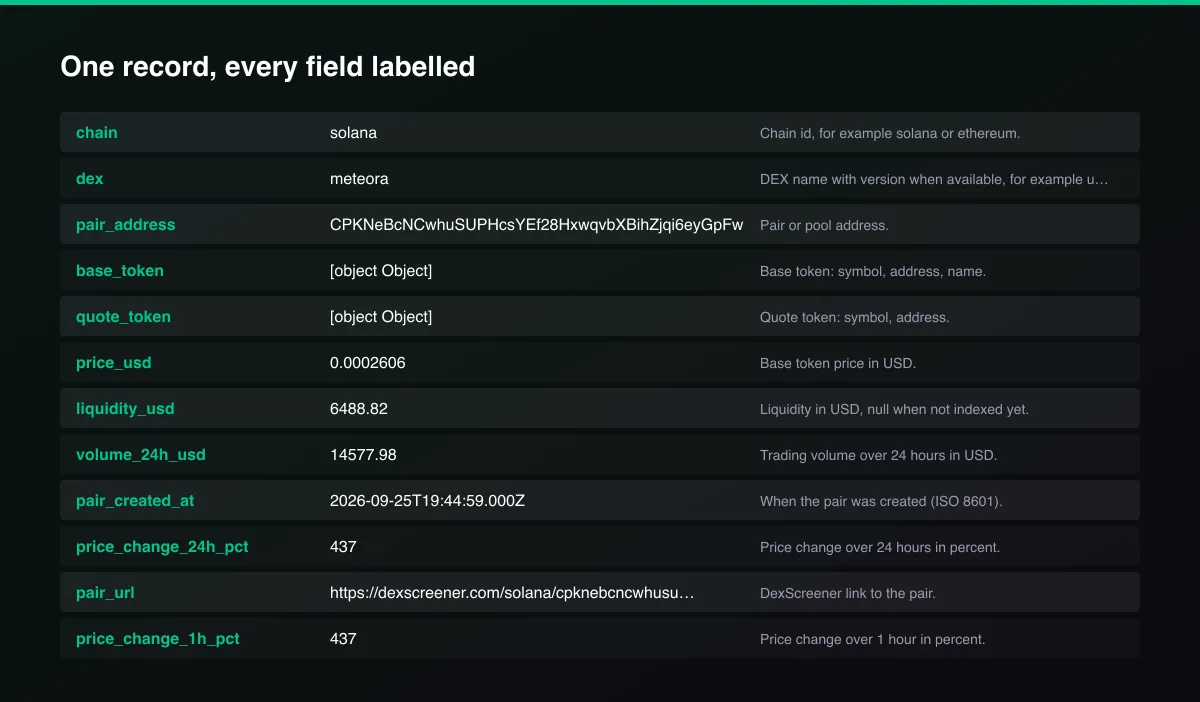
A real dataset item:
How to read and use the results
Each row is one trading pair, stamped with the exact time it was read.
- Check liquidity_usd first. Pairs with tiny or null liquidity are usually not tradable.
- Use pair_created_at to see how new the pair is.
- Null fields are meaningful. A brand-new pair may not be indexed yet; data_notes says so.
- Open pair_url to see the chart on DexScreener.
- This is discovery data, not a safety check. Many new pairs are scams or abandoned tokens.
Usage Examples
New Solana pairs from the last 6 hours
Top Ethereum pairs by volume with real liquidity
Look up specific pairs
Live new-pair feed (only new)
Tips for Best Results
- Set a minimum liquidity to filter out empty and throwaway pairs.
- Schedule new pairs mode every few minutes with a short max age to build a launch feed.
- Use scraped_at, not the launch time, to judge how fresh a liquidity figure is.
- Pairs are returned once per run; run the Actor again for a fresh snapshot.
- Default is 5 results for a fast test. Set the max to 0 to return everything available.
Reliability by mode
| Mode | Status | Needs login or key? | Notes |
|---|---|---|---|
| New pairs | ✅ | No | Newest pools of the chain, enriched with DexScreener figures. |
| Top by volume | ✅ | No | Up to 200 pools per chain per run. |
| Specific pairs | ✅ | No | Any pair DexScreener knows. |
| Pairs seconds old | 🟡 | No | Kept with null fields until indexers catch up. |
| Chains outside the list | ❌ | - | Ten major chains are supported. |
✅ works as described, 🟡 works with caveats, ❌ not supported.
Only new records (delta mode)
Turn on Only new pairs (delta mode) with a Delta key and schedule the Actor every few minutes. Each run returns, and bills, only pairs that earlier runs of that key have not delivered: a live new-pair feed instead of the same list again.
Known Limitations
- Most brand-new pairs are low quality or scam tokens. The Actor returns raw discovery data and makes no safety judgment; nothing is labeled safe or verified.
- Pair discovery uses a pool index and is capped at the 200 newest or highest-volume pools per chain per run.
- Pairs that DexScreener has not indexed yet use fallback figures and are marked in data_notes; price and volume may differ slightly from DexScreener.
- Liquidity and volume change quickly; each row is a snapshot at scraped_at.
- Only the listed chains are supported.
- This is market data, not investment advice.
Integrations
Run it from the Apify API, on a schedule, or from a webhook. Send results straight to Google Sheets, Make, Zapier, Slack or your own database with Apify's built-in integrations.
Export Formats
Download the dataset as JSON, CSV, Excel, XML, HTML table or RSS from the Output tab or the API.
Frequently Asked Questions
Where does the data come from?
Pair figures come from the public DexScreener API. New and top pairs are discovered through a public pool index (GeckoTerminal); both are official public APIs, not scraped web pages. Rate limits are respected by default.
Does it need an API key?
No. It reads public market data.
Why are liquidity and volume sometimes null?
Very new pairs may not be indexed yet. The row is kept, the fields are null, and data_notes says why.
Does it tell me which tokens are safe?
No. New pairs are frequently scams or abandoned tokens. This Actor only delivers market data.
Am I charged for failed results?
No. You are only charged for pairs that are written to the dataset.
How do I find new tokens on Solana?
Choose Solana, mode New pairs and a short max age (for example 6 hours), set a minimum liquidity, and schedule the Actor every few minutes.
Do I need an account or login?
No. The Actor reads public market data and needs no account or API key.
Am I charged for failed runs or empty results?
You are only charged for results that are actually written to the dataset.
Can I run it on a schedule?
Yes. Create a Task with your input and add a schedule in Apify Console. With monitor mode on, each scheduled run returns only what changed since the previous one.
Changelog
- 2026-09-26: Added delta mode, tiered pricing (discovery versus lookup), 1h change, buy/sell counts, FDV, market cap and the fetch_path field.
- 2026-09-25: First release: new pairs, top by volume and specific pair lookup on ten chains.
Enterprise and custom work
Need higher volumes, a custom output schema, dedicated scheduling or a no-breaking-changes commitment for a production pipeline? Open an issue on the Actor page and describe your use case. Bulk terms and custom builds are available.
Support
Questions or a missing field? Open an issue from the Issues tab on this Actor's page and it will be looked at.
Legal / Responsible Use
This Actor reads public market data from the DexScreener and GeckoTerminal public APIs within their published rate limits. You are responsible for how you use the data. It is not financial advice and not affiliated with either provider.


