

SEC Insider Cluster Detector — Coordinated Form 4 Buys
Pricing
from $100.00 / 1,000 insider cluster records
SEC Insider Cluster Detector — Coordinated Form 4 Buys
Track clustered insider buying and selling from SEC EDGAR — parsed, source-linked JSON for analysts, funds and AI agents.
Pricing
from $100.00 / 1,000 insider cluster records
Rating
0.0
(0)
Developer
NexGenData
Maintained by CommunityActor stats
0
Bookmarked
2
Total users
0
Monthly active users
19 days ago
Last modified
Share
SEC Insider Cluster Detector
Track clustered insider buying and selling from SEC EDGAR, parsed into clean JSON. Built for analysts, funds, fintech builders and AI agents. Factual public SEC/EDGAR data — not financial or investment advice. Not affiliated with the U.S. SEC.
📊 Sample Output
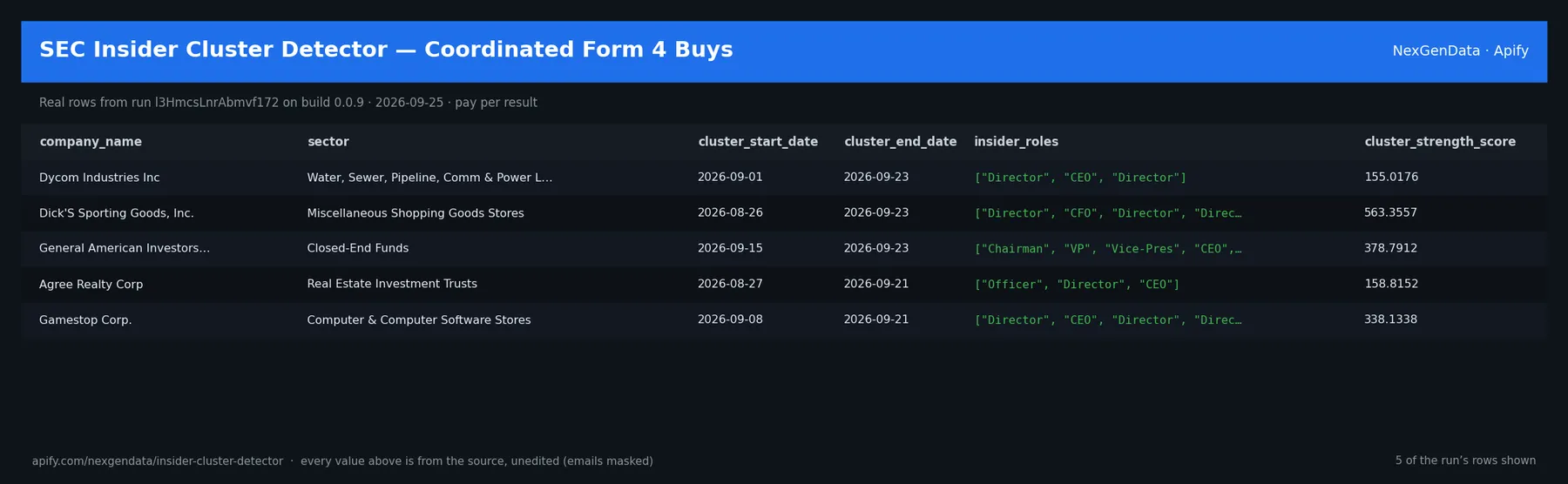
company_name | sector | cluster_start_date | cluster_end_date | insider_roles | total_value_usd |
|---|---|---|---|---|---|
| Dycom Industries Inc | Water, Sewer, Pipeline, Comm & Power Line Construction | 2026-09-01 | 2026-09-23 | ['Director', 'CEO', 'Director'] | 551307 |
| Dick'S Sporting Goods, Inc. | Miscellaneous Shopping Goods Stores | 2026-08-26 | 2026-09-23 | ['Director', 'CFO', 'Director', 'Director', 'Director', 'Director'] | 5088794 |
| General American Investors Co Inc | Closed-End Funds | 2026-09-15 | 2026-09-23 | ['Chairman', 'VP', 'Vice-Pres', 'CEO', 'Treasurer, PAO, PFO'] | 672290 |
| Agree Realty Corp | Real Estate Investment Trusts | 2026-08-27 | 2026-09-21 | ['Officer', 'Director', 'CEO'] | 4142871 |
| Gamestop Corp. | Computer & Computer Software Stores | 2026-09-08 | 2026-09-21 | ['Director', 'CEO', 'Director', 'Director'] | 48401613 |
Real rows from run l3HmcsLnrAbmvf172 on build 0.0.9 (2026-09-25), unedited apart from masked emails/phones and shortened long text; fields the source does not publish are empty.
🔧 Input reference
| Field | Type | Default | What it does |
|---|---|---|---|
min_cluster_size | integer | 3 | Minimum number of DISTINCT insiders that must have bought the same stock inside the rolling window for a cluster to qualify. 3 is the academic-research threshold (Lakonishok-Lee 2… |
date_range | string (last_30d, last_60d, last_90d) | "last_30d" | How far back to scan for clustered insider buying. last_30d is the canonical academic-research window — insiders rarely act independently on the same thesis if their decisions are… |
min_value_usd | integer | 25000 | Skip clusters where the total combined dollar value of all insider buys is below this threshold. Filters out trivial token buys (1-2K share Director gifts/exercises). Common thres… |
exclude_sells | boolean | true | If true, only return clusters where EVERY insider transaction in the window was a buy (no sells, no exercises, no dispositions mixed in). The is_all_buy=true flag isolates the hig… |
limit | integer | 5 | Maximum number of cluster records to push to the dataset (one row per stock — already aggregated, so a stock with 8 insiders piling in is ONE record not eight). Typical hedge-fund… |
tickers | array | [] | Optional list of stock tickers to restrict the cluster scan to. Useful when you already track a watchlist and only want cluster alerts for those names. Leave empty to scan the ful… |
include_industry | boolean | true | If true, include the OpenInsider-supplied industry classification (e.g., 'Pharmaceutical Preparations', 'Semiconductors', 'Commercial Banks') as the sector field on each cluster r… |
🧾 JSON sample record
One real record from run l3HmcsLnrAbmvf172 (emails/phones masked, long text shortened):
💰 Pricing
| Event | Price (USD) | When it is charged |
|---|---|---|
Actor Start (apify-actor-start) | $0.01 | Charged when the Actor starts running. Number of events charged depends on Actor memory (one event per GB, minimum one event). |
Insider cluster record (apify-default-dataset-item) | $0.1 | Charged per aggregated cluster returned — one stock with 3+ distinct insider buys inside the lookback window, with all insider names, roles… |
Pay-per-event: you pay only for what the run delivers. A run that delivers nothing bills no result events (only the actor-start event, when the actor defines one). Example: a run that delivers 100 results costs 100 × $0.1 = $10.00 plus the start fee.
🔗 Related Actors
More from the NexGenData SEC & US filings family:
- ETF Holdings Tracker — Daily Constituents & Weights API
- EU MAR Insider Transactions Tracker (IT+NL+ES+BE)
- HKEX Insider & Short Tracker — 內幕權益 API
- IPO Tracker — Upcoming & Priced US IPOs API
- Japan EDINET Insider Filings — インサイダー取引 API
- Unusual Options Activity Tracker — Flow & Volume API
48 more in this family on the NexGenData Store page.
📊 What you get
Clean JSON, one record per record. Key fields (full output has 16 fields):
company_name— Company / filer nameinsider_names— Insider nameinsider_roles— Insider role / relationshiptotal_value_usd— USD value
Pricing: $0.1 per record (Pay-Per-Event) — about 10 per $1. Actor start fee $0.01 per run. Live prices are in the Pricing table below.
🤖 Use with AI agents
Structured, source-linked SEC data built for LLM and agent pipelines — point Claude, the OpenAI Agents SDK, an n8n flow or any MCP-aware client at it and pull clustered insider buying and selling on demand.
Sample agent prompt:
Agentic payments (x402): Supports agentic payment via x402 — agents can call this actor with USDC, no API key required.
⏰ Run on a schedule
The recurring frame is the point — schedule a daily or weekly pull:
🔗 Related SEC actors
More insider trackers: Form 4 Monitor, Form 4 Scraper, Form 4 Tracker, Form 3 Tracker
Agent front doors: SEC Corporate Events MCP, Regulatory Filings MCP
Data parsed from public SEC EDGAR filings. Factual public SEC/EDGAR data — not financial or investment advice. Not affiliated with the U.S. SEC.


