📉 SEC Fails-to-Deliver Tracker — Short Squeeze Data avatar

📉 SEC Fails-to-Deliver Tracker — Short Squeeze Data

Pricing

Pay per event

Go to Apify Store
📉 SEC Fails-to-Deliver Tracker — Short Squeeze Data

📉 SEC Fails-to-Deliver Tracker — Short Squeeze Data

SEC fails-to-deliver (FTD) data by security: settlement date, fails quantity, CUSIP, symbol, price — from the SEC's bi-monthly FTD files. For short-squeeze, momentum traders, and market-microstructure analysts. Pay-per-record JSON.

Pricing

Pay per event

Rating

0.0

(0)

Developer

NexGenData

NexGenData

Maintained by Community

Actor stats

0

Bookmarked

12

Total users

1

Monthly active users

16 hours ago

Last modified

Categories

Share

Pay-per-result fails-to-deliver (FTD) data straight from the SEC's official bi-monthly settlement files. No Bloomberg terminal, no Ortex seat, no S3-subscriber paywall.

Every clearing fail in the U.S. equity market lands in one official place: the SEC's bi-monthly Fails-to-Deliver file. The catch is the SEC ships it as a pipe-delimited fixed-format dump with no API, no ticker index, and a quirky YYYYMMa/b half-month naming convention — so you download the whole-market file, write a parser, and repeat every two weeks. This actor does that for you and turns FTD into a queryable JSON feed: filter by ticker, CUSIP, minimum fails quantity, or file period and get back clean rows — settlement date, fails quantity, price — straight from the regulator's published figures, pay-per-record.

FTD data is one of the few hard, official, free signals about settlement stress and short-side pressure in U.S. equities. This actor reads the SEC's cnsfails files directly, parses them into clean JSON, and lets you surface the names with persistent, climbing fail positions that quant desks, short-squeeze researchers, and market-structure analysts actually care about.

Why use this

  • It is the primary source, not a reseller's interpretation. Records come from the SEC's own fails-to-deliver publication. No vendor smoothing, no proprietary "synthetic short interest" model between you and the regulator's published figures.
  • It is queryable. The raw SEC files are monolithic whole-market dumps. This actor filters by symbol, cusip, minQuantity, and period so you get only the rows you need.
  • It is pay-per-result. No monthly minimum, no seat license, no annual contract — pull five records or five thousand and pay for exactly what you use.
  • It handles the SEC's quirks. The half-month YYYYMMa / YYYYMMb naming, the pipe-delimited layout, and the required User-Agent contact header are all handled internally.
  • It is schedulable. Point a schedule at this actor and get a fresh feed of new fails the moment the SEC publishes the next half-month file.

One file per run. Each run processes a single half-month file (the most recent, or the one matching period). To build history, loop over consecutive period tags.

What you get

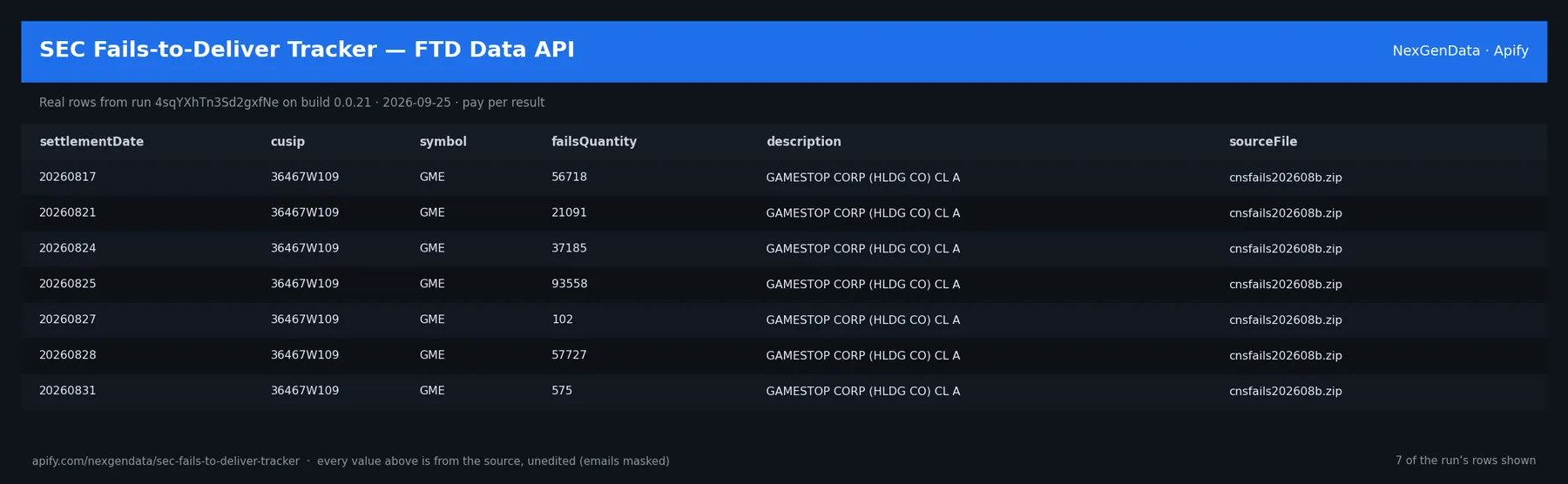
Each record is one fail position for one security on one settlement date, parsed from the official SEC file:

  • settlementDate — the settlement date the fail applies to, in YYYYMMDD format (e.g. 20260515).
  • cusip — the 9-character CUSIP identifier, the key the SEC files are organized around and the most reliable way to track a security across name/ticker changes.
  • symbol — the ticker symbol associated with the security.
  • failsQuantity — the number of shares that failed to deliver and remained open on the settlement date. The core metric.
  • description — the issuer/security name as carried in the SEC file.
  • price — the price associated with the fail record as published in the source file.
  • sourceFile — the exact SEC source file the record was parsed from (e.g. cnsfails202605b.zip), so every row is traceable. b = second half of the month; a = first half.

Every field comes directly from the SEC publication. We parse and structure — we do not augment, model, or estimate.

Use cases

  • Short-squeeze / persistent-fails watchlist — track climbing failsQuantity by symbol across consecutive periods to surface names with rising open fail positions.
  • Market-microstructure research — study settlement stress, T+1 impact, and how fail positions build and clear over time, traced by sourceFile and settlementDate.
  • Quant feature pipeline — fold FTD persistence in as a systematic factor, joined on cusip.
  • ETF-level fails monitoring — track fails for ETF tickers alongside their constituents.
  • Compliance / regulatory reporting — ingest each new bi-monthly file automatically without manual fixed-width parsing.

Sample input

{
"symbol": "GME",
"minQuantity": 10000,
"maxResults": 5000
}

Sample output

{
"settlementDate": "20260515",
"cusip": "36467W109",
"symbol": "GME",
"failsQuantity": 245310,
"description": "GAMESTOP CORP",
"price": 28.41,
"sourceFile": "cnsfails202605b.zip"
}

Input parameters

ParameterTypeRequiredDefaultDescription
symbolstringNoFilter by ticker symbol.
cusipstringNoFilter by CUSIP. The most reliable identifier across name/ticker changes.
minQuantityintegerNoOnly return records with failsQuantity greater than or equal to this value.
periodstringNomost recentOptional file-period filter using the SEC YYYYMM plus half-month tag convention (e.g. 202605b). Blank returns the most recent published file.
maxResultsintegerNo5000Maximum number of records to return.
userAgentContactstringNoContact info for the SEC User-Agent header.

How to use it

Python (apify-client)

from apify_client import ApifyClient
client = ApifyClient("<YOUR_APIFY_TOKEN>")
run_input = {
"symbol": "GME",
"minQuantity": 10000,
"period": "202605b",
"maxResults": 5000,
"userAgentContact": "your-name your-email@example.com",
}
run = client.actor("nexgendata/sec-fails-to-deliver-tracker").call(run_input=run_input)
for record in client.dataset(run["defaultDatasetId"]).iterate_items():
print(record["settlementDate"], record["symbol"], record["failsQuantity"])

cURL (run-sync-get-dataset-items)

curl -X POST "https://api.apify.com/v2/acts/nexgendata~sec-fails-to-deliver-tracker/run-sync-get-dataset-items?token=<YOUR_APIFY_TOKEN>" \
-H "Content-Type: application/json" \
-d '{
"symbol": "GME",
"minQuantity": 10000,
"period": "202605b",
"maxResults": 5000,
"userAgentContact": "your-name your-email@example.com"
}'

Pricing

This actor runs on Apify's pay-per-event (PPE) model — you pay only for results returned, not run-time. Per-record pricing and any per-run charge are shown on the actor's pricing tab. No monthly fee, no minimum commitment, no seat license. Use maxResults to cap spend precisely.

How this compares to Bloomberg / Ortex / S3 Partners

  • Source. This actor delivers the SEC's own published fails-to-deliver figures, parsed but otherwise untouched. Ortex and S3 Partners sell modeled short-interest and squeeze metrics — proprietary estimates layered on top of underlying data. FTD data here is the regulator's primary-source record.
  • Cost. The major terminals are subscription products, typically four to five figures per year per seat. This actor is pay-per-use — for a researcher, journalist, or small desk that needs FTD data specifically, the difference is large.
  • Scope. A terminal is a vast integrated platform; this actor does one thing — official US-equity FTD data — and does it cleanly, as a cheap scriptable complement.
  • Access model. Terminals are interactive and license-bound; this actor is API-first and built to feed datasets, notebooks, and downstream actors.

FAQ

How current is FTD data? The SEC publishes FTD files on a bi-monthly cadence (first and second half of each month) and the data itself lags roughly 2-4 weeks. With period blank, the actor returns the most recently published file.

What is the YYYYMMa / YYYYMMb period convention? The SEC publishes one FTD file per half-month: a for the first half, b for the second. For example, 202605b is the second-half-of-May-2026 file, which appears in sourceFile as cnsfails202605b.zip. Pass this format in period.

Does one run cover history? No — each run processes a single half-month file. Loop over period tags to backfill a longitudinal panel.

Is this real short interest? No. FTD figures record open settlement failures — a complementary signal to short interest, not the same thing. A fail can occur for several operational reasons; interpreting failsQuantity as naked-short activity is an analytical judgment.

Why CUSIP, not just ticker? CUSIP is the file's key and stays stable across ticker and name changes. You can filter by symbol or cusip, and combine either with minQuantity.

Why do I need a userAgentContact? The SEC requests automated access include a User-Agent header with contact information.

Schema stability & versioning

The output fields — settlementDate, cusip, symbol, failsQuantity, description, price, and sourceFile — are stable and safe to build against. New fields are additive; breaking changes are versioned and documented.

This actor retrieves and parses publicly available fails-to-deliver data published by the U.S. Securities and Exchange Commission. The data is provided for informational purposes only and is not investment advice. FTD figures reflect recorded settlement failures and should not be read, on their own, as confirmation of naked shorting. Always verify figures against the original SEC source when accuracy is material. NexGenData is not affiliated with or endorsed by the SEC.

Browse the full catalog at https://apify.com/nexgendata?fpr=2ayu9b.