🚪 SEC Delisting & Deregistration Tracker — Form 25/15
Pricing
from $25.00 / 1,000 vehicle records
🚪 SEC Delisting & Deregistration Tracker — Form 25/15
Track SEC exchange delistings and deregistrations (Form 25-NSE, 25, 15-12B) with company and date. For index providers, ETF rebalancers, and risk/compliance teams scrubbing dead tickers.
Pricing
from $25.00 / 1,000 vehicle records
Rating
0.0
(0)
Developer
NexGenData
Maintained by CommunityActor stats
0
Bookmarked
7
Total users
3
Monthly active users
a day ago
Last modified
Categories
Share
Every SEC exchange delisting and deregistration — Form 25-NSE, 25, and 15-12B — with company, ticker, and filing date, delivered as pay-per-record JSON instead of a Bloomberg Terminal seat.
When a company comes off an exchange, a quiet but consequential filing hits EDGAR: a Form 25 (the exchange's notification of delisting), a Form 25-NSE, or a Form 15-12B (the company's certification that it is deregistering and ending its reporting obligations). For index providers, ETF rebalancers, and risk and compliance teams, these filings are the authoritative signal that a ticker is going dark. Miss them and you carry a dead security in your index, your basket, or your risk model.
This actor tracks those filings as they appear on SEC EDGAR and returns each one as a structured record: company name, ticker, form type, filed date, and a direct link to the filing document. It is a scrubbing feed for dead and dying tickers — pull it daily and you have a continuously refreshed list of companies leaving the public markets.
Why use this
The information is public on EDGAR, but EDGAR is built for one-filing-at-a-time retrieval, not for "give me every delisting and deregistration in the last 30 days as a flat file." The platforms that do package this cleanly — a Bloomberg Terminal, primarily — bundle it inside a seat licence that runs roughly $24,000 a year and locks the data behind a terminal you cannot easily pipe into your own systems.
This actor gives you the delisting feed as queryable JSON, pay-per-result, with no seat and no commitment. You pass a date window (or a look-back in days), optionally narrow to a specific form set or a keyword, and get back clean records ready to drop into your index-maintenance pipeline, your compliance scrub, or your warehouse.
- Purpose-built form set. The default
formsfilter targets exactly the delisting and deregistration forms (25-NSE, 25, 15-12B) — you are not sifting the whole EDGAR firehose. - Flexible date control. Use
daysBackfor a rolling window orstartDate/endDatefor a fixed range, so the same actor serves both a daily scrub and a historical backfill. - Direct document links. Every record carries
documentUrl, so an analyst can jump straight to the source filing for verification.
What you get
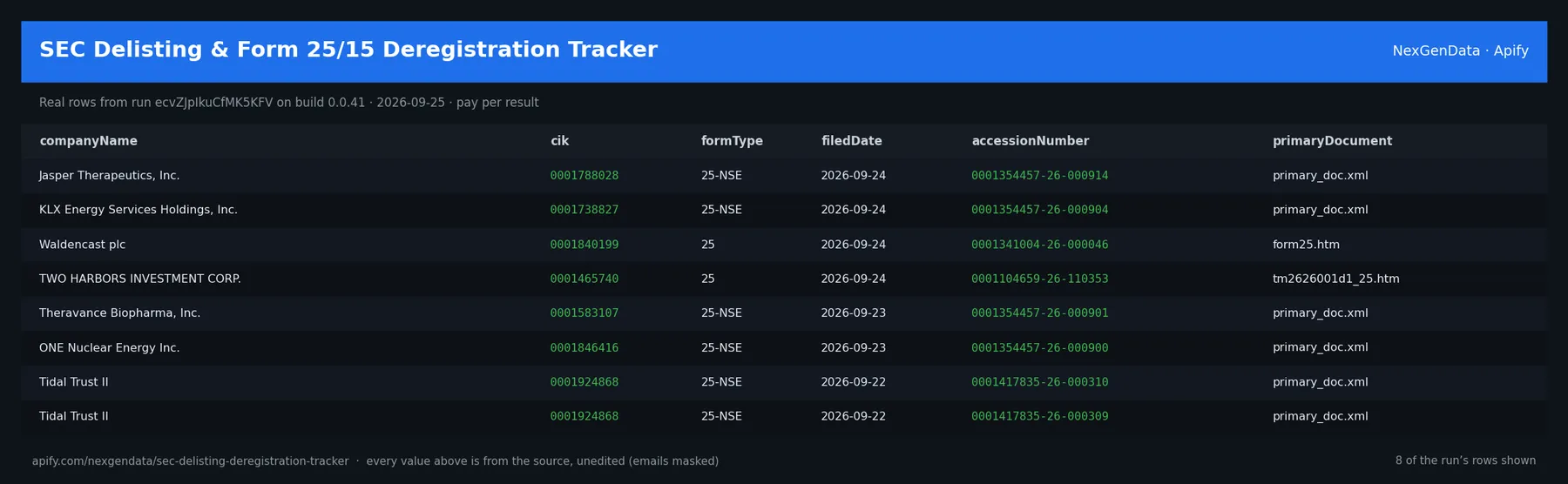
Each record returned by the actor is one delisting or deregistration filing, in flat JSON:
companyName— the filer's company nameticker— the company's ticker symbol (where available)formType— the SEC form (25-NSE, 25, 15-12B, etc.)filedDate— the date the form was filed with the SECdocumentUrl— a direct link to the filing document on EDGAR
The schema is stable and additive — safe to load into your index-maintenance or compliance pipeline and refresh daily.
Use cases
- Index maintenance. Pull the last day's delistings and deregistrations and scrub matching tickers from your index before the next reconstitution — the canonical "remove dead constituents" job for an index provider.
- ETF rebalancing. Cross-check delisting filings against your fund's holdings so a delisted name is flagged for removal ahead of a rebalance rather than discovered after settlement breaks.
- Risk and compliance ticker scrubbing. Feed the feed into your security master to retire dead tickers, preventing stale identifiers from polluting risk reports and reconciliations.
- Distressed and event-driven research. A Form 25 or 15-12B is often the tail end of a bankruptcy, going-private, or going-dark event — track them to map the full lifecycle of distressed names.
- Data-vendor reconciliation. Use the feed as an independent check against your primary market-data vendor's delisting flags, catching gaps or timing differences.
- Going-dark monitoring. Watch Form 15-12B specifically to catch companies voluntarily ending their reporting obligations — a signal for fixed-income and private-credit teams holding their debt.
- Audit trail for security retirement. Keep the
documentUrlfor each retired ticker as a documented, source-linked reason for removal in your compliance records.
Sample output
{"companyName": "Example Holdings Corp","ticker": "EXHC","formType": "25-NSE","filedDate": "2026-06-18","documentUrl": "https://www.sec.gov/Archives/edgar/data/0001234567/000123456726000045/form25.htm"}
A daily run returns one such record per delisting or deregistration filed in the window — the exact list your security-master scrub needs.
Input parameters
| Parameter | Label | Description |
|---|---|---|
forms | Form types | Comma-separated SEC delisting / deregistration forms (default set: 25-NSE, 25, 15-12B). |
query | Keyword (optional) | Optional exact-phrase keyword to AND with the form filter. |
daysBack | Days back | Look back this many days (ignored if explicit dates are set). |
startDate | Start date | Override the start of the range (YYYY-MM-DD). |
endDate | End date | Override the end of the range (YYYY-MM-DD). |
maxResults | Max results | Maximum number of filings to return. |
userAgentContact | SEC User-Agent contact | SEC requires a User-Agent with contact info (e.g. Company you@email.com). |
How to use
Python (apify-client)
from apify_client import ApifyClientclient = ApifyClient("YOUR_TOKEN")run = client.actor("nexgendata/sec-delisting-deregistration-tracker").call(run_input={"daysBack": 7,"maxResults": 200,"userAgentContact": "Your Company you@email.com",})for item in client.dataset(run["defaultDatasetId"]).iterate_items():print(item["filedDate"], item["formType"], item["companyName"], item["ticker"])
cURL
curl -X POST "https://api.apify.com/v2/acts/nexgendata~sec-delisting-deregistration-tracker/run-sync-get-dataset-items?token=YOUR_TOKEN" \-H "Content-Type: application/json" \-d '{"daysBack": 7,"maxResults": 200,"userAgentContact": "Your Company you@email.com"}'
Schedule it daily via Apify's scheduler and fire a webhook to Slack, Zapier, or your security-master ingest the moment new delistings land.
Pricing
This actor runs on Apify's pay-per-event model — $0.10 per result record, plus a negligible one-time actor-start charge per run. No subscription, no seat, no minimum.
Worked examples:
- A daily 7-day rolling scrub returning
15 filings → **$1.50 per run** - A 90-day historical backfill returning
150 filings → **$15.00** - A single fixed-window pull of 200 filings → ~$20.00
You pay only for records pushed to the dataset; an empty window costs nothing in result charges. Browse the full catalog at https://apify.com/nexgendata?fpr=2ayu9b
How this compares to Bloomberg
| Source | Price | What you get |
|---|---|---|
| Bloomberg Terminal | ~$24,000 / seat / yr | Delisting flags inside a full terminal — seat-locked, hard to pipe into your own systems |
| SEC EDGAR (official) | Free | Authoritative filings, but one-at-a-time retrieval; no bulk delisting feed or flat export |
| NexGenData Delisting & Deregistration Tracker | PPE $0.10 / record | Queryable Form 25 / 15 feed with company, ticker, date, and document link, as JSON |
A Bloomberg seat does far more than flag delistings, and if you need the full terminal it earns its keep. But if your actual job is scrubbing dead tickers out of an index, basket, or risk model, you need the delisting filings as a feed your pipeline can ingest — not as a flag buried in a terminal — and this actor delivers exactly that, priced per record.
FAQ
Q: Which forms does it track?
A: By default the delisting and deregistration set — Form 25-NSE, Form 25, and Form 15-12B. Override forms to narrow or extend the set.
Q: What is the difference between Form 25 and Form 15? A: A Form 25 is the exchange's notification of delisting a security; a Form 15-12B is the company's certification that it is deregistering and terminating its SEC reporting obligations. They often appear in sequence as a company leaves the public markets.
Q: Why do I need to provide a User-Agent contact?
A: The SEC requires every automated request to EDGAR to identify itself with contact information. Pass your company and email in userAgentContact so requests comply with SEC fair-access policy.
Q: Can I backfill historical delistings?
A: Yes — set startDate and endDate to any range to pull historical filings, or use daysBack for a rolling window.
Q: How current is the data? A: Each run reads live EDGAR, so results reflect filings available at run time. Schedule daily for a continuous scrub.
Schema stability & versioning
This actor follows NexGenData's additive-only schema contract. New fields may be added as new JSON keys (defaulting to null for older records), but existing fields are never renamed or removed without a major-version bump and advance notice. Date formats and form-type values are never silently changed. Build your security-master ETL on the five documented fields with confidence.
Compliance & legal
- The actor reads public, unauthenticated SEC EDGAR filings — government disclosure data published for exactly this kind of access.
- Every request identifies itself via the
userAgentContactyou supply, per SEC fair-access policy. - No credentials are stored and no paywalled source is involved.
- Treat the feed as informational; verify against the linked primary filing before acting on a delisting in a production index or compliance decision.
Related NexGenData actors
Part of NexGenData's SEC & disclosure intelligence lane — pair this actor with:
- SEC Going-Private Tracker — Schedule 13E-3 going-private transactions
- SEC Foreign Private Issuer Monitor (20-F / 6-K) — foreign-issuer annual and interim filings
- SEC 8-K Event Monitor — material corporate events as they file
- SEC Tender Offer & M&A Tracker — tender offers and merger filings
- Reg SHO Threshold Securities — fails-to-deliver threshold lists
- SEC IPO Prospectus Tracker — the other end of the listing lifecycle
Explore the full catalog of 200+ buyer-intent actors at https://apify.com/nexgendata?fpr=2ayu9b