

Shopify Revenue Estimator — Store Intel API
Pricing
from $20.00 / 1,000 store analyses
Shopify Revenue Estimator — Store Intel API
Estimate any Shopify store's monthly revenue, detect themes, installed apps & traffic sources. SimilarWeb, Semrush & Store Leads alternative for ecommerce strategists, brand investors and competitive due diligence. From $0.008/store analyzed.
Pricing
from $20.00 / 1,000 store analyses
Rating
0.0
(0)
Developer
NexGenData
Maintained by CommunityActor stats
1
Bookmarked
41
Total users
5
Monthly active users
6 days ago
Last modified
Categories
Share
Shopify Product Scraper by nexgendata
Extract Shopify store product catalogs including product titles, prices, variant details, inventory status, images, descriptions, vendor info, and collection assignments at scale. Built for dropshippers researching trending products and pricing and anyone who needs structured e-commerce data without the overhead of building a custom scraper.
📊 Sample Output
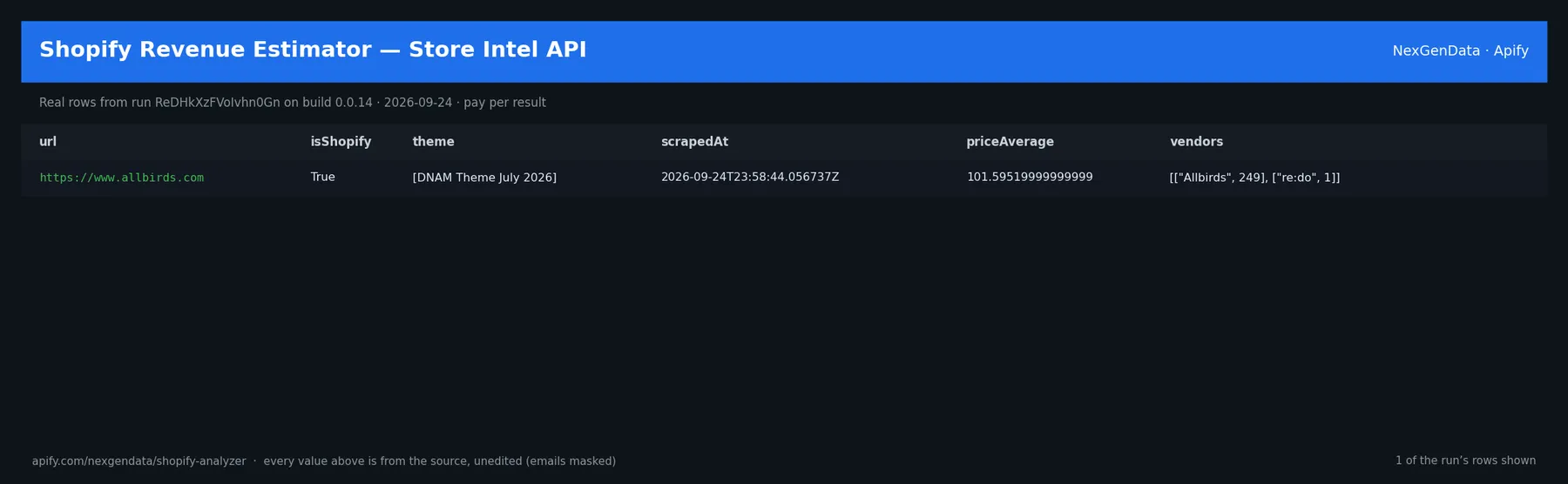
url | isShopify | theme | scrapedAt | priceAverage | vendors |
|---|---|---|---|---|---|
| https://www.allbirds.com | True | [DNAM Theme July 2026] | 2026-09-24T23:58:44.056737Z | 101.59519999999999 | [['Allbirds', 249], ['re:do', 1]] |
Real rows from run ReDHkXzFVoIvhn0Gn on build 0.0.14 (2026-09-24), unedited apart from masked emails/phones and shortened long text; fields the source does not publish are empty.
🔧 Input reference
| Field | Type | Default | What it does |
|---|---|---|---|
store_urls | array | [{"url": "https://www.allbirds.com"}] | Shopify store URLs to analyze. Accepts a list of URLs (each can be a string OR a {url: '...'} dict) OR a single URL string OR a comma/newline-separated list. Also accepts these al… |
max_products | integer | 250 | Maximum products to fetch per store (Shopify limits to 250 per request) |
urls | ['array', 'string'] | Alternative name for store_urls. Accepts a list OR a single string OR comma/newline-separated. | |
startUrls | ['array', 'string'] | Alternative name for store_urls. Accepts a list OR a single string OR comma/newline-separated. | |
storeUrls | ['array', 'string'] | Alternative name for store_urls. Accepts a list OR a single string OR comma/newline-separated. | |
shopifyStores | ['array', 'string'] | Alternative name for store_urls. Accepts a list OR a single string OR comma/newline-separated. | |
store_url | string | Alternative — a single value when you only need one. Comma-separated values are auto-split. | |
url | string | Alternative — a single value when you only need one. Comma-separated values are auto-split. | |
storeUrl | string | Alternative — a single value when you only need one. Comma-separated values are auto-split. | |
includeTechStack | boolean | false | Detect each store's technology stack (CMS, frameworks, analytics, CDN). Opt-in addon; charged once per successfully-analyzed store. |
🧾 JSON sample record
One real record from run ReDHkXzFVoIvhn0Gn (emails/phones masked, long text shortened):
💰 Pricing
| Event | Price (USD) | When it is charged |
|---|---|---|
Actor Start (apify-actor-start) | $5e-05 | Charged when the Actor starts running. Number of events charged depends on Actor memory (one event per GB, minimum one event). |
Store analysis (apify-default-dataset-item) | $0.02 | Single result in the default dataset. |
Add-on: Competitor price comparison (addon-competitor-pricing) | $0.01 | For each product scraped, compare against competitor stores in the same category to surface pricing deltas. Only fires when add-on is reque… |
Add-on: Tech stack detection (addon-tech-stack) | $0.02 | Detect the Shopify theme, installed apps, payment processors and tracking pixels for the store. One-time charge per store. |
Pay-per-event: you pay only for what the run delivers. A run that delivers nothing bills no result events (only the actor-start event, when the actor defines one). Example: a run that delivers 100 results costs 100 × $0.02 = $2.00 plus the start fee.
🔗 Related Actors
More from the NexGenData Leads, contacts & enrichment family:
- Person Enrichment API — Name & Company to Public Profile
- Phone Number Validation API — Format, Carrier & Line Type
- Restaurant & Food Business Leads — Local Prospect Lists API
- Shopify App Merchant Finder — Competitor App User Leads API
- Shopify Store Analyzer — Catalog, Apps & Revenue Signals API
- Shopify Store Detector — Tech, Theme & App Detection API
30 more in this family on the NexGenData Store page.
What This Actor Does
The Shopify Product Scraper connects to Shopify and extracts Shopify store product catalogs including product titles, prices, variant details, inventory status, images, descriptions, vendor info, and collection assignments. It handles pagination, rate limiting, and data normalization automatically so you get clean, structured JSON output ready for your database, dashboard, or analytics pipeline. No API keys to manage, no infrastructure to maintain.
Who Uses This
Dropshippers researching trending products and pricing, competitive pricing intelligence tools, market researchers analyzing e-commerce niches, and agencies auditing client product catalogs. If you need e-commerce data at scale without building and maintaining your own extraction pipeline, this actor handles the heavy lifting.
What You Get Back
Each run produces a structured dataset in JSON format. Every record includes all available fields from the source, normalized into a consistent schema. The data is immediately available for export in JSON, CSV, or Excel format, or you can push it directly to your data warehouse via Apify integrations with Google Sheets, Slack, Webhooks, and 50+ other platforms.
How It Compares
Shopify Storefront API requires store-specific access tokens. Import.io and Diffbot charge $299+/month for e-commerce scraping. Manual product research across stores is impossibly slow. This actor delivers the same data at $5 per 1,000 products with zero monthly commitment, no API key management, and results available in seconds. Pay only for what you use.
Sample Output
Use Cases
Teams use the Shopify Product Scraper across a range of workflows. Analysts feed the output into business intelligence dashboards for real-time monitoring. Developers integrate it into automated data pipelines that run on daily or weekly schedules. Researchers use bulk exports for large-scale analysis projects. Marketing teams track competitive movements and industry trends. The structured output format means the data slots into virtually any downstream system with minimal transformation.
Pricing: $20 per 1,000 Products
At $5/1K, processing 5,000 products costs $25.00 total. A daily pipeline pulling 500 products runs $2.50/day ($75/month). Compare that to building and maintaining your own scraping infrastructure, which typically costs $500-2,000/month in proxy fees, compute, and engineering time alone.
FAQ
How often can I run this? As often as you need. Schedule runs hourly, daily, or weekly through Apify's built-in scheduler, or trigger runs via API from your own systems.
What format is the output? JSON by default, with one-click export to CSV or Excel. You can also push results directly to Google Sheets, webhooks, or any HTTP endpoint via Apify integrations.
Do I need any API keys? No. The actor handles all authentication and access internally. Just configure your search parameters and run.
Can I integrate this with my existing tools? Yes. Apify supports integrations with Zapier, Make, Google Sheets, Slack, and direct webhook delivery. You can also use the Apify API to pull results programmatically into any system.
Related Shopify Actors
NexGenData offers a complete Shopify intelligence suite. Each actor targets a different use case:
| Actor | What It Does | Best For |
|---|---|---|
| Shopify Revenue Estimator | Revenue estimates, theme & app detection, traffic analysis | Competitive due diligence, investor research |
| Shopify Product Extractor | Full product catalogs with prices, variants, inventory | Dropshipping, price monitoring |
| Shopify Product Scraper | Lightweight product data via /products.json | Quick product lookups, data pipelines |
| Shopify Store Detector | Theme, 55+ app fingerprints, tech stack, Shopify plan | Tech stack analysis, market research |
| Shopify App Store Scraper | App listings, reviews, pricing, ratings from apps.shopify.com | App market intelligence, competitor tracking |
Sign up for Apify to get started with $5 in free credits every month.
Related tools
- Shopify Store Detector — Theme, Apps & Tech Stack Spy
- Shopify Product Scraper — Full Catalogs
- Shopify Product Extractor — Catalog & Prices
- ₿ Crypto Price Tracker — Real-Time & Alerts
Why Shopify Analyzer Beats SimilarWeb, Sensor Tower, Jungle Scout & SpyFu
| Feature | NexGenData Shopify Analyzer | SimilarWeb | Sensor Tower | Jungle Scout | SpyFu |
|---|---|---|---|---|---|
| Cost | $0.02 / store, pay-per-event | $199-499 / month | $$$$ enterprise | $49-129 / month | $39-79 / month |
| Shopify-specific signals | Yes — theme, app stack, product velocity | Generic web traffic | Mobile-app focus | Amazon only | SEO / SEM focus |
| Revenue estimation | Yes — order-velocity model | Yes (paid tier) | No | Amazon only | No |
| Bulk export | JSON / CSV / Excel | Plan-gated | Plan-gated | Plan-gated | CSV |
| App / tech stack detected | Yes — Klaviyo, Yotpo, ReCharge, etc. | Yes | Yes | No | No |
| Auth | Apify token | Account + plan | Account + plan | Account + plan | Account + plan |
| Monthly minimum | None | $199+ | $$$$ | $49+ | $39+ |
Shopify Analyzer is a drop-in alternative to SimilarWeb's Shopify-vertical reports and a much cheaper than Sensor Tower / Jungle Scout angle for DTC competitive intel. Teams pick it instead of building a custom Shopify-detection + revenue-model pipeline because every store domain comes back with traffic, revenue estimate, app stack, and theme in a single call — what would otherwise take 3-4 separate paid tools.
Related NexGenData Commerce Actors
| Use case | Actor |
|---|---|
| Shopify store product scraper | shopify-product-scraper |
| Shopify store analyzer (revenue + traffic) | shopify-store-analyzer |
| Shopify store detector (BuiltWith alt) | shopify-store-detector |
| Amazon product scraper | amazon-product-scraper |
| Google Shopping price tracker | google-shopping-scraper |
| SaaS / DTC pricing tracker | saas-pricing-tracker |
| JD.com product scraper (China commerce) | jd-com-product-scraper |
| Indie Hackers product launches | indie-hackers-products-tracker |
| Product Hunt daily launches | product-hunt-launches-scraper |
| E-commerce intelligence MCP for AI | ecommerce-intelligence-mcp-server |
Browse the full NexGenData catalog of 260+ actors at https://apify.com/nexgendata?fpr=2ayu9b


![Facebook Ad Library Scraper [From $0.3💰] · Reach · Transcripts avatar](https://images.apifyusercontent.com/bf6DAKrnMs_0oZXj6V0XGD7D1C-ESUBLCmhAdxV7R6Y/rs:fill:76:76/cb:1/aHR0cHM6Ly9hcGlmeS1pbWFnZS11cGxvYWRzLXByb2QuczMudXMtZWFzdC0xLmFtYXpvbmF3cy5jb20vbmduOHZSRVNUa3NleVdFNnAtYWN0b3ItZGVIQ2pzQVBLTUhyTlFZVzEtR3dVTlJ3ZW1PNC1GYWNlYm9va19pY29uXzIwMTMuc3ZnLnBuZw.webp)


