

Startup Funding Tracker — SEC Form D, TechCrunch & YC
Pricing
from $80.00 / 1,000 funding round records
Startup Funding Tracker — SEC Form D, TechCrunch & YC
Track startup funding rounds from SEC EDGAR Form D filings, TechCrunch, and Y Combinator in one call. Crunchbase alternative using 100% public/legal data — company, amount, round, investors, date. Filter by amount, industry, and date. No API key. Pay per record.
Pricing
from $80.00 / 1,000 funding round records
Rating
0.0
(0)
Developer
NexGenData
Maintained by CommunityActor stats
2
Bookmarked
183
Total users
18
Monthly active users
4 days ago
Last modified
Categories
Share
Startup Funding Tracker — SEC Form D, TechCrunch & YC (Crunchbase Alternative)
Watch mode: save a funding query once and get only the new rounds on every later run — $0.05 per check, and you pay for records only when there are new ones.
Small first run: the default returns 25 results (billed at $0.08 each, about $2) so you can verify schema and quality before a full run. Raise
maxResultsfor full runs — every result is billed at the price shown.
Track startup capital events from complete SEC EDGAR Form D filings and validated TechCrunch funding announcements. The default all_sources mode returns TechCrunch funding announcements first, then a capped set of Y Combinator companies, then SEC Form D filings, up to maxResults.
Optional delivery: Send results straight to your own Notion database or Supabase table in the same run, via Apify's native MCP connectors — the Actor never sees your credentials. Leave blank to get the dataset as usual.
Pricing: $1 ≈ 12 results (Pay-Per-Event, $0.08 per result).
📊 Sample Output
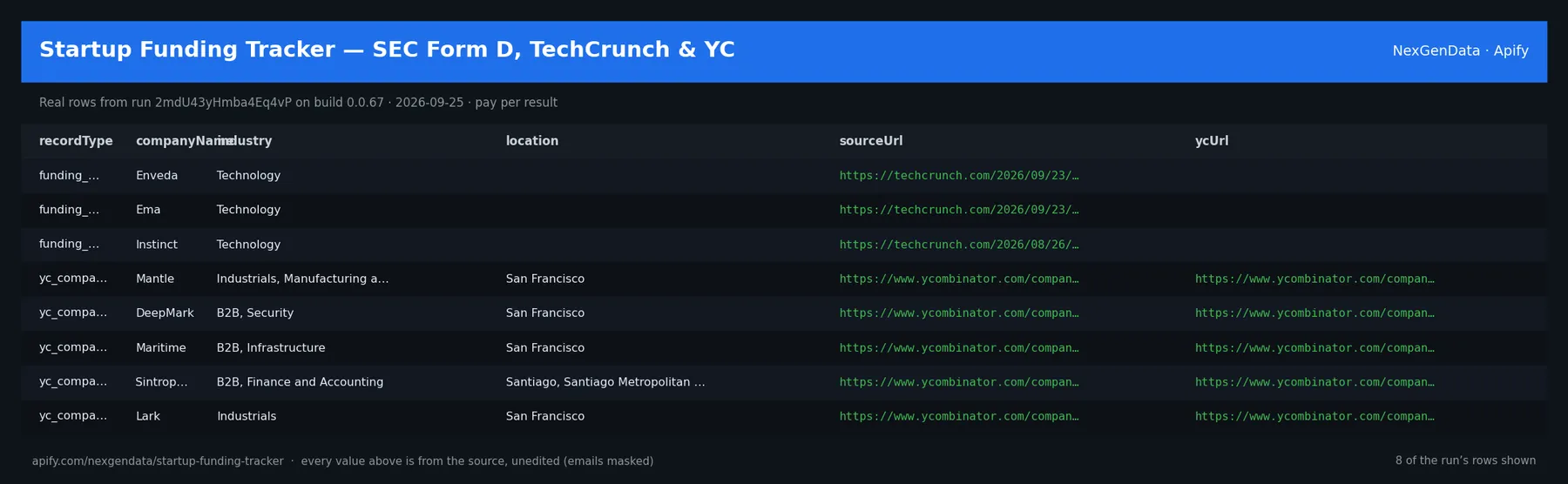
source | recordType | companyName | industry | location | sourceUrl |
|---|---|---|---|---|---|
| techcrunch | funding_round | Enveda | Technology | https://techcrunch.com/2026/09/23/enveda-secures-311m-to-bring-more-n… | |
| techcrunch | funding_round | Ema | Technology | https://techcrunch.com/2026/09/23/ema-raises-77m-as-ai-starts-eating-… | |
| techcrunch | funding_round | Instinct | Technology | https://techcrunch.com/2026/08/26/viral-ai-startup-instinct-has-raise… | |
| yc | yc_company | Mantle | Industrials, Manufacturing and Robotics | San Francisco | https://www.ycombinator.com/companies/mantle-2 |
| yc | yc_company | DeepMark | B2B, Security | San Francisco | https://www.ycombinator.com/companies/deepmark |
| yc | yc_company | Maritime | B2B, Infrastructure | San Francisco | https://www.ycombinator.com/companies/maritime |
Real rows from run 2mdU43yHmba4Eq4vP on build 0.0.67 (2026-09-25), unedited apart from masked emails/phones and shortened long text; fields the source does not publish are empty.
🧾 JSON sample record
One real record from run 2mdU43yHmba4Eq4vP (emails/phones masked, long text shortened):
💰 Pricing
| Event | Price (USD) | When it is charged |
|---|---|---|
Actor Start (apify-actor-start) | $0.01 | Charged when the Actor starts running. Number of events charged depends on Actor memory (one event per GB, minimum one event). |
Funding round record (apify-default-dataset-item) | $0.08 | Charged per funding record returned |
Watch check (watch-check) | $0.05 | Charged once per completed watch-mode change-detection check. Only charged when watchMode is enabled. |
Pay-per-event: you pay only for what the run delivers. A run that delivers nothing bills no result events (only the actor-start event, when the actor defines one). Example: a run that delivers 100 results costs 100 × $0.08 = $8.00 plus the start fee.
🔗 Related Actors
More from the NexGenData Startup, VC & funding family:
- Product Hunt Launches Scraper — New Launch Feed API
- Sequoia Portfolio Scraper — VC Companies, Sectors & Stage
- Sovereign Wealth Fund Tracker — Holdings & Profiles
- VC Portfolio Change Monitor — What Changed Since Last Run
12 more in this family on the NexGenData Store page.
🤖 For AI agents & automation
An agent can source deals and prospects from fresh funding activity across SEC Form D, TechCrunch, and YC — filter by round type, amount, or sector and return company plus investors.
Factual public data — not financial or investment advice.
Sample agent prompt:
Output fields (one item per result):
companyName— funded companyfundingAmount— round sizeroundType— seed/Series A/etc.filingDate— filing or announcement dateinvestors— participating investorsindustry— sectorlocation— company locationcompanyUrl— company websitesourceUrl— source recordsource— SEC EDGAR / TechCrunch / YC
Agentic payment (x402): this Actor uses Pay-Per-Event pricing, so AI agents can run it via Apify's experimental x402 agentic-payment support — pay per call in USDC on Base, no Apify account or API key required ($1 minimum).
Related (on Apify): sales-intelligence-mcp — MCP server for agent workflows over the same data domain.
Why use this actor
Competitive-intelligence platforms charge thousands per year for startup funding data. This actor follows SEC Form D search results to the authoritative filing XML, validates TechCrunch funding events, and normalizes both into one dated funding-round schema. An explicit YC mode provides directory companies without claiming that they are recent raises.
Data sources
SEC EDGAR Form D filings (primary source)
Every company raising capital through a private offering must file Form D with the SEC — the most reliable official source of US startup funding data.
What you get: company name, CIK number, filing date, total offering amount, amount sold, number of investors, industry classification, state, and direct links to SEC filings.
Startup filter (default on): Form D is also filed by pooled investment funds, REITs and real-estate LLCs/SPVs — often the majority of a day's filings. By default those are excluded (using SEC's own industry-group classification) so the feed is operating-company raises. Set includeFundsAndRealEstate: true to include them.
Ordering: named funding announcements (TechCrunch) come first, then SEC Form D filings — each newest first — so news stories are never buried under the day's filings. maxResults is a ceiling, not a promise; a very large run that reaches its time budget delivers what it collected and says so in the status message.
TechCrunch funding news
The actor parses TechCrunch RSS feeds for funding announcements and extracts structured data: company names, funding amounts, round types (Seed, Series A/B/C), and investor names.
What you get: article title, publication date, funding amount, round type, investors mentioned, and direct article links.
Y Combinator startup directory
Y Combinator companies are included in all_sources (best-effort, capped at a third of maxResults); select yc_startups to query the directory on its own by name, industry, or keyword. daysBack and minAmount do not apply because YC does not publish funding-round dates or amounts in this endpoint.
What you get: company name, description, batch (e.g. W24, S23), status, industries, team size, location, website, LinkedIn URL, and YC profile link.
Input configuration
| Field | Type | Default | Description |
|---|---|---|---|
mode | Enum | all_sources | Which sources: all_sources, sec_edgar, techcrunch, yc_startups |
searchQuery | String | (empty) | Filter by company name, industry, or keyword |
minAmount | Integer | 0 | Minimum funding amount in USD |
daysBack | Integer | 30 | How far back to search (1–365 days) |
maxResults | Integer | 25 | Maximum valid unique records to return (1–1,000); news first, then SEC filings, newest first |
includeFundsAndRealEstate | Boolean | false | Include pooled-fund, REIT and real-estate Form D filings (excluded by default) |
outputMode | Enum | raw | raw for individual records, tracker for aggregated analytics |
Sample input and output
In tracker mode the analytics summary is written to the unbilled TRACKER_REPORT key-value-store record. The default dataset contains only individually billable records.
Use cases
- VC deal sourcing — monitor new SEC Form D filings to discover companies raising capital before they hit the news. Filter by industry and minimum raise.
- B2B sales prospecting — find companies that just raised $X+ and are actively spending; prime targets for SaaS, recruiting, and services.
- Competitive funding intel — track funding in your vertical: who got funded, how much, and which investors are active.
- Market-trend research — analyze round sizes, hot sectors, and geography over time.
- Journalist / analyst research — structured funding data with parsed amounts and investors.
FAQ
Is there a free Crunchbase alternative? This startup funding scraper is a low-cost Crunchbase alternative built on legal public data (SEC EDGAR, TechCrunch, YC) — funding rounds, amounts, investors, and stages, with no scraping restrictions.
Where can I get startup funding data legally? From public sources: SEC Form D filings, TechCrunch, and YC — aggregated here into one structured funding-rounds feed.
How fresh is Form D data? Companies must file Form D within 15 days of the first sale, so leads here are typically days-to-weeks old — often ahead of the press release.
Why are some SEC amounts showing as zero? Form D filings sometimes omit the offering amount, especially early-stage. The record is still valuable for identifying companies actively raising.
Is this data legal to use? Yes. SEC EDGAR is a government database, TechCrunch RSS is a public feed, and YC's API is publicly accessible — no login, no terms violations.
Does this cover international startups? SEC EDGAR is US-only. TechCrunch covers global funding news, and YC includes international companies; combine sources for broader coverage.
Agentic payments (AI agent buyers welcome)
This actor supports autonomous discovery and invocation by AI agents (Claude Desktop, Cursor, OpenAI Agents SDK, Vercel AI SDK) via Apify's official MCP server (mcp.apify.com). Agents can find it by searching for Series A funding rounds, startup investor signals, or Crunchbase alternative, and run it without a human-in-the-loop flow. No code changes on the actor side — the integration lives on Apify's infrastructure.
Related NexGenData actors
- SEC Form D Scraper — startup fundraises filed with the SEC
- YC Companies Directory — Y Combinator alumni database
- Crunchbase News Scraper — funding announcements
- AngelList Startup Search — startup index
- Techstars Companies Directory — accelerator alumni
- Company Data Aggregator — LEI, SEC funding & tech stack
- Finance MCP Server — AI-callable finance data for LLM agents
Built by NexGenData.
Watch mode — get only what's new
Set watchMode: true to turn a one-off search into a saved monitor. Instead of returning every funding round that matches your funding query, a watch run returns only the funding rounds that are new since your last run.
- First run seeds a baseline: it records what currently matches and returns 0 records — nothing to alert on yet.
- Every later run returns only the newly-appearing funding rounds (each tagged
change_type: "new_filing"), plus any whose status changed. - Point a Schedule at it (daily/hourly) and you have a standing "New funding round match" feed.
What a watch run charges: one Watch check — a flat $0.05 per run, whether or not anything new is found. You are not charged the per-funding round price on a run that finds nothing. When new funding rounds do appear, each is billed at the normal per-record rate on top of the $0.05 check.
Inputs
| field | meaning |
|---|---|
watchMode | true to enable watch mode (default false = a normal one-off search) |
watchLabel | optional name; two watches with the same query but different labels keep separate memory |
Worked example — watch Series B fintech:
Run 1 returns 0 records and reports "baseline established: monitoring N funding round(s)". Schedule it daily; from run 2 on, you receive only the new funding rounds — a $0.05 check on quiet days, $0.05 + records on the days something lands.


