

Colombia Sanitary Product Registrations - INVIMA
Pricing
from $33.50 / 1,000 sanitary registration records
Colombia Sanitary Product Registrations - INVIMA
Colombia INVIMA sanitary registrations (cosmetics, food, devices, medicines, supplements): search by product words, group, in-force/expired status, modality, and issue or expiry dates - e.g. registrations up for renewal. No holder names. CC BY-SA 4.0. Pay per record.
Pricing
from $33.50 / 1,000 sanitary registration records
Rating
0.0
(0)
Developer
NexGen Signal
Maintained by CommunityActor stats
0
Bookmarked
2
Total users
1
Monthly active users
22 days ago
Last modified
Categories
Share
Colombia's INVIMA sanitary-registration registry (datos.gov.co resource ui32-p9f2) as clean,
per-registration reference data - one row per distinct sanitary registration, with every holder,
party and party-role column structurally removed so the dataset carries no natural-person data.
Each record is a registration: the file number (expediente), the sanitary registration number
(rsynso), the registered product, the authorised modality/use, the product group, the current status,
the issue and expiry dates, and the issuing INVIMA directorate. A single computed value, party_count,
reports how many source party-rows were folded into the registration - the aggregate itself, never a
party name.
Search
Question: Which sunscreen registrations in Colombia expire in the last quarter of 2026 (renewal leads)?
Run on 30 Sep 2026 this returned 7 records (7 × $0.05 = $0.35 on Apify's Free plan), for example:
| Registration | Product | Status | Expires |
|---|---|---|---|
| NSOC96142-19CO | EMULSION PROTECTOR SOLAR SPF40 | Vigente | 2026-10-01 |
| NSOC96230-19CO | HELIOCARE 360° INVISIBLE SPRAY PROTECTOR SOLAR SPF50+/ HELIOCARE 360° INVISIBLE | Vigente | 2026-10-04 |
| NSOC96513-19CO | AVON CARE SUN+ PROTECTOR SOLAR PARA NIÑOS. KIDS & BABY FPS 50 | Vigente | 2026-10-21 |
| NSOC96760-19CO | PROTECTOR SOLAR FPS 50 | Vigente | 2026-10-31 |
| NSOC97043-19CO | PROTECTOR SOLAR FACIAL FPS 60 | Vigente | 2026-11-15 |
Search options (all optional; a record must match every option you set, and several values in one option match any of them):
- Product (contains) (
products) — Words in the product name, e.g.PROTECTOR SOLAR,SHAMPOO,JERINGA. - Product group (
groups) — e.g.COSMETICOS,MEDICO QUIRURGICOS,ALIMENTOS,MEDICAMENTOS,SUPLEMENTO DIETARIO. - Status (
statuses) —Vigente(in force) orVencido(expired). - Modality (contains) (
modalities) — e.g.IMPORTAR,FABRICAR. - Issued from (
issuedFrom) — e.g.2025-01-01. - Issued to (
issuedTo) — e.g.2025-12-31. - Expires from (
expiresFrom) — e.g.2026-10-01. - Expires to (
expiresTo) — e.g.2026-12-31- registrations up for renewal.
Options go into the datos.gov.co query before the registrations are grouped, so only matching registrations are read and billed. Registration dates are as INVIMA publishes them (a few carry impossible years such as 4995). With no option set the actor returns registrations exactly as before.
What one record represents
INVIMA (Instituto Nacional de Vigilancia de Medicamentos y Alimentos) publishes its registry as one row per registration-party pair: the same registration recurs once for each party attached to it (manufacturer, importer, packager - and, critically, natural-person roles such as legal representative, attorney/apoderado and pharmaceutical chemist). This Actor collapses that to one row per distinct registration by grouping on the registration attributes and counting the parties. The party names and party roles are never selected, never grouped and never delivered.
The live registry holds 1,382,588 party-rows, which fold into 392,556 distinct registrations - the grain this Actor delivers. Because INVIMA publishes no count on the resource, that figure was measured live against the door at build time and is restated here so the number is auditable rather than asserted.
Sample output
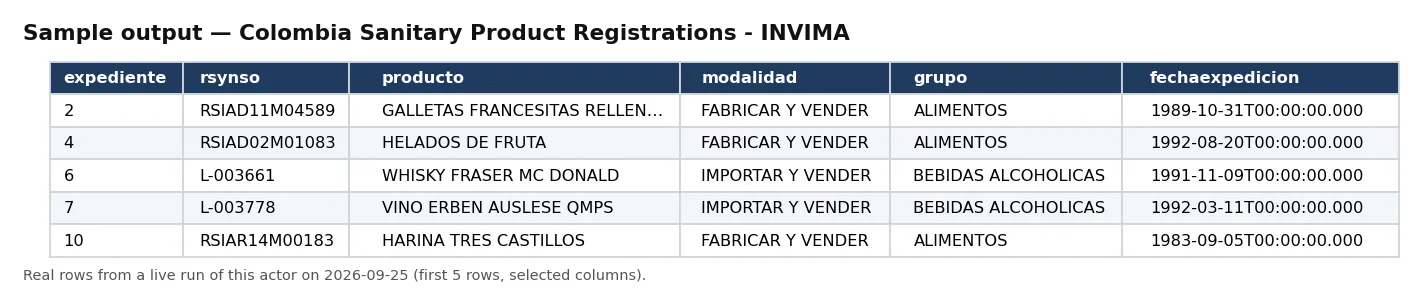
Real rows from a live run of this actor (first 5 rows, selected columns).
One full record from the same run, exactly as delivered:
Coverage and volume
Colombia INVIMA sanitary product registrations - 392,556 distinct registrations (folded live from 1,382,588 source party-rows; measured at build time, INVIMA publishes no count on the resource).
The registry spans foods, medicines, medical devices, cosmetics and other health-supervised product groups.
The Actor pages the Socrata SODA API with a server-side GROUP BY over the nine registration attributes,
20,000 groups at a time, and stops as soon as your Maximum records cap is met - so a small run samples
cheaply and a large run pulls the whole registry.
Licence and attribution
Colombia open data on datos.gov.co is published under Creative Commons Attribution-ShareAlike 4.0
(CC BY-SA 4.0). The full notice travels on every record:
INVIMA (Colombia). Colombia open data (datos.gov.co), CC BY-SA 4.0. Reproduced unchanged with attribution; ShareAlike applies to any redistributed database. Product-registration attributes only; every holder/party name (titular, nombrerol) and party role (rol) is structurally dropped - no natural-person data.
The required attribution - Instituto Nacional de Vigilancia de Medicamentos y Alimentos (INVIMA) - Colombia - is stamped on every record. ShareAlike applies to any
database you redistribute from this data.
Person-data policy
This is the defining property of the cell. The source registry attaches parties to each registration, and
some party roles are held by natural persons - the legal representative, the attorney (apoderado) and
the pharmaceutical chemist (quimico farmaceutico) among them, whose names appear in the source nombrerol
column. This Actor structurally excludes the holder column (titular), the party-name column
(nombrerol) and the party-role column (rol): they are never named in the query's SELECT/GROUP BY,
never read, and never delivered. A per-record assertion additionally rejects any of those keys, plus
generic person markers, if the source schema ever changed (verified with a planted-row test that injects a
person name into a holder/party field and confirms the record is refused). The result carries product,
registration and status information only - no natural-person data.
Interpretation caveat
One record per distinct INVIMA sanitary registration: registration file (expediente) x sanitary number (rsynso) x product x modality x product group x status x issue/expiry dates x INVIMA directorate. party_count is the number of source party-rows folded in (the only computed value). Holder names, party names and party roles are never read, grouped or emitted.
Values are reproduced verbatim from the registry; the Actor never rewrites a field. party_count is a
count of the folded source rows for that registration - it is the number of attached party-records, not a
measure of product volume or sales. Dates are the registry's own issue and expiry stamps.
Data quality and freshness
party_count is delivered as a real number; every other field is the registry's verbatim string. The
record_id is the composite registration key, so the dataset is safe to diff, deduplicate or upsert. Every
run re-reads the live resource, so the data is as fresh as INVIMA republishes, and each record's
observed_at stamp dates the snapshot. The run's RUN_RECEIPT records how many records were delivered and
charged and confirms charge_equals_delivered.
Provenance and compliance
Every run reads www.datos.gov.co/robots.txt at runtime; the gate result (URL, status, byte length,
SHA-256 of the policy, crawl-delay) is written to the run's RUN_RECEIPT. The /resource/ API path is
outside the registry's disallowed /browse paths, and the Actor honours the published crawl-delay. The API
is keyless. The Actor never bypasses a block or fetches through a mirror.
Inputs
Default changed on 30 Sep 2026: if you leave maxRecords out, a run now returns up to 10 records (it was 500). Set maxRecords yourself to get more — the maximum is unchanged.
- Maximum records (
maxRecords) - hard cap on registration records delivered and billed. You are billed only for records actually delivered.
Output
Records land in the Actor's default dataset and export as JSON, CSV, Excel or via the Apify API. A tabular
overview view surfaces the registration file, sanitary number, product, modality, group, status,
issue/expiry dates and party_count.
Fields in detail
The record leads with the composite record_id, then expediente (registration file), rsynso (sanitary
registration number), producto (registered product), modalidad (authorised use/modality), grupo
(product group), estadoregistro (status, e.g. Vigente/Vencido), fechaexpedicion (issue date),
fechavencimiento (expiry date) and nombredireccion (issuing INVIMA directorate - an organisational unit,
never a person). party_count is the only computed value. The provenance block - source, source_dataset,
licence, attribution, caveat, observed_at - closes every record.
Scaling and limits
Set Maximum records low to sample cheaply or high to pull the full registry. The Actor pages the SODA
API with a server-side aggregate and delivers incrementally, so memory stays flat regardless of how many
records you request, and you are billed only for what is delivered. Because INVIMA republishes the registry
on its own cycle, re-running the Actor picks up new registrations and status changes automatically, and
each record's observed_at stamp dates the snapshot - schedule a run to keep a downstream compliance or
market-monitoring table current. A registration expiring or lapsing shows up as a changed estadoregistro
or fechavencimiento on the next run, so a simple diff surfaces the registrations that moved.
Why the registration grain
The source registry is party-shaped - one row per registration-party pair - which is convenient for the
regulator but wrong for most downstream uses: it inflates every registration by its number of parties and,
because some parties are natural persons, it embeds personal data in what is otherwise a product catalogue.
Folding to the registration grain fixes both problems at once. You get one clean row per registration, a
party_count if you care how many parties were attached, and zero natural-person data. If you need the
registration-to-product mapping, the product and modality are on the record; if you need to track status
over time, the status and expiry date are on the record and change between runs, so a diff surfaces exactly
the registrations that lapsed, renewed or changed use.
Typical uses
Compliance and market-monitoring teams use this cell to keep a live table of which products hold a valid Colombian sanitary registration, when each expires, and in what product group and modality - the backbone of an import-eligibility or shelf-audit check. Analysts use it to size a product category (how many active food or medicine registrations exist) or to watch renewals and lapses over time. Because the record is keyed on the registration and carries the issue and expiry dates, it drops straight into a warehouse as a slowly-changing dimension, and a scheduled run keeps it current with no manual reconciliation.
Sibling Actors
It sits beside the Colombia SISMED medicine-price records, which draw a related price registry. It shares its engineering - the runtime robots gate, push-then-charge billing and verbatim-value discipline - with the fleet's other public-data records Actors. Where a sibling draws the same door for a different grain (medicine prices from SISMED), this cell stays strictly at the registration grain and folds away every party row, so the two never double-count.


