

EIA Short-Term Energy Outlook API — STEO Forecasts & History
Pricing
from $33.50 / 1,000 eia steo observations
EIA Short-Term Energy Outlook API — STEO Forecasts & History
EIA's Short-Term Energy Outlook as data: monthly, quarterly and annual forecasts and history for oil, gas, power, coal, renewables, prices and the economy. Every point marked forecast or history, with its release date. No API key. Part of NexGen Signal — official-source data products
Pricing
from $33.50 / 1,000 eia steo observations
Rating
0.0
(0)
Developer
NexGen Signal
Maintained by CommunityActor stats
0
Bookmarked
2
Total users
1
Monthly active users
20 days ago
Last modified
Categories
Share
🔮 EIA Short-Term Energy Outlook API — STEO Forecasts & History
Get EIA's Short-Term Energy Outlook (STEO) as data — monthly, quarterly and annual history and forecasts for crude oil and fuel prices, oil and gas production and consumption, electricity, coal, renewables, weather and the economy — from the U.S. Energy Information Administration's official Open Data bulk file STEO.zip.
Analysts, traders, planners and researchers use STEO as the reference near-term outlook. Every record says whether it is history or forecast (is_forecast, against the series' last historical period) and which outlook it comes from (steo_release), so forecasts from different months never get mixed up. 4,420 series, no API key.
The unit of output is one observation (one series, one period). You pay per observation delivered; a run that finds nothing costs nothing.
📊 Sample Output
| series_id | period | value | is_forecast | steo_release |
|---|---|---|---|---|
| STEO.NGHHMCF.M | 202712 | 4.161858 | true | 2026-09-09 |
| STEO.NGHHMCF.M | 202711 | 3.669787 | true | 2026-09-09 |
| STEO.NGHHMCF.M | 202710 | 3.371803 | true | 2026-09-09 |
| STEO.NGHHMCF.M | 202709 | 3.366505 | true | 2026-09-09 |
| STEO.NGHHMCF.M | 202708 | 3.313929 | true | 2026-09-09 |
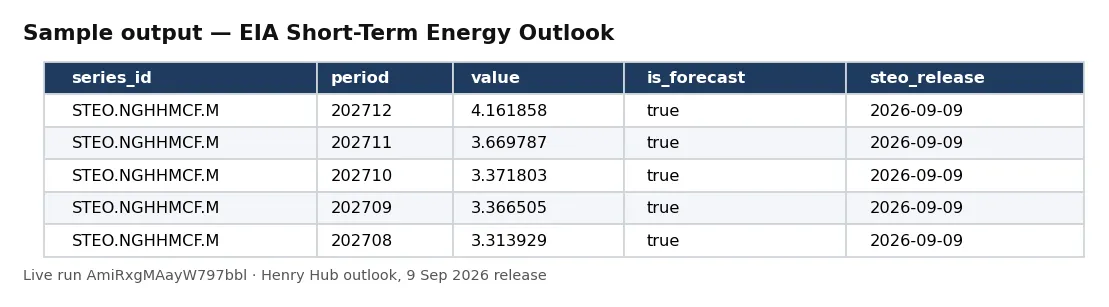
Rows from live run AmiRxgMAayW797bbl on Apify (input: name contains henry hub, from 2026, 40 records). Notice the forecast months flagged true and the release date of the outlook on every row.
✅ What you get
Every field of each record:
record_id—<series_id>:<period>, unique per observation.series_id— EIA series id, e.g.STEO.BREPUUS.M.series_name— series name as EIA publishes it.units— units, e.g.dollars per barrel.units_short— short units, when EIA gives them.frequency—A,Q,M,W,Dor4(four-week average).frequency_label— annual, quarterly, monthly, weekly, daily, four-week average.period— period exactly as published:2025,2025Q2,202506or20250613.period_start— first day of the period as an ISO date.value— the observation. Only non-null observations are delivered.geography— EIA geography code(s), e.g.USA-TX.geography2— second geography for flows between two areas.iso3166— ISO 3166 code, when given.latitude,longitude— plant-level series only.series_description— EIA's description of the series, when given.series_start,series_end,series_last_updated— the series' first and last period, and when EIA last updated it.last_historical_period— last period that is history; later periods are forecasts.is_forecast— true when the period is after the last historical period.steo_release— release date (vintage) of the outlook file, so forecasts from different months stay apart.source,source_dataset,licence,attribution,observed_at— provenance on every record: EIA and the dataset, the bulk file and its last-modified date, EIA's public-domain statement quoted, the acknowledgment EIA asks for (e.g.Source: U.S. Energy Information Administration (Sep 2026)), and the UTC time the record was read.
⚙️ Sample inputs
1. Store example — Brent and WTI price outlook
The 10 newest points of the first matching series in file order (annual WTI, forecast years first); about $0.50 on the Free plan.
2. Narrowed — Henry Hub monthly outlook, 2026 onward
Monthly Henry Hub history and forecast from January 2026 to the end of the outlook.
3. Bulk — forecast months of every monthly price series
Monthly series with "price" in the name, from September 2026 on. In the 9 September 2026 outlook, history ends by August 2026 for all 137 monthly price series, so every record here is a forecast (is_forecast true).
Input fields:
| Field | Meaning |
|---|---|
seriesIdPrefixes | series ids starting with any of these — end with a dot to take every frequency of one series |
seriesIds | exact series ids |
nameContains | series whose name has every word of an entry, any order; put a phrase in double quotes to keep its words together |
geography | text in the geography or ISO code, e.g. USA-TX |
frequencies | any of A, Q, M, W, D, 4 |
periodFrom | first period wanted: 2024, 2024Q2, 2024-06 or 2024-06-15 |
periodTo | last period wanted (same formats) |
latestOnly | one record per series: its newest observation inside the window |
maxRecords | most observations delivered and billed in this run (default 1,000) |
🧾 JSON sample record
🔧 How it works
-
Robots check.
www.eia.gov/robots.txtis read on every run; it allows/opendata/bulk/. A real disallow stops the run with nothing charged. -
Streamed download. The actor opens
https://www.eia.gov/opendata/bulk/STEO.zipand decompresses the ZIP line by line as it arrives. Nothing is saved to disk and the file is never downloaded first. -
Filter before parsing. Each line is one series. Its id is checked against your prefixes, ids and frequencies before the line is parsed, so a narrow request skips most of the file. Name and geography filters parse every series line.
-
Deliver, then charge. Non-null observations inside your period window become records, newest first, pushed in batches; each batch is charged after delivery, so records and charges always match. The download stops the moment
maxRecordsor your maximum charge is reached. -
Receipt.
RUN_RECEIPTrecords the file and its date, lines read, series matched, whether the file was read to the end, and delivered and charged counts.
No login, API key, proxy or bot workaround — one public EIA file, and no personal data in it.
💰 Pricing example
Per observation delivered, no start fee, no monthly charge:
| Apify plan | Price per observation |
|---|---|
| Free | $0.05 |
| Bronze | $0.045 |
| Silver | $0.04 |
| Gold, Platinum, Diamond | $0.0335 |
- 10 observations (the Store example): $0.50 on the Free plan, $0.335 on Gold.
- 1,000 observations (the default cap): $50 on Free, $45 on Bronze, $40 on Silver, $33.50 on Gold.
Coverage and size. Live count from the file read on 3 October 2026 (STEO.zip, release of 9 September 2026): 753,105 observations in 4,420 series (plus 177 category lines = 4,597 lines; the planning index counted 4,597 series and 753,105 observations — they agree). The file is 5.4 MB compressed. A filter is required; a whole-file read takes seconds, and a full pull is 753,105 records, billed per observation. Each STEO release replaces the previous one in the bulk file; to keep a history of forecasts, run this actor after each release and keep the records (they carry steo_release).
⚖️ Legal & ToS
Data: U.S. Energy Information Administration, Open Data bulk download (STEO.zip). EIA's copyright and reuse page says: "U.S. government publications are in the public domain and are not subject to copyright protection. You may use and/or distribute any of our data, files, databases, reports, graphs, charts, and other information products that are on our website or that you receive through our email distribution service." EIA asks for an acknowledgment with the publication date; every record carries one in attribution.
The actor reads only this public file with a declared User-Agent; www.eia.gov/robots.txt allows the path and is checked on every run. No login, key, proxy or form. Energy statistics and facility-level series only — no personal data.
This actor is not affiliated with or endorsed by EIA. Figures are EIA's as published in the file; check EIA's release notes for revisions.
❓ FAQ
Do I need an EIA API key or account? No. The actor reads EIA's public bulk file, which needs no key, login or registration.
Why must I give a series prefix, id, name or geography? Because the file is large (753,105 observations). A filter keeps runs fast and bills only what you asked for; the actor refuses an unfiltered run with a clear message.
Why did my run return 0 records? Nothing in the file matched — usually a prefix that is too specific or a period window with no data. The receipt shows how many series matched. A zero-record run is not charged.
How fresh is the data?
As fresh as EIA's STEO.zip, which EIA republishes as its releases update; each record names the file's last-modified date.
Can I get the whole file?
Yes: widen the filters and raise maxRecords. The file is streamed, never held in memory; the receipt states how far it was read. Large pulls take a long time and are billed per observation.
How do I know which points are forecasts?
is_forecast is true when the period is after last_historical_period; steo_release is the outlook's release date.
Can I compare outlooks over time?
Yes — schedule a run after each monthly STEO release and keep the records; steo_release tells them apart.
🆘 Troubleshooting
- 0 records — STEO ids start with
STEO.; check the series on EIA's STEO data browser. - Mixed forecasts and history — filter on
is_forecastin your dataset, or setperiodFromafter the last historical period. - Stopped at maxRecords — raise
maxRecordsor uselatestOnly. - CAPPED message — your maximum total charge was reached; raise it in the run options.
🔗 Related Actors
- CFTC Commitments of Traders (COT) Data — Weekly Positions — weekly futures positioning in crude oil, natural gas and power alongside EIA prices.
- EU Fuel Prices — Weekly Oil Bulletin by Country Since 2005 — European pump prices to compare with US gasoline and diesel.
- Spain Fuel Prices by City & Station — Cheapest (MINCOTUR) — station-level fuel prices in Spain.
- ENERGY STAR Product Records — EPA Certified Products — efficiency ratings for appliances and equipment.
🏢 About NexGen Signal — official-source data products from government and regulator publications. Browse the catalog: apify.com/nexgensignal
⭐ Found this useful?
If this actor saved you time, a rating on its Apify Store page helps other buyers find it.
Part of NexGen Signal — official-source data products.


