

EU Forest Carbon Stock Records — EEA FISE
Pricing
from $33.50 / 1,000 forest ghg records
EU Forest Carbon Stock Records — EEA FISE
Keyless pay-per-record EEA FISE UNFCCC GHG inventory — country/year/sector-code/pollutant, incl. LULUCF forest categories, values verbatim. Partition by country. EEA acknowledge. $0.05 per record on the Free plan, $0.0335 on Gold.
Pricing
from $33.50 / 1,000 forest ghg records
Rating
0.0
(0)
Developer
NexGen Signal
Maintained by CommunityActor stats
0
Bookmarked
2
Total users
1
Monthly active users
12 hours ago
Last modified
Categories
Share
Keyless. Pay per record. Europe's greenhouse-gas inventory as surfaced in the Forest Information System — country, year, sector, pollutant, including the land-use and forestry carbon categories.
This actor turns the European Environment Agency (EEA) Forest Information System for Europe (FISE) UNFCCC greenhouse-gas inventory dataset into clean, per-observation records. Each run reads the EEA's keyless DiscoData SQL service for the country you choose and delivers one row per country / year / IPCC-sector / pollutant observation: the country, the year, the IPCC-sector code and its parent code, the pollutant, the reporting format, the emission or removal value, the unit, and the reporting notation. The dataset spans the IPCC Common Reporting Format sectors including the land-use, land-use-change and forestry (LULUCF) carbon-stock-change categories. Country / sector observation grain, structured for engineering use, reusable with acknowledgement of the EEA, with no personal data of any kind.
What this is, in one paragraph
The Forest Information System for Europe (FISE) surfaces the UNFCCC greenhouse-gas inventory alongside its forest data. This actor reads that inventory table and flattens each observation into a single analysis-ready record: the country code, the year, the IPCC-sector code (sector_code_id) with its parent-sector code, the pollutant (CO₂, CH₄, N₂O, aggregate GHG, and so on), the reporting format, the emission or removal value, the unit (for example MtCO₂e), and the reporting notation. Because the sector is carried as the source's numeric code, verbatim — this actor does not resolve codes to names or interpret them — the full sector hierarchy is available, and the land-use-and-forestry (LULUCF) carbon categories that make this the forest-sector layer are present alongside the rest of the inventory and can be isolated by sector code. Values and notation are carried verbatim. You are billed only for records actually delivered.
Who buys this and for what job
- Climate, forestry, and land-sector analytics teams working with Europe's LULUCF and whole-inventory GHG data from a single feed.
- Carbon-accounting and ESG products building national and sectoral emission/removal series.
- Researchers and NGOs studying the forest and land carbon balance in the context of the full inventory.
- Data engineers who want the FISE UNFCCC GHG table as clean rows without writing SQL against a 650k-row table.
EEA licence — reuse with acknowledgement
One licence rider travels on every record. EEA data may be reused, including commercially, provided the source is acknowledged: "Source: European Environment Agency (EEA)." Where third-party content is marked, it keeps its own terms. These are inventory observations as reported and compiled — not an independent verification.
Observation grain — no person data
The unit of every record is a country / year / sector / pollutant observation — a measurement, never a person. The dataset carries no natural-person fields; countries, sector codes, pollutants, units, and values are the entire payload, and a person-key guard runs on every record as a pure backstop.
A required partition — this is a large dataset
The FISE UNFCCC GHG table holds 654,293 rows, so this actor requires a partition: every run must set a countryCode. The country bounds the run; there is no unbounded all-Europe pull. Optional year and pollutant filters narrow further, and maxRecords is the hard ceiling.
Sample output
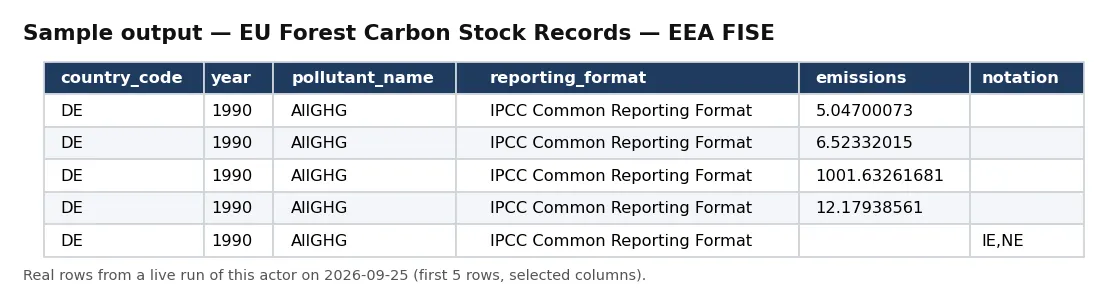
Real rows from a live run of this actor (first 5 rows, selected columns).
One full record from the same run, exactly as delivered:
Pricing
| Event | Free plan | Bronze | Silver | Gold / Platinum / Diamond |
|---|---|---|---|---|
forest_ghg_record | $0.05 | $0.045 | $0.04 | $0.0335 |
Delivered before charged. Blocked runs and empty results cost nothing.
Input
| Field | Type | Default | Description |
|---|---|---|---|
countryCode | string | — | Required 2-letter country code (e.g. DE, FR, IT). |
year | integer | — | Optional year to filter. |
pollutant | string | — | Optional pollutant/gas (e.g. CO2, CH4, N2O, AllGHG). |
maxRecords | integer | 10 | Ceiling on records delivered and billed. |
Default changed on 30 Sep 2026: if you leave maxRecords out, a run now returns up to 10 records (it was 500). Set maxRecords yourself to get more — the maximum is unchanged.
Output
One JSON object per observation. Real example (values as reported):
An unbilled RUN_RECEIPT records the robots check, the filters, rows seen and delivered, and whether charged equals delivered.
Field reference
Each record is one observation. Scope: country_code and year. Sector: sector_code_id and parent_sector_code_id (the source's numeric IPCC-sector codes, carried verbatim; the LULUCF land-and-forestry categories live within this hierarchy). Measurement: pollutant_name, reporting_format, emissions, unit, and notation. Key: source_row_id. Provenance: source, source_url, licence, attribution, disclaimer, and observed_at.
How a run works
A run first re-reads the source host's robots posture from your runtime — the EEA DiscoData host — and stops at the door if that ever changes. It pages the FISE UNFCCC GHG table filtered to your countryCode (and optional year and pollutant), and flattens each observation to one record — carrying the value, unit, and notation verbatim, and the sector as the source's own numeric code, never anything person-shaped — delivered before it is charged, so a blocked or empty run costs you nothing. The actor stops at your maxRecords ceiling and records charge_equals_delivered in the receipt.
Coverage and scope
The table holds 654,293 rows across reporting countries, years, sectors, and pollutants — the whole IPCC inventory including the LULUCF land-and-forestry carbon categories. Because each record carries the country_code, year, sector_code_id, and pollutant_name, building a national or sectoral series — or isolating the forestry/land sectors by their codes — is straightforward. Pull one country, or one pollutant within a country, to seed a carbon warehouse.
Working with the inventory
The inventory is a time series waiting to be assembled, and the fields make it mechanical. Every record carries the country_code, year, sector_code_id, and pollutant_name, so a single filtered pull sorted by year reconstructs a sector's emission or removal trajectory for a given pollutant, and the unit travels on every row so a downstream consumer never guesses a scale. The parent_sector_code_id exposes the sector hierarchy, so the land-use-and-forestry categories can be rolled up or drilled down, and the notation preserves the reporting reality — a reporting code is not a silent zero. Because the sector is carried as the source's own code, the dataset joins cleanly to any IPCC-CRF sector reference the buyer maintains, and two years can be diffed to track the land-and-forest carbon balance.
Cost guidance
One forest_ghg_record per delivered observation: cost = rows delivered × your plan's per-record price. Always scope with countryCode and narrow with year and pollutant. 1,000 observations is $50 (Free) / $33.50 (Gold). This is a large per-country slice, so filter and cap deliberately.
Honest limitations
- Codes, not names. The sector is carried as the source's numeric IPCC-sector code (with its parent); this actor does not resolve codes to names — map them against the IPCC CRF reference yourself.
- As reported. Values and notation are as compiled; this actor reformats, it does not verify or recompute.
- Partition required. Every run must set a
countryCode. - No person data of any kind.
Differentiation
It is distinct from the fleet's eu-ghg-inventory-records, which reads the GHG_Inventory ghg_value table at a variable-uid grain (with resolved sector/gas/measure dimensions); this cell reads the FISE (Forest Information System for Europe) UNFCCC table at a country / year / IPCC-sector-code / pollutant grain and carries the sector as a verbatim code — a different source table, a different structure, surfaced through the forest information system and centred on the land-and-forestry carbon categories. Both are EEA GHG data; they are different tables serving different joins.
The NexGen Signal family
Part of the NexGen Signal family of pay-per-record data products:
- EU GHG Inventory Records — EEA
- EU Industrial Emissions Records — EEA IED Facilities
- EU Natura 2000 Site Records — EEA Protected Sites
- EU Grassland Condition Records — Grassland Watch
- EU Air Quality Scenario Records — EEA AQ Plans
Source: European Environment Agency (EEA), Forest Information System for Europe (FISE) — UNFCCC GHG dataset (discodata.eea.europa.eu). EEA data may be reused, including commercially, provided the source is acknowledged: "Source: European Environment Agency (EEA)"; marked third-party content keeps its own terms. Country / year / IPCC-sector-code / pollutant observation grain, including the LULUCF land-and-forestry carbon categories; the sector is the source's numeric code carried verbatim, not resolved or interpreted; no natural-person data of any kind. Inventory observations as reported and compiled, not an independent verification.


