

EU Natura 2000 Site Records — EEA Protected Sites
Pricing
from $33.50 / 1,000 site records
EU Natura 2000 Site Records — EEA Protected Sites
Keyless, pay-per-record EEA/BISE protected-site data. One row per site — code, name, country, type, designation, ecosystem, area, protected habitat/species counts. Site grain; EEA acknowledge; no person data.
Pricing
from $33.50 / 1,000 site records
Rating
0.0
(0)
Developer

NexGen Signal
Maintained by CommunityActor stats
0
Bookmarked
2
Total users
1
Monthly active users
15 days ago
Last modified
Categories
Share
Keyless. Pay per record. Every protected nature site in Europe, as one clean table.
This actor turns the European Environment Agency (EEA) BISE protected-sites dataset into clean, per-site records — the register of Natura 2000 and related protected sites across Europe. Each run reads the EEA's keyless DiscoData SQL service and delivers one row per site: its code and name, the country, the site type and designation, the major ecosystem type, the area, the year established, and the counts of protected habitat types and species. Protected-site grain, structured for engineering use, reusable with acknowledgement of the EEA, with no personal data of any kind.
What this is, in one paragraph
Natura 2000 is the EU's network of protected nature sites, and the EEA's Biodiversity Information System for Europe (BISE) publishes the site register. This actor reads that register and flattens each protected site into a single analysis-ready record: the site code and name, the country, the site type and designation (with the national-language designation), the major ecosystem type, the area in square kilometres and hectares, the year established, the number of protected habitat types and species, the regions, whether a management plan exists, and the site description. It is the protected-area layer of Europe's environmental map — the published constraints on where development is restricted. Values are exactly as published. You are billed only for records actually delivered.
Who buys this and for what job
- Environmental due-diligence, planning, and infrastructure teams checking whether a location intersects a protected site before siting or development.
- ESG, renewable-energy, and land-use products screening portfolios against protected-area constraints by country and ecosystem.
- Researchers and conservation NGOs studying the coverage, designation, and biodiversity of the protected-site network.
- Data engineers who want the protected-site register as clean rows without writing SQL against the EEA service or paging a large table.
EEA licence — reuse with acknowledgement
One licence rider travels on every record. EEA data may be reused, including commercially, provided the source is acknowledged: "Source: European Environment Agency (EEA)." Where third-party content is marked, it keeps its own terms. This rider is carried in this README and on every single record. The data is a site register of published designations — facts as published, never a development or planning verdict: the presence of a site record states a designation exists, not that any specific project is permitted or barred.
Site grain — no person data
The unit of every record is a protected site. The site_name and country_name are place names, not people; the register carries no natural-person fields, and this actor emits none. A person-key guard runs on every record as a pure backstop. The site, its designation, its area, and its biodiversity counts are the entire payload.
Sample output
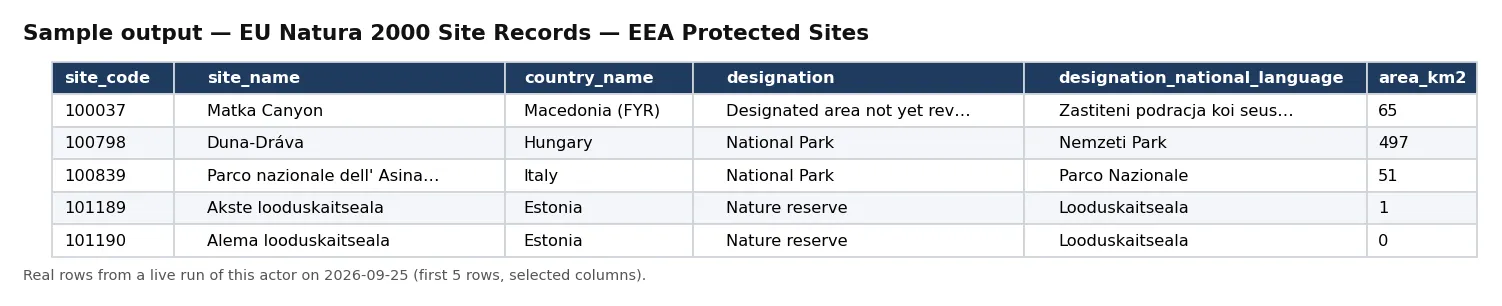
Real rows from a live run of this actor (first 5 rows, selected columns).
One full record from the same run, exactly as delivered:
Pricing
| Event | Free plan | Bronze | Silver | Gold / Platinum / Diamond |
|---|---|---|---|---|
site_record | $0.05 | $0.045 | $0.04 | $0.0335 |
Delivered before charged. Blocked runs and empty results cost nothing.
Input
| Field | Type | Default | Description |
|---|---|---|---|
countryName | string | — | Optional. Keep only sites whose country name contains this text (e.g. Germany, France). |
siteType | string | — | Optional. Keep only sites of this type/designation code. |
maxRecords | integer | 10 | Ceiling on records delivered and billed. |
Default changed on 30 Sep 2026: if you leave maxRecords out, a run now returns up to 10 records (it was 500). Set maxRecords yourself to get more — the maximum is unchanged.
Output
One JSON object per protected site. Real example (values as published):
An unbilled RUN_RECEIPT records the robots check, the filters, rows seen and delivered, and whether charged equals delivered.
Field reference
Each record is one protected site. Identity: record_id / site_code, site_name, and country_name. Designation: site_type, designation, and designation_national_language. Character: major_ecosystem_type, area_km2, area_ha, and year_established. Biodiversity: number_protected_habitat_types and number_protected_species. Context: regions, management_plan, and site_description. Provenance: source, source_url, licence, attribution, disclaimer, and observed_at.
How a run works
A run first re-reads the source host's robots posture from your runtime — the EEA DiscoData host — and stops at the door if that ever changes. It then queries the BISE protected-sites table through the DiscoData SQL service, pushing your optional countryName and siteType filters into the query so the dataset is bounded server-side, and pages through the results. Each site is flattened to one record — reading only site attributes, never a person — delivered before it is charged, so a blocked or empty run costs you nothing. The actor stops at your maxRecords ceiling and records charge_equals_delivered in the receipt.
Coverage and scope
The protected-sites table holds on the order of 130,000+ sites across reporting countries. Because each record carries country_name, site_type, and the area and biodiversity counts, segmenting by country or designation and filtering by size is straightforward. Pass a countryName to scope to one country, or pull the whole table to build a Europe-wide protected-area layer for screening.
Working with the site register
The register is a screening layer, not a verdict engine. Each site_code is the stable identifier the wider Natura 2000 and BISE ecosystem uses, so a site record pulled here joins cleanly to habitat, species, and boundary datasets keyed on the same code. The country_name and site_type fields let you narrow to a jurisdiction and a designation class before any spatial work, and the area_km2 / area_ha pair plus the protected-habitat and protected-species counts give a first-pass sense of a site's scale and sensitivity without opening the full designation dossier. Because designations change slowly, a periodic pull keeps a downstream screening table current with a small refresh — and every record carries the explicit reminder that a designation existing is a published fact, never a determination about any particular project.
Cost guidance
One site_record per delivered site: cost = sites delivered × your plan's per-record price. Scope with countryName or siteType to keep runs bounded — one country is typically a few thousand to tens of thousands of sites. 1,000 sites is $50 (Free) / $33.50 (Gold). Pull one country for a focused screen; the full ~130,000-site table is a larger one-time seed.
Honest limitations
- A register, not a verdict. These are protected-site records as published — the designation exists as stated, but this is not a planning permission, an environmental-impact assessment, or a development determination.
- As published. Site attributes, designations, and counts are exactly as the EEA distributes them; this actor reformats, it does not interpret.
- Acknowledge the EEA. Reuse requires acknowledging the EEA as the source; the acknowledgement travels on every record.
- No person data of any kind.
Differentiation
It is distinct from the fleet's emissions, waste-water, and industrial-facility cells (which carry pollution, treatment, or installation data, not protected-area designations). Its specific job is the EEA/BISE protected-site register — the Natura 2000 and related designations, site by site, that environmental-screening and land-use systems check locations against.
The NexGen Signal family
Part of the NexGen Signal family of pay-per-record data products:
- EU Wastewater Compliance Records — EEA UWWTD
- EU Industrial Emissions Records — EEA IED Facilities
- Natural Hazard Event Records — NASA EONET
- England Flood Station Records — EA Monitoring
- Air Quality Monitor Records — US EPA AQS
Source: European Environment Agency (EEA), Biodiversity Information System for Europe (BISE) protected sites (discodata.eea.europa.eu). EEA data may be reused, including commercially, provided the source is acknowledged: "Source: European Environment Agency (EEA)"; marked third-party content keeps its own terms. Site register of published designations, never a development or planning verdict. Site grain; no person data of any kind.


