

EU Water Return Flow Records — EEA WISE
Pricing
from $33.50 / 1,000 water return-flow records
EU Water Return Flow Records — EEA WISE
Per-record EU water returns, leakage, and losses by country, spatial unit, category, and period from EEA WISE State of Environment (Waterbase). Keyless, pay per record, no person data.
Pricing
from $33.50 / 1,000 water return-flow records
Rating
0.0
(0)
Developer
NexGen Signal
Maintained by CommunityActor stats
0
Bookmarked
2
Total users
1
Monthly active users
10 days ago
Last modified
Categories
Features
Share
Keyless. Pay per record. Water Europe returns and loses — return flows, leakage, and losses by country, spatial unit, and period, verbatim.
This actor turns the European Environment Agency (EEA) WISE State of Environment (Waterbase) water-returns dataset into clean, per-record data — the water Europe returns to the environment, and the water it loses on the way. Each run reads the EEA's keyless DiscoData SQL service and delivers one row per return observation, structured for water-balance and leakage analysis, reusable with acknowledgement of the EEA, with no personal data of any kind.
What this is, in one paragraph
The EEA compiles national reporting on returned water — the flows put back into the environment after use, together with the leakage and losses along the way — into the WISE State of Environment (Waterbase) water-returns dataset. This actor reads that table and delivers one record per spatial unit / observed-property / period: the country and spatial unit, the observed-property CATEGORY CODE (for example, losses and leakage, or returns to freshwater) carried verbatim, the time period and reference year, the observed VOLUME in the source units verbatim, and the observation-STATUS flag. It is the returns-and-losses side of Europe's water balance — the counterpart to the withdrawals.
Who buys this and for what job
- Water-balance analysts closing the loop between withdrawals and returns
- Utility and network teams quantifying leakage and distribution losses by area
- Researchers studying return flows and water losses across Europe and over time
- Data engineers who want the WISE water-returns table as clean rows from a keyless source.
EEA licence — reuse with acknowledgement
One licence rider travels on every record. EEA data may be reused, including commercially, provided the source is acknowledged: "Source: European Environment Agency (EEA)." Where third-party content is marked, it keeps its own terms. These are reported values and labels as filed — not a compliance verdict.
Spatial-unit grain — no person data
The unit of every record is a water-return observation for a spatial unit — a return or loss volume, never a person. The spatial unit is a location code; there is no contact, operator, or responsible-person field in the source, and none is selected or emitted; the free-text remark and metadata narrative fields are excluded at field selection. A person-key guard runs on every record as a backstop.
Sample output
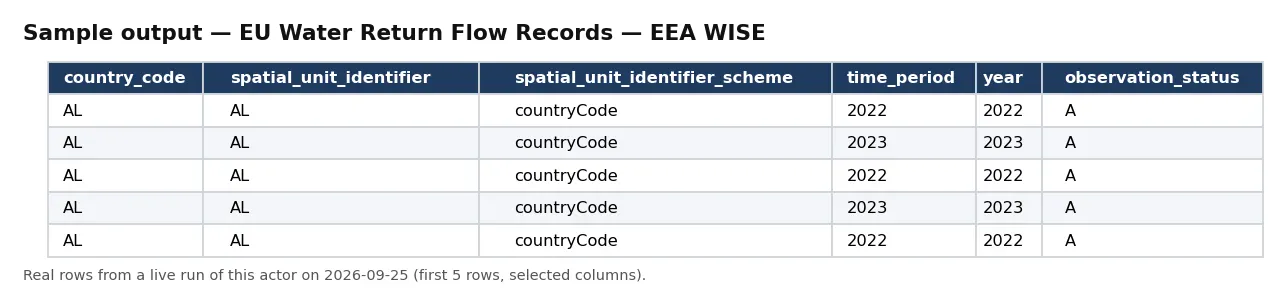
Real rows from a live run of this actor (first 5 rows, selected columns).
One full record from the same run, exactly as delivered:
Pricing
| Event | Free plan | Bronze | Silver | Gold / Platinum / Diamond |
|---|---|---|---|---|
water_return_record | $0.05 | $0.045 | $0.04 | $0.0335 |
Delivered before charged. Blocked runs and empty results cost nothing.
Input
| Field | Type | Default | Description |
|---|---|---|---|
countryCode | string | — | Optional 2-letter country code (e.g. DE, FR). |
year | integer | — | Optional reference year to filter. |
maxRecords | integer | 500 | Ceiling on records delivered and billed. |
Output
One JSON object per return observation. Real example (values as reported):
An unbilled RUN_RECEIPT records the robots check, the filters, rows seen and delivered, and whether charged equals delivered.
Field reference
Each record is one return observation. Identity: record_id, country_code, spatial_unit_identifier, and spatial_unit_identifier_scheme. Category and period: observed_property (the CATEGORY CODE, verbatim), time_period, and year. Measurement: observed_volume (in the source units) and observation_status. Provenance travels on every record: source, source_url, licence, attribution, disclaimer, and observed_at.
How a run works
A run first re-reads the source host's robots posture from your runtime — the EEA DiscoData host — and stops at the door if that ever changes. It pages the WISE water-returns table (filtered to your optional countryCode and optional year), and flattens each row to one record — carrying every value and label verbatim, never anything person-shaped — delivered before it is charged, so a blocked or empty run costs you nothing. The actor stops at your maxRecords ceiling and records charge_equals_delivered in the receipt.
Coverage and scope
The table holds on the order of 6,867 rows. Because each record carries the country_code, the spatial unit, the observed-property category, and the year, segmenting is straightforward. Pull one slice, or the whole table to seed a warehouse.
Working with the data
The returns are the other half of the water ledger, and the fields make them additive. Because every record pairs an observed_property category with an observed_volume at a spatial_unit_identifier, an analyst can separate genuine returns from leakage and losses, and quantify how much abstracted water is lost before it is used — the volume travels in the source units, and the observation_status flag marks provisional or estimated figures. The year frames each volume in time.
Identifiers and joins
Every record carries the spatial_unit_identifier and country_code, keying each return to the fleet's water-abstraction cell for the same spatial unit — so net consumption (withdrawals minus returns) can be estimated on a shared identifier — and to the reservoir-storage cell for the same spatial context.
Returns and losses versus withdrawals
This cell is the deliberate counterpart to the abstraction cell. Abstraction says how much water was TAKEN; this cell says how much was RETURNED and how much was LOST as leakage on the way. The distinction matters because a high withdrawal with high returns is a very different pressure from the same withdrawal with high losses. Keeping returns and withdrawals as separate actors lets a buyer pay for the side they need, and joining the two on the spatial unit closes the human water balance for a basin.
Cost guidance
One water_return_record per delivered row: cost = rows delivered × your plan's per-record price. Scope with countryCode and optional year to keep runs bounded. 1,000 rows is $50 (Free) / $33.50 (Gold).
Honest limitations
- As reported. Values, labels, and flags are as filed; this actor reformats, it does not audit or recompute.
- A label, not a verdict. These are reported values and classifications, not an independent compliance or conservation assessment.
- Acknowledge the EEA. The acknowledgement travels on every record.
- No person data of any kind.
Differentiation
It is distinct from eu-water-abstraction-records — that cell carries the WITHDRAWALS (water taken), while this cell carries the RETURNS and LOSSES (water put back or lost); returns vs withdrawals. Its specific job is the WISE water-returns, leakage, and losses by spatial unit, category, and period.
The NexGen Signal family
Part of the NexGen Signal family of pay-per-record data products:
- EU Reservoir Storage Records — EEA WISE
- EU Water Return Flow Records — EEA WISE
- EU Water Emission Load Records — EEA WISE
- EU Riverine Pollutant Load Records — EEA WISE
- EU Surface Water Chemical Status Records — EEA WISE
Source: European Environment Agency (EEA), WISE State of Environment (Waterbase) (discodata.eea.europa.eu). EEA data may be reused, including commercially, provided the source is acknowledged: "Source: European Environment Agency (EEA)"; marked third-party content keeps its own terms. Spatial-unit / category / period grain; the spatial unit is a location code; free-text remark/metadata fields excluded, no contact/operator/responsible-person field selected or emitted. No natural-person data of any kind. Values and labels as filed, not a compliance verdict.


