
Mine Operator & Safety Records — US MSHA
Pricing
from $33.50 / 1,000 mine records
Mine Operator & Safety Records — US MSHA
Keyless, pay-per-record MSHA mine register — one row per US mine with operator/controller entities, type, status, commodity, location and safety attributes. Public-domain; no inspector or person data.
Pricing
from $33.50 / 1,000 mine records
Rating
0.0
(0)
Developer
NexGen Signal
Maintained by CommunityActor stats
0
Bookmarked
2
Total users
1
Monthly active users
12 days ago
Last modified
Categories
Share
Keyless. Pay per record. Every US mine, its operator, and its safety profile.
This actor turns the US MSHA (Mine Safety and Health Administration) Open Government Data into clean, per-mine records — the official register of every mine in the United States and the legal entity that operates it. Each run reads MSHA's keyless bulk data file and delivers one row per mine: its identity and location, the controlling and operating companies, the mine type and status, the commodity, and MSHA's own safety-relevant attributes — the Section 103(i) inspection-frequency designation, gas category, methane liberation, and more. Operator/organization grain, structured for engineering use, in the public domain, with no inspector, contact, or other person-level fields ever emitted.
What this is, in one paragraph
MSHA regulates every mine in the country and publishes the master mine file as open data. This actor reads that file, filters to the state, commodity, and status you want, and flattens each mine into a single analysis-ready record: the mine and its coordinates, the operator and controller legal entities that run and own it, the mine type (surface, underground, facility) and current status, the primary commodity, the employment and shift profile, and the safety attributes MSHA tracks — most importantly the 103(i) inspection-frequency designation that flags gassy mines for more frequent inspection, plus methane liberation and gas category. Values are exactly as published by MSHA. You are billed only for records actually delivered.
Who buys this and for what job
- Mining suppliers, insurers, and lenders building an operator/mine reference keyed by MSHA id, enriched with type, status, commodity, and safety attributes for underwriting and territory planning.
- ESG, supply-chain, and commodity analysts mapping who operates which mines, where, for what commodity, and with what structural safety profile.
- Researchers and journalists studying the mining sector — ownership, activity, and safety designations across states and commodities.
- Data engineers who want the MSHA mine register as clean rows without parsing the fixed pipe-delimited open-data file.
Public-domain data — attributes, not a verdict
Two honesty riders travel on every record. First, licensing: MSHA data is collected by the US Department of Labor — a work of the US federal government, no copyright, public domain under 17 U.S.C. §105 — free to reuse with attribution to MSHA. Second, fitness: the safety-related attributes here (the 103(i) inspection-frequency designation, gas category, methane liberation, mine type and status) are facility characteristics, not a compliance verdict, citation history, or a prediction of any incident. Operator and controller names are the regulated legal entities, not individuals.
Operator/organization grain — no person data
This actor works at operator/organization grain: one record per mine, keyed to the legal entities that operate and control it. The MSHA mine file contains no inspector names and no operator contact-person fields, and this actor emits none; the one free-text field that could conceivably name an individual (driving directions to the mine) is dropped entirely, with a person-key guard on every record as a backstop, and the acceptance suite feeds a record whose directions field names individuals and asserts none of it can ever appear in output.
Sample output
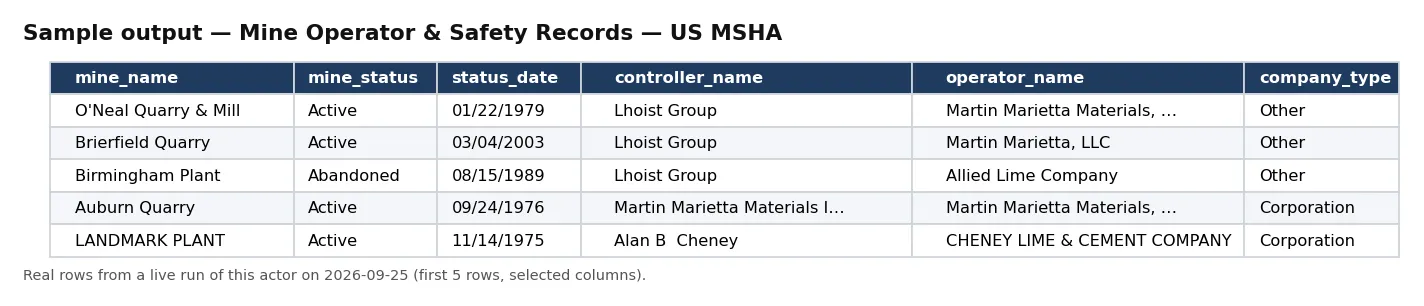
Real rows from a live run of this actor (first 5 rows, selected columns).
One full record from the same run, exactly as delivered:
Pricing
| Event | Free plan | Bronze | Silver | Gold / Platinum / Diamond |
|---|---|---|---|---|
mine_record | $0.05 | $0.045 | $0.04 | $0.0335 |
Delivered before charged. Blocked runs and empty results cost nothing.
Input
| Field | Type | Default | Description |
|---|---|---|---|
state | string | — | Optional. Keep only mines in this 2-letter state code (e.g. WV, KY, NV). |
coalMetal | string | — | Optional. Coal or Metal/Non-Metal. |
status | string | — | Optional. Keep only mines whose status contains this text (e.g. Active, Abandoned, Intermittent). |
maxRecords | integer | 10 | Ceiling on records delivered and billed. |
Default changed on 30 Sep 2026: if you leave maxRecords out, a run now returns up to 10 records (it was 500). Set maxRecords yourself to get more — the maximum is unchanged.
Output
One JSON object per mine. Real example (values as published by MSHA, Oak Grove Mine, Alabama):
An unbilled RUN_RECEIPT records the robots check, the filters, mines seen and delivered, whether charged equals delivered, and a note that no inspector/contact-person fields are emitted.
Field reference
Each record is one mine. Identity: record_id / mine_id, mine_name, coal_or_metal, mine_type, mine_status, and status_date. Operator/organization: controller_id, controller_name, operator_id, operator_name, company_type, and controller_since. Location: state, county_name, congressional_district, msha_district, msha_office, longitude, and latitude. Industry: primary_sic, secondary_sic, primary_commodity, and secondary_commodity. Safety and operations: inspection_frequency_103i, inspection_frequency_date, gas_category, methane_liberation, avg_mine_height_ft, portable_operation, days_per_week, hours_per_shift, prod_shifts_per_day, maint_shifts_per_day, employees, part48_training, producing_pits, nonproducing_pits, tailing_ponds, pillar_recovery_used, highwall_miner_used, multiple_pits, miners_representative, and safety_committee. Provenance and caveats: nearest_town, source, source_url, licence, attribution, disclaimer, and observed_at.
How a run works
A run first re-reads the source host's robots posture from your runtime — the MSHA Open Government Data host serves no robots file, a no-policy posture — and stops at the door if that ever changes. It then downloads the MSHA Mines bulk file (a pipe-delimited export) and streams it row by row. Each mine is checked against your optional state, coalMetal, and status filters before delivery, so you are billed only for mines that pass them. Each matching mine is flattened to one record — reading only mine, operator, and safety fields and never the free-text directions field — and delivered before it is charged, so a blocked or empty run costs you nothing. The actor stops at your maxRecords ceiling and records charge_equals_delivered in the receipt.
Coverage and scope
The MSHA mine file covers roughly 92,000 mines — active, intermittent, temporarily idled, abandoned, and sealed — split between Coal and Metal/Non-Metal, across every state. Active operations are a few thousand at any time; the rest are the full historical register. Because each record carries state, county, coordinates, commodity, and status, you can scope by geography, commodity, or activity. Pass a state to pull one state's mines, coalMetal to focus on coal or on metal/non-metal, or status to isolate active operations from the abandoned history. The 103(i) inspection-frequency designation and methane liberation make the gassy, higher-oversight mines easy to surface.
Cost guidance
One mine_record per delivered mine: cost = mines delivered × your plan's per-record price. The full file is ~92,000 mines, so scope with state, coalMetal, and status to keep runs bounded — one state's active coal mines is typically a few dozen. 1,000 mines is $50 (Free) / $33.50 (Gold).
Honest limitations
- Attributes, not a verdict. The safety fields are MSHA-tracked mine characteristics — not citations, penalties, injury history, or a compliance judgment. This actor never makes a safety determination.
- Operators are entities. Operator and controller names are the regulated legal entities on file with MSHA, not individuals.
- Mine register, not citation history. This is the master mine file; violation, inspection, and accident histories are separate MSHA datasets not joined here.
- As published. Values are exactly as MSHA distributes them; this actor reformats and decodes codes, it does not recompute.
- No person data — no inspector or contact-person fields; the free-text directions field is never emitted.
Differentiation
Its nearest neighbors are the fleet's other US federal-register products (facilities, rulemaking, grants), but none touch mining. This actor's specific job is the MSHA mine + operator register with safety attributes: who operates which mine, where, for what commodity, and with what MSHA-tracked safety profile — an operator/organization dataset, not a person dataset and not a citation-history score.
The NexGen Signal family
Part of the NexGen Signal family of pay-per-record data products:
- Airport Facility Records — US FAA NASR
- EPA Facility Compliance Records — Envirofacts
- Storm Event Records — US NOAA / NCEI
- Federal Rulemaking Records — US Federal Register
- Grant Opportunity Records — US Grants.gov
Source: US MSHA (Mine Safety and Health Administration) Open Government Data, Mines dataset. MSHA data is a work of the US Department of Labor / US federal government, no copyright, public domain (17 U.S.C. §105); free to reuse with attribution to MSHA. Safety-related fields are facility attributes, not a compliance verdict or citation history; operators/controllers are regulated legal entities, not individuals. Reformatted to mine records; no inspector or contact-person fields are emitted.


