

Storm Event Records — US NOAA / NCEI
Pricing
from $33.50 / 1,000 storm event records
Storm Event Records — US NOAA / NCEI
Keyless, pay-per-record NOAA/NCEI Storm Events Database — one row per US storm event with type, county, dates, casualties, damages (USD), and magnitude. Public-domain; no narratives, no person data.
Pricing
from $33.50 / 1,000 storm event records
Rating
0.0
(0)
Developer
NexGen Signal
Maintained by CommunityActor stats
0
Bookmarked
2
Total users
1
Monthly active users
12 days ago
Last modified
Categories
Share
Keyless. Pay per record. Every US storm event, with damages, casualties, and magnitude.
This actor turns the US NOAA / NCEI Storm Events Database into clean, per-event records — the authoritative log of severe and significant weather across the United States. Each run reads NOAA's public annual bulk file and delivers one row per storm event: the type and location, the begin and end times, the injuries and deaths, the property and crop damage, the magnitude, and — for tornadoes — the Enhanced Fujita scale and path dimensions. Event grain, structured for engineering use, in the public domain, with NOAA's own official-data disclaimer on every record. Free-text narrative fields are never emitted.
What this is, in one paragraph
The Storm Events Database is NOAA's official record of storms and other significant weather phenomena — tornadoes, hail, floods, thunderstorm winds, winter storms, heat, wildfire, and dozens more event types — compiled from National Weather Service reports. This actor reads the annual "details" file for the year you choose, filters to the state and event type you want, and flattens each event into a single analysis-ready record: identity, classification, county/zone geography, timing, human impact, economic damage, and hazard-specific magnitudes. Values are exactly as published by NOAA, with damage strings additionally parsed into plain USD numbers. You are billed only for records actually delivered.
Who buys this and for what job
- Insurance, reinsurance, and catastrophe modellers building a structured US storm loss history — damages, casualties, and magnitudes keyed by event and county.
- Climate and atmospheric researchers studying event frequency, severity, and trends across decades and regions.
- Risk, agriculture, and infrastructure teams quantifying exposure to hail, wind, flood, and tornado events by state and county.
- Data engineers and data journalists who want the storm log as clean rows without parsing NOAA's fixed-format bulk files.
Public-domain data — with NOAA's official-data caveat
Two honesty riders travel on every record. First, licensing: NOAA / NCEI Storm Events data is a work of the US federal government — no copyright, public domain under 17 U.S.C. §105 — free to reuse with attribution to NOAA / NWS. Second, fitness: Storm Data is an official NOAA publication, but some information may be unverified by the National Weather Service, which does not guarantee the accuracy or validity of the information, and location precision varies by era (older records are coarser). This is informational data, not a basis for legal, emergency, navigational, or safety-of-life decisions.
Event grain — no person data, no narratives
This actor works at event grain: storm types, places, times, impacts, and magnitudes. The database includes two free-text narrative fields (episode and event narratives) that can contain eyewitness accounts naming individuals — this actor drops both entirely and never emits them, alongside a person-key guard on every record as a backstop. What you get is the structured, non-narrative event record.
Sample output
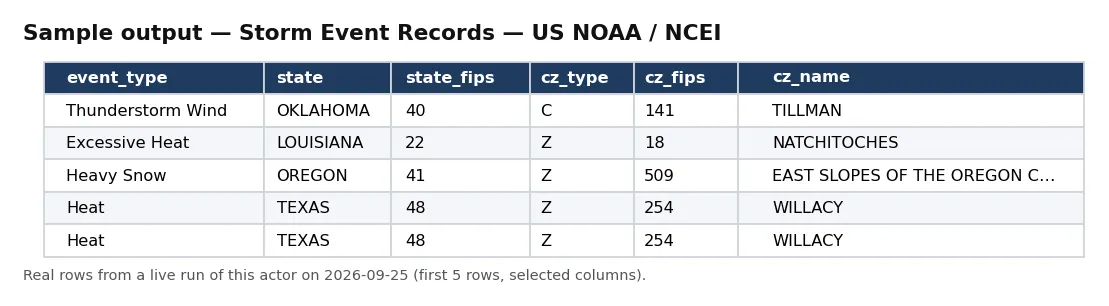
Real rows from a live run of this actor (first 5 rows, selected columns).
One full record from the same run, exactly as delivered:
Pricing
| Event | Free plan | Bronze | Silver | Gold / Platinum / Diamond |
|---|---|---|---|---|
storm_event_record | $0.05 | $0.045 | $0.04 | $0.0335 |
Delivered before charged. Blocked runs and empty results cost nothing.
Input
| Field | Type | Default | Description |
|---|---|---|---|
year | integer | 2024 | Data year of the Storm Events details file to read. |
state | string | — | Optional. Keep only events in this US state/territory (full name as NOAA uses it, e.g. TEXAS). |
eventType | string | — | Optional. Keep only events whose type contains this text (e.g. Tornado, Hail, Flash Flood). |
maxRecords | integer | 10 | Ceiling on records delivered and billed. |
Default changed on 30 Sep 2026: if you leave maxRecords out, a run now returns up to 10 records (it was 500). Set maxRecords yourself to get more — the maximum is unchanged.
Output
One JSON object per storm event. Real example (values as published by NOAA, an EF0 tornado in Davis County, Iowa, 2024):
An unbilled RUN_RECEIPT records the robots check, the year and file, the filters, source rows seen and delivered, whether charged equals delivered, and a note that narrative fields are never emitted.
Field reference
Each record is one storm event. Identity: record_id / event_id, episode_id, and event_type. Geography: state, state_fips, cz_type (county or NWS zone), cz_fips, cz_name, wfo, and the point coordinates begin_lat, begin_lon, end_lat, end_lon, plus the named references begin_range/begin_azimuth/begin_location and the matching end_ set. Timing: year, month_name, begin_date_time, end_date_time, and cz_timezone. Human impact: injuries_direct, injuries_indirect, deaths_direct, and deaths_indirect. Economic impact: damage_property and damage_crops (as published), plus damage_property_usd and damage_crops_usd (parsed to numbers). Hazard specifics: magnitude, magnitude_type, flood_cause, category, tor_f_scale, tor_length, and tor_width. Provenance and caveats: report_source, data_source, source, source_url, licence, attribution, disclaimer, and observed_at.
How a run works
A run first re-reads NCEI's robots posture from your runtime — the Storm Events files live under /pub/data/..., which the site's Disallow: /data* rule does not cover — and stops at the door if that ever changes. It then resolves the current details filename for your chosen year from NOAA's directory index (the filename carries a creation-date suffix that changes as data is revised), downloads the gzipped CSV, and streams it row by row. Each row is checked against your optional state and eventType filters before delivery, so you are billed only for events that pass them. Each matching row is flattened to one record — with the two narrative fields dropped — damage strings parsed to USD, and delivered before it is charged, so a blocked or empty run costs you nothing. The actor stops at your maxRecords ceiling and records charge_equals_delivered in the receipt.
Event types and coverage
The database spans the full range of severe and significant weather, and this actor surfaces the event_type on every row. Common pulls include Tornado (with EF scale, path length and width), Hail (with size magnitude), Thunderstorm Wind (with speed magnitude), Flash Flood and Flood (with flood cause), Winter Storm, Heavy Snow, Blizzard, Excessive Heat, Drought, Wildfire, High Wind, Lightning, Coastal Flood, and many more. Because each record also carries county/zone geography and begin/end coordinates, you can scope by place as well as by hazard. Pass a single eventType to build a focused feed — say, only tornadoes with their scales and paths — or pull a whole year and group by event_type and state downstream. Paired with state, one run gives you a bounded, low-cost slice of a single state's season.
Cost guidance
One storm_event_record per delivered event: cost = events delivered × your plan's per-record price. A single year's details file holds tens of thousands of events across all states and types, so scope with state and eventType to keep runs bounded — one state's tornadoes in a year is typically a few dozen to a few hundred. 1,000 events is $50 (Free) / $33.50 (Gold).
Honest limitations
- Official, but not guaranteed. Some entries are unverified by the NWS, which does not guarantee accuracy or validity; treat the data as informational.
- Precision varies by era. Older records (especially pre-1996) have coarser location and coverage than recent years.
- Not for safety-of-life use. Do not use this feed for emergency, navigational, or evacuation decisions.
- No narratives. The free-text episode and event narratives are never emitted; this is the structured record only.
- As published, plus parsed damages. Values are exactly as NOAA distributes them; the only derived fields are the USD parses of the damage strings.
- No person data is emitted.
Differentiation
This actor is the consolidated full-event record from the US NOAA Storm Events Database: one row per event carrying all of it together — identity and type, county/zone geography and coordinates, timing, injuries and deaths, property and crop damage (parsed to USD), and hazard-specific magnitudes including tornado EF scale, length, and width — the whole structured record in a single pull. Choose this actor when you want the complete event record in one place rather than a single dimension of it. The fleet also ships natural-hazard-event-records (NASA EONET) — a global catalogue of curated natural events with latest position and magnitude — which is a different source and job from this US official storm log with impacts.
The NexGen Signal family
Part of the NexGen Signal family of pay-per-record data products:
- Natural Hazard Event Records — NASA EONET
- Air Quality Monitor Records — US EPA AQS
- EPA Facility Compliance Records — Envirofacts
- National Macro Indicator Records — World Bank
- US Treasury Fiscal Records — Rates & Debt
Source: US NOAA National Centers for Environmental Information (NCEI) Storm Events Database. Data is a work of the US federal government, no copyright, public domain (17 U.S.C. §105); free to reuse with attribution to NOAA/NWS. Storm Data is an official NOAA publication but some information may be unverified by the NWS, which does not guarantee accuracy or validity; not for safety-of-life use. Reformatted to event records; free-text narratives and person data are never emitted.


