

UK Gender Pay Gap Records — Employer Reports
Pricing
from $33.50 / 1,000 pay-gap records
UK Gender Pay Gap Records — Employer Reports
Look up a UK employer's gender pay gap report by name or Companies House number: mean and median hourly and bonus gaps and pay quartiles for the year. Each match says whether the report name, current name or number matched. OGL v3.0; no person data.
Pricing
from $33.50 / 1,000 pay-gap records
Rating
0.0
(0)
Developer
NexGen Signal
Maintained by CommunityActor stats
0
Bookmarked
2
Total users
1
Monthly active users
12 days ago
Last modified
Categories
Share
Keyless. Pay per record. Every UK employer's gender pay gap, as officially reported.
This actor turns the UK Gender Pay Gap Service into clean, per-employer records — the official, mandatory disclosures of how large employers' pay differs between men and women. Each run reads the government service's keyless CSV for the reporting year you choose and delivers one row per employer: the mean and median hourly gaps, the bonus gaps, the male/female split across all four pay quartiles, the employer size band, and the submission dates. Employer/organization grain, structured for engineering use, under the Open Government Licence, with a hard person-gate: the responsible-person name, employer address, postcode, and every free-text/URL field are structurally excluded and never emitted.
What this is, in one paragraph
UK employers with 250 or more staff must report their gender pay gap every year. This actor reads the official service's published data for a reporting year and flattens each employer's return into a single analysis-ready record: the headline mean and median hourly pay gaps, the mean and median bonus gaps, the proportion of men and women receiving a bonus, and the male/female representation in the lower, lower-middle, upper-middle, and top pay quartiles — plus the employer's size band and when it submitted. Values are exactly as reported by employers. You are billed only for records actually delivered.
Who buys this and for what job
- DEI, HR-analytics, and benchmarking products that need every employer's gender-pay-gap figures as clean rows to compare against a client's own numbers.
- ESG and investment-research teams scoring companies on disclosed pay equity across years and size bands.
- Journalists and researchers studying pay-gap trends by sector, size, and time.
- Data engineers who want the official figures without downloading and reshaping the yearly CSV — with the person and address fields already stripped.
Open Government Licence — free commercial reuse
One licence rider travels on every record. UK gender pay gap data is published under the Open Government Licence v3.0 (OGL v3.0) — free to copy, publish, distribute, and adapt, including commercially, with the required attribution: "Contains public sector information licensed under the Open Government Licence v3.0." One honest caveat rides every record too: a pay gap is a workforce-composition statistic and is not in itself evidence of unequal pay; figures are as self-reported by employers.
Hard person-gate — no responsible person, no address
The raw file carries a ResponsiblePerson field — a named individual, often with an email address — plus the employer's street Address, PostCode, and a free-text information URL. This actor emits none of them. Those columns are not in the field map at all (structural exclusion), a person-key guard runs on every record as a backstop, and the acceptance suite feeds a record whose ResponsiblePerson, address, postcode, and URL are populated and asserts none of it can ever appear in output. What remains is the employer entity (name, Companies House number, SIC) and the aggregate pay-gap statistics.
Sample output
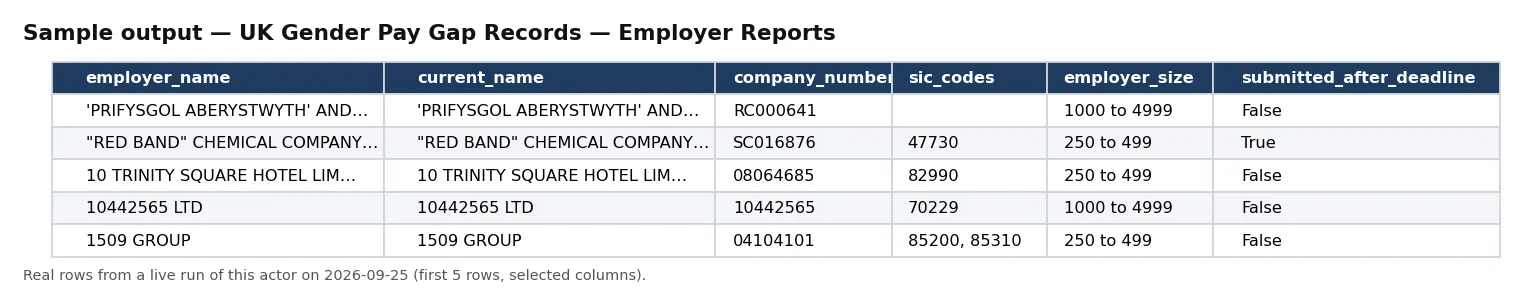
Real rows from a live run of this actor (first 5 rows, selected columns).
One full record from the same run, exactly as delivered:
Pricing
| Event | Free plan | Bronze | Silver | Gold / Platinum / Diamond |
|---|---|---|---|---|
pay_gap_record | $0.05 | $0.045 | $0.04 | $0.0335 |
Delivered before charged. Blocked runs and empty results cost nothing.
Input
| Field | Type | Default | Description |
|---|---|---|---|
employerNames | array | — | Optional. Whole words of the employer's name (e.g. Tesco). Matched against the name on the report and the current name; matched_on says which. |
companyNumbers | array | — | Optional. Exact 8-character Companies House numbers (e.g. 00519500, SC173199). Leading zeros kept; 519500 is padded to 00519500. |
year | integer | 2024 | Reporting year (e.g. 2024 for the 2024/25 reporting year). |
employerSize | string | — | Optional. Keep only employers in this size band (e.g. "1000 to 4999"). |
maxRecords | integer | 10 | Ceiling on records delivered and billed. |
Default changed on 30 Sep 2026: if you leave maxRecords out, a run now returns up to 10 records (it was 500). Set maxRecords yourself to get more — the maximum is unchanged.
Look up one employer: {"employerNames": ["Tesco"], "year": 2025, "maxRecords": 10} returns only Tesco employers' 2025/26 reports; {"companyNumbers": ["00519500"], "year": 2024} returns that company's 2024/25 report. A name matches whole words only (Tesco does not match Tescombe). Each run covers one reporting year; employers that did not report that year are not returned. No match = nothing charged.
Output
One JSON object per employer per reporting year. Real example (values as reported):
An unbilled RUN_RECEIPT records the robots check, the reporting year, the filters, rows seen and delivered, and whether charged equals delivered.
Field reference
Each record is one employer's return for one reporting year. Identity: record_id (employer id + year), employer_id, employer_name, current_name, company_number, and sic_codes. Context: reporting_year and employer_size. Hourly gaps: diff_mean_hourly_percent and diff_median_hourly_percent. Bonus gaps: diff_mean_bonus_percent, diff_median_bonus_percent, male_bonus_percent, and female_bonus_percent. Quartile representation: male_/female_ lower_quartile, lower_middle_quartile, upper_middle_quartile, and top_quartile. Submission: submitted_after_deadline, due_date, and date_submitted. Provenance: source, source_url, licence, attribution, disclaimer, and observed_at.
How a run works
A run first re-reads the source host's robots posture from your runtime — the service serves no robots file, a no-policy posture — and re-proves the download door for your chosen reporting year. If the service returns a 5xx (it has a history of transient 502s), the actor defers cleanly — it reports the status and stops rather than delivering partial or nothing-charged garbage. On a healthy 200, it reads the year's CSV and flattens each employer to one record — reading only the employer entity and the aggregate statistics, never the responsible-person, address, postcode, or URL fields — delivered before it is charged, so a blocked or empty run costs you nothing. The actor stops at your maxRecords ceiling and records charge_equals_delivered in the receipt.
Coverage and scope
A single reporting year holds on the order of 11,000+ employer returns across every sector and size band from 250 staff upward. Because each record carries reporting_year and employer_id, year-over-year comparison is a simple join on employer id, and size-band filtering isolates the segment you care about. Pull one year to benchmark, or several years to build a trend for a set of employers.
Cost guidance
One pay_gap_record per delivered employer return: cost = returns delivered × your plan's per-record price. Scope with employerSize or maxRecords to keep runs bounded. A whole year is ~11,000 returns; 1,000 returns is $50 (Free) / $33.50 (Gold).
Honest limitations
- Not evidence of unequal pay. A gender pay gap reflects workforce composition across roles and seniority; it is not, by itself, evidence of men and women being paid differently for the same work.
- As self-reported. Figures are submitted by employers; this actor reformats, it does not audit.
- Employer grain, per year. One row is one employer's return for one reporting year.
- Defers on outage. If the service is returning 5xx, the actor defers rather than delivering partial data.
- No person data — responsible-person, address, postcode, and free-text/URL fields are excluded.
Differentiation
It is distinct from the fleet's UK company cells (which carry company status, filings, and control, not pay-gap statistics) and from any HR or jobs cell. Its specific job is the official UK gender-pay-gap employer return — the mandated pay-equity statistics, per employer, per year, with the person and address fields removed.
The NexGen Signal family
Part of the NexGen Signal family of pay-per-record data products:
- UK Tariff Commodity Records — HS Codes & Taxonomy
- UK Contract Opportunity Records
- EU Regulatory Change Records — CELLAR
- Organization Sanctions & LEI Risk
- Grant Opportunity Records — US Grants.gov
Source: UK Gender Pay Gap Service (gender-pay-gap.service.gov.uk). Contains public sector information licensed under the Open Government Licence v3.0 — free to reuse, including commercially, with attribution. Aggregate employer statistics only; a pay gap is not in itself evidence of unequal pay. Reformatted to employer records; the responsible-person name, address, postcode, and free-text/URL fields are structurally excluded and never emitted.


