

UK Road Traffic Flow Records — DfT AADF
Pricing
from $33.50 / 1,000 aadf records
UK Road Traffic Flow Records — DfT AADF
Keyless pay-per-record UK DfT AADF traffic flows — count point, road, year, and vehicle-class counts. No persons. OGL v3.0. GOLD $0.05 ladder.
Pricing
from $33.50 / 1,000 aadf records
Rating
0.0
(0)
Developer

NexGen Signal
Maintained by CommunityActor stats
0
Bookmarked
2
Total users
1
Monthly active users
12 days ago
Last modified
Categories
Share
Keyless. Pay per record. Every UK road count point's annual average daily traffic, by vehicle class, year by year.
This actor turns the UK Department for Transport (DfT) road traffic statistics into clean, per-flow records — the Annual Average Daily Flow (AADF) at every count point on the UK's road network. Each run reads the DfT's keyless AADF API and delivers one row per count point / road / year: the count point and its location, the road name, category, and type, the junctions the link runs between, the link length, the estimation method, and the average daily vehicle counts broken down by class (pedal cycles, two-wheeled motor vehicles, cars and taxis, buses and coaches, LGVs, HGVs, and all motor vehicles). Count-point / road / year grain, structured for engineering use, under the Open Government Licence v3.0, with no personal data of any kind.
What this is, in one paragraph
The DfT publishes the Annual Average Daily Flow — the estimated average number of vehicles using a road link on a typical day — for every count point on the UK network, back to 2000. This actor reads that dataset and flattens each count-point-year into a single analysis-ready record: the count point id, the year, the region and local authority, the road name, category (principal / trunk / motorway), and type, the start and end junctions of the link, the count point's coordinates and the link length, the estimation method, and the average daily counts for each vehicle class. Values are official statistics, carried verbatim as published. It is the traffic-volume layer of the UK road network. You are billed only for records actually delivered.
Who buys this and for what job
- Transport-planning, logistics, and infrastructure teams analysing traffic volumes and vehicle mix by road, region, and year.
- Retail-siting, out-of-home advertising, and property teams scoring locations by passing traffic.
- Environmental, active-travel, and policy products studying modal share and HGV / cycle volumes over time.
- Data engineers who want the AADF series as clean rows without paging a 600k-record API by hand.
Open Government Licence v3.0 — free commercial reuse
One licence rider travels on every record. DfT road traffic statistics are published under the Open Government Licence v3.0 (OGL v3.0) — free to reuse, including commercially, with attribution: "Contains public sector information licensed under the Open Government Licence v3.0." That attribution travels on every record. One honest caveat rides too: AADF figures are official statistics, some estimated (see estimation_method), carried verbatim — not a real-time traffic measurement.
Count-point grain — no person data
The unit of every record is a count point on a road for a year — infrastructure, never a person. The coordinates are the count point's own fixed location, not anyone's. The dataset carries no natural-person fields — roads, count points, and vehicle-class volumes are the entire payload — and a person-key guard runs on every record as a pure backstop.
Sample output
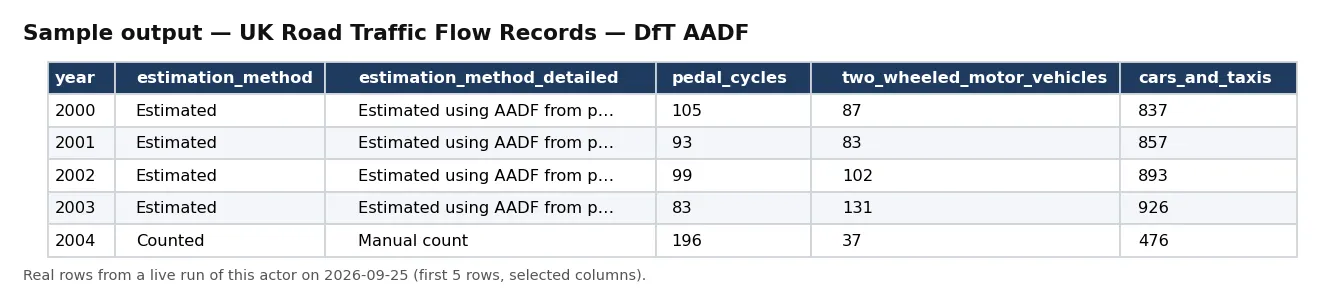
Real rows from a live run of this actor (first 5 rows, selected columns).
One full record from the same run, exactly as delivered:
Pricing
| Event | Free plan | Bronze | Silver | Gold / Platinum / Diamond |
|---|---|---|---|---|
aadf_record | $0.05 | $0.045 | $0.04 | $0.0335 |
Delivered before charged. Blocked runs and empty results cost nothing.
Input
| Field | Type | Default | Description |
|---|---|---|---|
year | integer | — | Optional year to filter (e.g. 2023). |
regionId | string | — | Optional DfT region id to filter. |
roadNameContains | string | — | Optional. Keep only rows whose road name contains this text (e.g. A1, M25). |
maxRecords | integer | 10 | Ceiling on records delivered and billed. |
Default changed on 30 Sep 2026: if you leave maxRecords out, a run now returns up to 10 records (it was 500). Set maxRecords yourself to get more — the maximum is unchanged.
year and regionId are applied by the DfT API itself (exact match), so a one-year search reads only that year's rows; roadNameContains is then checked by the actor. Latest year in the source when checked (Sep 2026): 2025. Example: {"year": 2025, "roadNameContains": "M25", "maxRecords": 10}.
Output
One JSON object per count-point-year. Real example (values as published):
An unbilled RUN_RECEIPT records the robots check, the filters, rows matched and delivered, and whether charged equals delivered.
Field reference
Each record is one count-point-year. Identity and place: record_id, count_point_id, year, region_id, local_authority_id, easting, northing, latitude, and longitude. Road: road_name, road_category, road_type, start_junction_road_name, end_junction_road_name, link_length_km, and link_length_miles. Method: estimation_method and estimation_method_detailed. Vehicle-class counts: pedal_cycles, two_wheeled_motor_vehicles, cars_and_taxis, buses_and_coaches, lgvs, all_hgvs, and all_motor_vehicles. Provenance: source, source_url, licence, attribution, disclaimer, and observed_at.
How a run works
A run first re-reads the source host's robots posture from your runtime — the DfT road-traffic host, whose robots is an explicit allow-all — and stops at the door if that ever changes. It pages the keyless AADF API, applies your optional year, region, and road-name filters, and flattens each count-point-year to one record — carrying the counts verbatim, never anything person-shaped — delivered before it is charged, so a blocked or empty run costs you nothing. The actor stops at your maxRecords ceiling and records charge_equals_delivered in the receipt.
Coverage and scope
The AADF series holds on the order of 600,000+ count-point-years across the UK network, back to 2000. Because each record carries the year, road_category, region_id, and the vehicle-class counts, segmenting by road class, region, or year — and building a traffic time series for any count point — is straightforward. Pull one year, one road, or the whole series to seed a traffic warehouse.
Working with the flows
The series is a time series waiting to be assembled, and the identifiers make it mechanical. Every record carries the count_point_id and year, so a single filtered pull sorted by year reconstructs a count point's traffic trajectory, and the per-class counts let an analyst track how the vehicle mix — cars versus HGVs versus cycles — shifted over two decades. The road_category and road_type roll individual links up to the motorway, trunk, or principal-road network, while the coordinates place each count point for a spatial join to catchments or sites. Because the estimation_method travels on every row, a careful consumer can separate directly-counted links from estimated ones, and two annual pulls can be diffed to see where traffic grew or fell.
Cost guidance
One aadf_record per delivered count-point-year: cost = rows delivered × your plan's per-record price. Scope with year, regionId, or roadNameContains to keep runs bounded. The whole series is ~600,000 rows; 1,000 rows is $50 (Free) / $33.50 (Gold).
Honest limitations
- Official statistics, as published. AADF figures are annual averages, some estimated; this actor reformats, it does not recompute or measure in real time.
- Count points, not every road. The dataset covers the DfT count-point network at the published grain.
- Attribute the DfT. The OGL v3.0 attribution travels on every record.
- No person data of any kind.
Differentiation
It is distinct from the fleet's uk-road-collision-records (STATS19 collisions — where crashes happened, an incident feed) — this cell is traffic volumes (how many vehicles use a link), a different dataset at a different grain. Its specific job is the DfT AADF count-point series.
The NexGen Signal family
Part of the NexGen Signal family of pay-per-record data products:
- UK Road Collision Records — DfT STATS19
- GB NaPTAN Transit Node Records — DfT
- UK Port Freight Flow Records — DfT PORT0499
- EU Vehicle CO2 Records — EEA
- UK Company Status Records — Companies House
Source: UK Department for Transport, road traffic statistics — Annual Average Daily Flow (roadtraffic.dft.gov.uk). Contains public sector information licensed under the Open Government Licence v3.0 — free to reuse, including commercially, with attribution to the Department for Transport. Count-point / road / year grain; the coordinates are the count point's own location; no person data of any kind. Official statistics, some estimated, carried verbatim; not a real-time measurement.


