

EPO Amended Patent Specification Watch
Pricing
from $201.00 / 1,000 epo publication deltas
EPO Amended Patent Specification Watch
Granted European patents narrowed or upheld after opposition or limitation (B2/B3). A litigation-relevant signal — roughly 35 a week worldwide.
Pricing
from $201.00 / 1,000 epo publication deltas
Rating
0.0
(0)
Developer
NexGen Watch
Maintained by CommunityActor stats
0
Bookmarked
2
Total users
1
Monthly active users
2 days ago
Last modified
Categories
Share
™️ EPO Amended Patent Specification Watch
Granted European patents narrowed or upheld after opposition or limitation (B2/B3). A litigation-relevant signal — roughly 35 a week worldwide.
Output is one epo_publication_record row per result; billing is pay-per-event, the value event being one epo publication delta (a $0.02 start fee per run, then $0.30 per epo publication delta plus one $0.10 source check per run that reads the source). Source: data.epo.org.
📊 Sample Output
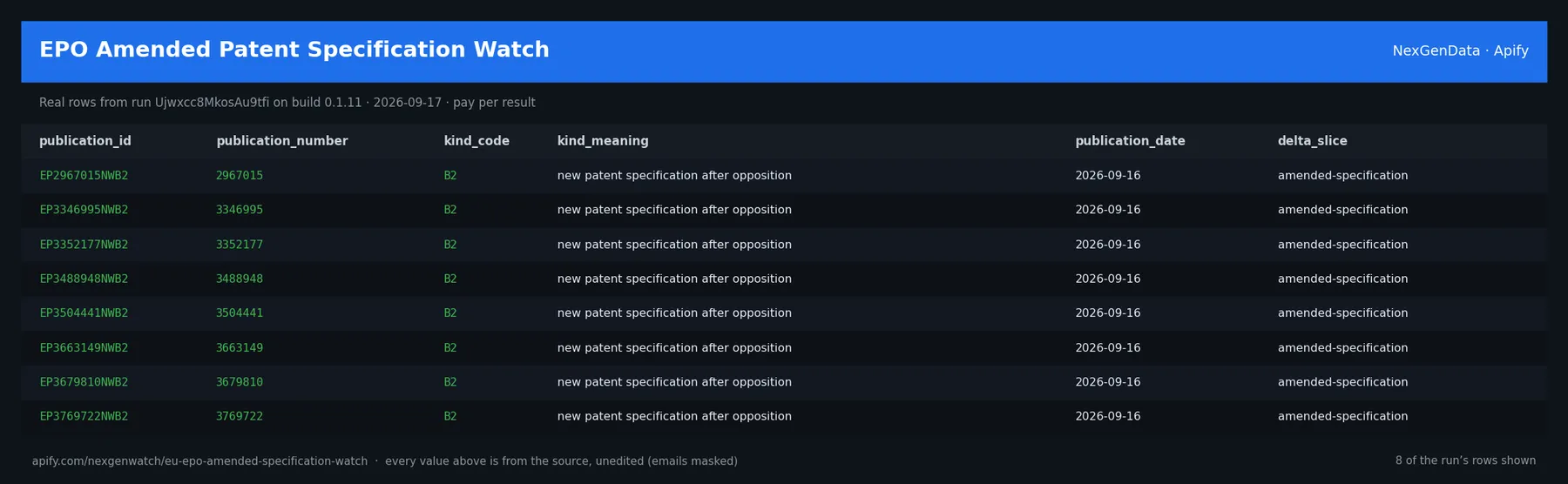
Real rows from run Ujwxcc8MkosAu9tfi on build 0.1.11 (2026-09-17), the same input as the Quick start below — every value is as the source published it (emails masked, long text shortened):
| publication_id | publication_number | kind_code | kind_meaning | publication_date | delta_slice |
|---|---|---|---|---|---|
| EP2967015NWB2 | 2967015 | B2 | new patent specification after opposition | 2026-09-16 | amended-specification |
| EP3346995NWB2 | 3346995 | B2 | new patent specification after opposition | 2026-09-16 | amended-specification |
| EP3352177NWB2 | 3352177 | B2 | new patent specification after opposition | 2026-09-16 | amended-specification |
| EP3488948NWB2 | 3488948 | B2 | new patent specification after opposition | 2026-09-16 | amended-specification |
| EP3504441NWB2 | 3504441 | B2 | new patent specification after opposition | 2026-09-16 | amended-specification |
| EP3663149NWB2 | 3663149 | B2 | new patent specification after opposition | 2026-09-16 | amended-specification |
| EP3679810NWB2 | 3679810 | B2 | new patent specification after opposition | 2026-09-16 | amended-specification |
| EP3769722NWB2 | 3769722 | B2 | new patent specification after opposition | 2026-09-16 | amended-specification |
The run finished with the status message: PARTIAL: emitted 10 item(s); ITEM CAP REACHED: max_items (10) kept 10 of 16 matching publication(s). The rest are not in the baseline. Narrow delta_types or number_prefix, or raise max_items.
✅ What you get
Each row is flat JSON with these fields (from the dataset schema and the sample run; a field the source does not publish for a given row is null):
record_key(string/null) — e.g.epo:EP2967015NWB2publication_id— e.g.EP2967015NWB2publication_number— e.g.2967015kind_code— e.g.B2kind_meaning— e.g.new patent specification after oppositionseries_token— e.g.NWpublication_date— e.g.2026-09-16delta_slice— e.g.amended-specificationdocument_url— e.g.https://data.epo.org/publication-server/rest/v1.2/patents/EP2967015NWB2/documentrecord_type(string) — e.g.epo_publication_recorddelta_type(string/null) — null in every sample rowdelta_kinds(array/null) — null in every sample row
⚙️ Sample inputs
1. Quick start — the Store example (this is what the sample above came from)
The sample run charged exactly: 1 × $0.02 apify-actor-start + 1 × $0.10 source-check + 0 × $0.30 epo-publication-delta = $0.12 on the Free tier — snapshot preview rows are delivered unbilled; only the source check and the start fee were charged.
2. A smaller, narrowed run
Caps the run at 5 rows; same billing shape as the sample run above.
3. Watch mode on a schedule
The first run seeds a private baseline and emits zero deltas; every later run emits one row per change, billed at $0.30 each plus the $0.10 source check; billed deltas are capped at 500 per run.
🧾 JSON sample record
One real record from run Ujwxcc8MkosAu9tfi, exactly as it lands in the dataset (emails masked, long text shortened):
🔧 How it works
Transport. Plain HTTPS from the Apify platform, no proxy. robots.txt is read first and a disallowed path is never fetched. Every request carries an identified contact User-Agent.
Charging. Each epo publication delta is charged at the moment it is pushed (epo-publication-delta); a row that fails to charge is not delivered, so the dataset count always equals the charged count. One source-check is charged per run that actually read the source.
Source
EPO publication server, weekly Bulletin publication lists (public, logged-out)
Public, logged-out only — no API key, login, cookie or CAPTCHA.
robots.txt on the publication server permits all paths.
The four delta types, and their weekly volumes
| value | kind codes | measured per week |
|---|---|---|
application-publication | A1, A2, A3, A4 | ~3,700 |
grant-publication | B1 | ~1,900 |
amended-specification | B2, B3 | ~35 |
correction-publication | A8, A9, B8, B9 | ~50 |
The volumes are very uneven and they matter. Selecting
application-publication means roughly 3,700 deltas on the first comparison run,
and billed deltas are capped at 500 per run — so it takes several runs to drain,
each reporting the withholding. If you want a low-volume, high-signal feed, watch
amended-specification (a patent narrowed or upheld after opposition) and
correction-publication.
Kind selection narrows the baselined record set, not just the reporting, so watching B2 stores 35 records rather than 5,767. Because that changes which records exist, the selection is part of the baseline identity: changing it starts a fresh baseline instead of emitting a corpus-wide phantom delta storm.
Fair use
The EPO publishes a 10 GB / 7 days per-IP limit. This actor reads one weekly list
per publication date — about 470 KB each — and the kind code is embedded in the
publication id, so no per-publication document is ever fetched. A 52-week backfill is
about 24 MB. It never requests document.html, and a test asserts that.
Snapshot mode is a PREVIEW
watch_mode: false returns at most 25 records, hard-capped in code.
Watch semantics
First watch run seeds and emits zero deltas. A publication leaving the window is the window moving — a Bulletin week does not un-publish — and is never reported as a withdrawal. Any publication id that does not parse is counted and reported rather than silently dropped.
Terminal states
NORMAL · SUCCEEDED-0: GENUINE_EMPTY · SUCCEEDED-0 (no change) · PARTIAL · BLOCKED.
One delta type per Actor
This Actor watches amended-specification and nothing else. The other delta types in this family are separate Actors, each with its own price and its own baseline — so you pay for the feed you want and no other.
What is not done. No login, no cookie or CAPTCHA bypass, no private or personal-account data, no browser automation.
⏰ Set it on a schedule
A single run is a snapshot. The value is the feed: open the actor in Apify Console → Schedules → Create new, add this actor with input 3 above (watch_mode: true), and pick a cadence:
- Daily —
0 7 * * *(07:00 UTC): catch changes within a day. - Weekly —
0 7 * * 1: a Monday digest.
The baseline persists in a named key-value store between runs, so every scheduled run compares against the last one; use a different baseline_id for independent watches. Schedules can also POST results to a webhook (Console → Integrations).
💰 Pricing example
| Event | Free | Bronze | Silver | Gold |
|---|---|---|---|---|
Actor Start (apify-actor-start) | $0.02 | $0.02 | $0.02 | $0.02 |
Source check (source-check) | $0.10 | $0.09 | $0.08 | $0.07 |
EPO Publication Delta (epo-publication-delta) | $0.30 | $0.27 | $0.24 | $0.20 |
Worked at the live Free-tier price (watch mode, one delta per change):
- 8 epo publication deltas: $0.02 start + $0.10 source check + 8 × $0.30 = $2.52
- 25 epo publication deltas: $0.02 start + $0.10 source check + 25 × $0.30 = $7.62
- 4000 epo publication deltas: $0.02 start + $0.10 source check + 4000 × $0.30 = $1,200.12
A run that delivers zero rows charges the $0.02 start fee plus the $0.10 source check (the source was read and reported empty). A BLOCKED run (source refused) fails loud and charges no value event. The start fee is charged once per GB of run memory; the default run memory is 1024 MB.
Yield on the sample run: PARTIAL: emitted 10 item(s); ITEM CAP REACHED: max_items (10) kept 10 of 16 matching publication(s). The rest are not in the baseline. Narrow delta_types or number_prefix, or raise max_items.. max_items is a hard ceiling on what is delivered and billed, never a target. Snapshot output is capped at 25 records regardless of the cap you set; watch mode is the full feed.
⚖️ Legal & ToS
This actor reads public, logged-out pages and feeds published by data.epo.org. It collects only what the source publishes to any visitor, keeps to the source's robots rules (checked on every run), identifies itself with a contact User-Agent, and does not access accounts, private data or anything behind authentication. Use the output in line with the source's terms and your local law; the intended use is B2B research and monitoring.
❓ FAQ
Q: Do I need an API key or a login?
A: No. The source (data.epo.org) is read logged-out; the input schema has no key field and the actor carries no secrets.
Q: Why did my run return 0 rows?
A: Read the run's status message. GENUINE_EMPTY means the source was read and had nothing in scope for your input (in watch mode the first run always seeds the baseline and returns zero deltas); BLOCKED means the source refused and the run failed without billing a value event — retry later or narrow the input. A zero-row run bills the start fee plus one source check.
Q: How many rows can one run return?
A: Up to max_items (default 4000); snapshot previews stop at 25. Raise the cap for a bigger run; you pay per delivered row.
Q: What does watch mode remember between runs?
A: A private baseline of source-native record ids in a named key-value store (baseline_id names it, so several independent watches can coexist). Each later run diffs the live source against it and emits only changes.
Q: How fresh is the data?
A: Every run reads the source live at run time; nothing is cached between runs except the watch baseline. Put it on a schedule for a continuous feed.
Q: What formats can I export?
A: The dataset downloads as JSON, CSV, Excel, XML or RSS from the run's Dataset tab or the Apify API, and any run can push to a webhook or integration.
Q: How is this different from the other IP and trademark watches actors?
A: Same output shape and billing model; this one covers data.epo.org. The siblings under Related Actors cover the other sources or slices — run several on one schedule for a combined feed.
🆘 Troubleshooting
- Run FAILED with BLOCKED → the source refused the request or changed its page shape → nothing was billed beyond the start fee; retry after a while, and if it persists open an Issue with the run id.
- Status says CAPPED → your cap (
max_items) was reached → raise it for a bigger run. - Input validation error on start → a field is outside the schema's allowed values → start from the Quick start block and change one field at a time.
- Run TIMED-OUT → a very wide request on a slow day → raise the run timeout in Run options or narrow the input; what was delivered before the timeout is still in the dataset.
- First watch run shows no deltas → expected: it seeds the baseline; changes appear from the second run.
🔗 Related Actors
- Canada CIPO Trademark Decision Watch — Trademarks Opposition Board decisions published by the Canadian Intellectual Property Office: case title, neutral citation, publication date and the…
- CIPO Trademarks Journal Change Watch — Seed-zero weekly change feed over the public CIPO Trademarks Journal — new marks and changes for your watched classes or owners
- EPO Patent Application Publication Watch — European patent applications as they publish (A1/A2/A3). A high-volume bulk feed — roughly 3,700 publications a week
- EPO Patent Correction Publication Watch — Corrected European patent publications (A8/A9/B8/B9). Roughly 50 a week — docketing accuracy rather than bulk
- EPO Patent Grant Publication Watch — European patents as they are granted (B1). Roughly 1,900 a week
- 🏢 About NexGenData — NexGen Watch is NexGenData's fleet of 256 public monitoring and lookup actors built on official sources, pay-per-result. Browse the catalog at apify.com/nexgenwatch.
⭐ Found this useful?
If this actor saved you a manual check, a quick review on the Apify Store helps other teams find it. Feature request or a source that changed? Open it from the Issues tab — every one is read.


