

UK Companies House Filing and Control Watch
Pricing
from $33.50 / 1,000 company deltas
UK Companies House Filing and Control Watch
Companies House filing history AND persons with significant control for the companies you name, in one cell: a new filing appearing, and a PSC being added, removed or having their nature of control change.
Pricing
from $33.50 / 1,000 company deltas
Rating
0.0
(0)
Developer
NexGen Watch
Maintained by CommunityActor stats
0
Bookmarked
2
Total users
1
Monthly active users
4 days ago
Last modified
Categories
Share
🔎 UK Companies House Filing and Control Watch
Companies House filing history AND persons with significant control for the companies you name, in one cell: a new filing appearing, and a PSC being added, removed or having their nature of control change. PER-COMPANY SCOPE: the public service serves one company at a time, so this watches your list — it is not a whole-register feed. Filing documents are not opened or parsed.
-
Public, logged-out only — no API key, login, cookie or CAPTCHA.## Pricing| Event | Price (FREE tier) ||---|---|| Actor start (`apify-actor-start`) | $0.02 one-time || Source check (`source-check`) | $0.10 |
| Per delta (company-delta) | $0.05 |
A filing appears in the history the moment Companies House accepts it, but its DOCUMENT can take days to process — the service says so on the row itself. During that window the row carries no transaction id. Measured live: 24 of 25 rows had an id and the one that did not was the newest filing.
Rather than drop it, this cell gives such a row a deterministic key built from its date,
type and description, so a brand-new filing is reported immediately. When the document
later lands, that filing's key becomes the official transaction id — which surfaces as a
key change, not a silent substitution. If you reconcile on transaction_id, use
document_available to tell the two states apart.
PSC entries carry no official identifier on the public page at all, so they are keyed on company number + normalised name + notified-on date. That is the strongest identity the public service offers, and a PSC renaming themselves will read as a removal plus an addition.
Output is one company_record row per result; billing is pay-per-event, the value event being one company delta (a $0.02 start fee per run, then $0.05 per company delta plus one $0.10 source check per run that reads the source).
No login, no API key and no CAPTCHA solving are involved: the source is read logged-out with an identified contact User-Agent.
📊 Sample Output
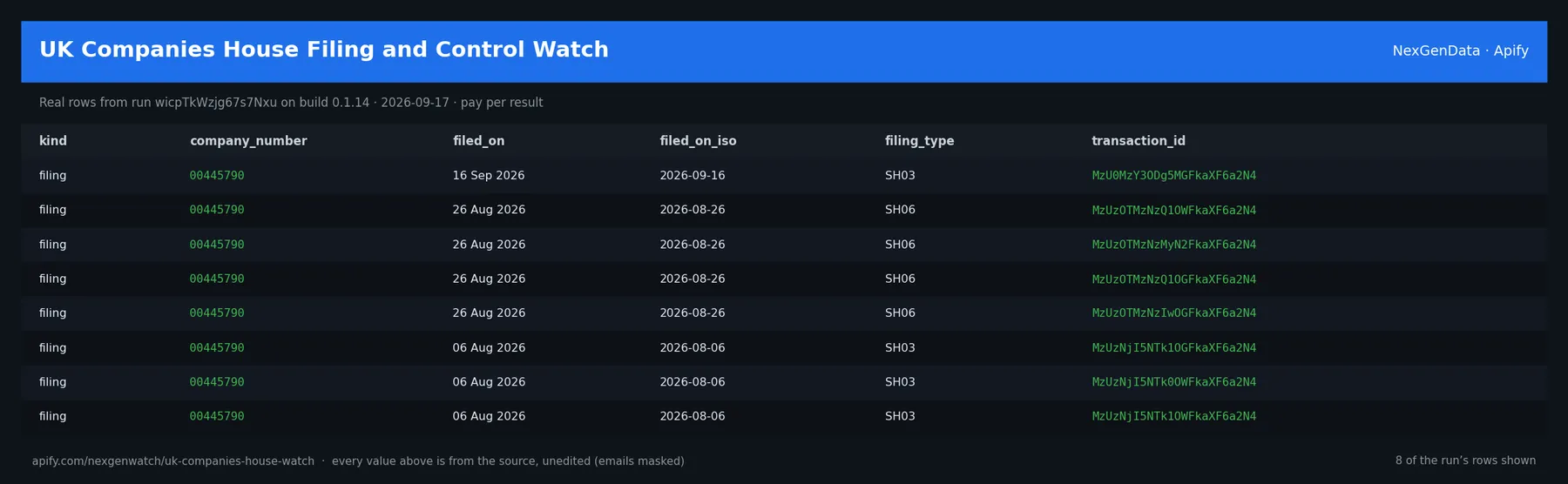
Real rows from run wicpTkWzjg67s7Nxu on build 0.1.14 (2026-09-17), the same input as the Quick start below — every value is as the source published it (emails masked, long text shortened):
| kind | company_number | filed_on | filed_on_iso | filing_type | transaction_id |
|---|---|---|---|---|---|
| filing | 00445790 | 16 Sep 2026 | 2026-09-16 | SH03 | MzU0MzY3ODg5MGFkaXF6a2N4 |
| filing | 00445790 | 26 Aug 2026 | 2026-08-26 | SH06 | MzUzOTMzNzQ1OWFkaXF6a2N4 |
| filing | 00445790 | 26 Aug 2026 | 2026-08-26 | SH06 | MzUzOTMzNzMyN2FkaXF6a2N4 |
| filing | 00445790 | 26 Aug 2026 | 2026-08-26 | SH06 | MzUzOTMzNzQ1OGFkaXF6a2N4 |
| filing | 00445790 | 26 Aug 2026 | 2026-08-26 | SH06 | MzUzOTMzNzIwOGFkaXF6a2N4 |
| filing | 00445790 | 06 Aug 2026 | 2026-08-06 | SH03 | MzUzNjI5NTk1OGFkaXF6a2N4 |
| filing | 00445790 | 06 Aug 2026 | 2026-08-06 | SH03 | MzUzNjI5NTk0OWFkaXF6a2N4 |
| filing | 00445790 | 06 Aug 2026 | 2026-08-06 | SH03 | MzUzNjI5NTk1OWFkaXF6a2N4 |
The run finished with the status message: NORMAL: emitted 10 item(s)
✅ What you get
Each row is flat JSON with these fields (from the dataset schema and the sample run; a field the source does not publish for a given row is null):
record_key(string/null) — e.g.ch:00445790:filing:MzU0MzY3ODg5MGFkaXF6a2N4kind— e.g.filingcompany_number— e.g.00445790filed_on— e.g.16 Sep 2026filed_on_iso— e.g.2026-09-16filing_type— e.g.SH03description— e.g.Purchase of own shares. ANNOTATION Clarification hmrc confirmation received thattransaction_id— e.g.MzU0MzY3ODg5MGFkaXF6a2N4document_available— e.g.Truesource_url— e.g.https://find-and-update.company-information.service.gov.uk/company/00445790/filiscope_note— e.g.filing-history listing only; the filing document is not openedrecord_type(string) — e.g.company_recorddelta_type(string/null) — null in every sample row
Every run also writes a RUN_RECEIPT record to its key-value store with the source checks it made and the counts it charged — diagnostics never land in the paid dataset.
⚙️ Sample inputs
1. Quick start — the Store example (this is what the sample above came from)
The sample run charged exactly: 1 × $0.02 apify-actor-start + 1 × $0.10 source-check + 0 × $0.05 company-delta = $0.12 on the Free tier — snapshot preview rows are delivered unbilled; only the source check and the start fee were charged.
2. A smaller, narrowed run
Caps the run at 5 rows; same billing shape as the sample run above.
3. Watch mode on a schedule
The first run seeds a private baseline and emits zero deltas; every later run emits one row per change, billed at $0.05 each plus the $0.10 source check; billed deltas are capped at 500 per run.
🧾 JSON sample record
One real record from run wicpTkWzjg67s7Nxu, exactly as it lands in the dataset (emails masked, long text shortened):
🔧 How it works
Transport. Plain HTTPS from the Apify platform, no proxy. Every request carries an identified contact User-Agent.
Watch semantics. Snapshot mode (watch_mode: false) returns a preview capped at 25 records. Watch mode keys every record on a source-native id, stores a private baseline in a named key-value store, and on each later run emits one delta row per change (new / changed / removed). A blocked fetch is never diffed, so a source outage cannot show up as a mass removal.
Terminal states. A run ends NORMAL, CAPPED (your cap was reached), PARTIAL (something was withheld and the message says what), GENUINE_EMPTY (the source was read and truly had nothing in scope) or BLOCKED (the source refused or changed shape — the run FAILS loud and bills nothing). A zero-row run is never reported as a silent success.
Charging. Each company delta is charged at the moment it is pushed (company-delta); a row that fails to charge is not delivered, so the dataset count always equals the charged count. One source-check is charged per run that actually read the source.
What is not done. No login, no cookie or CAPTCHA bypass, no private or personal-account data, no browser automation.
⏰ Set it on a schedule
A single run is a snapshot. The value is the feed: open the actor in Apify Console → Schedules → Create new, add this actor with input 3 above (watch_mode: true), and pick a cadence:
- Daily —
0 7 * * *(07:00 UTC): catch changes within a day. - Weekly —
0 7 * * 1: a Monday digest.
The baseline persists in a named key-value store between runs, so every scheduled run compares against the last one; use a different baseline_id for independent watches. Schedules can also POST results to a webhook (Console → Integrations).
💰 Pricing example
| Event | Free | Bronze | Silver | Gold |
|---|---|---|---|---|
Actor Start (apify-actor-start) | $0.02 | $0.02 | $0.02 | $0.02 |
Source check (source-check) | $0.10 | $0.09 | $0.08 | $0.07 |
Company Delta (company-delta) | $0.05 | $0.04 | $0.04 | $0.03 |
Worked at the live Free-tier price (watch mode, one delta per change):
- 8 company deltas: $0.02 start + $0.10 source check + 8 × $0.05 = $0.52
- 25 company deltas: $0.02 start + $0.10 source check + 25 × $0.05 = $1.37
- 500 company deltas: $0.02 start + $0.10 source check + 500 × $0.05 = $25.12
A run that delivers zero rows charges the $0.02 start fee plus the $0.10 source check (the source was read and reported empty). A BLOCKED run (source refused) fails loud and charges no value event. The start fee is charged once per GB of run memory; the default run memory is 1024 MB.
Yield on the sample run: NORMAL: emitted 10 item(s). max_items is a hard ceiling on what is delivered and billed, never a target. Snapshot output is capped at 25 records regardless of the cap you set; watch mode is the full feed.
⚖️ Legal & ToS
This actor reads public data only. It collects only what the source publishes to any visitor, identifies itself with a contact User-Agent, and does not access accounts, private data or anything behind authentication. Use the output in line with the source's terms and your local law; the intended use is B2B research and monitoring.
❓ FAQ
Q: Do I need an API key or a login?
A: No. the input schema has no key field and the actor carries no secrets.
Q: Why did my run return 0 rows?
A: Read the run's status message. GENUINE_EMPTY means the source was read and had nothing in scope for your input (in watch mode the first run always seeds the baseline and returns zero deltas); BLOCKED means the source refused and the run failed without billing a value event — retry later or narrow the input. A zero-row run bills the start fee plus one source check.
Q: How many rows can one run return?
A: Up to max_items (default 500); snapshot previews stop at 25. Raise the cap for a bigger run; you pay per delivered row.
Q: What does watch mode remember between runs?
A: A private baseline of source-native record ids in a named key-value store (baseline_id names it, so several independent watches can coexist). Each later run diffs the live source against it and emits only changes.
Q: How fresh is the data?
A: Every run reads the source live at run time; nothing is cached between runs except the watch baseline. Put it on a schedule for a continuous feed.
Q: What formats can I export?
A: The dataset downloads as JSON, CSV, Excel, XML or RSS from the run's Dataset tab or the Apify API, and any run can push to a webhook or integration.
Q: How is this different from the other company registry checks actors?
A: Same output shape and billing model; this one covers UK Companies House Filing and Control Watch. The siblings under Related Actors cover the other sources or slices — run several on one schedule for a combined feed.
🆘 Troubleshooting
- Run FAILED with BLOCKED → the source refused the request or changed its page shape → nothing was billed beyond the start fee; retry after a while, and if it persists open an Issue with the run id.
- Status says CAPPED → your cap (
max_items) was reached → raise it for a bigger run. - Input validation error on start → a field is outside the schema's allowed values → start from the Quick start block and change one field at a time.
- Run TIMED-OUT → a very wide request on a slow day → raise the run timeout in Run options or narrow the input; what was delivered before the timeout is still in the dataset.
- First watch run shows no deltas → expected: it seeds the baseline; changes appear from the second run.
🔗 Related Actors
- Oregon New Businesses — Monthly Formation Feed — Oregon businesses registered in the latest published month, from the Secretary of State's official monthly new-business file — registry number, busin…
- Texas Franchise Taxpayer Status Check — Resolves Texas taxpayers against the Comptroller's official franchise-tax account-status service — by 11-digit taxpayer number, SOS file number or ex…
- UK Charity Eligibility Lookup — Charity Commission register — Look up UK charities on the official Charity Commission register — one verdict per query with number, name and status. No API key; pay per answer
- UK Food Hygiene Establishment Check — Check UK establishments against the official FSA food-hygiene ratings API — one official answer per identifier (FHRSID or name): current hygiene rati…
- UK Food Hygiene Prospect Finder — FSA Ratings — Prospecting lists of UK food businesses from the FSA's own public ratings API: rating, scores, address and authority contact per establishment
- UK Gambling Operator Licence Check — GC Register — UK Gambling Operator Licence Check — Gambling Commission register
- 🏢 About NexGenData — NexGen Watch is NexGenData's fleet of 256 public monitoring and lookup actors built on official sources, pay-per-result. Browse the catalog at apify.com/nexgenwatch.
⭐ Found this useful?
If this actor saved you a manual check, a quick review on the Apify Store helps other teams find it. Feature request or a source that changed? Open it from the Issues tab — every one is read.


![Companies House Scraper [Only $0.003💰] | Directors | SIC Codes avatar](https://images.apifyusercontent.com/KaN1_vi00ALPRaVEFAN-igm8-RddXcZj0a0xm1sCLrA/rs:fill:76:76/cb:1/aHR0cHM6Ly9hcGlmeS1pbWFnZS11cGxvYWRzLXByb2QuczMudXMtZWFzdC0xLmFtYXpvbmF3cy5jb20vZHRSN3FuVGJRck5pU0NtajctYWN0b3ItVlFQQUpjOVBwSXpMeDFFVEYtN0t0d1ZySVRwWC1pbWFnZXNfJTI4NCUyOS5qZmlm.webp)
