

Oregon New Businesses — Monthly Formation Feed
Pricing
from $13.40 / 1,000 registry records
Oregon New Businesses — Monthly Formation Feed
One structured registryrecord per record from the official public source, logged-out. Public, robots-honoured.
Pricing
from $13.40 / 1,000 registry records
Rating
0.0
(0)
Developer
NexGen Watch
Maintained by CommunityActor stats
0
Bookmarked
2
Total users
1
Monthly active users
2 days ago
Last modified
Categories
Share
🔎 Oregon New Businesses — Monthly Formation Feed
One structured registry_record per record from the official public source, logged-out. Public, robots-honoured.
Difference: one record per associated-name row on each Oregon business registered in the latest published month (registry number, business name, entity type, registry date, associated-name type + person name + address) from the Oregon Secretary of State's official monthly new-business file. This is a monthly FORMATION-EVENT feed — the rolling set of businesses registered last month — a distinct job from the full active-business roster. Associated-name rows carried VERBATIM as published; nulls preserved.
Output is one oregon_new_business_association row per result; billing is pay-per-event, the value event being one registry record (a $0.02 start fee per run, then $0.02 per registry record). Source: data.oregon.gov.
No login, no API key and no CAPTCHA solving are involved: the source is read logged-out with an identified contact User-Agent.
📊 Sample Output
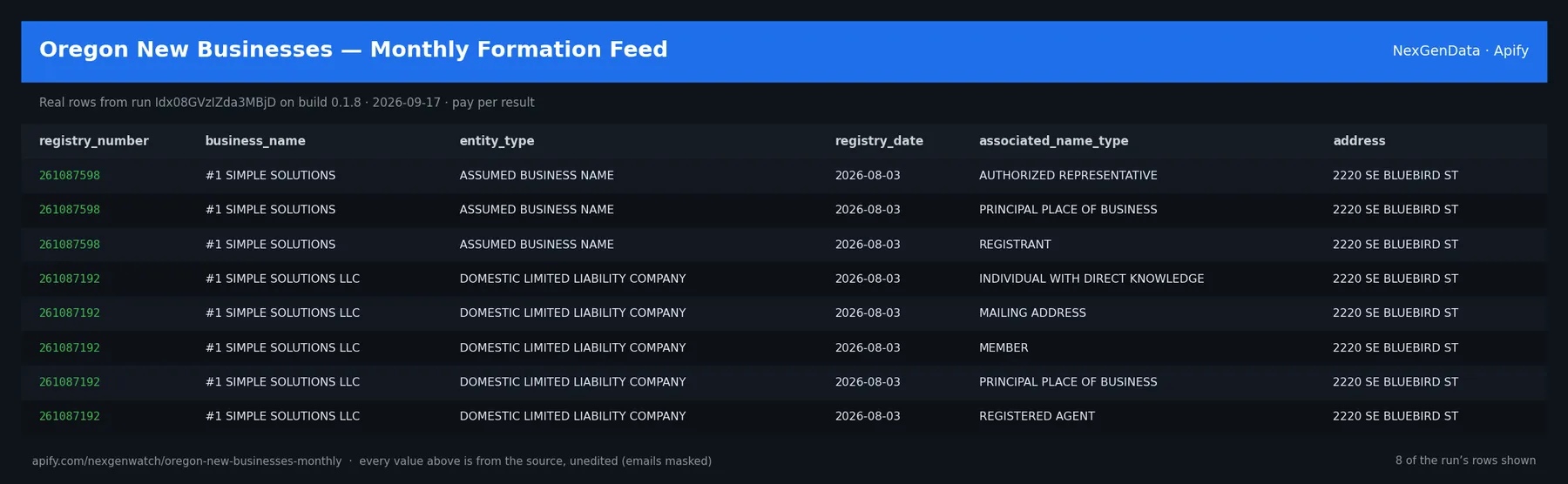
Real rows from run Idx08GVzIZda3MBjD on build 0.1.8 (2026-09-17), the same input as the Quick start below — every value is as the source published it (emails masked, long text shortened):
| registry_number | business_name | entity_type | registry_date | associated_name_type | address |
|---|---|---|---|---|---|
| 261087598 | #1 SIMPLE SOLUTIONS | ASSUMED BUSINESS NAME | 2026-08-03 | AUTHORIZED REPRESENTATIVE | 2220 SE BLUEBIRD ST |
| 261087598 | #1 SIMPLE SOLUTIONS | ASSUMED BUSINESS NAME | 2026-08-03 | PRINCIPAL PLACE OF BUSINESS | 2220 SE BLUEBIRD ST |
| 261087598 | #1 SIMPLE SOLUTIONS | ASSUMED BUSINESS NAME | 2026-08-03 | REGISTRANT | 2220 SE BLUEBIRD ST |
| 261087192 | #1 SIMPLE SOLUTIONS LLC | DOMESTIC LIMITED LIABILITY COMPANY | 2026-08-03 | INDIVIDUAL WITH DIRECT KNOWLEDGE | 2220 SE BLUEBIRD ST |
| 261087192 | #1 SIMPLE SOLUTIONS LLC | DOMESTIC LIMITED LIABILITY COMPANY | 2026-08-03 | MAILING ADDRESS | 2220 SE BLUEBIRD ST |
| 261087192 | #1 SIMPLE SOLUTIONS LLC | DOMESTIC LIMITED LIABILITY COMPANY | 2026-08-03 | MEMBER | 2220 SE BLUEBIRD ST |
| 261087192 | #1 SIMPLE SOLUTIONS LLC | DOMESTIC LIMITED LIABILITY COMPANY | 2026-08-03 | PRINCIPAL PLACE OF BUSINESS | 2220 SE BLUEBIRD ST |
| 261087192 | #1 SIMPLE SOLUTIONS LLC | DOMESTIC LIMITED LIABILITY COMPANY | 2026-08-03 | REGISTERED AGENT | 2220 SE BLUEBIRD ST |
The run finished with the status message: NORMAL: 10 unique rows (0 duplicates collapsed) from None. billable=10
✅ What you get
Each row is flat JSON with these fields (from the dataset schema and the sample run; a field the source does not publish for a given row is null):
record_type(string) — e.g.oregon_new_business_associationregistry_number(string/null) — e.g.261087598business_name(string/null) — e.g.#1 SIMPLE SOLUTIONSentity_type(string/null) — e.g.ASSUMED BUSINESS NAMEregistry_date(string/null) — e.g.2026-08-03associated_name_type(string/null) — e.g.AUTHORIZED REPRESENTATIVEfirst_name(string/null) — e.g.BRIANmiddle_name(string/null) — e.g.Mlast_name(string/null) — e.g.OTISaddress(string/null) — e.g.2220 SE BLUEBIRD STcity(string/null) — e.g.MILWAUKIEstate(string/null) — e.g.ORzip_code(string/null) — e.g.97222source(string/null) — e.g.oregon-new-businesses-monthlyrelease_date(string/null) — null in every sample rowsource_url(string/null) — e.g.https://data.oregon.gov/resource/esjy-u4fc.jsonobserved_at(string/null) — e.g.2026-09-17T17:41:18Zterminal(string/integer/null) — null in every sample rowreported_total(string/integer/null) — null in every sample rowraw_seen(string/integer/null) — null in every sample rowduplicates(string/integer/null) — null in every sample rowunique_found(string/integer/null) — null in every sample rowdelivered(string/integer/null) — null in every sample rowscope(string/integer/null) — null in every sample rownote(string/integer/null) — null in every sample rowlicense(string/integer/null) — null in every sample rowattribution(string/integer/null) — null in every sample row
What you get
One registry_record per entity, deduplicated on the source-native id. Fields the source does not publish are honest null. A run_receipt row carries the source URL, scope, reconciliation counts, and delivered/duplicate totals.
Every run also writes a RUN_RECEIPT record to its key-value store with the source checks it made and the counts it charged — diagnostics never land in the paid dataset.
⚙️ Sample inputs
1. Quick start — the Store example (this is what the sample above came from)
The sample run charged exactly: 1 × $0.02 apify-actor-start + 10 × $0.02 registry_record = $0.22 on the Free tier — every delivered row was billed.
2. A smaller, narrowed run
Caps the run at 5 rows — about $0.12 on the Free tier ($0.02 start + 5 × $0.02).
3. A full-size run
Up to 5000 rows (the schema default for maxRecords) — about $100.02 on the Free tier ($0.02 start + 5000 × $0.02) if the source has that many.
🧾 JSON sample record
One real record from run Idx08GVzIZda3MBjD, exactly as it lands in the dataset (emails masked, long text shortened):
🔧 How it works
Transport. Plain HTTPS from the Apify platform, no proxy. robots.txt is read first and a disallowed path is never fetched. Every request carries an identified contact User-Agent. Pacing: CRAWL_DELAY=0.0.
Charging. Each registry record is charged at the moment it is pushed (registry_record); a row that fails to charge is not delivered, so the dataset count always equals the charged count.
How it behaves
Rows are paged from the keyless Oregon Socrata resource (:id order, $limit/$offset) and count(*) reconciled. Each business carries one row per associated-name type (individual with direct knowledge, registered agent, mailing address, principal place of business, etc.), copied verbatim. The file rolls monthly to the latest published new-business set. Streaming, bounded to maxRecords; full-scope :id-ordered, memory bounded.
Source
https://data.oregon.gov/resource/esjy-u4fc.json
What is not done. No login, no cookie or CAPTCHA bypass, no private or personal-account data, no browser automation.
💰 Pricing example
| Event | Free | Bronze | Silver | Gold |
|---|---|---|---|---|
Actor Start (apify-actor-start) | $0.02 | $0.02 | $0.02 | $0.02 |
Registry Record (registry_record) | $0.02 | $0.02 | $0.02 | $0.01 |
Worked at the live Free-tier price:
- 8 registry records: $0.02 start + 8 × $0.02 = $0.18
- 25 registry records: $0.02 start + 25 × $0.02 = $0.52
- 5000 registry records: $0.02 start + 5000 × $0.02 = $100.02
A run that delivers zero rows charges the $0.02 start fee only. A BLOCKED run (source refused) fails loud and charges no value event. The start fee is charged once per GB of run memory; the default run memory is 1024 MB.
Yield on the sample run: NORMAL: 10 unique rows (0 duplicates collapsed) from None. billable=10. maxRecords is a hard ceiling on what is delivered and billed, never a target.
⚖️ Legal & ToS
This actor reads public, logged-out pages and feeds published by data.oregon.gov. It collects only what the source publishes to any visitor, keeps to the source's robots rules (checked on every run), identifies itself with a contact User-Agent, and does not access accounts, private data or anything behind authentication. Use the output in line with the source's terms and your local law; the intended use is B2B research and monitoring.
❓ FAQ
Q: Do I need an API key or a login?
A: No. The source (data.oregon.gov) is read logged-out; the input schema has no key field and the actor carries no secrets.
Q: Why did my run return 0 rows?
A: Read the run's status message. GENUINE_EMPTY means the source was read and had nothing in scope for your input; BLOCKED means the source refused and the run failed without billing a value event — retry later or narrow the input. A zero-row run bills the start fee only.
Q: How many rows can one run return?
A: Up to maxRecords (default 5000). Raise the cap for a bigger run; you pay per delivered row.
Q: How fresh is the data?
A: Every run reads the source live at run time; nothing is cached between runs. Put it on a schedule for a continuous feed.
Q: What formats can I export?
A: The dataset downloads as JSON, CSV, Excel, XML or RSS from the run's Dataset tab or the Apify API, and any run can push to a webhook or integration.
Q: How is this different from the other company registry checks actors?
A: Same output shape and billing model; this one covers data.oregon.gov. The siblings under Related Actors cover the other sources or slices — run several on one schedule for a combined feed.
Q: Are there rate limits?
A: The actor paces itself against the source (CRAWL_DELAY=0.0) and honours its robots rules; there is no per-buyer limit beyond your Apify plan's concurrency.
🆘 Troubleshooting
- Run FAILED with BLOCKED → the source refused the request or changed its page shape → nothing was billed beyond the start fee; retry after a while, and if it persists open an Issue with the run id.
- Status says CAPPED → your cap (
maxRecords) was reached → raise it for a bigger run. - Input validation error on start → a field is outside the schema's allowed values → start from the Quick start block and change one field at a time.
- Run TIMED-OUT → a very wide request on a slow day → raise the run timeout in Run options or narrow the input; what was delivered before the timeout is still in the dataset.
🔗 Related Actors
- 🇸🇬 MAS Financial Institutions Directory Change Watch — Auditable deltas on Singapore's MAS Financial Institutions Directory — institutions added, removed, or with a licence/profile change. Keyed on the MA…
- New York Active Corporation Check — Resolves entities against the New York Department of State active-corporations dataset — by DOS ID or exact name. One official answer per identity; a…
- New Zealand Gazette Insolvency Notice Watch — New Zealand Gazette insolvency notices — applications to wind up, liquidator, receiver and administrator appointments, bankruptcies, creditor meeting…
- Texas Franchise Taxpayer Status Check — Resolves Texas taxpayers against the Comptroller's official franchise-tax account-status service — by 11-digit taxpayer number, SOS file number or ex…
- UK Charity Eligibility Lookup — Charity Commission register — Look up UK charities on the official Charity Commission register — one verdict per query with number, name and status. No API key; pay per answer
- UK Companies House Filing and Control Watch — Companies House filing history AND persons with significant control for the companies you name, in one cell: a new filing appearing, and a PSC being…
- 🏢 About NexGenData — NexGen Watch is NexGenData's fleet of 256 public monitoring and lookup actors built on official sources, pay-per-result. Browse the catalog at apify.com/nexgenwatch.
⭐ Found this useful?
If this actor saved you a manual check, a quick review on the Apify Store helps other teams find it. Feature request or a source that changed? Open it from the Issues tab — every one is read.
