

Zhihu Scraper
Pricing
from $0.90 / 1,000 results
Zhihu Scraper
Zhihu Scraper extracts Zhihu questions, answers, articles, user profiles, comments, followers, and engagement data automatically for research, marketing, and lead generation. 高效抓取知乎问题、回答、文章、用户资料、评论、粉丝及互动数据,助力数据分析与市场研究。
Pricing
from $0.90 / 1,000 results
Rating
0.0
(0)
Developer

Scraper Fleet
Maintained by CommunityActor stats
0
Bookmarked
1
Total users
0
Monthly active users
a day ago
Last modified
Categories
Features
Share
What is Zhihu Scraper? · 知乎采集器是什么?
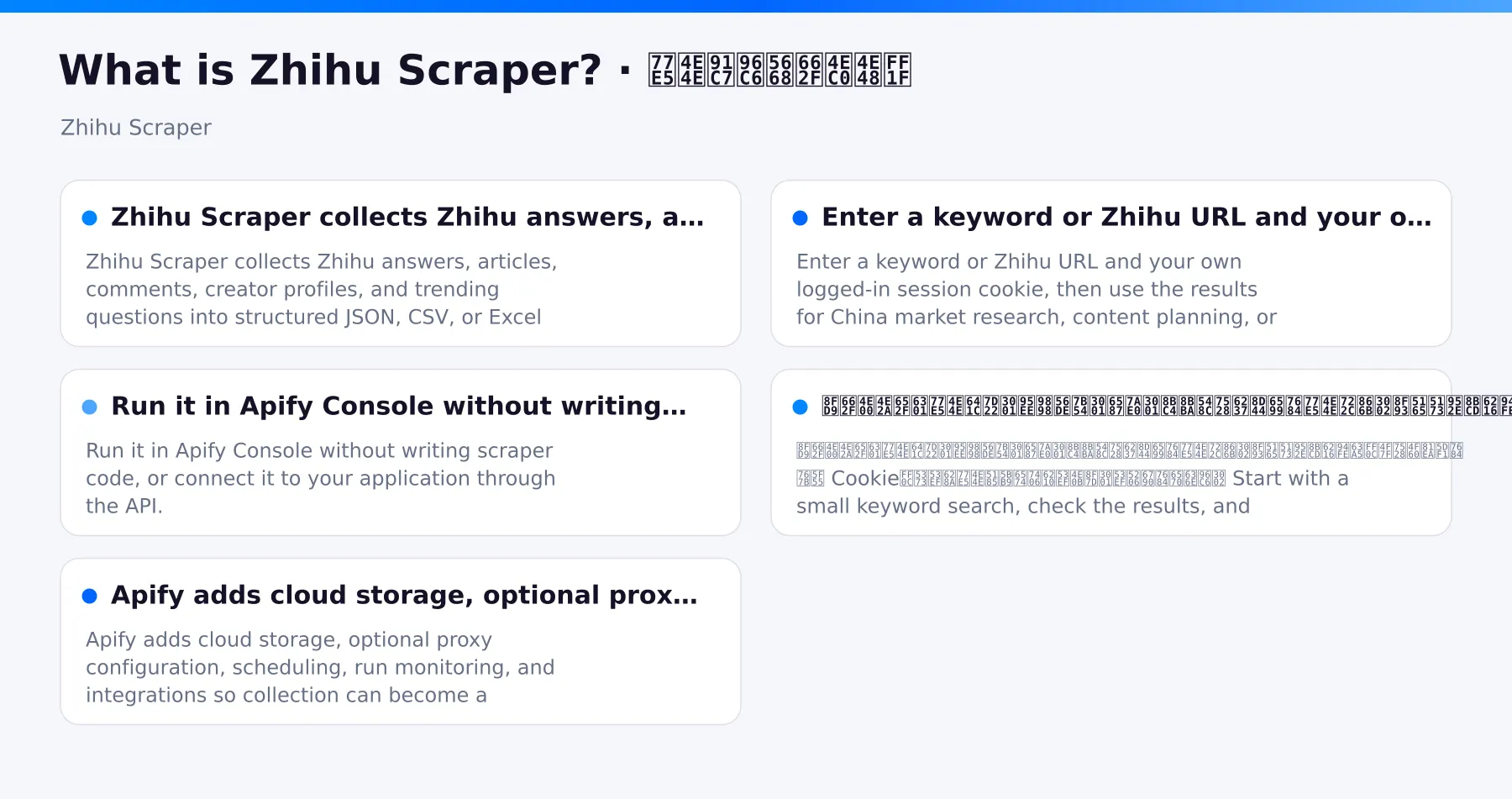 Zhihu Scraper collects Zhihu answers, articles, comments, creator profiles, and trending questions into structured JSON, CSV, or Excel data. Enter a keyword or Zhihu URL and your own logged-in session cookie, then use the results for China market research, content planning, or social listening. Run it in Apify Console without writing scraper code, or connect it to your application through the API.
这是一个支持知乎搜索、问题回答、文章、评论和用户资料的知乎爬虫。输入关键词或链接,使用你自己的登录 Cookie,即可把知乎内容整理成可下载、可分析的数据集。
Start with a small keyword search, check the results, and expand the workflow you need. Apify adds cloud storage, optional proxy configuration, scheduling, run monitoring, and integrations so collection can become a repeatable part of your research process.
Why use Zhihu Scraper? · 功能与优势
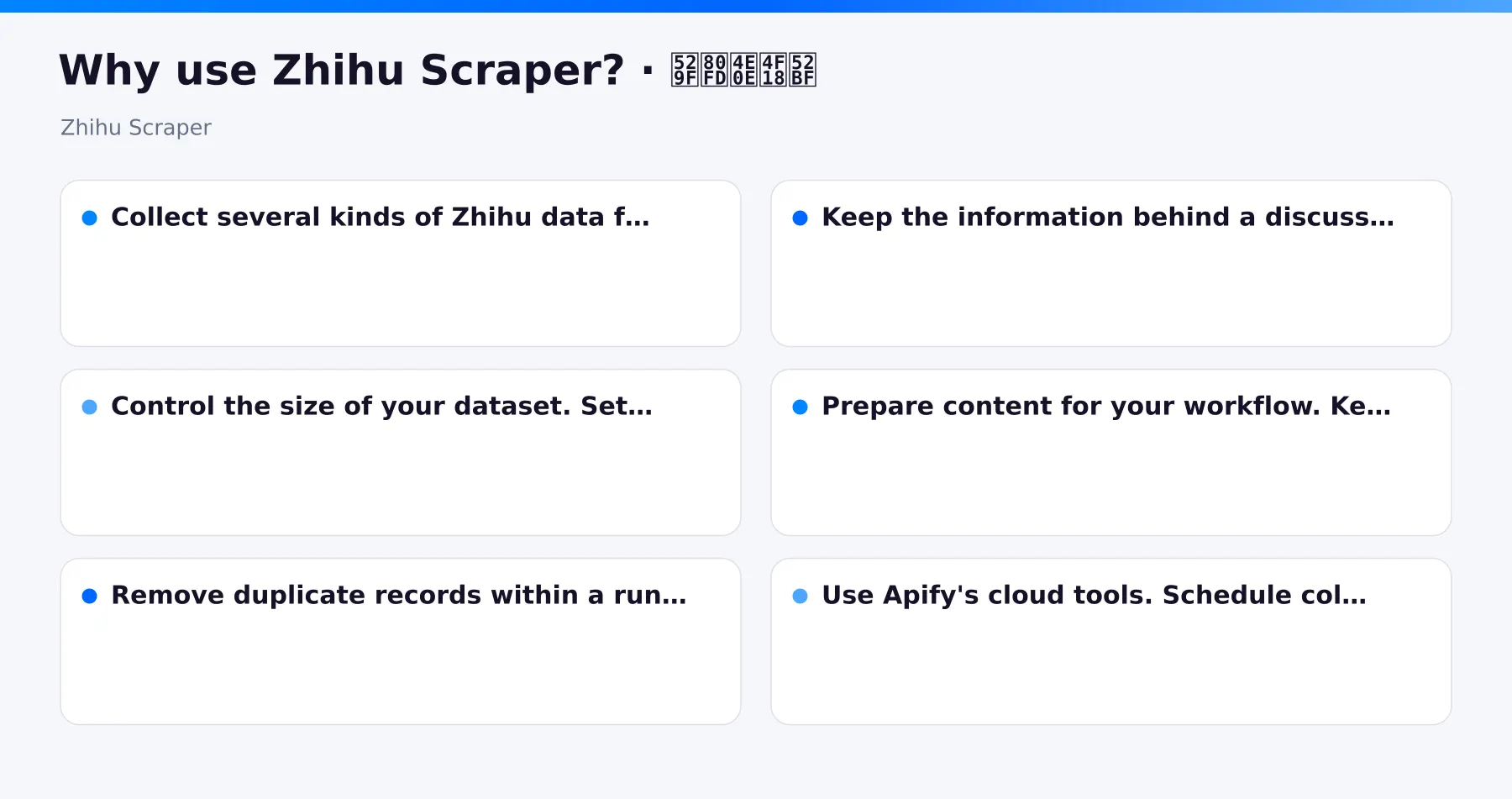
- Collect several kinds of Zhihu data from one tool. Choose search, question answers, content details, comments, comment replies, user profiles, creator articles, or the hot list.
- Keep the information behind a discussion. Available records combine text with source IDs, author data, engagement counts, and publication times, helping you investigate an answer rather than save an isolated quotation.
- Control the size of your dataset. Set a total result limit and a separate limit for each keyword or URL. Automated pagination retrieves available results within those limits.
- Prepare content for your workflow. Keep plain text for analysis, retain available HTML, or request a Markdown conversion for documents and research tools.
- Remove duplicate records within a run. Searches across multiple keywords share a dataset, making it easier to work with overlapping topics.
- Use Apify's cloud tools. Schedule collection, follow run status and logs, retrieve results through an API, and pass data to a spreadsheet or automation platform.
Choose a small first collection so you can inspect the fields before expanding the input. Runtime depends on the operation, target pages, replies, connection settings, and request retries. A target limit bounds saved records; it does not promise that every target will produce that many results.
What data can you extract from Zhihu? · 八种采集方式
| Operation | What you provide | What you collect |
|---|---|---|
search | One or more keywords | Available Zhihu search results |
question_answers | Question URLs or IDs | Zhihu answers under those questions |
content_detail | Answer, article, pin, or question URLs | Individual content details |
comments | Answer, article, or pin URLs | Zhihu comments, optionally including replies |
comment_replies | Root comment IDs | Replies linked to those comments |
user_profile | Profile URLs or user slugs | Available information about Zhihu users |
user_content | Profile URLs or user slugs | The creator's published articles |
hot_list | No target URL needed | Current Zhihu hot list questions |
Choose the operation that matches your task. A keyword finds relevant discussions; a question URL focuses on its answers; a profile URL supports creator research. The creator-content operation supplies a 用户文章列表: it collects articles, not every answer or other activity from that account.
评论和评论回复是不同的数据层级。采集评论时可以选择包含回复;已有评论 ID 时,也可以只获取对应的回复线程。
How to scrape Zhihu step by step · 快速开始
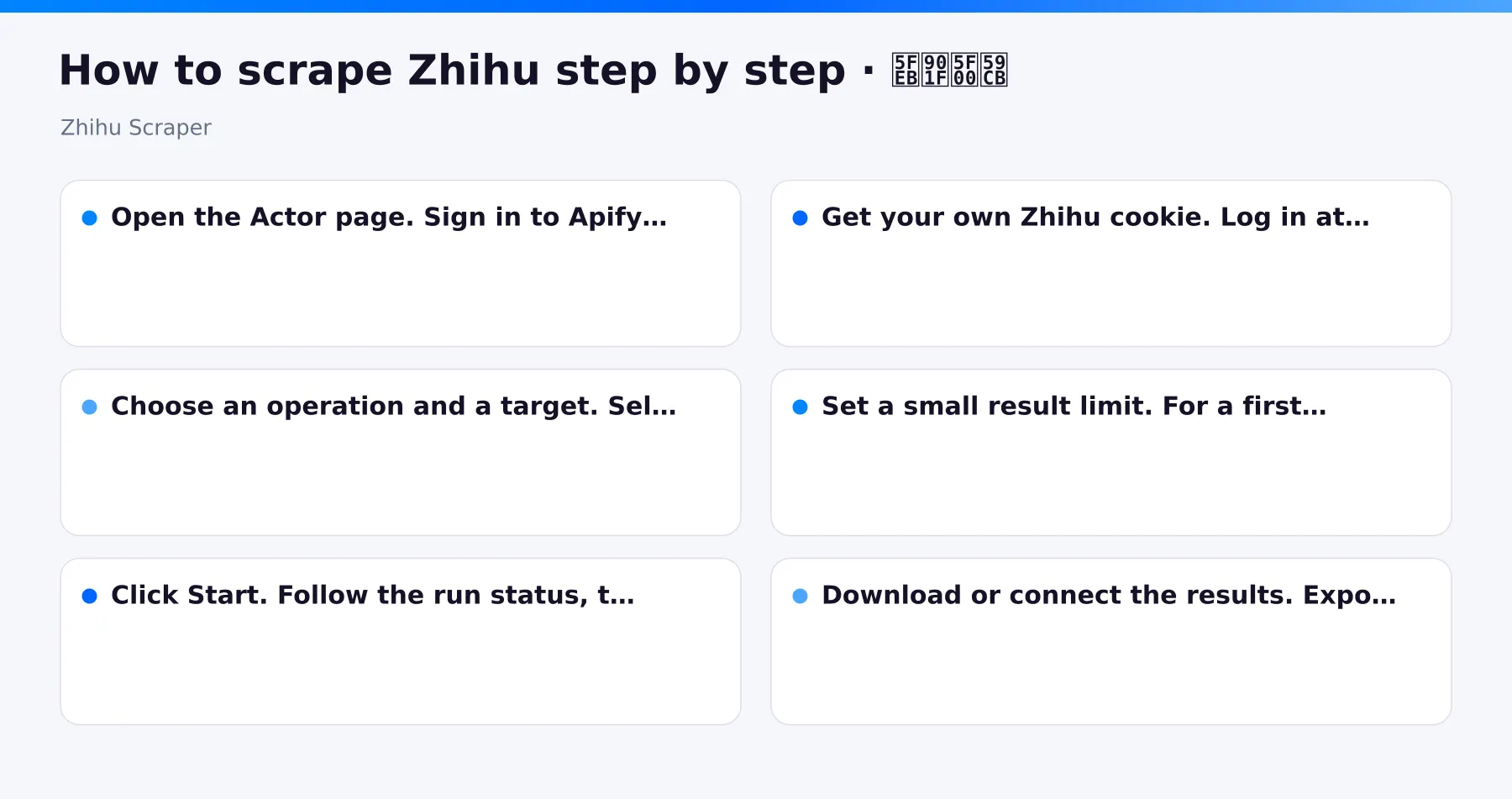 You can collect your first dataset from the input form. You need an Apify account, a Zhihu session you are authorized to use, and a clear keyword or target URL.
- Open the Actor page. Sign in to Apify and open the input form. Apify's Free plan does not require a credit card to sign up.
- Get your own Zhihu cookie. Log in at zhihu.com and copy the session cookie from your browser as described below.
- Choose an operation and a target. Select
searchfor a keyword,question_answersfor a question, or the relevant mode for content, comments, profiles, and trends. - Set a small result limit. For a first test, use five results. Add content filters or change sorting only when they help your research.
- Click Start. Follow the run status, then open its dataset to inspect the collected records.
- Download or connect the results. Export JSON, CSV, or Excel, or use the API to send the dataset to another tool.
Check your first dataset · 检查首次结果
When the run finishes, open the dataset and compare query_keyword with the topic you entered. Check record_type, content_type, and a source reference before downloading the whole result. Open an available question_url to review the discussion behind an answer. This gives you a practical check that the selected operation produced the kind of material you need.
For a spreadsheet, select useful columns such as title, content, author_name, upvote_count, comment_count, and question_url. Export a small CSV first and confirm that Chinese text imports correctly. Keep a JSON copy when you need the complete record structure or want to preserve the difference between a missing value and zero.
Configure your connection · 代理设置
The optional proxyOptions field lets you configure an Apify proxy connection. Leave it unset for an initial test if your session works from the run's connection. If access fails, check the session and connection requirements before changing settings. Some sessions can depend on the IP context in which they were obtained.
Use the proxy form to select the configuration available to your account, then compare a small test with your previous run. Record the chosen settings in your saved task if you plan to repeat the collection. Proxy usage may add charges, and a working proxy connection still needs the required session cookie.
How to provide your Zhihu cookie · 登录 Cookie
In your browser, open developer tools and select Network. Inspect a request to www.zhihu.com, choose Copy as cURL, and copy the -b or --cookie value into the Actor's Cookie field. A trusted cookie-manager export can also be pasted as JSON text.
The cookie check looks for z_c0, __zse_ck, and d_c0. These identify your logged-in and browser-verified session. Keep the cookie private and refresh it when your session expires. A proxy changes the connection route; it does not supply a login.
Start with Zhihu content search · 内容搜索
Use the same topic throughout your first test so the input and output are easy to compare:
Zhihu keyword search accepts several terms in keywords. Try the English phrase first, then a Chinese equivalent such as 人工智能 in a separate run if you want to compare the discussions each query returns. Keep the same limits when making that comparison.
Collect a question, article, or comment thread · 内容详情
For question answers, switch to question_answers and put the question URL in urls. For an individual answer or article, select content_detail. Recognized URLs include www.zhihu.com/question/..., answer URLs, zhuanlan.zhihu.com/p/..., and supported pins.
For comments and replies, choose comments, enter the content URL, and turn on include_replies when the conversation matters. Replies are separate records. For a targeted follow-up, use comment_replies with the root comment IDs returned by your earlier collection.
Zhihu Scraper input parameters · 输入参数
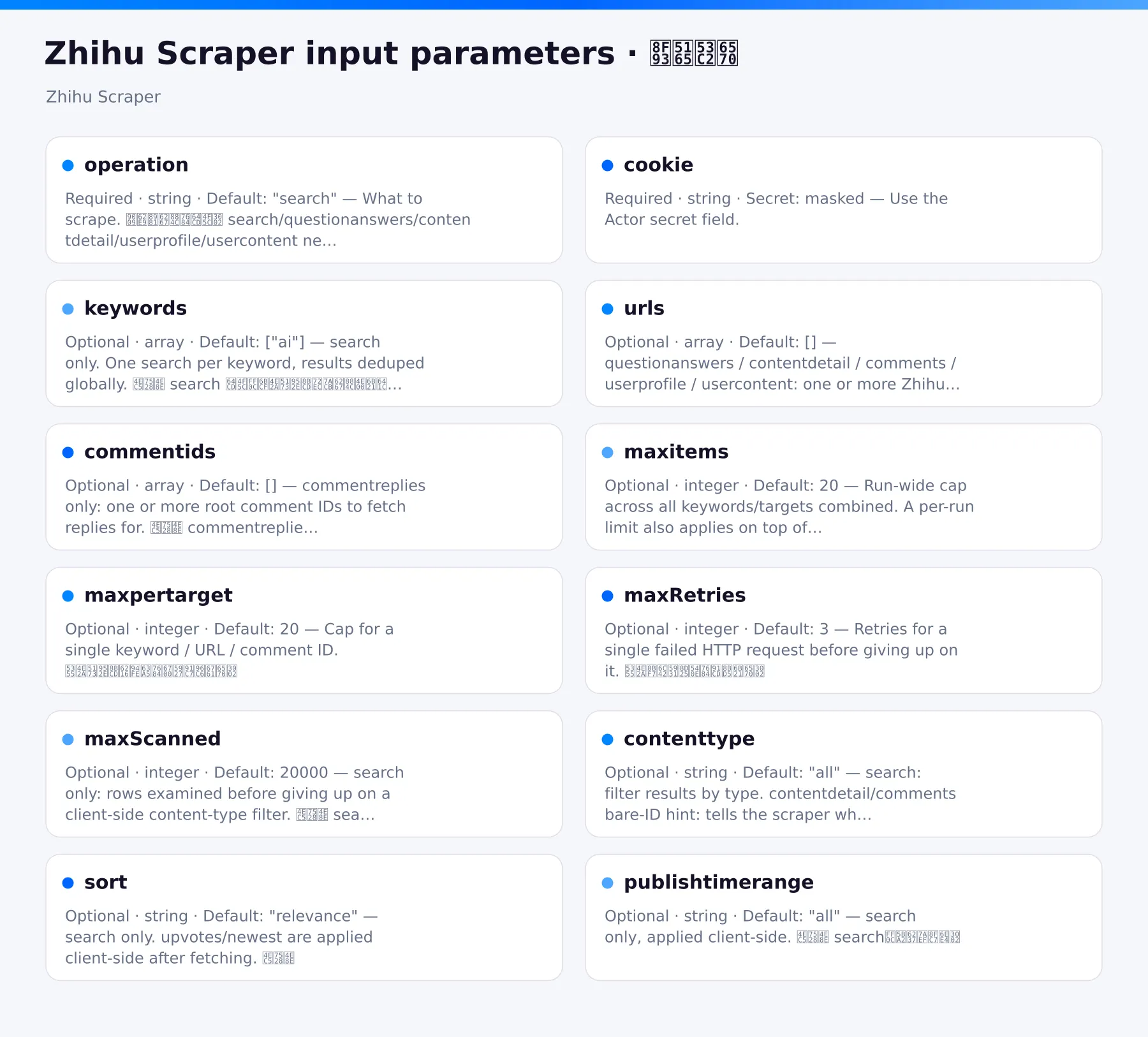
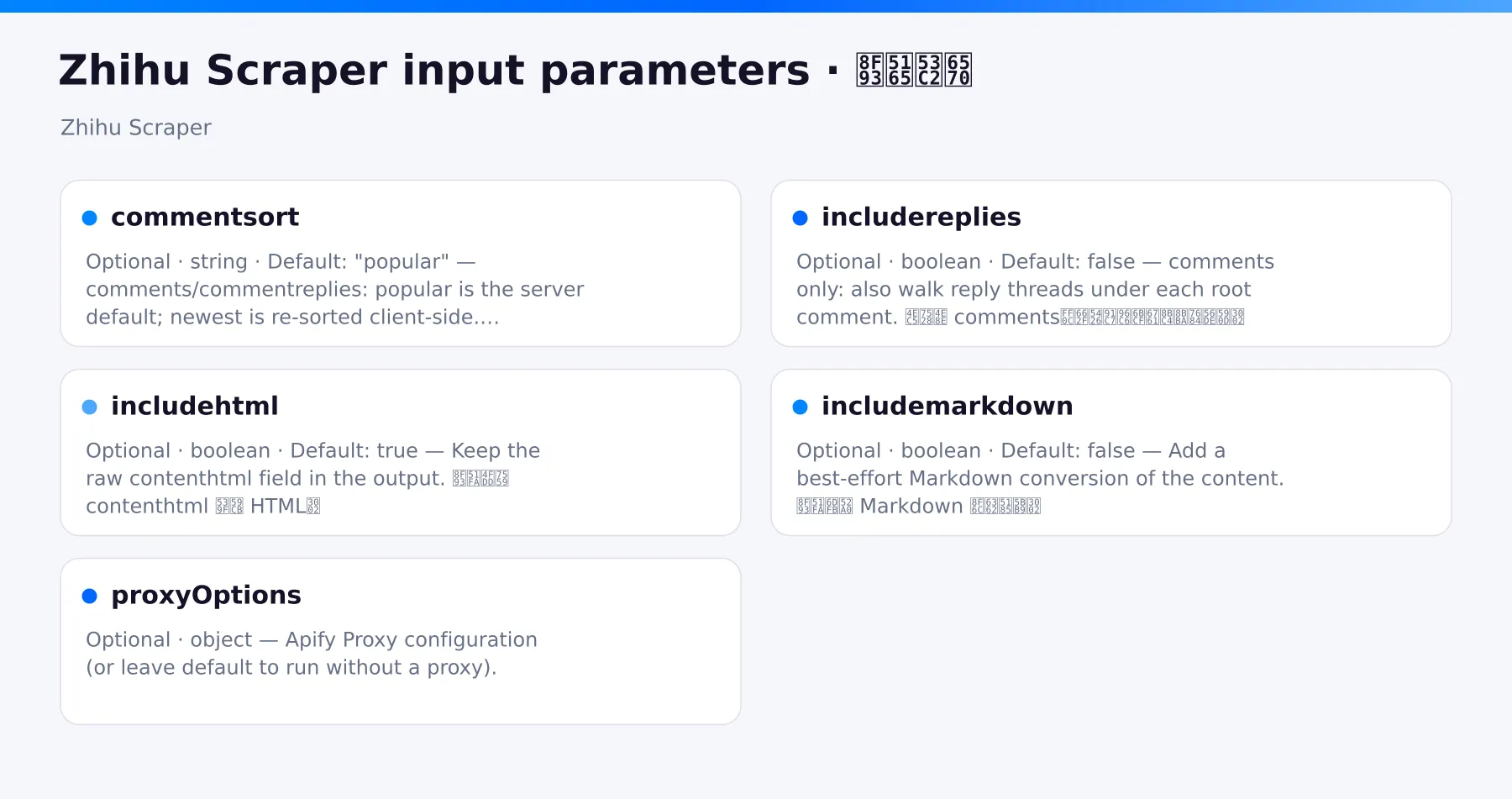 The required fields are
operation and cookie. Keywords, URLs, and comment IDs depend on the operation you choose. Use the input form for complete descriptions and current options.
| Parameter | Description | Required | Example |
|---|---|---|---|
operation | Select the collection task | Yes | search |
cookie | Your logged-in Zhihu session | Yes | Your own Cookie header |
keywords | Terms for Zhihu keyword search | For search | ["artificial intelligence"] |
urls | Question, content, or profile targets | For URL-based modes | ["https://www.zhihu.com/question/123456789"] |
comment_ids | Root comments whose replies you need | For comment_replies | ["123456789"] |
max_items | Total result limit for this run | Optional | 5 |
max_per_target | Result limit for one keyword or URL | Optional | 5 |
include_replies | Include child replies in comment collection | Optional | true |
proxyOptions | Optional Apify proxy configuration | Optional | Configure in the form |
Choose filters for the task · 筛选与排序
content_type controls supported search filtering or provides a type hint for a bare numeric content ID. sort selects relevance, upvotes, or newest for search. publish_time_range offers windows from one day to one year. comment_sort controls popular or newest comment ordering.
Search upvote sorting and publication-time filtering apply to the candidates already fetched. They help prioritize your dataset, but they are not an exhaustive ranking of every matching Zhihu post. An especially narrow filter can return fewer records.
Choose content and result limits · 内容格式与数量
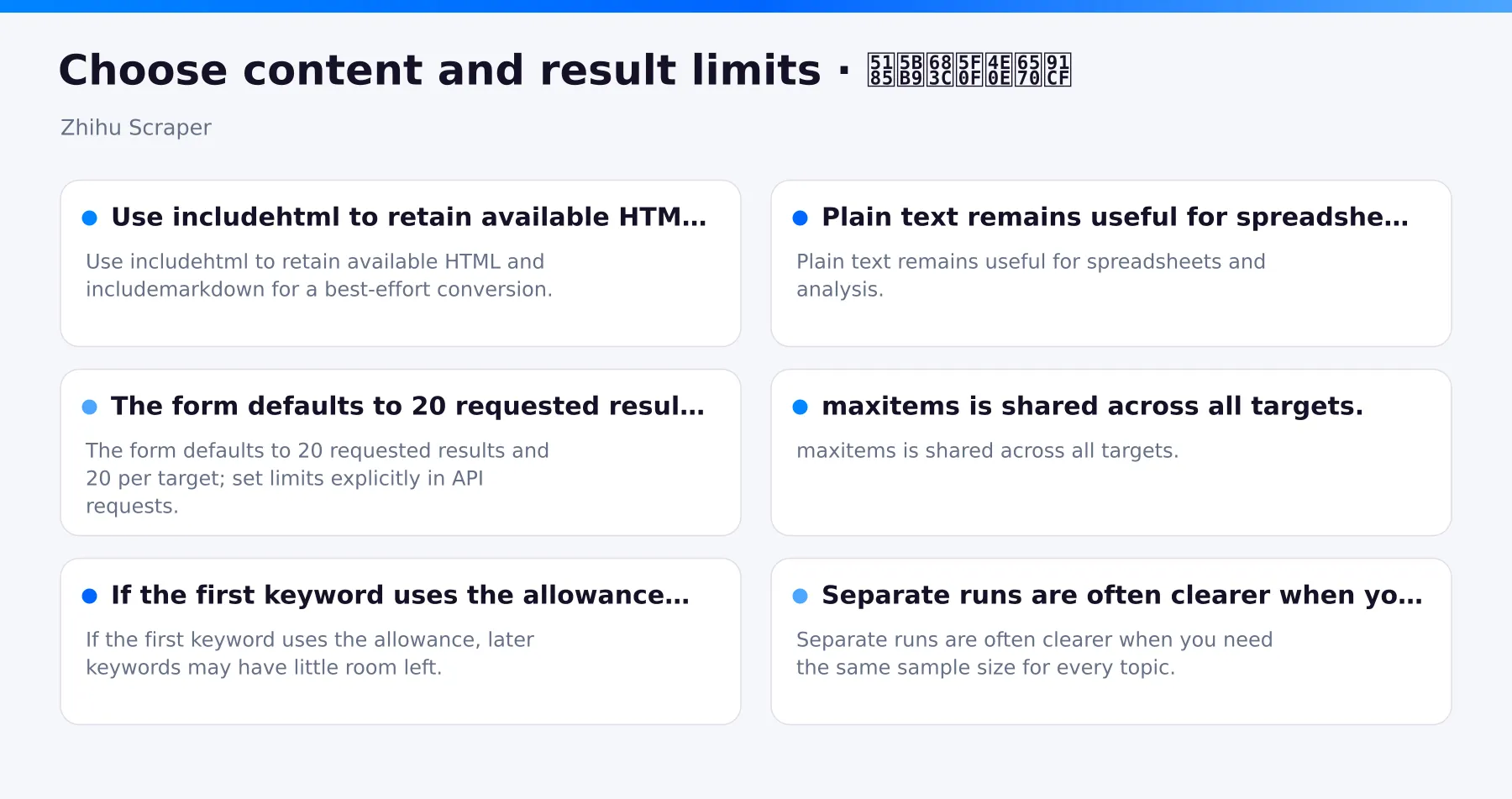 Use
include_html to retain available HTML and include_markdown for a best-effort conversion. Plain text remains useful for spreadsheets and analysis. The form defaults to 20 requested results and 20 per target; set limits explicitly in API requests.
max_items is shared across all targets. If the first keyword uses the allowance, later keywords may have little room left. Separate runs are often clearer when you need the same sample size for every topic. Non-paying accounts currently have a 20-record cap per run.
关键词搜索、内容类型和发布时间应围绕你的研究问题设置。输入字段名称保持英文原样,方便在表单、JSON 与 API 之间对应。
Zhihu Scraper output example · 输出数据
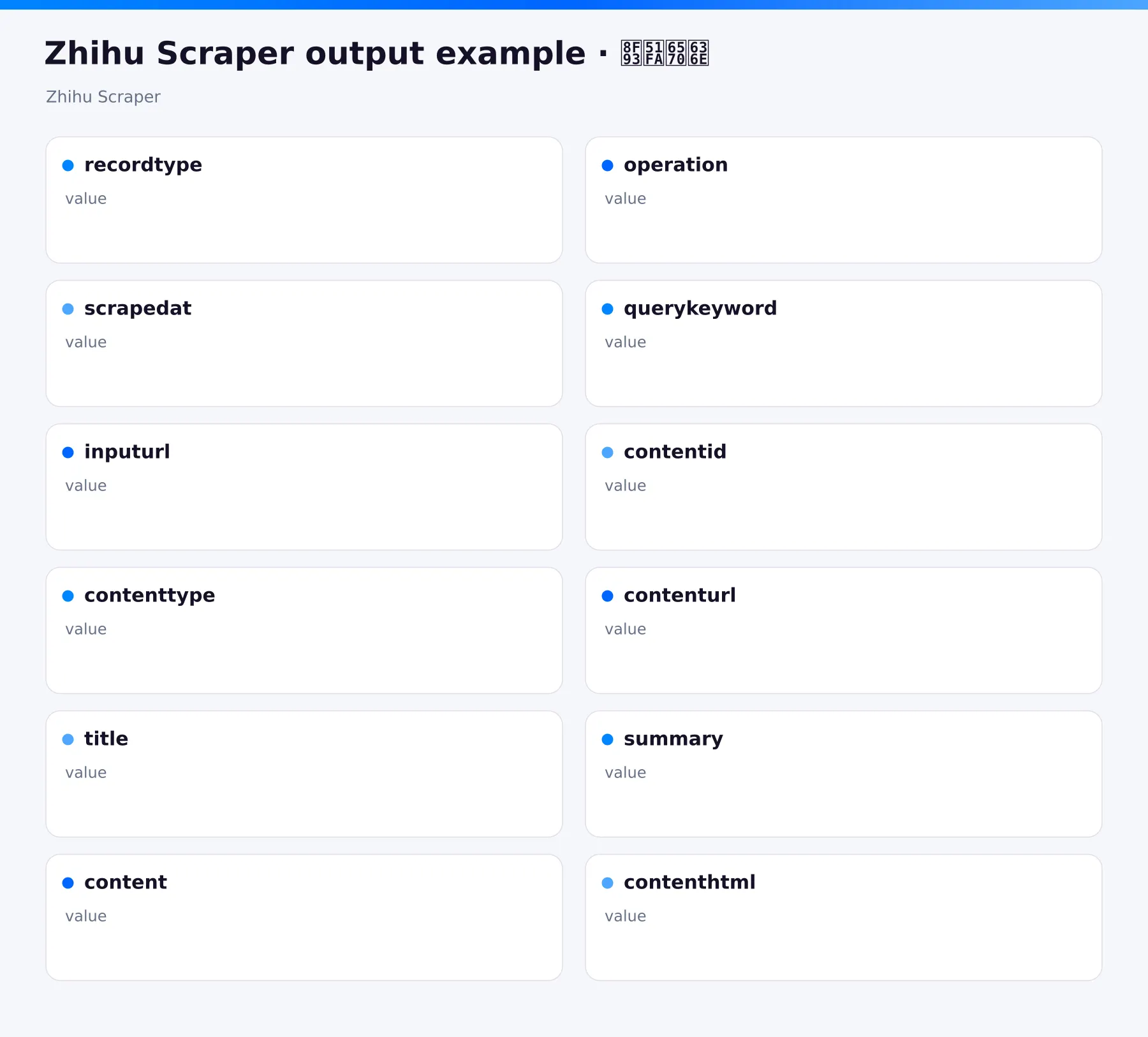
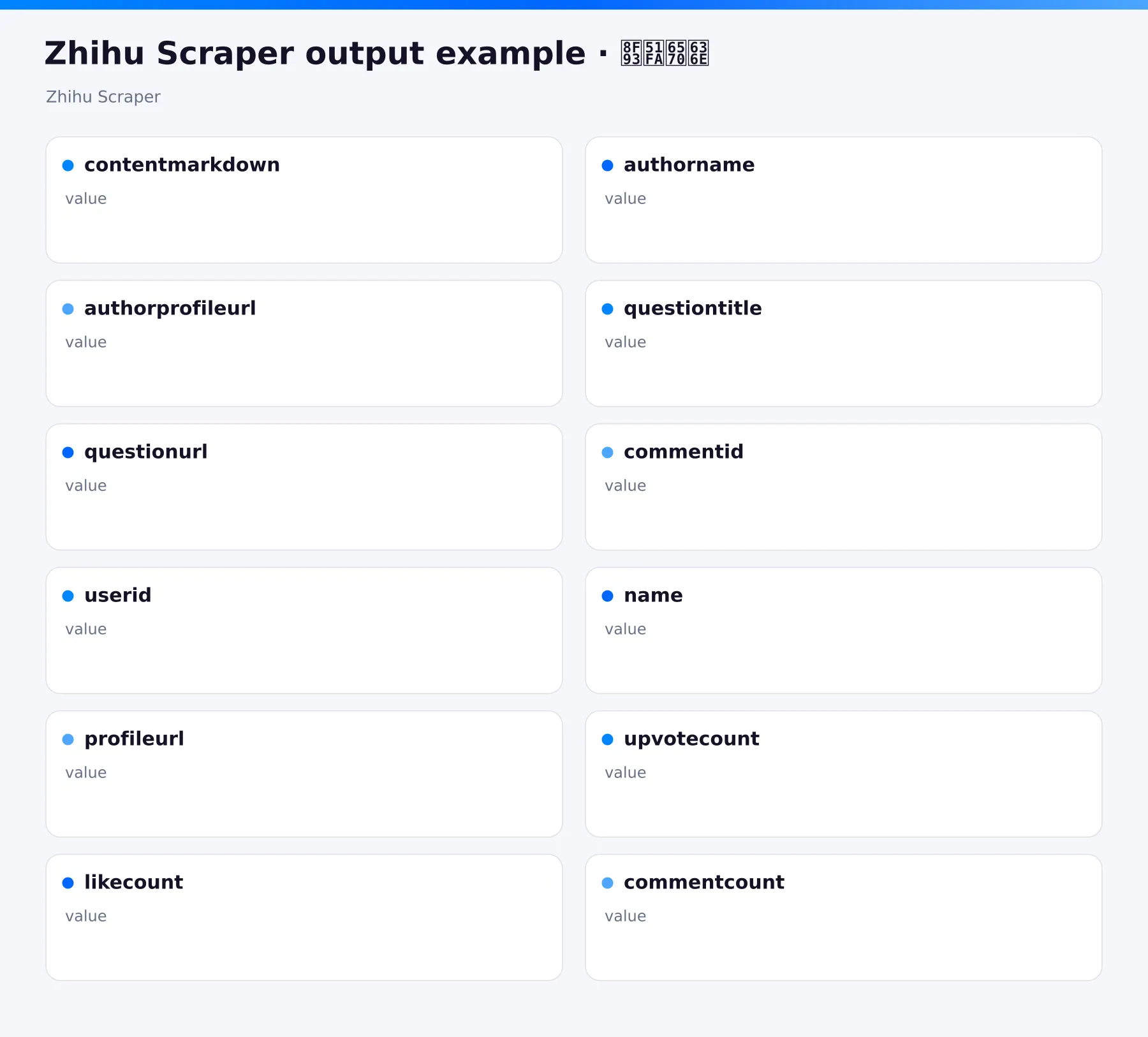
 Each result becomes one dataset record. Content records include available text, engagement, author information, and references to the underlying Zhihu questions or articles. Comment, reply, and profile records use the same shared structure with their relevant fields populated.
These two illustrative, shortened examples show the structure for the artificial intelligence input above. IDs, author names, counts, dates, and text are fictional values. Field names and types follow the maintained output schema and record-building logic; these examples are not captured search results.
Answer text, author data, and engagement
Useful content fields include content_id, content_type, content_url, title, summary, content, upvote_count, comment_count, publish_time, and update_time. Author data can include a name, profile reference, bio, and available activity metrics.
Full answer text is available when Zhihu returns it. Some responses contain excerpts or omit details; use the content-detail operation when you need to investigate a particular source. An upstream content_url can be an API address, while question_url provides a question-page reference.
Comment threads and creator profiles
Comment and reply records add comment_id, parent_comment_id, reply_to_comment_id, like_count, and available reply counts. Those identifiers let you reconnect a conversation after export.
Creator profiles can include user_id, profile_url, bio, follower counts, article counts, and other available profile information. Fields that do not apply to a record remain null. Keep those missing values distinct from zero when analyzing engagement.
搜索结果、评论回复与用户资料可以共用数据集,但字段含义不同。分析时先按 record_type 和 operation 分组,再比较相同类型的记录。
Zhihu Scraper use cases · 谁适合使用?
 Zhihu research helps teams understand detailed questions, explanations, and discussions from a Chinese Q&A community. Match the operation to the decision you want the data to support.
China market research and consumer research
Market researchers use keyword Q&A search to discover how people describe a product category, compare alternatives, or explain purchasing concerns. Collect relevant questions and answers, group recurring themes, and keep source links with each observation. Chinese and English queries can reveal different conversations around the same topic.
Brand monitoring and China social listening
Brand teams compare Zhihu answers and comments around product names, launches, and competitor topics. Root comments show responses to the original content; reply threads add context to disagreements and follow-up questions. Scheduling the same query helps you collect a series of snapshots for later comparison.
Zhihu articles, creator research, and editorial planning
Content teams use available creator profiles and published articles to identify relevant expertise, study recurring topics, and plan questions their own audience needs answered. Article URLs and timestamps help organize the research. Profile information supports discovery; it does not independently verify a creator's identity or qualifications.
Zhihu Hot List Scraper workflows for trends
Journalists and analysts select hot_list to collect trending questions with available rank and heat information. Save separate snapshots to see which topics enter, leave, or change position. Your saved runs create the comparison history; the operation itself returns the current list.
市场研究关注需求与问题,品牌监测关注相关讨论,内容团队关注主题与作者。保留关键词、采集时间和来源链接,方便回看与复核。
How much does it cost to scrape Zhihu? · 价格与免费试用
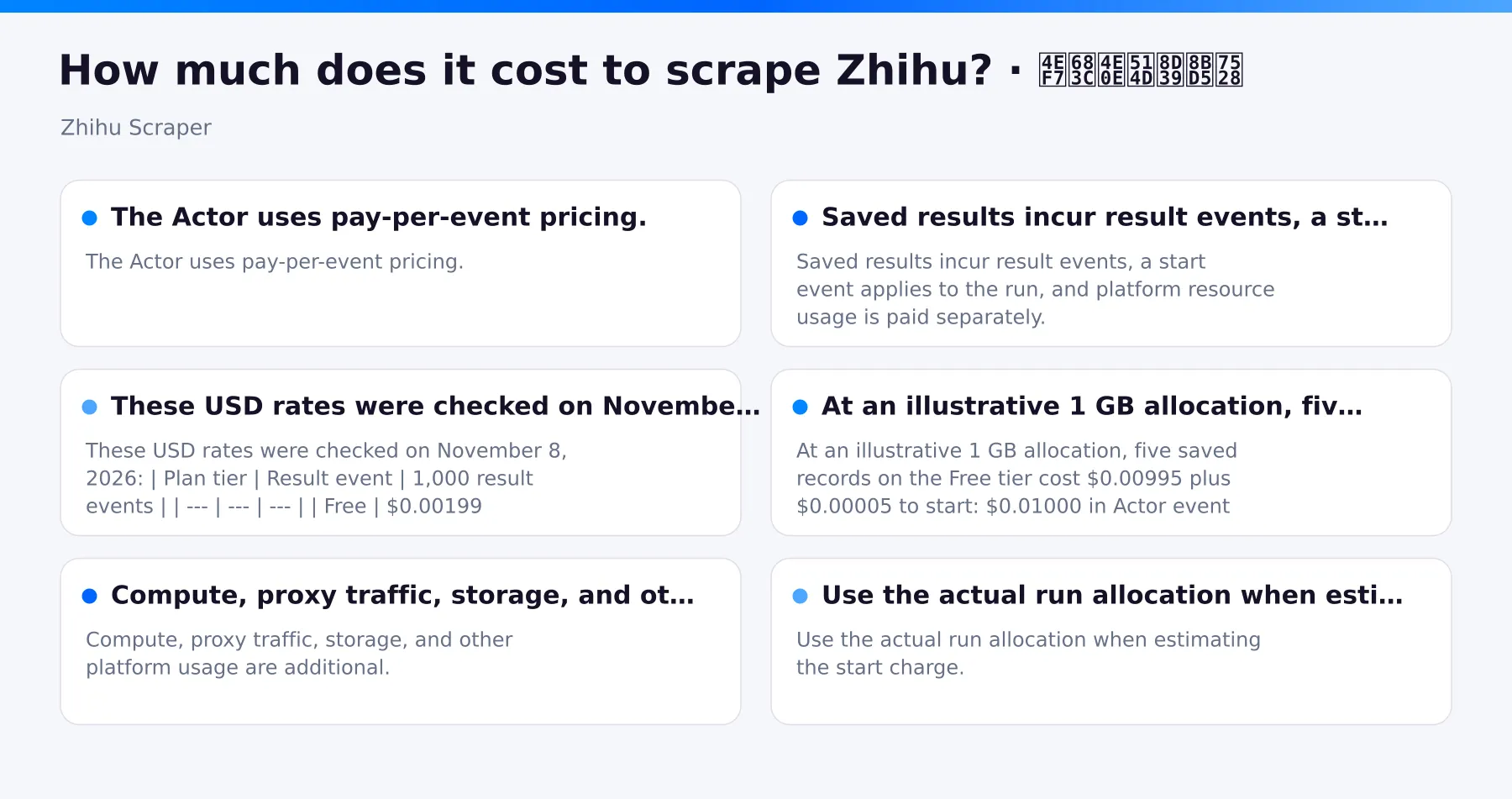 The Actor uses pay-per-event pricing. Saved results incur result events, a start event applies to the run, and platform resource usage is paid separately. These USD rates were checked on November 8, 2026:
| Plan tier | Result event | 1,000 result events |
|---|---|---|
| Free | $0.00199 | $1.99 |
| Bronze | $0.00180 | $1.80 |
| Silver | $0.00160 | $1.60 |
| Gold, Platinum, Diamond | $0.00120 | $1.20 |
The start event costs $0.00005 per GB of allocated memory, with a minimum of one event. At an illustrative 1 GB allocation, five saved records on the Free tier cost $0.00995 plus $0.00005 to start: $0.01000 in Actor event charges. Compute, proxy traffic, storage, and other platform usage are additional. Use the actual run allocation when estimating the start charge.
Each saved answer, article, root comment, reply, or profile is a result record. Enabling replies can therefore use the shared record allowance and increase result charges. More difficult targets and request retries can also increase infrastructure usage without producing more saved results.
The 1,000-result figures show unit-price arithmetic rather than a promise of a particular run size. Check this Actor's Pricing tab before a larger collection, and review the usage breakdown for your own small test.
Is scraping Zhihu free? · 可以免费开始吗?
Apify's Free plan includes $5 in monthly usage credit and requires no credit card to sign up. This Actor still has paid events. Accounts without a paid plan are limited to 20 records per run; that quantity cap, available credit, and platform charges are separate constraints.
Begin with five results and keep replies disabled until you need them. Inspect the dataset and usage before requesting more. Do not estimate a monthly free-result total solely by dividing the credit by the result price, because start events and platform usage also contribute to the bill.
免费计划额度、每次结果上限、结果事件费用和代理费用需要分别确认。回复是独立结果,也会使用数量上限。先用小规模测试判断字段是否合适,再决定采集规模。
Zhihu Scraper API and Python · 集成与自动化
 Use the API tab to run the Actor and retrieve its dataset from your application. API access is useful when Zhihu data needs to feed a spreadsheet, database, dashboard, or research service.
How to scrape Zhihu with Python
Install the Apify Python client and supply your Apify token and Zhihu cookie through environment variables:
This example starts a new run and uses the applicable credit or charges. Its input keys are the same ones you see in the form. An Apify token authorizes the platform; ZHIHU_COOKIE provides your authenticated Zhihu session.
Automate Zhihu API workflows
Create an Apify schedule for recurring keyword or hot-list collection. Keep the query and filters consistent when you want comparable snapshots. Use webhooks to trigger processing when a run finishes, and follow status or errors in Console.
With Make, Zapier, or n8n, a completed-run workflow can retrieve the dataset, select relevant fields, and append rows to Google Sheets or notify a team in Slack. Configure the integration for your destination; these are platform workflows, not additional collection operations.
Export JSON for structured processing or CSV and Excel for spreadsheets. Apify also supports JSONL, XML, and RSS dataset formats. There is no outputFormat input in this Actor; select the export after collection. See the dataset guide and Apify Academy for workflow help.
Copy to your AI assistant · 复制给 AI 助手
Copy this prompt into an assistant that can read documentation or connect to your Apify account:
Zhihu MCP server for AI assistants · MCP 连接
Connect an MCP-capable client to Apify with this Actor selected. The assistant can use its input schema and work with run results through your authorized account.
Complete the client's supported Apify authorization flow and follow the current Apify MCP setup instructions. Client interfaces and permissions differ. A compatible assistant can use the selected Actor's input schema; executing the tool starts a normal run with the same Zhihu cookie requirement and billing.
More scrapers by Scraper Fleet · 更多数据工具
| Actor | Complementary task |
|---|---|
| Bilibili Video Scraper | Collect video statistics and optional top-level comments for Chinese video research |
| Facebook Group Scraper | Collect accessible group posts, comments, group information, and exposed admin profiles |
| TikTok Video Downloader | Save authorized TikTok videos as MP4 files with metadata and download links |
Each tool serves a different source and has its own inputs, limits, and access requirements. Keep source identifiers and collection times when combining records in a wider research project.
Zhihu Scraper FAQ · 常见问题
These answers cover common Zhihu scraping tasks, access requirements, exports, and troubleshooting.
Do I need a login or an API key?
You need your own logged-in Zhihu cookie for collection. Console users enter it in the Cookie field. Python, API, and MCP workflows also need authorized Apify access. This tool does not replace your Zhihu account with an official API key.
How does this compare with an official Zhihu API?
This is an Apify collection tool that uses your session for supported Zhihu requests. It provides a consistent input form, datasets, exports, and automation around those tasks. Official API availability and permissions are a separate matter; access to the Actor does not grant broader Zhihu permissions.
Can I work with the Zhihu API v4 through this tool?
The collector uses Zhihu endpoints, including v4 endpoints for supported tasks, while you interact through Apify's input form or API. Use the Actor's operation names and documented fields rather than constructing upstream calls yourself. It is not a general-purpose proxy for every Zhihu endpoint.
Can I run it on a schedule?
Yes. Apify schedules can repeat the configured collection. Check that your session remains valid and that your selected limits and credit support the frequency. Scheduling hot-list snapshots is useful when you want to compare trends over time.
Can I export a Zhihu hot-list RSS feed? · 知乎热榜RSS
Apify supports RSS export for datasets. Collect a current hot-list snapshot, then choose the supported export format. A recurring feed or historical comparison needs your own scheduling and storage workflow; the Actor does not retrieve past hot lists on demand.
Why did I receive fewer records than requested?
Available results, per-target limits, the run-wide allowance, account caps, filtering, and failed requests can reduce the count. The search loop also has a fixed 2,000-row scanning safeguard. Check the run status and returned records before increasing limits; the exposed maxScanned option does not override that safeguard.
What if my cookie expires or requests fail?
Refresh your own browser session and update the Cookie input. For 401, 403, or 429 responses, also check access and rate or IP restrictions. A proxy may help with a connection issue, but it does not repair an invalid login or guarantee access.
What happens when Zhihu changes its website?
Changes to responses or access checks can affect collection. Check the current input instructions and report the affected operation through Issues. Include a redacted error and expected behavior so the maintainer can investigate. No automatic repair or fixed update cadence is promised.
Can I use the data commercially?
Commercial use depends on the content, applicable licenses, platform terms, privacy requirements, and your intended reuse. Purchasing or running a scraper does not transfer rights to authors' writing or personal information. Assess those requirements for your project before republishing or selling results.
Which export format should I choose?
Use JSON for structured processing, arrays, and null values. CSV or Excel works well for selected fields in a spreadsheet. Check text encoding and import settings for Chinese content, and retain an original structured export if you flatten the data.
Is it legal to scrape Zhihu? · 法律与数据使用
Legality depends on the data, access method, jurisdiction, and intended use. This Actor uses a session you provide to request accessible content; it does not establish permission for unrestricted collection or reuse.
Follow Zhihu's terms and applicable copyright, privacy, and data-protection requirements, including GDPR or CCPA where relevant. Collect only what you need, control access to datasets, and retain source references. This section provides general guidance rather than legal advice.
请使用你有权使用的账号,遵守平台条款、内容许可与适用法律。回答、文章、作者资料和评论的再利用权限需要按具体用途确认。
Need help with Zhihu Scraper? · 支持与反馈
For help, a bug report, or a feature request, contact our team through this Actor's Issues tab. Share the operation, non-sensitive target, expected result, and a redacted error message. Never include a session cookie or API token in a public issue.
For a custom workflow, contact us through the same Issues tab. Describe the target data, required fields, result volume, and destination so our team can discuss your requirements with you.
需要帮助、功能改进或定制采集流程?请通过本 Actor 的 Issues 联系我们,说明目标数据、所需字段和预期结果。


