
Startup Funding Rounds Scraper - Global News
Pricing
$8.00 / 1,000 rounds
Startup Funding Rounds Scraper - Global News
Startup funding rounds from news worldwide: company, amount in USD, round, valuation, investors, sector and country, merged from every outlet that reported it, with SEC Form D checks for US rounds and a free investors table. $8 per 1,000 rounds.
Pricing
$8.00 / 1,000 rounds
Rating
0.0
(0)
Developer

Steadywren
Maintained by CommunityActor stats
0
Bookmarked
2
Total users
1
Monthly active users
2 days ago
Last modified
Categories
Security
Limited permissionsShare
Fresh startup funding rounds from news in many countries and languages - company, amount in USD, round, investors, sector, HQ country - merged across every outlet that reported them, with an SEC Form D check for US rounds. For deal flow, B2B sales triggers and investor tracking. $8 per 1,000 rounds, AI extraction included.
What you get
- Round facts:
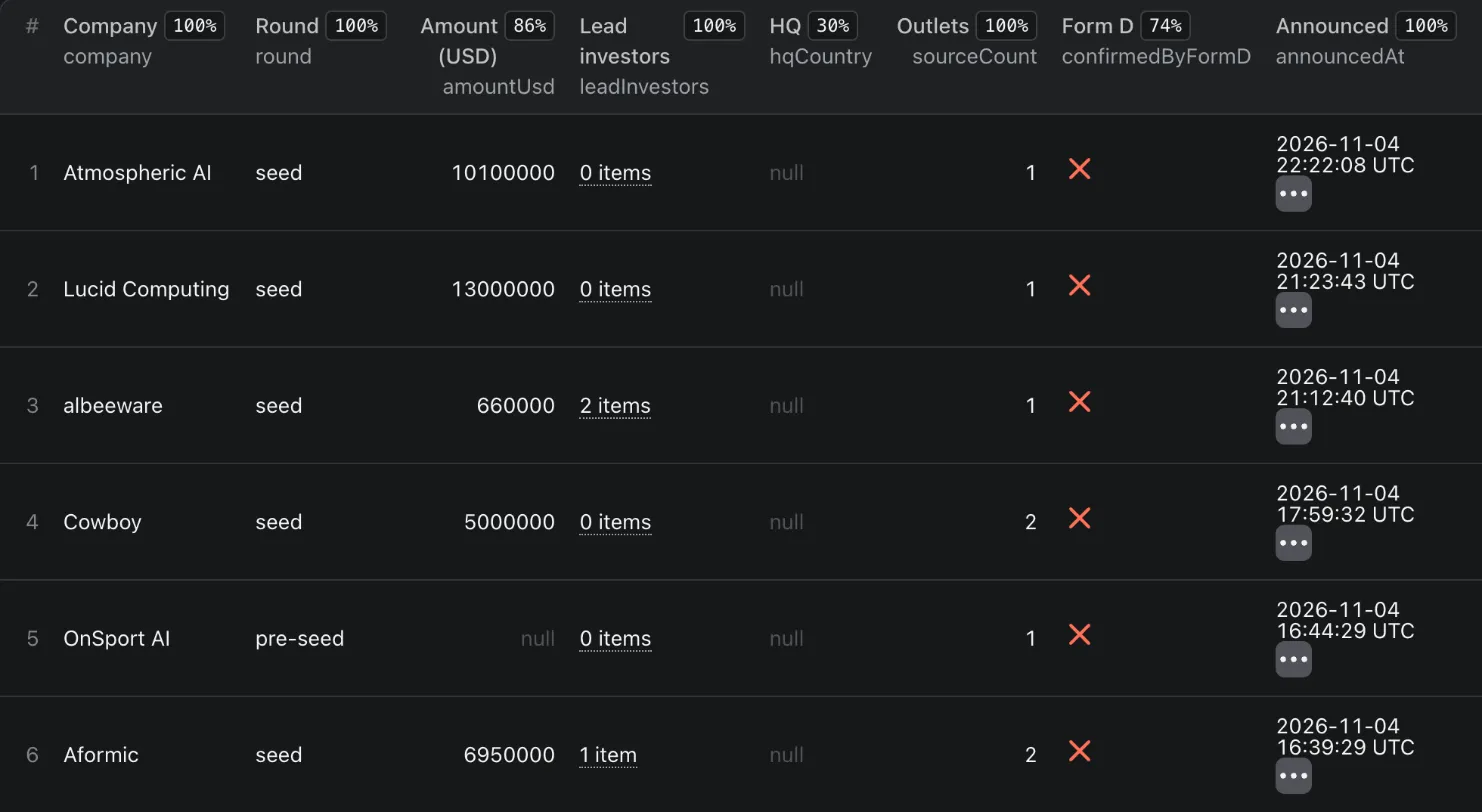
company,headline(an English headline when one exists),round(pre-seed,seed,series-a...series-h,growth,debt,grant,unspecified),amount+currency(as reported),amountUsd,valuationUsd,leadInvestors,investors,sector,hqCountry(ISO code),announcedAt(earliest article),confidence(0-1).nullmeans unknown. - Global, multilingual coverage: every Google News edition you pick (
US:en,DE:de,FR:fr,IN:en...) is searched with funding wording in its own language - English, German, French, Spanish, Portuguese, Italian, Dutch, Polish and Ukrainian have their own phrases ("Finanzierungsrunde", "lève millions", "ronda de financiación"...); other languages use the English phrases. The AI returns English fields and the amount in USD, so a Spanish and a German report of the same deal end up in one clean row. In our test run (2026-11-04) 24% of the rounds appeared only in non-English local press. - One round, many outlets: the same deal reported by Business Wire, TechCrunch and a local paper is one row,
with every article in
sources(outlet,domain,url,googleUrl,publishedAt,edition,headline,amount,currency),sourceCount,editions,firstSeenOutlet,localPressOnly, andamountConflictswhen outlets report different amounts. In our test run 43% of the rounds were reported by 2+ outlets and merged. - SEC Form D check: for US rounds (and rounds whose country is unknown) the Actor searches SEC EDGAR for a Form D
filed by the company itself and adds
confirmedByFormD,formDUrlandformDFiledAt. - Free investors table (dataset
investors):investor,rounds,asLead,companies,roundTypes,knownAmountUsd(sum of the known USD amounts of its rounds), most active first. - New since your last run:
roundIdstays the same across runs;isNewandfirstSeenAtmark rounds you have already received.
Use it for deal flow and market maps (every new round in your sectors and countries, every morning), B2B sales triggers (companies that just raised money and are about to hire and buy tools), investor tracking (which firms led the most rounds this week) and local press coverage (rounds in Germany, France, Spain, India or Poland that the English tech press never covered).
Sample output
Serval, reported on 2026-10-29 (trimmed, URLs shortened):
Numbers from our test run
7 days, 6 editions (US:en, GB:en, IN:en, DE:de, FR:fr, ES:es), 2026-11-04:
| What | Result |
|---|---|
| Headlines read | 1,076 (500 unique) |
| Funding rounds found | 188 |
| Reported by 2+ outlets, merged into one row | 81 (43%) |
| Only in non-English local press | 46 (24%) |
| Lead investors named | 75 of 188 (from headlines only) |
| Rounds with conflicting amounts between outlets | 10 |
| Form D: rounds checked / confirmed with a filing link | 105 / 5 |
In a hand check of 50 headlines, company, amount, round and lead investor were all right in about 48 of 50 (96%).
How much does it cost?
$8 per 1,000 rounds. Example: the default input (US:en, last 2 days, 50 rounds) = 50 rounds x $0.008 = $0.40 per run (our test run, 2026-11-05).
- $0.008 per merged round: one round = one charge, no matter how many outlets reported it. AI extraction, USD conversion, publisher URLs and the Form D check are included; there are no add-on prices.
- The Investors table and
RUN_SUMMARYare free. - No start fee; platform compute is included.
- Max rounds (default 50) and your spending limit cap the cost. The Actor never decodes URLs, checks Form D or charges for rounds beyond your limits.
How to use
- Pick the Google News editions (
COUNTRY:language, up to 10) and the Time range. - Optionally filter by Round types, Minimum amount (USD), Sectors or HQ countries, and set Max rounds.
- Click Start, then download JSON, CSV or Excel from the Output tab.
Main filters: editions, time range, round types, minimum amount, sectors, HQ countries.
Example input: {"editions": ["US:en", "GB:en", "DE:de", "FR:fr"], "timeRange": "7d", "rounds": ["seed", "series-a"], "minAmountUsd": 1000000, "maxRounds": 200}.
Use with AI assistants (MCP)
Connect this Actor to Claude, ChatGPT or any MCP client: https://mcp.apify.com?tools=steadywren/startup-funding-rounds-scraper
Try:
- "Find seed and Series A rounds of at least $2M announced in Germany, France and Spain in the last 7 days and list the lead investors."
- "Which investors led the most fintech rounds this week, and in which companies?"
How it compares
Checked against 7 funding-round Actors in Apify Store (READMEs and Store descriptions) on 2026-11-03.
| This Actor | Other funding-round scrapers in Apify Store | |
|---|---|---|
| Non-English local press, translated and normalised to USD | yes (9 languages with own phrases) | not claimed (one partly: EU-Startups, Inc42) |
| One round merged from many outlets, conflicting amounts flagged | yes | not claimed |
| SEC Form D matched to the round (filing link) | yes | not claimed (one lists Form D filings as separate rows) |
| Investor activity table per run | yes, free | not claimed |
| Company enrichment (employees, LinkedIn) | no (sector + HQ country only) | several |
| Price per 1,000 rounds | $8 | $2 - $80 |
Monitor daily
Run it daily with an Apify Schedule and "onlyNewRounds": true: each run delivers and charges only rounds you
have not received yet. Send the results to Google Sheets, Slack, Make, Zapier, n8n or a webhook with Apify
integrations, or read them through the Apify API (?format=csv or xlsx on the dataset URL).
How the history works: with Track rounds between runs on (default) the Actor saves the delivered rounds in a
key-value store named funding-rounds-state in your account, under a key computed from your editions and filters
(order and case do not matter; the key is in RUN_SUMMARY.stateKey). A round keeps its roundId across runs
(company, round type and amount size), so a later run marks it isNew: false with its firstSeenAt. Rounds are
forgotten 90 days after they were first delivered. Only new rounds delivers only rounds not delivered before and
remembers them even with tracking off; rounds cut by Max rounds are not remembered and can come in a later run.
With both off, isNew and firstSeenAt are null. Change the editions or filters and you start a fresh history.
FAQ
Is it legal? The Actor collects publicly available data only, without login and without personal data of private individuals. Check the site's terms for your use case. It reads public Google News feeds, public SEC EDGAR filings and the public ECB reference rates; names of people appear only as the headlines and investor lists published them.
What if Google News changes or a run fails? The run fails with a clear error instead of returning empty
results, and you are not charged for results it did not deliver. No matching rounds finishes green with a message
and nothing charged - but only when every feed was read and every headline judged. The run fails when no feed could
be fetched (for example Google blocked the first requests), when the AI could not read any headline, or when no
round was delivered and the result is incomplete (Google blocked or broke some feeds, or the AI stopped early). If
Google starts refusing mid-run, the Actor stops making Google requests and delivers what it already has. Each run's
summary (feeds, headlines, rounds found / delivered, Form D checks, AI cost, blocked flag, messages) is in the
Storage tab -> Key-value store -> RUN_SUMMARY.
Do I need proxies? Are there limits? No proxies are used or needed. Google News returns at most 100 items per search, so when a search is full the Actor splits the time range into smaller date windows (down to single days, up to 300 headlines per search phrase and edition); a single day with more than 100 items still stops at 100. Requests are polite: Google requests start at least 0.5 s apart, with retries on 403/429/503 (1, 2, 4 s or Google's Retry-After up to 30 s). It never solves captchas, uses logins or rotates its identity. Only the headlines are read, so rounds announced only inside article text are missed. Up to 10 editions and 1,000 rounds per run.
How fresh is the data? Live at run time, from Google News of the chosen time range (today included). With the default input a run took about 1.5 minutes in our test run on 2026-11-04 (publisher URLs cached from an earlier run); a first run decodes every URL and took about 2.5 minutes on Apify (151 s, 50 rounds).
How are amounts normalised? amount and currency are the figure the outlets reported (ISO currency code), as a
plain number ($1.2B = 1200000000, EUR 7,1 millions = 7100000). amountUsd and valuationUsd are converted with
the latest ECB daily reference rates; USD amounts pass through unchanged. Indian units are computed by the Actor
itself (1 lakh = 100,000, 1 crore = 10,000,000, so "Rs 5 crore" = 50,000,000 INR). "Up to $10M" is taken as the cap,
10,000,000. When no amount is stated the fields are null - the Actor never guesses numbers. If the ECB rates cannot
be loaded, only USD amounts get amountUsd. When outlets report different amounts (more than 5% apart), the round
takes the amount most outlets reported (ties: the earliest) and lists the others in amountConflicts with their
outlets.
What does confidence mean? For each headline the AI gives a 0-1 confidence that it reports a real round with
the right amount. The round's confidence is the average over its articles, +0.1 when 2 or more outlets
reported it and -0.2 when there are amount conflicts, kept between 0 and 1. Low values are worth a quick look at
sources.
Why are investors often empty? The Actor reads headlines (and Google's short snippet) only - it does not open
article pages. Investors are filled only when a headline names them ("led by Sequoia"); in our test run that was 75
of 188 rounds. The AI is instructed to list only investment firms and funds; an individual named as an investor in a
public headline (for example a known angel) can still appear in leadInvestors / investors.
How does the Form D check work, and what are its limits? For rounds with HQ country US or unknown, the Actor
searches SEC EDGAR full-text search for Form D filings from 120 days before to 30 days after the announcement. It
accepts only a filing by the company itself under the same name (legal forms like Inc. or LLC ignored); filings of
funds and SPVs ("a Series of ...", "Fund", "LP") are rejected, and the newest match wins. A confirmed match also
sets hqCountry to US. Limits: only US filings exist on EDGAR, the name must match exactly, and many startups file
later or never. So confirmedByFormD: false means "no filing found in that window", not "fake round"; null means
not checked (non-US company, Check SEC Form D off, or EDGAR refused and the checks stopped). In our test run, 105
rounds were checked and 5 confirmed.
Which editions and languages work? Any Google News edition written as COUNTRY:language, up to 10 per run.
English, German, French, Spanish, Portuguese, Italian, Dutch, Polish and Ukrainian editions use funding phrases in
their own language; any other language is searched with the English phrases. Whatever the language, the output
fields are in English.
What is not included? No Crunchbase or PitchBook data, no employee counts, no founder or contact details, and no
contact data of anyone (any person named in a headline stays in the original headline text). Data comes only from
public news headlines, SEC EDGAR and ECB rates.
More from Steadywren
- Google News Scraper & AI Company Signals - Google News articles per company with AI event type, sentiment and trigger events.
- Substack Scraper & Newsletter Revenue Estimate - Substack leaderboards with an estimated revenue range per newsletter.
- Goodreads Scraper & Series Read-Through - Goodreads book series with ratings and read-through.
- All Steadywren Actors - small tools, steady results. Custom builds: steadywren.com.
Input reference
| Field | Type | Default | Description |
|---|---|---|---|
editions | array | ["US:en"] (form prefilled with US:en, GB:en, IN:en, DE:de, FR:fr, ES:es) | Google News editions. Country and language of each Google News edition to search, as COUNTRY:language (US:en, GB:en, IN:en, DE:de, FR:fr, ES:es, BR:pt, IT:it, NL:nl, PL:pl, UA:uk ...). Each edition is searched with funding phrases in its own language; other languages use the English phrases. Up to 10 editions. Empty = US:en. |
timeRange | string | 2d | Time range. How far back to look for funding news (whole days, today included): 1d (today), 2d, 3d, 7d, 14d, 30d. |
rounds | array | every type | Round types. Only these round types. Empty = every type. |
minAmountUsd | integer | 0 | Minimum amount (USD). Only rounds of at least this many US dollars (other currencies converted with the latest ECB daily reference rates). Above 0, rounds without a known USD amount (not reported, or currency not convertible) are left out. |
sectors | array | every sector | Sectors. Only rounds whose sector contains one of these words (English, case-insensitive, e.g. fintech, health, robotics). The sector comes from the headline, so rounds without one are left out. Empty = every sector. |
countries | array | every country | HQ countries. Only companies headquartered in these countries (2-letter codes like US, GB, DE). The country comes from the headline, so rounds without one are left out. Empty = every country. |
checkFormD | boolean | true | Check SEC Form D. For US companies and companies of unknown country, search SEC EDGAR for a Form D filed by the company itself under the same name (funds and SPVs are ignored) and add confirmedByFormD, formDUrl and formDFiledAt. |
resolveUrls | boolean | true | Publisher URLs. Replace the Google News links of the first 3 sources of each round with the publishers' own article URLs. |
trackChanges | boolean | true | Track rounds between runs. Remember the delivered rounds (per editions + filters) for 90 days and mark each round isNew with firstSeenAt. |
onlyNewRounds | boolean | false | Only new rounds. Deliver (and charge) only rounds not delivered by an earlier run with the same editions and filters (works even with tracking off). Good for daily schedules. |
maxRounds | integer | 50 | Max rounds. Stop after this many rounds (newest first, 1-1,000). You pay per round, so this also caps the cost. |
maxAiCostUsd | number | 0.5 | Max AI cost per run (USD). Cap on the AI cost of reading headlines in one run (paid by the Actor, not charged to you; 0.05-2). When it is reached, the rounds read so far are delivered. |
Search keywords: startup funding rounds, funding rounds, crunchbase alternative, startup funding, series a funding


